
A manufacturing technician helps a factory make products safely, consistently, and with fewer interruptions. The work can include setting up equipment, checking dimensions, following process instructions, documenting results, solving recurring problems, and supporting engineers or maintenance staff. Some roles are close to production; others focus more on process improvement, testing, or equipment support.
The title covers several jobs. One company may want a production support technician. Another may mean a process, quality, test or equipment technician. Read the duties before assuming the role is a simple production job or an engineering position.
What does a manufacturing technician do?
Technicians often work close to the line. They may inspect a first piece, change a fixture, collect process data, troubleshoot a machine, update a work instruction or help qualify a new tool. In electronics or medical manufacturing, documentation and controlled procedures can take as much attention as the equipment.
| Work area | Possible technician task |
|---|---|
| Production support | Keep a process running and escalate repeat failures |
| Quality | Measure parts, record results and isolate nonconforming product |
| Process | Follow parameters, test changes and document the result |
| Equipment | Coordinate with maintenance and perform defined adjustments |
| Improvement | Help collect data for an engineer or supervisor |
Manufacturing technician vs related jobs
A production operator usually runs a defined process. A manufacturing technician often handles more troubleshooting, measurement and documentation. A manufacturing engineer typically owns process design, equipment selection or larger improvement projects. A quality control inspector focuses more directly on inspection and acceptance decisions.
The job can overlap with process technician and industrial maintenance technician. The employer’s equipment and training plan matter more than the title alone.
How do you become one?
Some employers accept a high school diploma and provide on-the-job training. Others prefer a certificate or associate degree in manufacturing technology, mechatronics, electronics, machining, composites or a related field. Previous work in maintenance, assembly, automotive repair, laboratory work or quality can transfer if you can document careful procedures and troubleshooting.
Look for programs with measurement, blueprint reading, lean or process basics, electrical and mechanical systems, data collection and hands-on equipment. Ask which local employers hire graduates and what the first job actually involves.
Pay and the limits of the title
Manufacturing technician is not one universal BLS occupation. Depending on the work, the closest comparison may be production workers, industrial engineering technicians, electro-mechanical technicians, machinists or industrial machinery mechanics.
For example, the BLS reported a $66,120 median annual wage in May 2025 for industrial engineering technologists and technicians, a group that can support production studies, workflows and cost analysis. It reported $73,900 for electro-mechanical and mechatronics technologists and technicians. Those figures are useful only when the duties line up.
Do not attach the higher benchmark to every manufacturing technician posting. Compare the job’s education requirement, tools, shift, responsibility and advancement path.
Work schedule and safety
Factories may run multiple shifts. A technician can work days, nights, rotating schedules, shutdowns or weekends depending on the product and equipment. Ask whether the role supports one line or the whole plant, and whether overtime is expected during launches or breakdowns.
Safety may involve machine guarding, hazardous energy, chemicals, heat, noise, ergonomic repetition or cleanroom rules. Training should explain the actual hazards of the facility. Production pressure is not a reason to skip isolation, protective equipment or a quality hold.
Is it a good change after 40?
Manufacturing can suit someone who likes practical systems but wants a more controlled environment than field service or construction. Skills from maintenance, construction, automotive work, logistics or quality can help. The transition may still require comfort with computers, measurements, written procedures and repeatability.
Before enrolling, visit a plant or ask a hiring manager what new technicians do during their first six months. Compare the first wage, shift, commute, training support and benefits. A senior salary chart is not a first-year guarantee.
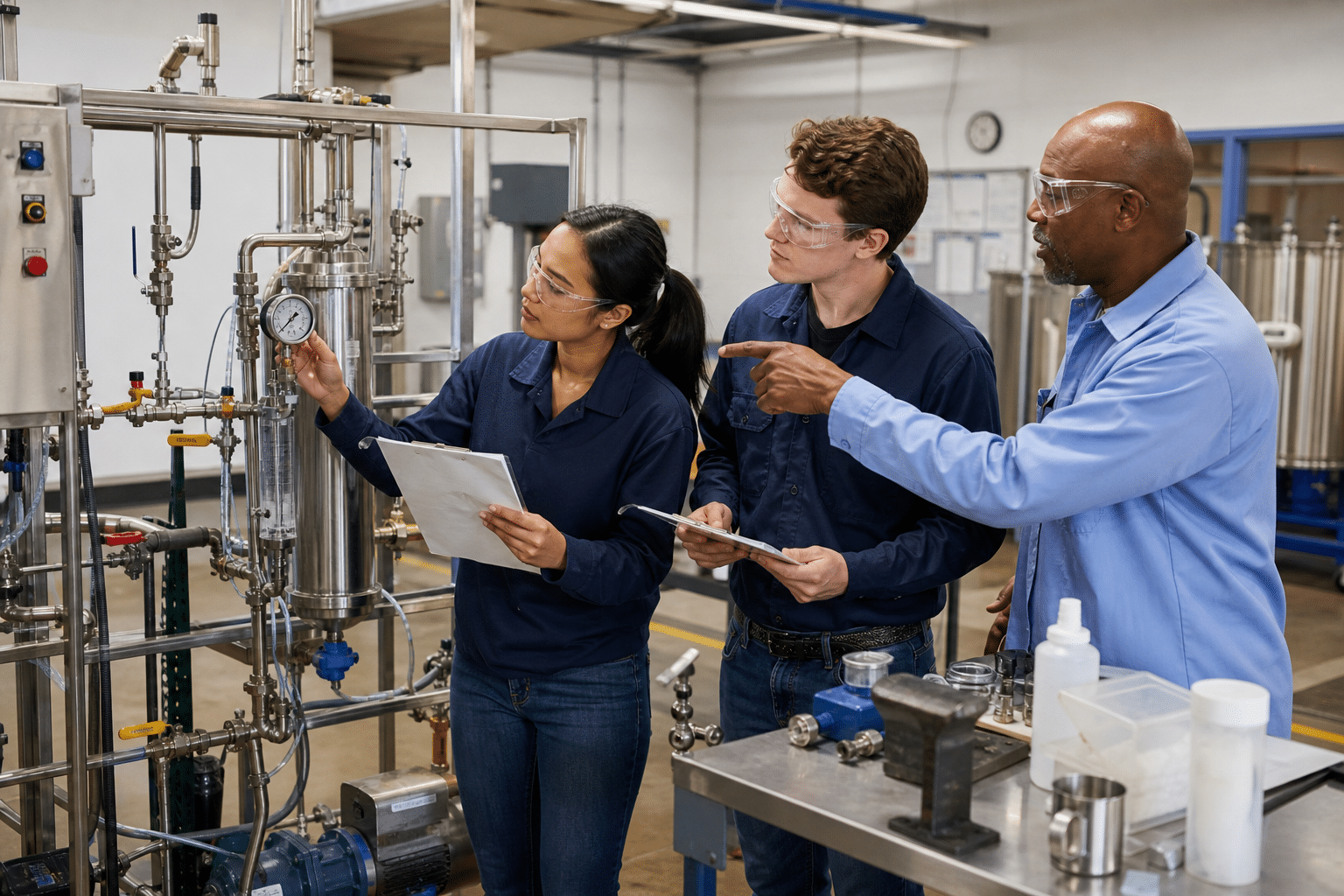
Look at the product and process before the title: One job may involve fixtures, measurements, and first-piece checks, while another may involve process data, automation, and engineering trials. Ask which tasks fill most of the shift, what decisions the technician can make, and how problems move between production and maintenance.
Bottom line
Manufacturing technician is a useful entry point into production, quality, process support and advanced equipment. It is a good fit when you want hands-on work with clear procedures and room to build technical depth. Choose carefully because the same title can describe very different jobs.
What separates a useful first role from a dead end
Manufacturing technician jobs can look alike until you ask what happens after the first few months. In one plant, a new technician learns a defined station, records problems, and gradually takes on setup, changeover, testing, or quality checks. In another, the role stays limited to repetitive work with little chance to understand the process. Neither arrangement is dishonest, but they lead to different careers.
Ask how the team handles a recurring defect or a missed production target. A healthy answer mentions operators, quality staff, maintenance, and a way to record the problem. That is where a technician learns to see the difference between a one-off mistake and a process issue. If you enjoy that part of the work, compare the role with a production technician job before you commit to training.
For a second career, do not overlook the schedule. Shift work may be manageable when it comes with clear routines and time to recover. It is harder when the employer cannot explain training, overtime, or the actual equipment you will support. A short plant visit can answer more than a polished job description.
- BLS: Industrial Engineering Technologists and Technicians – production studies, training and pay benchmark; checked September 2, 2026.
- BLS: Electro-mechanical and Mechatronics Technologists and Technicians – equipment and automation benchmark; checked September 2, 2026.
- OSHA: Control of Hazardous Energy – hazardous-energy principles; checked September 2, 2026.
- Apprenticeship.gov – apprenticeship and OJT context; checked September 2, 2026.
Reviewed September 3, 2026: Manufacturing technician roles can focus on setup, process checks, documentation, troubleshooting, or production support. Match training to the equipment and industry near you. See production technician work for a close comparison.
For a first job, ask what equipment a new hire is trusted to touch after training and what a good six-month review looks like. Clear answers about skill growth are more useful than a vague promise of advancement.