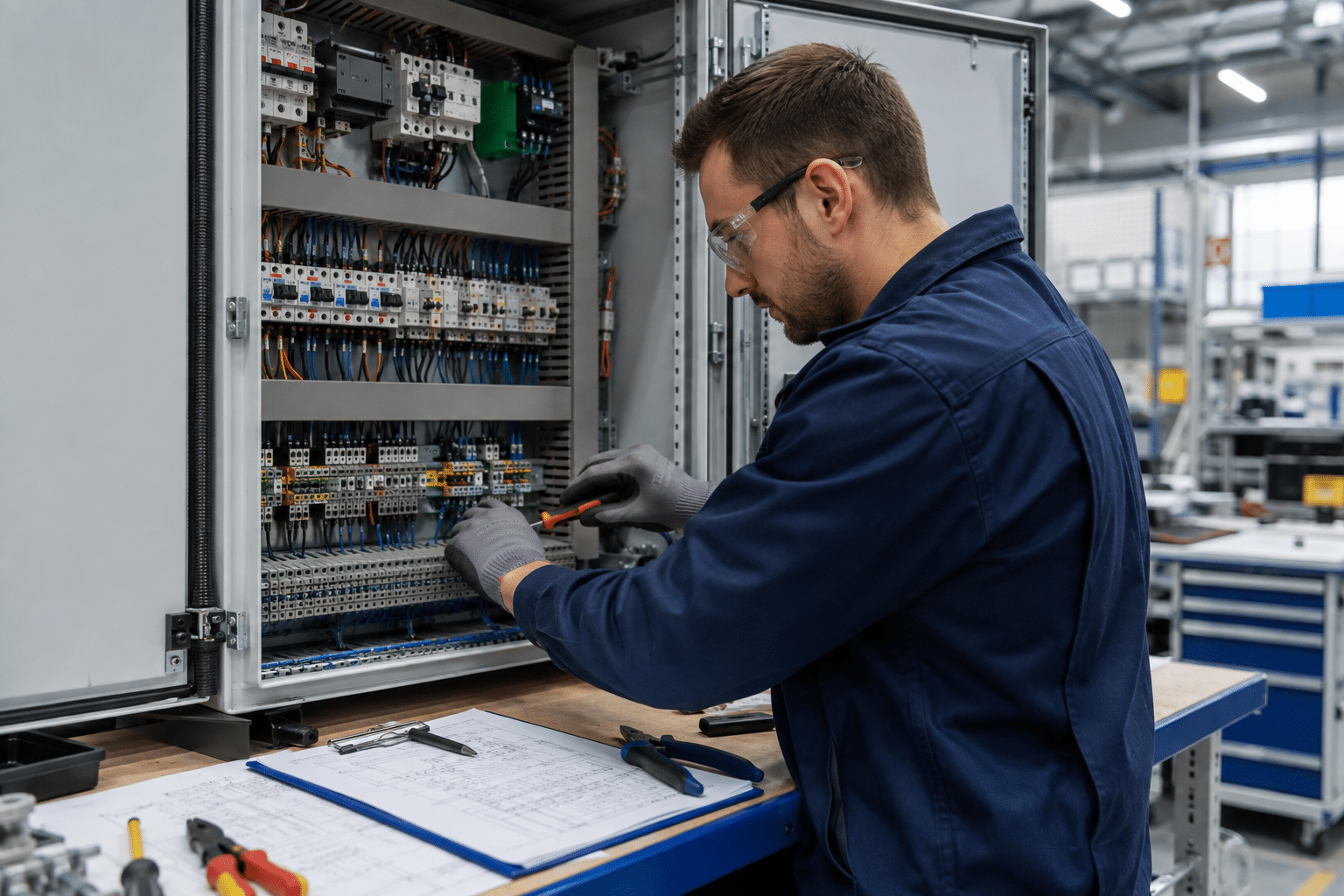
Electrical assembly is hands-on work, but it is controlled by drawings, part numbers, torque values, and inspection steps. An assembler may build a control cabinet, route a wiring harness, solder a connection, or test a finished unit before it leaves the bench. That makes the job a possible entry into industrial electrical work, while also requiring patience with repetition and the discipline to question an unclear instruction.
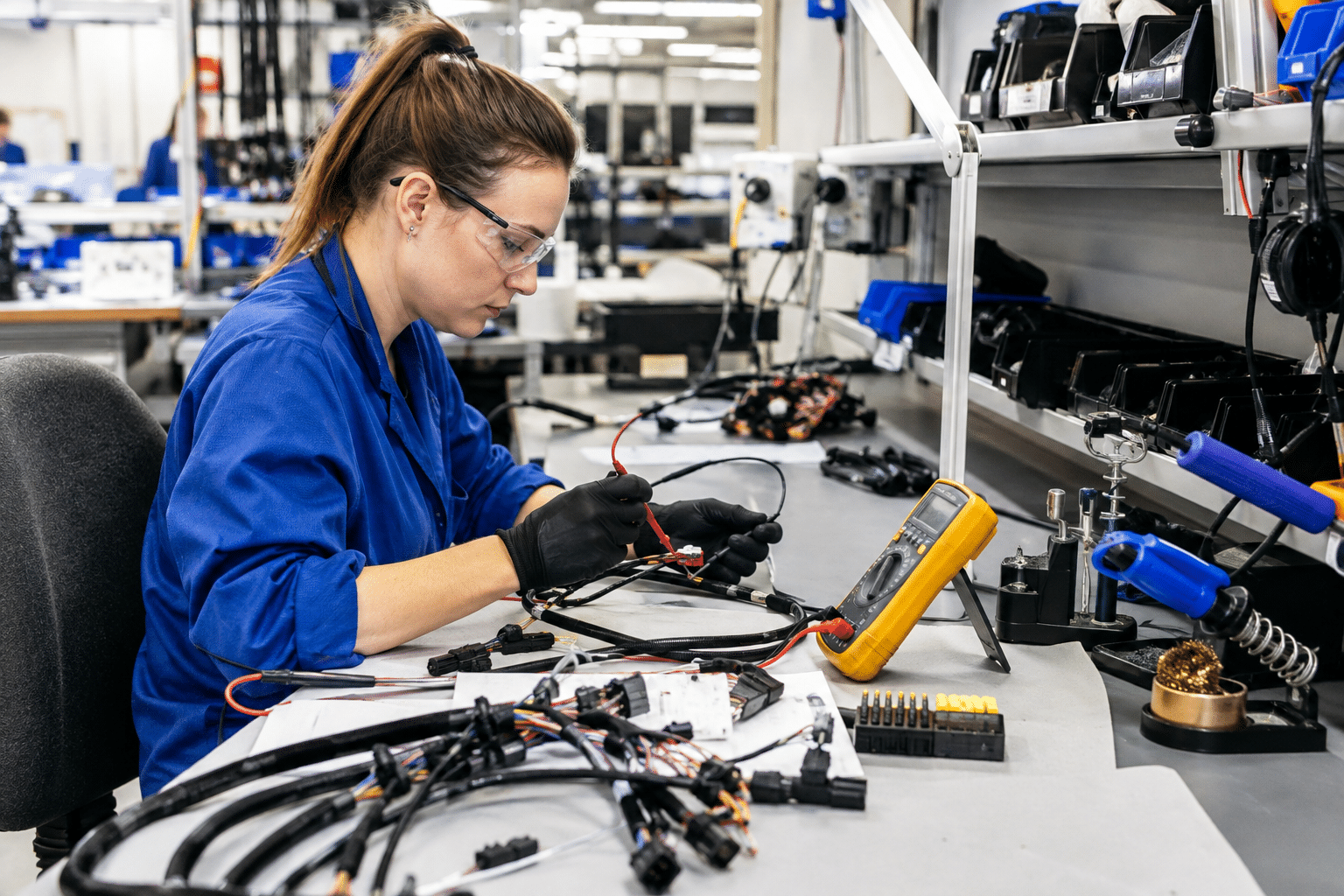
A practical example: On a control-panel job, the assembler may identify each wire from the schematic, crimp the correct terminal, route it through the panel, tighten it to the specified torque, and record the continuity test. A neat-looking panel can still fail if one wire is misplaced or one connection is loose.
What does an electrical assembler do?
- Read schematics, diagrams, bills of material, and assembly instructions.
- Prepare wire, terminals, connectors, fasteners, and other components.
- Route and secure wiring, install parts, crimp or solder connections, and label assemblies.
- Use hand tools, torque tools, meters, test fixtures, and sometimes power tools.
- Inspect workmanship and document tests or nonconforming parts.
Some jobs are bench-based and detailed. Others involve larger panels or equipment and require lifting, standing, ladders, or team assembly. The product and the industry make a big difference.
Training and certifications
The BLS says assemblers and fabricators typically enter with a high school diploma or equivalent and receive on-the-job training. Electrical and electronic assembly may require additional technical instruction, especially when the work involves soldering, tight tolerances, medical equipment, aerospace products, or defense systems.
Useful preparation includes basic electricity, reading schematics, color-code recognition, measurement, soldering, crimping, and safe tool use. Certification can help in some workplaces, but the employer’s process and quality standard remain decisive.
Pay and outlook
BLS reported a May 2025 median annual wage of $45,850 for electrical, electronic, and electromechanical assemblers, excluding coil winders, tapers, and finishers. BLS projects 5% growth for that detailed group from 2025 to 2035, while the broader assembler category is affected by automation and industry mix.
Could it fit a career change after 40?
This can be a realistic entry point for someone who prefers controlled indoor work and visible, hands-on results. The tradeoffs are repetition, production quotas, close quality checks, and the possibility of shift work. Ask how much of the job is wiring versus mechanical assembly and testing.
Experience in electronics repair, automotive work, appliance repair, controls, sewing, jewelry, or any careful hands-on craft can be relevant. Employers also notice neat work, reliable attendance, and the willingness to ask before making an unauthorized change.
Questions to ask before applying
- What product is assembled, and how complex are the schematics?
- Are soldering, crimping, torque, or IPC-related qualifications required?
- What are the shift, standing, lifting, and production expectations?
- Does training lead to testing, quality, field service, or technician roles?
How quality is checked
Electrical assembly is often judged by what cannot be seen after the cabinet or harness is closed. A wire may be the correct color but still be routed incorrectly. A terminal may look secure but fail a pull test. A component may be installed in the right location but tightened below the required torque. That is why good assemblers treat the drawing, the work instruction, and the inspection step as part of the product rather than as paperwork added afterward.
Depending on the employer, quality checks may include visual inspection, continuity checks, insulation tests, polarity checks, torque verification, or a controlled functional test. The assembler may record a result, initial a traveler, scan a part number, or flag a discrepancy for quality staff. The goal is not to hide mistakes. It is to catch them while correction is still simple.
A realistic first year
During the first weeks, expect to learn the product, the tools, the component names, and the company’s documentation system. You may repeat a small portion of the assembly while a lead checks your technique. Later, you may work on a larger section, learn a second product family, or assist with testing. Progress is usually measured by safe, consistent work rather than speed alone.
People who advance often become senior assemblers, test technicians, inspectors, wiring specialists, or leads. The next step is not automatic, but careful documentation and a willingness to learn electrical fundamentals can create options. Ask whether the employer pays for additional training and whether internal postings are common.
What can make the job difficult?
Fine-motor work can be tiring, especially when the product requires repeated crimping, fastening, or routing. Production changes can also create pressure when a customer order is late. A healthy workplace gives employees a clear method for stopping the line, asking for clarification, and reporting a defective component. During an interview, ask how supervisors respond when the drawing and the physical part do not agree. The answer tells you a great deal about the real quality culture.
Tools and habits that matter
The most useful habits are simple: keep the work area organized, return tools to their place, verify the part number before installation, and make the record match the physical assembly. A clean bench makes it easier to notice a loose terminal or a missing fastener. It also makes handoffs easier when another assembler, tester, or supervisor continues the job.
Electrical assemblers should be comfortable asking questions about unclear drawings. A small clarification early is usually cheaper than reworking a finished panel. It is also worth learning the company’s escalation path: some issues go to engineering, some to quality, and some to a lead assembler. Knowing whom to ask is part of becoming dependable.
Is this a good second-career entry point?
For an adult changing careers, electrical assembly can offer a measured way to test whether manufacturing suits you. You can see the product, learn a defined process, and gradually take on more complex work. Before applying, compare the shift, commute, physical requirements, and training plan. A role with clear instruction and a realistic progression may be more valuable than a slightly higher starting wage with no support.
Small details, real responsibility
A finished assembly is often one part of a larger system. The quality of a connector, label, ground, or fastener can affect the technician or customer who receives the product later. That is why this work deserves more than speed. It rewards people who stay attentive through the final check, even when the task is familiar.
Sources
For related technical work, see our electronics technician guide and electrical engineering technician guide.