A commercial diver performs underwater inspection, construction, repair, salvage, or maintenance work for ports, utilities, contractors, energy companies, and other clients. The job combines diving skills with tools, procedures, surface support, and detailed planning. It can be physically demanding and weather-dependent, and the safety of the entire dive team matters more than individual bravado.
This is not recreational scuba with a paycheck. A commercial dive is a planned work operation with a dive supervisor, equipment checks, communications, surface support, emergency procedures, and a defined task. The water is only one part of the job.
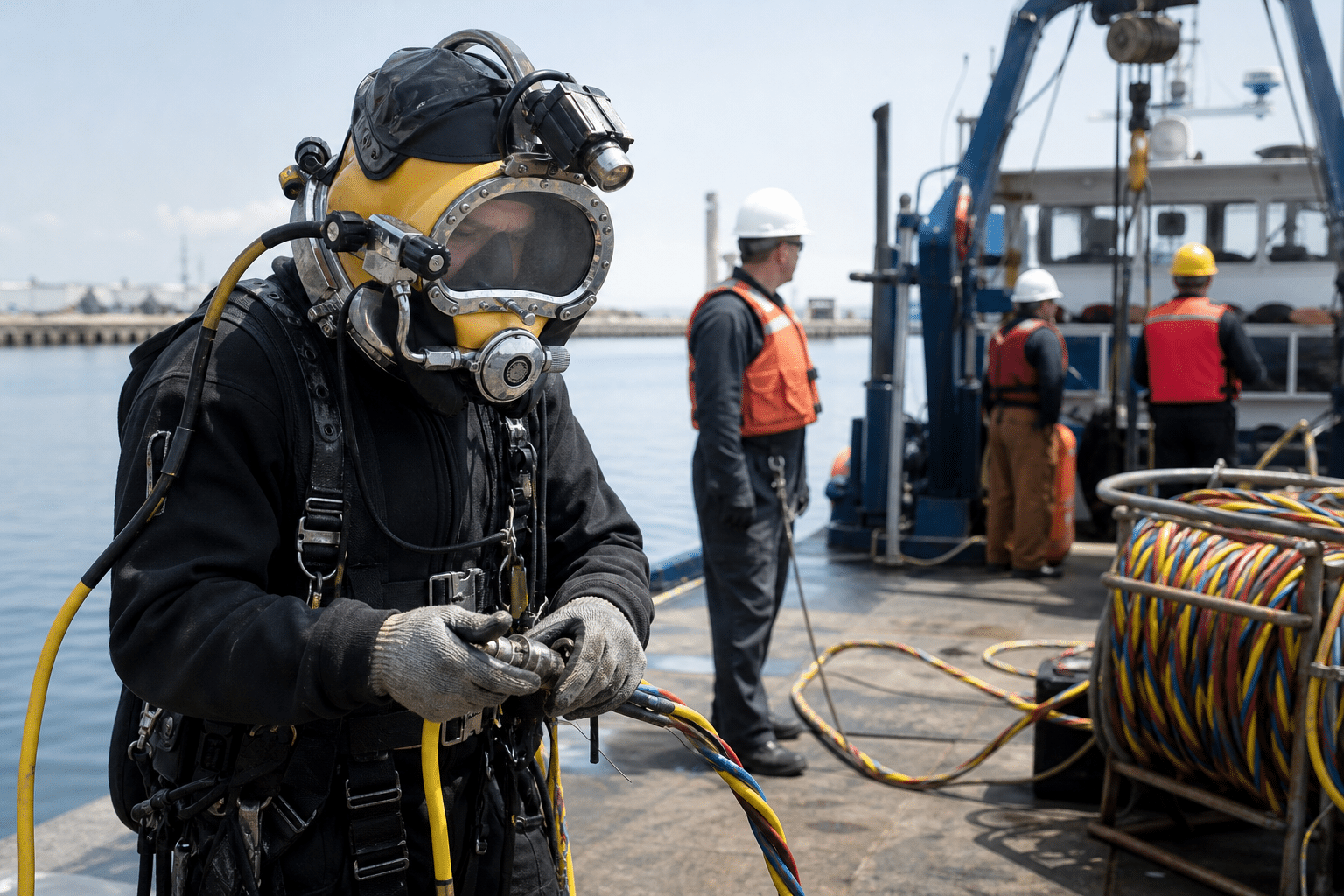
The work starts on the surface: Before entering the water, the team confirms the task, conditions, communications, equipment, emergency plan, and roles. Underwater visibility may be poor, so the diver’s observations and the surface record need to be clear enough for the supervisor to decide what happens next.
What does a commercial diver do?
The task depends on the employer and industry. A diver may inspect bridge supports, pilings, seawalls, hulls, docks, underwater pipelines, or treatment equipment; take photographs, video, measurements, or thickness readings; install or remove structures; use hydraulic or pneumatic tools; assist with salvage or dredging; perform underwater welding when trained; and write inspection notes.
- Inspect underwater structures, vessels, and equipment.
- Measure, photograph, video, or document conditions below the surface.
- Install or remove underwater hardware and structures.
- Use tools, cutting equipment, and lifting gear under an approved plan.
- Assist with salvage, marine construction, ship repair, or utility work.
- Maintain dive equipment and communicate findings to the surface team.
Some jobs are inspection-heavy. Others involve construction, ship repair, offshore energy, inland commercial work, or public utilities. The title does not tell you how much welding, rigging, travel, or actual bottom time a position includes.
Commercial diver versus related work
| Role | Main focus | Typical difference |
|---|---|---|
| Commercial diver | Underwater construction, inspection, and repair | Performs assigned work below the surface with a dive team |
| Recreational dive instructor | Sport-diving instruction | Works within recreational diving activities |
| Underwater welder | Underwater cutting and welding | A specialty within commercial diving |
| Rigger | Lifting and load control | Prepares and moves loads, often above water or on a vessel |
| Marine mechanic | Boat and marine equipment repair | Usually works from the surface or inside the vessel |
Our guides to crane operator work, pipefitting, and quality control inspection cover adjacent skills that may appear in commercial projects.
Equipment and skills
Commercial diving may use surface-supplied air, helmets or masks, umbilicals, compressors, gas panels, communications, harnesses, weights, cameras, hydraulic tools, and lifting gear. The equipment is selected for the job and diving mode. A diver needs to understand the system, not just put on a mask.
- Controlled movement in water and strong basic fitness.
- Hand-tool, mechanical, electrical, or welding experience where relevant.
- Reading drawings, work packages, inspection instructions, and measurements.
- Rigging awareness and careful tool control.
- Clear radio communication with the surface team.
- Calm responses to equipment faults and changing conditions.
- Accurate logs, photographs, measurements, and reports.
Previous construction, shipyard, welding, mechanics, or military experience can help you understand the task. It does not replace commercial diving training or the employer’s qualification process.
Training and how people enter
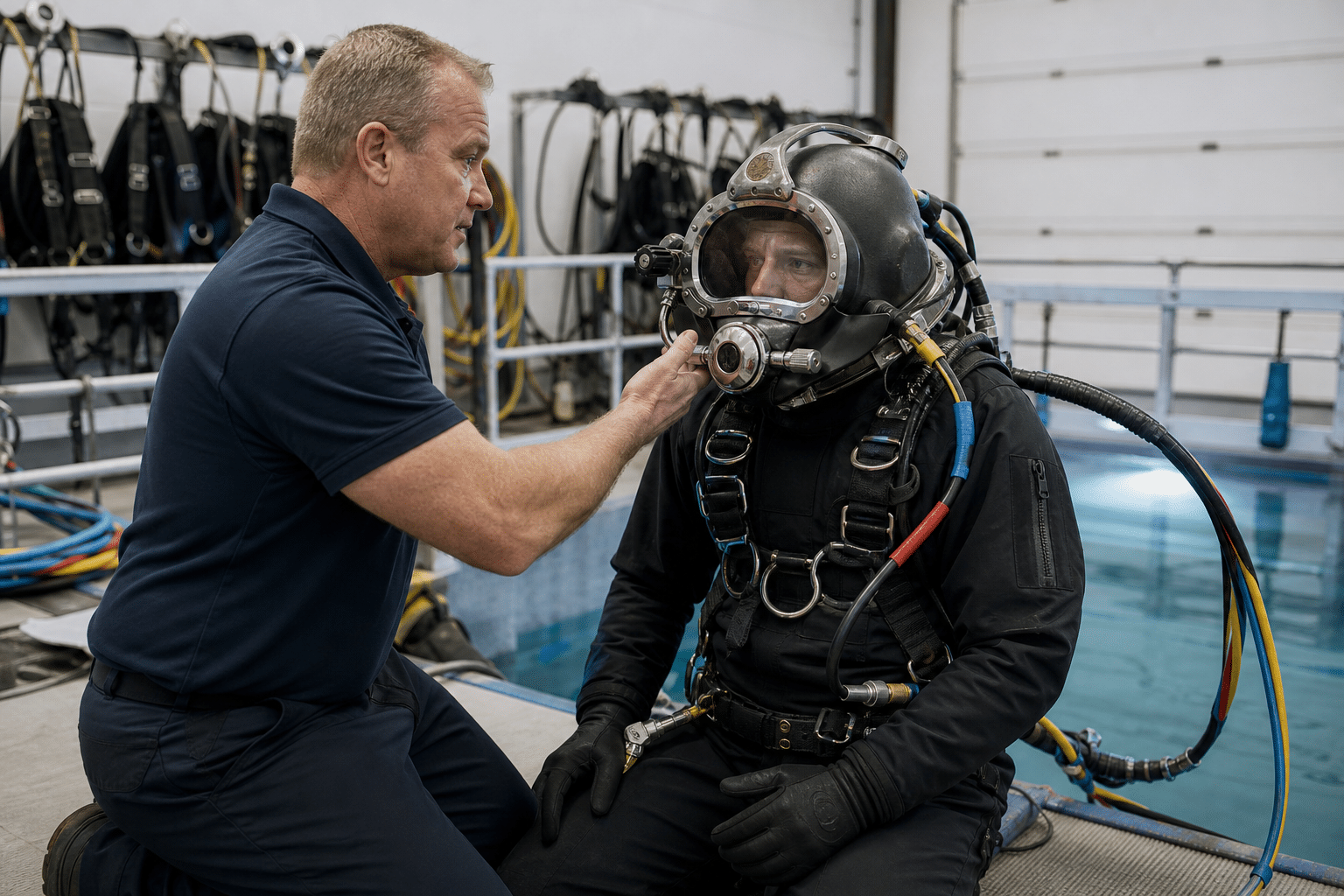
Most career changers begin with a commercial diving school or an employer-supported entry route. Programs may teach surface-supplied diving, underwater tools, rigging, welding, inspection, first aid, emergency procedures, and dive planning. Compare equipment time, instructor experience, recognized credentials, placement information, and total cost instead of relying on a short-course headline.
OSHA’s commercial diving rules require dive-team members to have the experience or training needed for assigned work. The standard also includes training in relevant tools and systems, the diving mode, emergency procedures, and CPR and first aid. It is an employer safety requirement, not a promise that one certificate qualifies you for every project.
The OSHA commercial diving standards cover general industry, maritime, and construction references. Read the employer’s safe-practices manual and ask which diving mode and work types you would actually perform.
Commercial diver pay and outlook
BLS reports Commercial Divers as a specific occupation. It counted 4,200 jobs in 2024 and reported a $61,130 median annual wage in May 2024. Employment is projected to grow 9% from 2024 to 2034, with about 400 net new jobs.
| BLS category | 2024 jobs | May 2024 median pay | 2024-34 projection |
|---|---|---|---|
| Commercial Divers | 4,200 | $61,130 | 9% growth |
BLS lists a postsecondary nondegree award and moderate-term on-the-job training as typical. The median does not tell you how much a diver earns during school, how often a job travels, or how much income comes from overtime and project work. Pay can change with depth, location, vessel work, inspection skills, welding, hazardous conditions, and time away from home.
Ask an employer how it pays travel time, standby time, per diem, lodging, and emergency callouts. Also ask how much of the year is steady local work versus project-based travel.
Safety is part of the job description
OSHA Subpart T covers commercial diving operations and includes dive-team qualifications, pre-dive procedures, procedures during and after a dive, equipment, and recordkeeping. OSHA’s pre-dive rule addresses planning, surface and underwater hazards, breathing-gas supply, thermal protection, equipment, team assignments, decompression, and emergency procedures.
That list should change how you evaluate training ads. A program that talks about exciting underwater work but cannot explain emergency planning, surface support, equipment logs, and realistic job placement deserves careful questions.
Commercial diving can involve cold water, poor visibility, currents, entanglement hazards, heavy tools, boats, pressure changes, and long days. Never treat this article or a school brochure as medical clearance. Discuss fitness requirements with the employer and a qualified medical professional.
Is commercial diving a good career change after 40?
It is possible, but the physical and financial test is serious. You may spend money on training before earning commercial wages, and the first job may require relocation, travel, seasonal work, or helper duties. Previous welding, rigging, shipyard, construction, or mechanical experience can make the transition more practical.
Talk with working divers, visit a school, and ask to see the equipment and schedule before enrolling. Compare the cost of training with likely first-year income and time away from home. Our career-change roadmap after 40 can help you make that comparison on paper.
Questions to ask before enrolling or applying
- Which diving mode and work specialties does the program teach?
- How much supervised equipment time is included?
- What first jobs do graduates actually obtain, and where are they located?
- Which certifications, medical evaluations, and first-aid training are expected?
- How often do employees travel, work offshore, or stay away overnight?
- What are the rules for refusing work outside your training or safe conditions?
Bottom line
Commercial diving is a specialized trade that combines underwater work with construction, inspection, tools, documentation, and disciplined safety procedures. It can suit someone who accepts the physical demands and uncertain travel pattern, but a short course is not a shortcut to every diving job. Verify the training, equipment, employer pathway, and real schedule before spending money.
Related guides: Railroad Signal Maintainer: Duties, Training, Pay and Career Fit and Surveying Technician: Duties, Training, Pay and Career Fit.
Sources
- BLS: Commercial Divers
- OSHA: Commercial Diving standards
- OSHA: Qualifications of dive team
- OSHA: Pre-dive procedures
\n
Reviewed September 3, 2026: Commercial diving requires more than comfort in water. Training, dive-team procedures, equipment, depth, weather, and work type all matter. Confirm the employer and school requirements before paying for a program. Compare the physical demands with concrete finishing work.