A concrete finisher works after a pour to place, level, smooth, texture, edge, joint, and protect concrete as it sets. The timing depends on the mix, weather, surface, crew, and project requirements. It is skilled physical work with early starts and changing conditions, and the quality of the finished surface is often decided during a short window.
Concrete finishers may work on sidewalks, floors, foundations, slabs, walls, roads, bridges, curbs, decorative surfaces, or industrial projects. The employer’s specialty makes a big difference.
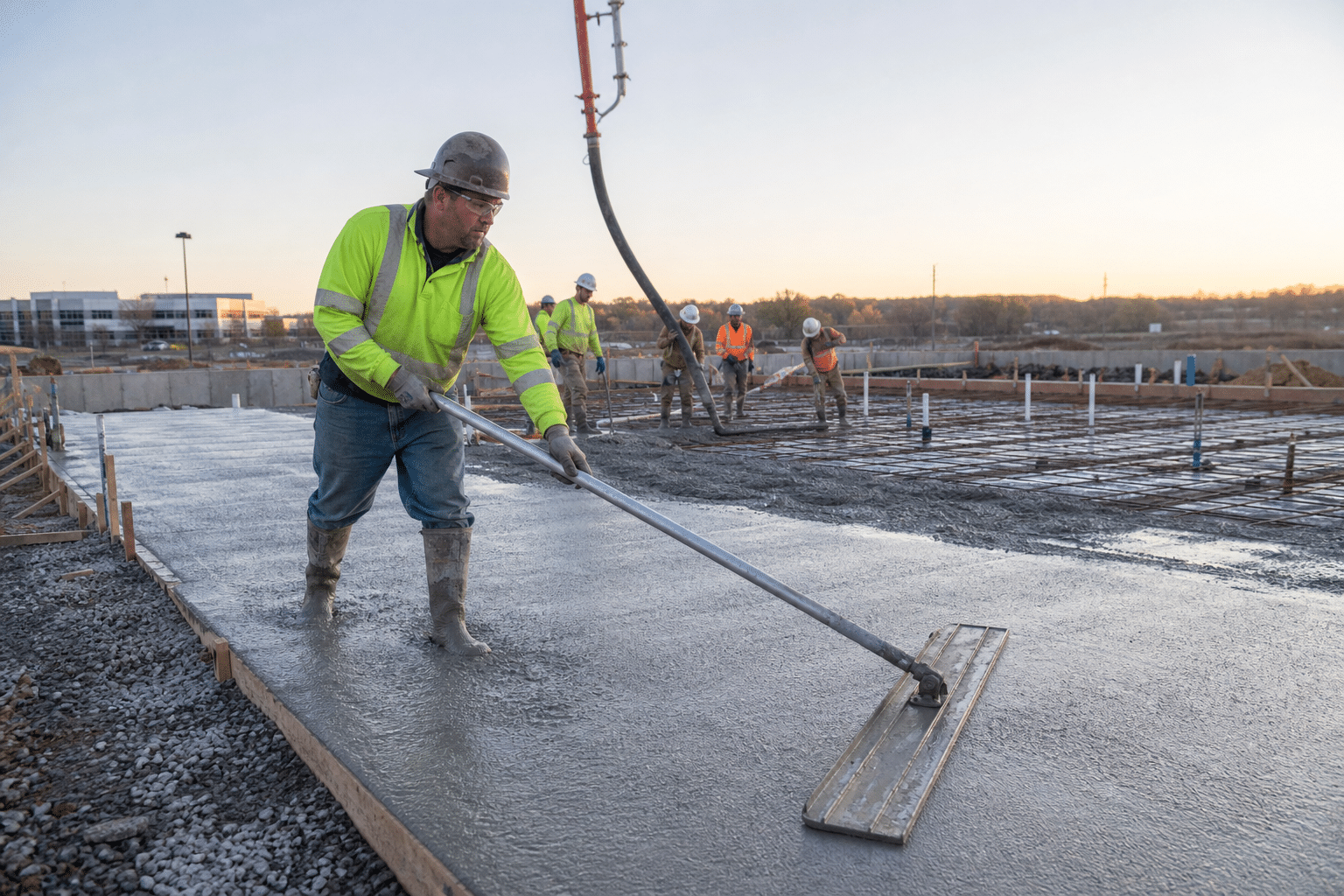
Timing drives the work: A finisher may need to correct a high spot, close the surface, form an edge, or cut a joint while the concrete is workable but not too soft. Adding water or rushing a pass can change the finish and durability, so the crew watches the material as well as the clock.
What does a concrete finisher do?
The Bureau of Labor Statistics includes cement masons and concrete finishers in its masonry workers profile. The work may include:
- reading plans, grades, dimensions, and finish requirements;
- preparing forms, reinforcement, tools, and access before the pour;
- guiding the placement of concrete with the crew;
- screeding or striking off excess concrete to establish the level;
- bull floating or otherwise working the surface at the right time;
- edging corners and forming joints;
- applying the specified texture or finish;
- checking slopes, flatness, edges, and visible defects;
- protecting or curing the surface according to the project procedure;
- repairing or resurfacing existing concrete when the company offers that work;
- cleaning tools and documenting the job.
Timing is a large part of the skill. Work the surface too early and the finish can be weak or uneven. Wait too long and the concrete may no longer respond to the tool. Experienced finishers watch the material, weather, crew, and clock together.
Types of concrete work
Flatwork
Flatwork includes floors, sidewalks, patios, slabs, driveways, and other horizontal surfaces. The finisher may spend long periods kneeling, bending, walking on forms or boards, and moving tools across the surface. Flatness, slope, joints, and texture all matter.
Foundations, walls, and structural work
Some finishers work on foundations, walls, columns, beams, panels, or other structural components. The job may involve forms, vibration, edges, patching, and coordination with reinforcing steel and concrete placement crews.
Roads and heavy civil projects
Highways, bridges, runways, and large paving projects use specialized equipment and larger crews. The schedule may start early, the work zone may be noisy, and the crew may move quickly as a pour progresses.
Decorative and repair work
Stamped, colored, polished, exposed-aggregate, and resurfacing work requires different preparation and finishing methods. Decorative work can look less industrial, but mistakes remain visible and timing still matters.
Concrete finisher versus related jobs
| Role | Main focus | Typical difference |
|---|---|---|
| Concrete finisher | Level, shape, texture, and protect fresh concrete | Owns the surface result after placement |
| Cement mason | Broad concrete and masonry finishing work | Often overlaps with concrete finisher in employer language |
| Construction laborer | Material handling, site preparation, and general support | May assist a pour without leading finishing tasks |
| Carpenter | Forms, framing, and structural wood or composite work | May build concrete forms rather than finish the concrete |
| Pipefitter | Fabricate and install piping systems | Works with pipe systems rather than concrete surfaces |
| Sheet metal worker | Fabricate and install sheet metal products | Works with metal layout and installation |
Our guides to carpenter apprenticeships, pipefitting, sheet metal work, and industrial painting cover nearby construction routes.
Skills and tools that matter
Concrete finishing is physical, but the best workers also pay close attention to material behavior and sequence. Useful skills include:
- reading grades, dimensions, and finish notes;
- judging when the surface is ready for the next tool;
- keeping edges, joints, and slopes consistent;
- using hand tools without damaging the surface;
- communicating with the pump, placement, form, and labor crews;
- staying organized when the pour is moving fast;
- protecting finished areas from traffic, weather, and contamination.
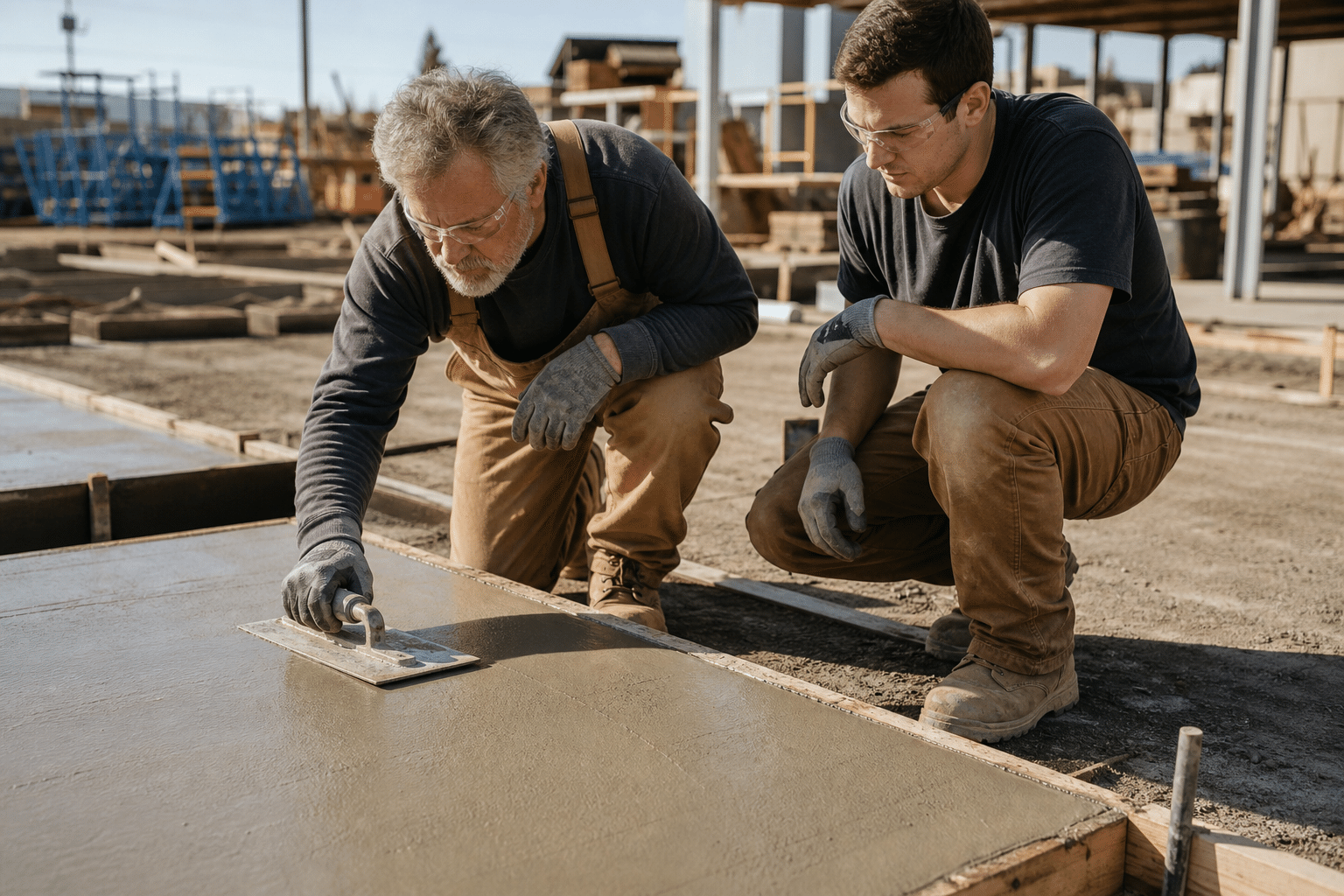
Tools can include screeds, bull floats, darbies, groovers, edgers, trowels, power trowels, brooms, grinders, saws, hoses, levels, and measuring equipment. A new worker may begin by preparing tools, moving materials, cleaning, and learning the sequence before handling the most visible finish work.
How do you become a concrete finisher?
The BLS says masonry workers typically enter with a high school diploma or equivalent and learn through an apprenticeship or on-the-job training. Concrete employers may use titles such as laborer, finisher helper, cement mason apprentice, or concrete technician.
- Start as a laborer or finisher helper on a concrete crew.
- Apply for a cement mason or concrete-finishing apprenticeship.
- Join a contractor that trains workers through repeated pours and supervised tasks.
- Move from construction labor, carpentry, landscaping, paving, masonry, or heavy civil work.
- Complete a technical or union program that includes concrete placement and finishing.
Apprenticeship.gov includes cement masons and concrete finishers among approved occupation searches. Program length, wages, work processes, and instruction vary by sponsor. Ask whether the program covers flatwork, structural concrete, paving, repair, decorative work, equipment, and safe silica practices.
Before paying for a course, visit a real job site or training shop if possible. You need to see the tools, the pace, the posture, and the weather exposure for yourself.
Pay and job outlook
The BLS masonry workers profile reported a $58,270 median annual wage for the broader masonry workers group in May 2025. Within that profile, the listed median for cement masons and concrete finishers was $57,020. The wider group included brickmasons, blockmasons, stonemasons, and terrazzo workers, so neither number is a guaranteed wage for a new finisher.
| BLS benchmark, May 2025 | Figure | How to read it |
|---|---|---|
| Masonry workers median | $58,270 | Broader BLS profile including several masonry occupations |
| Cement masons and concrete finishers median | $57,020 | Detailed occupation benchmark within that profile |
| Masonry workers jobs | 277,700 | Broad group employment in 2025 |
| Cement masons and concrete finishers jobs | 204,800 | Detailed occupation employment in 2025 |
| Masonry workers projected growth, 2025-35 | 1% | Broad group projection |
| Masonry workers projected openings | 18,400 per year | Broad group average, including replacement needs |
Local pay depends on project type, region, union or contractor route, overtime, travel, weather, and skill. A finisher who can read grades, operate power equipment, repair surfaces, or lead a crew may qualify for different work than a new helper.
Safety and working conditions
Concrete work can involve heavy hoses, moving equipment, wet cement, wet-cutting tools, noise, vibration, heat, cold, slips, trips, kneeling, lifting, and long periods of standing. Fresh concrete can irritate skin and eyes. Cutting, grinding, drilling, or breaking concrete can create respirable crystalline silica dust.
OSHA’s construction silica standard requires employers to limit exposure and take protective steps. Water delivery, dust controls, respiratory protection where required, housekeeping, training, and medical procedures may all matter depending on the task. Do not assume that a short exposure or an outdoor setting eliminates the need for controls.
Ask an employer:
- What type of concrete work will I do most often?
- How early do crews start, and how much travel is normal?
- How much kneeling, lifting, climbing, and tool handling is expected?
- What controls are used for silica dust and wet cement?
- Who decides when the concrete is ready for the next finishing step?
- Which power tools may apprentices use?
- How does the company handle bad weather or a delayed pour?
- What does advancement look like after helper and apprentice work?
Is concrete finishing a good second career after 40?
It can suit someone who likes visible results, teamwork, outdoor work, and a task that changes as the material changes. Previous construction, landscaping, labor, masonry, carpentry, or equipment experience can help.
The physical test is not optional. Finishers may kneel, squat, bend, drag tools, handle hoses, lift forms or materials, and work in heat or cold. A small sample day on a crew can tell you more than a polished school brochure. Ask about the actual specialty and the equipment used.
Income timing also matters. The first job may be helper or laborer work, with responsibility and pay increasing as you can handle layout, edging, joints, power equipment, and more complex pours. Use our career-change roadmap after 40 to compare the starting wage, training cost, commute, seasonality, and recovery time.
Questions to ask before applying
- Is the company focused on slabs, foundations, paving, decorative work, or repair?
- Will I start as a laborer, helper, apprentice, or finisher?
- Which tools and equipment will I learn first?
- How are apprentice wages and increases structured?
- What happens when rain, heat, cold, or a delayed delivery changes the schedule?
- What protective equipment and silica training are provided?
- How much work is outdoors or on uneven ground?
- What skill marks the move from helper to dependable finisher?
Bottom line
A concrete finisher turns a fresh pour into a usable surface. The job requires timing, physical effort, tool control, crew communication, and attention to grades and texture. It can be a solid entry into construction, but the weather and body demands should be tested honestly.
The BLS listed a $57,020 median for cement masons and concrete finishers in May 2025 inside its broader masonry profile. That is a benchmark, not a starting-wage promise. Visit a crew, compare apprenticeship and helper routes, and ask exactly what type of concrete work you would be doing.
Sources
- BLS: Masonry Workers
- BLS: May 2025 occupational wage table
- Apprenticeship.gov: Cement Mason and Concrete Finisher occupation
- OSHA: Respirable Crystalline Silica – Construction
- OSHA: Respirable Crystalline Silica standard
\n
Reviewed September 3, 2026: Concrete finishing is shaped by weather, pour schedules, posture, lifting, pace, and the type of project. Talk with local crews before choosing the trade. Compare the physical work with other construction paths.
\n