A pipefitter installs, assembles, repairs, and maintains piping systems that carry water, steam, gas, chemicals, air, or other fluids. The work can involve drawings, measurements, cutting, welding or joining, supports, valves, testing, and jobsite coordination. Apprenticeship and helper routes are common, but the system and work environment determine what skills are needed.
The title covers more than one kind of job. Some pipefitters work on new construction. Others maintain process piping in a plant, fit high-pressure steam lines, or specialize in pipe welding. Before you compare salaries or training programs, find out which version of the trade an employer actually means.
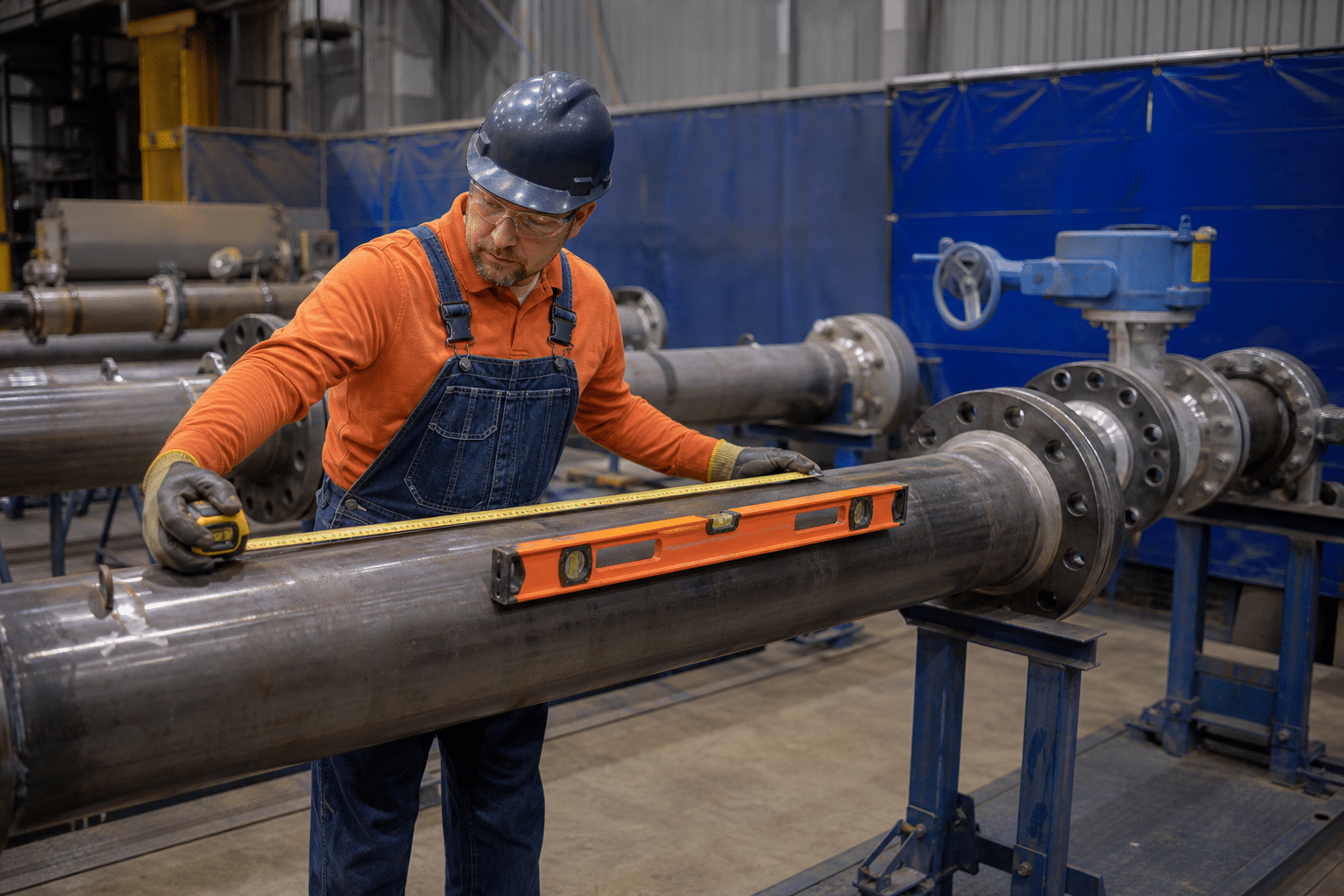
Fit-up happens before the pressure test: The pipefitter checks dimensions, alignment, supports, valve orientation, access, and the drawing before the system is closed. A small mismatch at the start can create stress, rework, or a difficult repair after the line is tested.
What does a pipefitter do?
Pipefitters turn drawings and measurements into working piping systems. A job may start with a blueprint or isometric drawing and end with a pressure test, a commissioning check, or a repair that puts a production line back into service.
Typical work includes:
- reading blueprints, isometric drawings, and specifications;
- measuring, cutting, threading, bending, and fitting pipe;
- installing valves, supports, hangers, and related equipment;
- joining pipe with welding, brazing, threading, or mechanical fittings;
- aligning sections so the system can expand, drain, or connect to equipment correctly;
- testing systems for leaks or pressure problems;
- inspecting, maintaining, and repairing existing piping;
- documenting the work and coordinating with welders, electricians, operators, and supervisors.
The United Association describes pipefitters working on heating, cooling, steam, process piping, and gas-distribution systems. The American Welding Society also points to pipe supports, valves, pressure testing, and technical drawings as part of the job.
Pipefitting is not simply putting pipes together. A small error in elevation, alignment, material, or valve orientation can create a serious problem later. The job rewards people who can measure carefully, notice inconsistencies, and follow a sequence without rushing.
Pipefitter, plumber, steamfitter, or welder?
The trades overlap, and employers do not use titles perfectly. The broad BLS occupation groups plumbers, pipefitters, and steamfitters together, but the day-to-day work can still be quite different.
| Role | Main emphasis | Common setting |
|---|---|---|
| Pipefitter | Industrial and commercial piping, equipment connections, valves, and process systems | Plants, large buildings, energy projects |
| Plumber | Water, drainage, gas, and fixtures in buildings and some industrial sites | Homes, businesses, construction sites |
| Steamfitter | High-pressure steam and hot-fluid systems; often a regional or employer-specific term | Power, industrial, and institutional facilities |
| Pipe welder | Welding pipe joints to a required procedure or code; may also fit and install pipe | Fabrication shops, plants, construction, shutdowns |
| Industrial electrician | Power, controls, motors, and electrical systems around the equipment | Manufacturing and industrial facilities |
These labels are useful starting points, not guarantees. Ask whether the position is mainly fabrication, installation, maintenance, shutdown work, welding, or service. That answer affects the tools, schedule, qualifications, and physical demands.
If you are comparing nearby routes, our guides to becoming a plumber, industrial electrician work, welder pay, and industrial maintenance cover some of the differences.
How do you become a pipefitter?
Most people enter through an apprenticeship, a helper job, technical school, or a combination of those routes. BLS says apprenticeships commonly last four or five years and generally combine paid on-the-job training with technical instruction. Apprentices learn safety, blueprint reading, mathematics, applied physics, local rules, tool use, and the practical side of pipe installation.
There is no single national application process. You may find opportunities through:
- A United Association local or another union training center.
- A contractor or trade association that sponsors apprentices.
- Apprenticeship.gov and state workforce resources.
- A community college or technical school that leads to helper work or an apprenticeship.
- An employer that hires helpers and develops them into fitters.
A paid apprenticeship can be attractive because you earn while learning, but acceptance is not automatic. Programs may test math, require an interview, check driving eligibility, or ask you to demonstrate that you can work safely in a physically demanding environment. Openings also depend on local construction and industrial work.
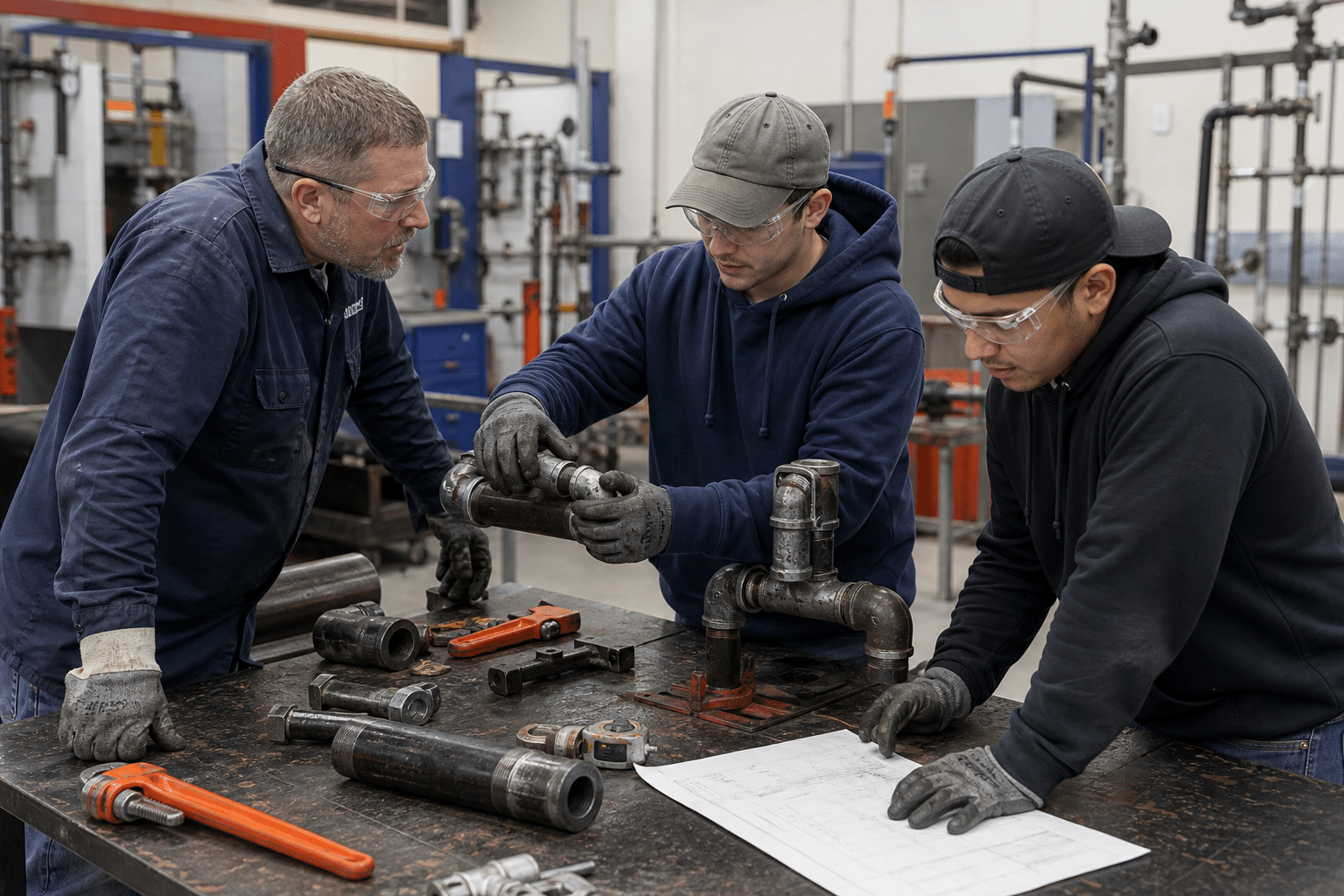
Before paying for a private course, ask these questions:
- Does the program have a direct relationship with employers or an apprenticeship sponsor?
- How much time is spent on real pipe layout, fitting, and measurement?
- Is welding practice included, and is it relevant to the jobs you want?
- What tools, books, fees, and transportation costs are extra?
- Will the credential satisfy any requirement, or is it only a certificate of attendance?
- What happens after graduation if the school does not place you?
A short course can help with basics. It does not replace supervised experience on large systems, around heavy materials, or under a plant’s procedures.
Skills that matter on the job
Pipefitters need mechanical ability, but strength alone will not carry the job. The useful skill set includes:
Layout and measurement
You may work from a drawing, calculate offsets, mark pipe, and check that a run will meet equipment connections. Measurement errors become expensive when the pipe is large, heavy, or already welded into place.
Technical drawings
Blueprints, plans, P&IDs, isometric drawings, and specifications communicate different parts of the same job. Learning to compare the drawing with the real work area is a major step toward working independently.
Joining and fabrication
Depending on the role, you may thread, groove, braze, weld, or use flanged and mechanical connections. Pipefitter welders need additional process-specific practice and may need to pass employer or code-based tests.
Rigging and material handling
Large pipe, valves, and fittings often cannot be moved safely by hand. Hoists, slings, forklifts, and coordinated lifts require training and communication. The safest worker is not the one who tries to muscle everything into place.
Troubleshooting
Leaks, vibration, poor flow, unexpected heat, and misalignment can have several causes. Good troubleshooting starts with the system, the drawings, and the evidence rather than a guess.
Safety and working conditions
The trade can be demanding. BLS notes that plumbers, pipefitters, and steamfitters may lift heavy materials, climb ladders, work in tight spaces, and work outdoors in changing weather. The specific burden depends on whether the job is plant maintenance, commercial construction, fabrication, or a shutdown project.
Potential exposures include hot surfaces, pressure, chemicals, fumes, sharp edges, noise, welding hazards, moving equipment, and fall risks. Employers may require hard hats, eye protection, gloves, hearing protection, flame-resistant clothing, respirators, or fall protection for particular tasks.
Lockout/tagout is especially important during maintenance when unexpected startup or stored energy could injure someone. OSHA’s standard requires an energy-control program for applicable servicing and maintenance. The exact procedure comes from the employer and the equipment, so a general article cannot replace site training.
Ask a prospective employer:
- How much of the work is indoors, outdoors, elevated, or in confined spaces?
- Are shifts, shutdowns, travel, or overtime common?
- What lifting and material-handling equipment is available?
- How are apprentices supervised?
- Which safety training is provided before field work?
What does a pipefitter earn?
There is no separate national BLS wage table for every pipefitter title. BLS reports plumbers, pipefitters, and steamfitters as one occupation. In May 2025, the median annual wage for that group was $63,800. The lowest 10 percent earned less than $44,150, and the highest 10 percent earned more than $108,420.
| BLS benchmark, May 2025 | Annual wage |
|---|---|
| Lowest 10 percent | Less than $44,150 |
| Median for plumbers, pipefitters, and steamfitters | $63,800 |
| Highest 10 percent | More than $108,420 |
| Government, excluding state and local education and hospitals | $71,660 median |
| Manufacturing | $65,770 median |
These figures are useful context, not a promise about a pipefitter offer. An apprentice normally earns less than a fully trained worker, with increases tied to the program or employer. Union packages may include health coverage, retirement contributions, and overtime rules that make total compensation different from the hourly wage alone.
Pay can change with location, industrial specialization, welding qualifications, travel, shift work, shutdowns, overtime, and whether the job is covered by a collective bargaining agreement. Compare the base rate, guaranteed hours, benefits, per diem, travel time, and callout rules before deciding that one offer is better.
Job outlook and advancement
BLS projects employment for plumbers, pipefitters, and steamfitters to grow 7 percent from 2025 to 2035, with about 42,000 openings per year on average. The total includes replacement openings as well as new positions, and it does not predict demand in one city or one specialty.
An entry-level worker may progress toward journey-level work, then become a foreperson, estimator, project manager, instructor, inspector, or contractor. A pipefitter who adds welding, controls awareness, rigging, or shutdown experience may qualify for different assignments, but every added credential should connect to a real job requirement.
Is pipefitting a good career change after 40?
It can be, especially for someone with mechanical, construction, military, maintenance, HVAC, welding, or equipment experience. Those backgrounds do not eliminate the learning curve, but they may make tools, drawings, worksite communication, or safety routines less unfamiliar.
The harder question is cash flow. A multi-year apprenticeship may offer paid work, but the starting wage can still be lower than your current income. Build a simple plan for transportation, tools, insurance, family expenses, and the time needed to reach the next wage step.
Your body matters too. Pipefitting can involve kneeling, climbing, awkward positions, heavy components, heat, and long periods on a jobsite. A person with a previous injury should discuss actual job tasks with an employer and qualified health professional rather than assuming the trade is either safe or impossible.
Start by reading local job postings. Count how often employers ask for welding, rigging, a driver’s license, travel, night work, or industrial experience. Then compare those requirements with an apprenticeship’s curriculum. That small exercise will tell you more than a national salary headline.
Questions to ask before applying
- Is the opening for a pipefitter, steamfitter, pipe welder, or maintenance fitter?
- Is the work construction, fabrication, plant maintenance, or service?
- What does the first year pay, and how do wage increases work?
- Is training paid, and who sponsors the classroom instruction?
- Are travel, shutdowns, nights, or overtime part of the normal schedule?
- Which licenses or local registrations apply to this work?
- What percentage of the job involves welding, rigging, ladders, or confined spaces?
Bottom line
Pipefitting is a technical trade built around measurement, layout, fabrication, installation, testing, and repair. The work can lead to industrial, energy, commercial, and institutional jobs, but the title hides meaningful differences between specialties.
The most common entry route is a four- or five-year apprenticeship, although helpers, technical-school graduates, and workers moving from nearby trades also enter the field. BLS reports a $63,800 median for the broader plumber, pipefitter, and steamfitter occupation in May 2025, but your real offer will depend on location, specialty, training stage, schedule, and benefits.
For a career changer after 40, the decision comes down to more than pay. Check the local route, the first-year income, the physical work, and the type of piping you would actually handle. If those pieces fit, pipefitting can be a practical path into industrial work without a four-year engineering degree.
Sources
- U.S. Bureau of Labor Statistics: Plumbers, Pipefitters, and Steamfitters
- Apprenticeship.gov: Apprenticeship Occupations
- United Association: Pipefitters
- American Welding Society: Pipefitter Career Profile
- OSHA: The control of hazardous energy (lockout/tagout)
\n
Reviewed September 3, 2026: Pipefitting training should be judged by the systems, job sites, tools, welding or rigging work, and apprenticeship support involved. Ask about travel and shutdown work before applying. See the pipefitter guide.
\n