A crane operator controls lifting equipment to move materials safely on construction sites, industrial facilities, ports, and other work areas. The job involves machine checks, load charts, signals, rigging awareness, site conditions, and communication with the crew. Certification requirements depend on the crane and work, but safe judgment is needed on every lift.
The title covers several equipment types and work settings. A mobile crane operator, tower crane operator, overhead crane operator, and port or industrial operator may have very different days. Always read the equipment and site details in the posting.
A lift can change after the plan is made: Wind, ground conditions, obstructions, load weight, visibility, or a new worker entering the area may alter the risk. The operator confirms the conditions, communicates with the signal person, and stops the lift when the approved plan no longer matches the site.
What does a crane operator do?
The Bureau of Labor Statistics places crane and tower operators within material moving machine operators. A crane operator may:
- inspect the crane and safety devices before a shift;
- review the lift plan, load weight, radius, height, and travel path;
- read the manufacturer’s manual and load chart;
- set up or confirm outriggers, mats, counterweights, boom, and attachments;
- operate controls smoothly and watch the load throughout the lift;
- communicate with riggers and signal persons by radio or standard signals;
- move loads around people, structures, power lines, and other equipment;
- stop work when weather, ground conditions, visibility, or communication changes;
- record inspections, defects, lifts, or maintenance concerns;
- secure the equipment at the end of the shift.
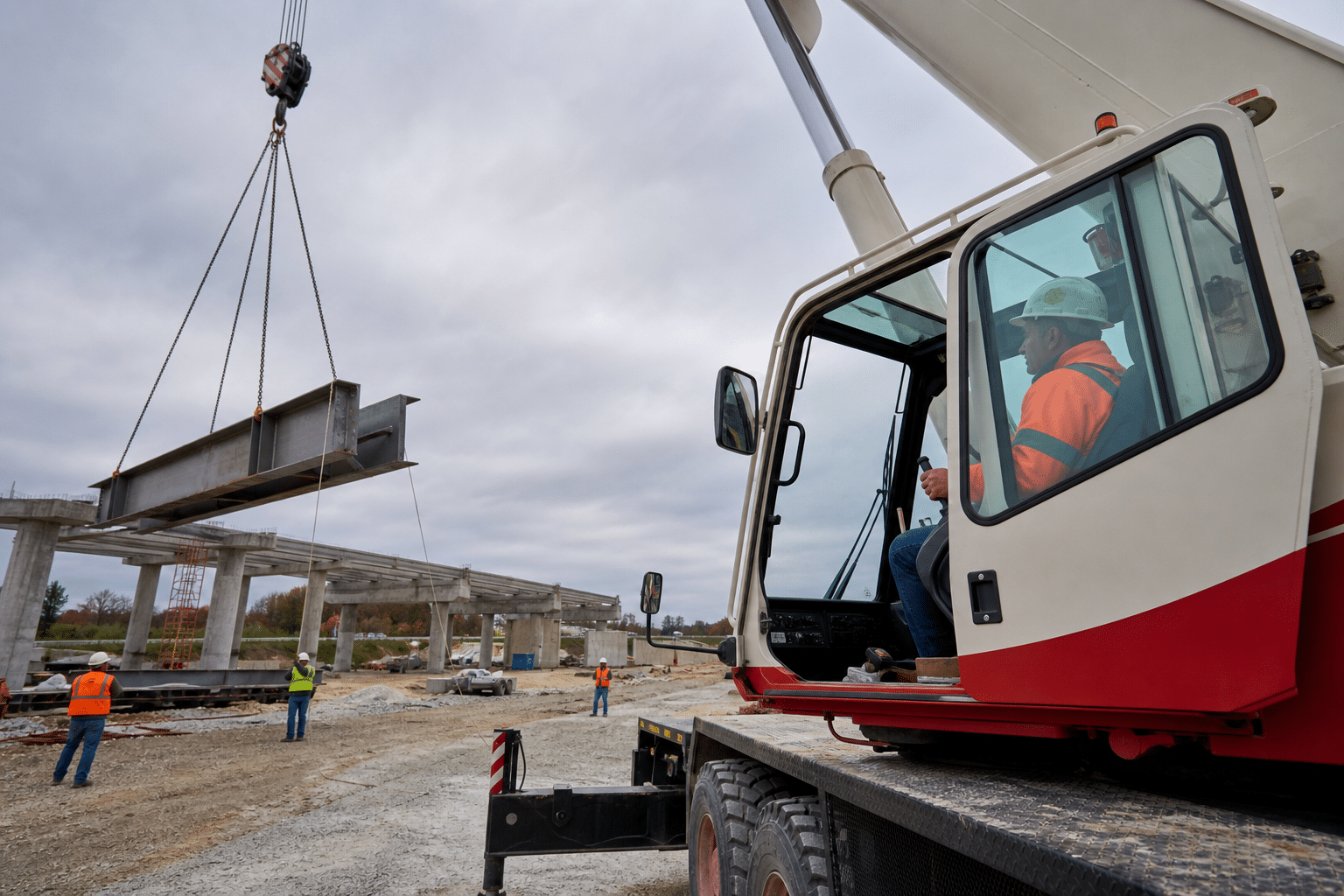
The operator is one part of a lift team. Riggers choose and attach lifting equipment. Signal persons guide the operator when visibility is limited. A lift director, supervisor, or competent person may coordinate the plan. Good operators understand those roles and do not treat certification as permission to improvise.
What kinds of cranes are involved?
Mobile cranes
Mobile cranes can be set up on roads, construction sites, industrial yards, or other locations. The operator must understand ground conditions, setup, travel, swing radius, overhead hazards, and the crane’s configuration. Setup can take substantial time before the first load moves.
Tower cranes
Tower cranes work from a fixed installation and move loads across a large radius. The operator may work from a cab or remote controls, depending on the equipment. Visibility, radio communication, wind, and coordination with crews below are central concerns.
Overhead and industrial cranes
Factories, warehouses, shipyards, and maintenance facilities may use overhead cranes or bridge cranes. The setting may be indoors, but the loads, pinch points, production traffic, and communication demands remain serious. The employer’s rules can differ from construction rules.
Specialty lifting equipment
Some jobs involve crawler cranes, rough-terrain cranes, lattice boom equipment, derricks, or other specialized machines. A person experienced on one type may need additional training or evaluation before operating another.
Crane operator versus related jobs
| Role | Main focus | Typical difference |
|---|---|---|
| Crane operator | Control lifting equipment and move loads safely | Responsible for operation within assigned limits |
| Rigger | Select, inspect, and attach slings, hardware, and other lifting gear | Connects the load to the crane |
| Signal person | Direct the operator with signals or radio communication | Guides movement when the operator needs assistance |
| Heavy equipment operator | Operate excavators, loaders, graders, or similar machines | Handles earthmoving or site equipment rather than suspended loads |
| Millwright | Install, align, maintain, and repair industrial machinery | May coordinate lifts but does not necessarily operate cranes as the main job |
| Boilermaker | Build, install, and repair boilers, pressure vessels, and related systems | Often works around heavy lifts but has a different craft scope |
Our guides to heavy equipment certification, millwright work, boilermaker apprenticeships, and pipefitting cover nearby routes.
Training, certification, and licensing
Crane work has a stricter entry path than many equipment jobs. For construction equipment covered by OSHA’s crane standard, 29 CFR 1926.1427 requires the employer to ensure that the operator is trained, certified or licensed, and evaluated before operating covered equipment, subject to the rule’s exceptions.
OSHA allows several compliance paths, including certification by an accredited crane operator testing organization and an audited employer program. When a state or local government has a qualifying licensing program, its license may apply. A certificate is not a universal license for every crane, capacity, site, or jurisdiction.
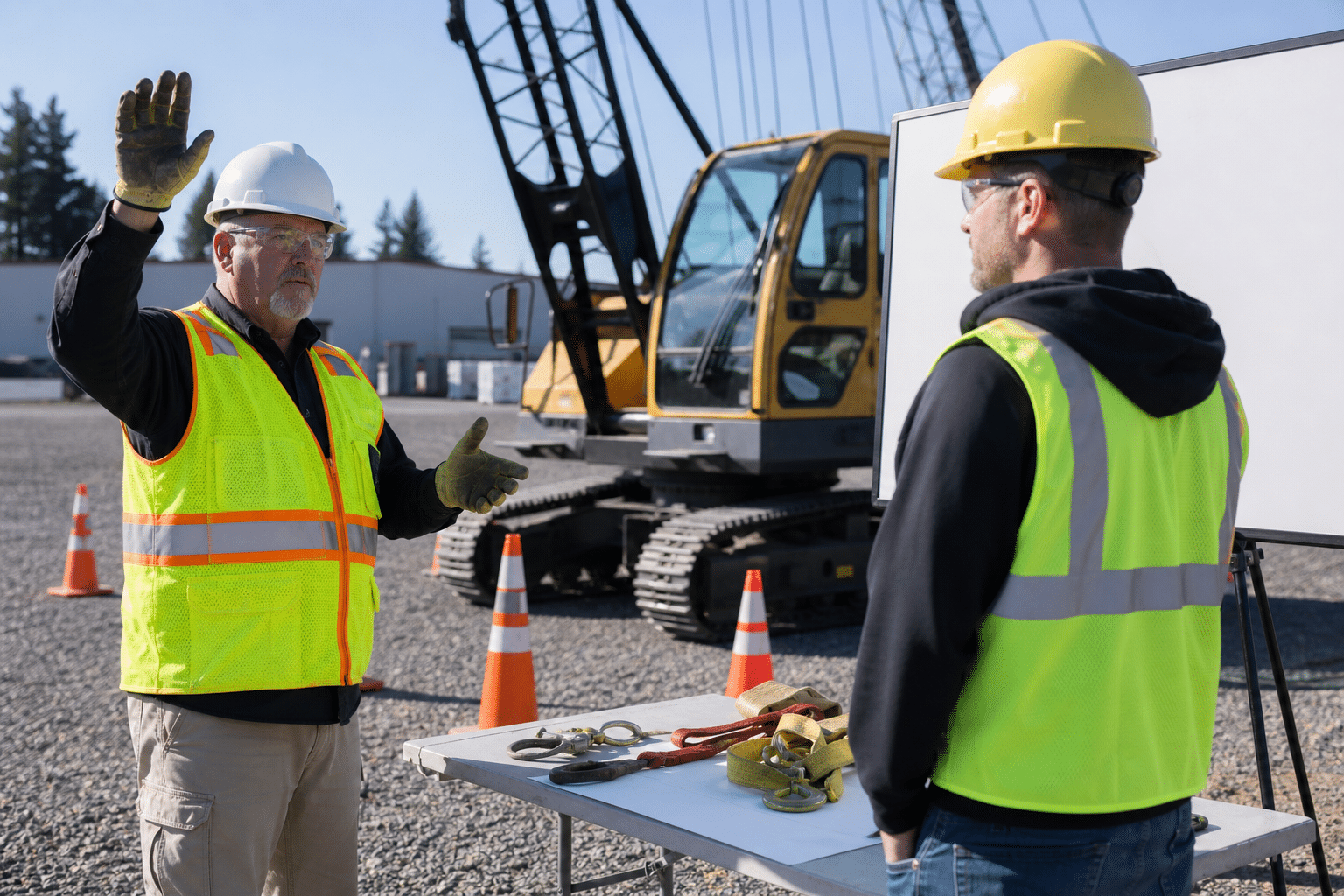
During training, the operator-in-training must work within the rule’s supervision and task limits. OSHA also makes clear that a certificate or degree by itself does not prove that a person is qualified for a particular lift. The employer still evaluates the operator’s knowledge, skills, equipment, and assigned work.
Common entry routes include:
- Starting as a rigger or signal person and learning lift planning on the ground.
- Applying to a construction or operating-engineer apprenticeship.
- Entering an employer’s trainee program with classroom and practical instruction.
- Moving from heavy equipment, hoisting, construction, maritime, millwright, or industrial work.
- Completing training and testing for the crane type and capacity used by a target employer.
Apprenticeship.gov lists crane and tower operators as an occupation. Before paying for a course, confirm which equipment it covers, whether practical time is included, how testing is handled, and whether employers in your area recognize the credential.
Pay and job outlook
The BLS reports crane and tower operators as a detailed occupation inside its material moving machine operators profile. In May 2025, the median annual wage for crane and tower operators was $68,080. The broader group median was $46,670, so using the group number alone would hide the difference between crane work and other material-moving jobs.
| BLS benchmark, May 2025 | Figure | How to read it |
|---|---|---|
| Crane and tower operators median | $68,080 | National median for the detailed occupation |
| Broader material moving machine operators median | $46,670 | Includes several other equipment occupations |
| Crane and tower operator jobs | 42,900 | Estimated employment in 2025 |
| Projected employment in 2035 | 44,500 | BLS projection |
| Projected change, 2025-35 | 4% | Rounded BLS projection |
The crane and tower operator category is projected to add about 1,600 jobs from 2025 to 2035. Local demand can depend on construction, ports, manufacturing, energy, infrastructure, and major projects. Pay may also be shaped by overtime, travel, per diem, union agreements, shift work, equipment type, and whether the job is a regular plant position or project-based work.
Ask whether the advertised wage assumes certification, overtime, travel, or a particular equipment class. An entry-level rigger or trainee offer should not be compared directly with a qualified operator’s rate.
Safety and working conditions
Crane work involves suspended loads, moving equipment, pinch points, power lines, unstable ground, weather, wind, limited visibility, and communication failures. A lift can become unsafe because the site changes, not because the operator forgot a basic rule.
OSHA’s crane standard addresses operator training, certification, evaluation, signal communication, inspections, power-line safety, and other requirements. The employer should provide site-specific procedures and training. Stop-work authority matters. A worker should be able to raise a concern without being pushed to continue a questionable lift.
Ask an employer:
- Which crane types, capacities, and attachments will I operate?
- Is the work construction, industrial, maritime, utility, or another setting?
- Who creates and approves lift plans?
- How are ground conditions, wind, power lines, and blind lifts handled?
- Is certification paid for by the employer?
- What is the path from rigger or trainee to operator?
- How much travel, overtime, night work, or weather exposure is normal?
- How are inspections and defects documented?
Is crane operating a good second career after 40?
It can fit someone who stays calm around complex equipment, respects procedures, communicates clearly, and can maintain attention through a slow lift. Previous experience with heavy equipment, rigging, construction, shipyards, manufacturing, maintenance, or logistics may help.
The work is not passive. Operators may sit for long periods, climb access ladders, work at height, deal with vibration and weather, and maintain intense concentration. Ground personnel may lift, walk, climb, and work around active sites. A medical judgment about your individual fitness belongs with a qualified professional; the practical job question is what the employer requires and what accommodations or alternate roles exist.
Use our career-change roadmap after 40 to compare the cost of certification, trainee pay, travel, schedule, and the time needed to reach a qualified operator role.
Questions to ask before applying
- Does the company hire trainees, riggers, signal persons, or only certified operators?
- Which crane type and capacity will I learn first?
- Is the credential portable, employer-specific, or tied to a state or city?
- How much practical operating time is included in training?
- Who pays for written and practical tests?
- What are the rules for weather, wind, power lines, blind lifts, and ground conditions?
- What are the normal hours and project locations?
- What advancement is possible after certification?
Bottom line
Crane operating is a specialized lifting job built around equipment knowledge, load information, communication, and disciplined stop-work decisions. The route often starts on the ground as a rigger, signal person, helper, or trainee before a worker operates independently.
The BLS reported a $68,080 median for crane and tower operators in May 2025 and projects 4 percent growth from 2025 to 2035. OSHA certification and evaluation rules still depend on the equipment and setting. Before paying for training, speak with local employers and identify the exact crane class, credential, and first paid role you are targeting.
Sources
- BLS: Material Moving Machine Operators
- Apprenticeship.gov: Crane and Tower Operators
- OSHA: Operator Training, Certification, and Evaluation
- NCCCO: Mobile Crane Operator Certification
- NCCER: Crane Operator Certifications
\n
Reviewed September 3, 2026: Crane operator requirements depend on the equipment, worksite, employer, and applicable certification rules. Ask about practical evaluation, signal communication, weather, and site conditions before enrolling. Compare the route with heavy equipment certification.