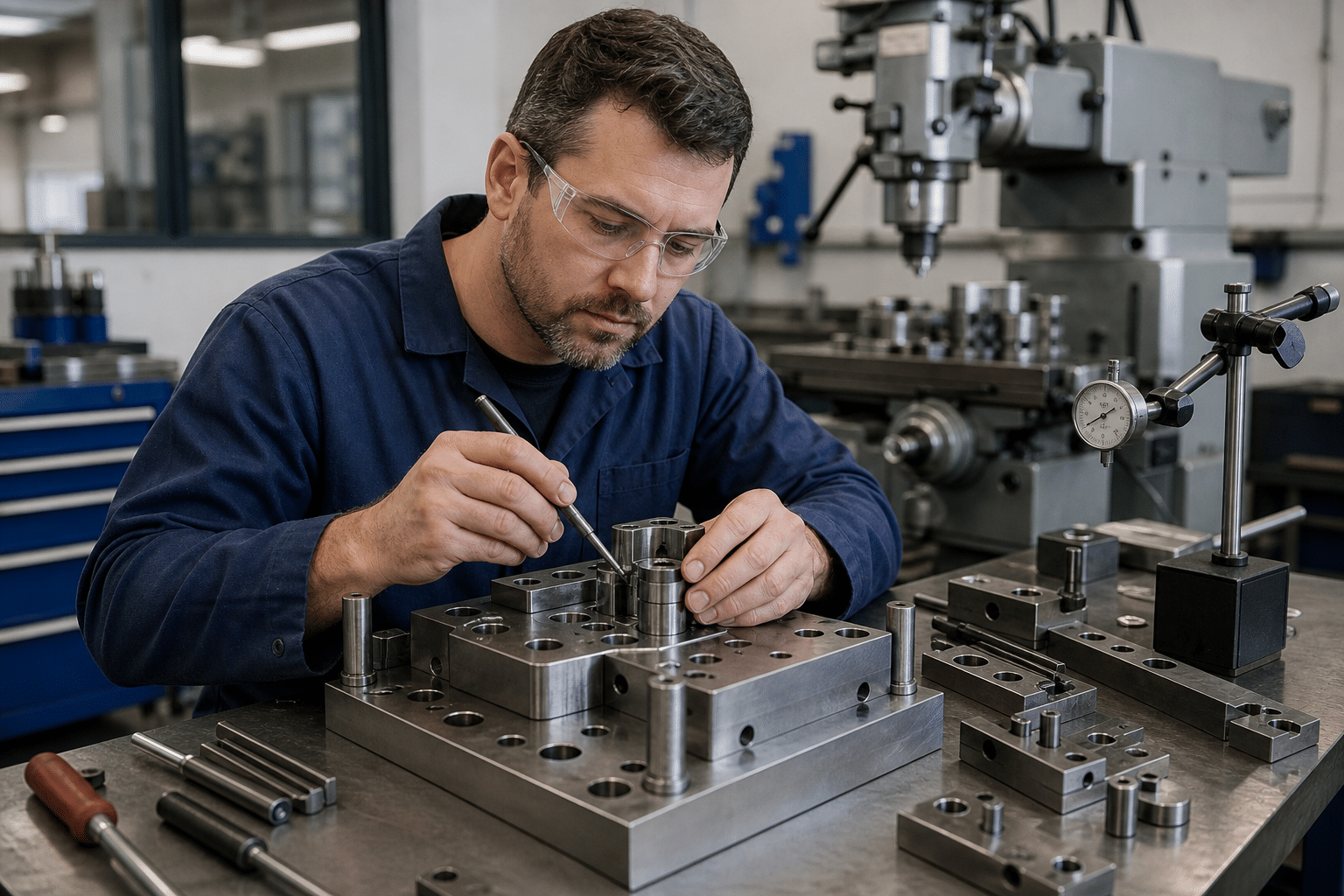
A tool and die maker builds, repairs, and adjusts the tooling used to form, cut, stamp, mold, or hold manufactured parts. The work combines machining, measurement, drawings, materials, fitting, and patience with small differences that can affect an entire production run. It is a precision trade with a learning curve that often rewards strong shop fundamentals.
The title can sound abstract until you see the result. A die may form sheet metal into a car component. A mold may shape plastic. A fixture may hold a part in exactly the right position while it is machined or assembled. The tool and die maker has to make the tool accurate enough for production to repeat the result.
Tooling problems show up in the part: A die may produce a burr, incorrect dimension, or uneven mark because of wear, alignment, clearance, material, or setup. The maker measures the part, checks the tool and process, makes a controlled adjustment, and verifies the result before production resumes.
What does a tool and die maker do?
The U.S. Bureau of Labor Statistics groups tool and die makers with machinists but describes them as workers who make precision tools, molds, and dies. They read drawings and CAD/CAM files, operate manual and CNC machines, fit parts, and test completed tools.
Typical duties include:
- studying drawings, specifications, CAD files, and revision notes;
- planning how a tool, die, mold, jig, or fixture will be made;
- selecting material and deciding how it will be held and machined;
- setting up mills, lathes, grinders, EDM equipment, or CNC machines;
- cutting, drilling, turning, grinding, or wire-cutting components;
- measuring dimensions, alignments, clearances, and surface conditions;
- filing, stoning, fitting, and adjusting components by hand;
- assembling the tool and checking how its parts move together;
- testing the tool under production conditions or with a sample part;
- repairing worn, damaged, or misaligned tooling;
- documenting changes and communicating with production or engineering.
The work can involve a long sequence of small decisions. A component may measure correctly by itself but still fail when assembled with another part. Tool and die makers have to think about the whole system, not just one cut.
What are tools, dies, molds, jigs, and fixtures?
The terms overlap in everyday conversation, but they describe different jobs in manufacturing.
| Term | Plain-English meaning | Example use |
|---|---|---|
| Die | A tool that cuts, bends, draws, or forms material | Stamping a sheet-metal bracket |
| Mold | A cavity that gives material a shape | Forming a plastic housing |
| Jig | A device that guides a cutting or drilling operation | Holding a drill in the correct location |
| Fixture | A device that holds a part in a repeatable position | Holding a component for machining or welding |
| Gauge | A reference or measuring tool used to check a feature | Confirming a hole or contour is within limits |
Some employers specialize in one type of tooling. Others build a range of fixtures, dies, and molds. Ask what the shop makes, which materials it uses, and how much of the work is new construction versus repair.
Tool and die maker versus related jobs
Tool and die makers share skills with machinists, CNC programmers, mold makers, maintenance workers, and quality inspectors. The final responsibility is different.
| Role | Main focus | Typical difference |
|---|---|---|
| Tool and die maker | Build, fit, test, and repair precision tooling | Owns the fit and function of a tool or die |
| CNC machinist | Set up and run CNC jobs to make parts | May produce production parts rather than complete tooling |
| Machinist | Make precision metal parts with manual or computer-controlled machines | Broader title that can include CNC and manual work |
| Mold maker | Build and maintain molds for plastic, rubber, or other formed products | Often specializes in mold construction and repair |
| Quality control inspector | Measure parts and compare them with specifications | Documents whether the product meets the requirement |
| Industrial maintenance technician | Keep production equipment operating | Repairs the machine that uses the tool, not necessarily the tool itself |
Our guides to CNC machining, machinist apprenticeships, and quality control inspection can help you compare the daily work.
Skills that matter
Precision measurement
Tooling may require very small tolerances. You need to understand what the drawing requires and use the right instrument to check it. A measurement is only useful when the method, instrument, and reference are appropriate.
Drawing and CAD/CAM literacy
Many shops use engineering drawings and digital files. You may need to understand dimensions, tolerances, sections, surface requirements, and revision control before a machine ever starts.
Machine and hand skills
The work may involve CNC mills and lathes, grinders, EDM, files, stones, hand tools, and assembly equipment. A tool and die maker may move between a machine and a bench several times in one job.
Three-dimensional problem-solving
Tooling has to fit into a production process. You must think about clearance, sequence, alignment, wear, access for repair, and how the tool behaves under pressure or repeated cycles.
Patience
The last adjustment can take longer than the first rough cut. People who enjoy careful iteration often do better than people who want every task to be finished quickly.
How do you become a tool and die maker?
The BLS says tool and die makers may need postsecondary courses and typically gain competency through on-the-job training or an apprenticeship. Technical schools and community colleges can teach machining, blueprint reading, CAD/CAM, inspection, and CNC basics. Employers then build site-specific skill.
Common routes include:
- Starting as a machine operator or apprentice in a tooling department.
- Completing a machining or manufacturing certificate before applying.
- Earning a two-year degree with machining, design, measurement, and CNC coursework.
- Moving from CNC machining, quality inspection, fabrication, maintenance, welding, or mold work.
- Joining an employer-sponsored apprenticeship with paid work and related instruction.
Apprenticeship.gov lists tool and die makers as an occupation. Program details vary by sponsor, so check the wage schedule, training hours, machine access, classroom content, and expected time to qualification. A short course can introduce the trade, but it is not the same as becoming able to build and repair production tooling independently.
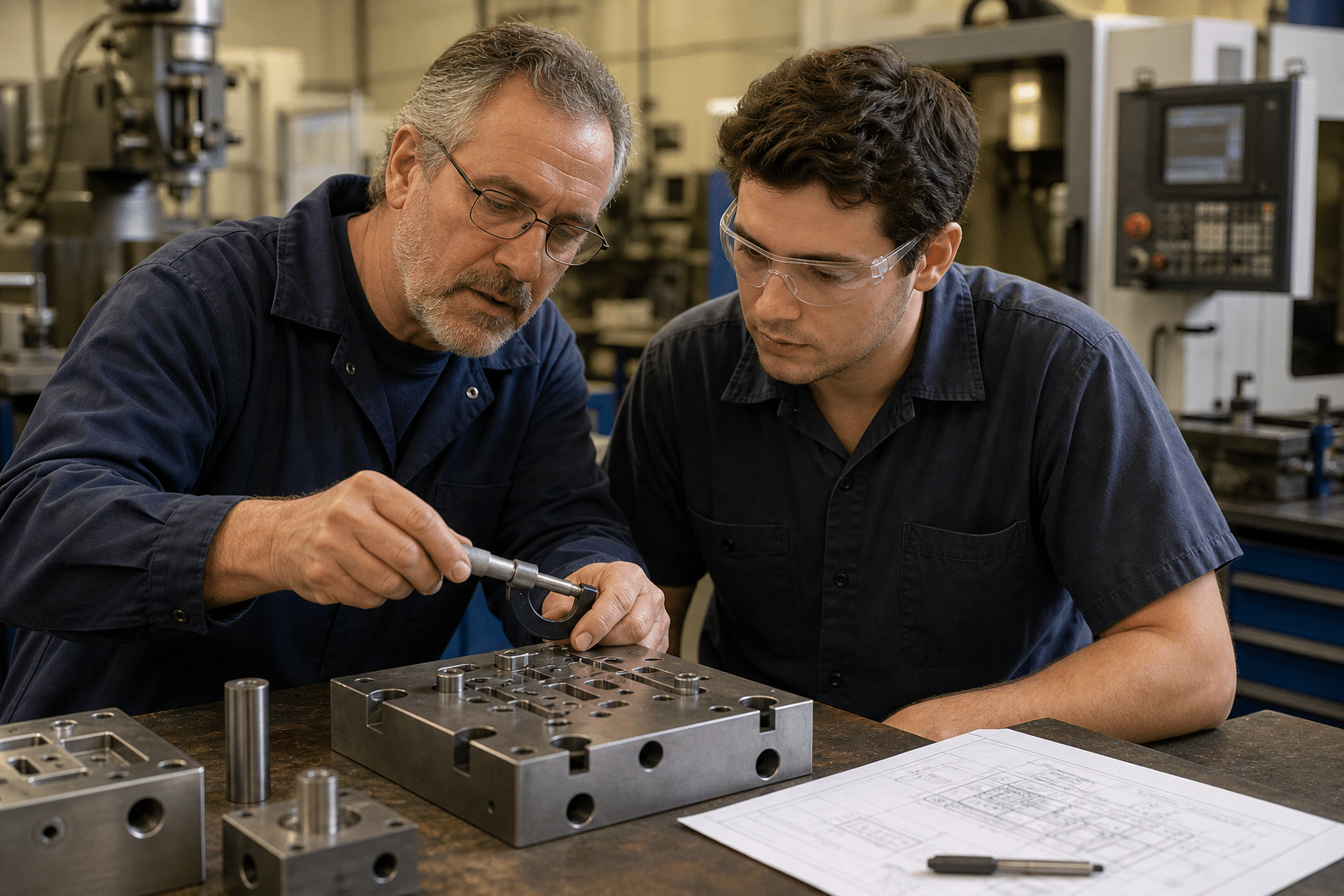
Before enrolling, ask to see the shop. Look for mills, lathes, grinders, EDM, inspection tools, and real projects. Also ask how graduates get their first paid role. The strongest program is not necessarily the one with the most impressive title; it is the one that connects training to a local employer and actual equipment.
Pay and job outlook
The BLS reports a median annual wage of $64,050 for tool and die makers in May 2025. That figure is not the same as apprentice pay or the wage for every machinist who operates a CNC machine.
| BLS benchmark, May 2025 | Figure | How to read it |
|---|---|---|
| Tool and die makers median | $64,050 | National median for the specific occupation |
| Lowest 10 percent | Below $44,680 | A lower-end national reference |
| Highest 10 percent | Above $92,680 | An upper-end national reference |
| Machinists median | $58,750 | A related but different occupation |
| Tool and die makers in transportation equipment | $78,200 | Median for one major industry |
| Tool and die makers in fabricated metal products | $63,160 | Median for one major industry |
The BLS projects tool and die maker employment to decline 9 percent from 2025 to 2035 as automation and CNC technology change some tasks. That does not mean there will be no openings. The combined machinists and tool and die makers profile projects about 30,400 openings per year on average, largely because workers retire or move to other occupations. Tooling shops may also need people who can set up, inspect, repair, and adapt equipment rather than only perform a repetitive cut.
Apprentice pay typically increases as skills and responsibility increase. Ask whether the advertised wage is an apprentice rate, a qualified rate, or a total that assumes overtime.
Safety and working conditions
Tool and die shops may involve machine tools, grinding, flying chips, sharp stock, coolants, lifting, noise, and repetitive standing or hand work. The exact hazards depend on the equipment and material.
OSHA’s machine-guarding standard addresses points of operation, rotating parts, flying chips, and sparks. Lockout/tagout can apply when a machine or production system is serviced and unexpected movement or stored energy is possible. Follow the shop’s procedure and authorized roles rather than assuming experience makes a step unnecessary.
Ask about:
- the size and weight of tooling you will move;
- how chips, coolant, and grinding dust are managed;
- which machines trainees may operate;
- whether the shop runs nights or weekends;
- how a tool is tested before production uses it;
- who approves a dimensional or design change;
- what protective equipment and safety training are provided.
Is tool and die work a good second career after 40?
It can suit someone who likes precision, machines, practical problem-solving, and work that produces a physical result. Experience in CNC machining, maintenance, inspection, fabrication, welding, automotive repair, or technical drawing may shorten the learning curve.
The trade asks for patience and a willingness to spend time learning before reaching the most interesting jobs. You may begin with machine operation, deburring, inspection, or simple fitting. That foundation matters because a tool has to be made accurately, assembled correctly, and understood well enough to repair later.
Shop culture and schedule also matter. Some tooling departments work regular hours. Others support plants that run continuously. Visit the workplace if possible. A clean, organized shop with good training is a different experience from a rushed operation where the newest person is left to guess.
Use our career-change roadmap after 40 to compare the apprenticeship wage, training cost, commute, schedule, and time needed to reach qualified toolmaker work.
Questions to ask before applying
- What tooling does the shop make: dies, molds, jigs, fixtures, or gauges?
- Will I learn manual machines, CNC, grinding, EDM, inspection, and fitting?
- Is the role an apprenticeship, operator job, or qualified tool and die position?
- What education or experience is required before the first day?
- Which drawings, CAD/CAM systems, and measuring tools are used?
- How much work is new tooling compared with repair and maintenance?
- What are the normal hours, overtime expectations, and physical requirements?
- What does advancement look like after apprenticeship: toolmaker, lead, programmer, designer, or supervisor?
Bottom line
Tool and die makers build the precision equipment behind many manufactured products. Their work combines machining with fitting, measurement, assembly, testing, and repair. It is a deeper craft than simply running a repeat production cycle, and it takes time to learn.
The BLS median was $64,050 in May 2025, but apprentice pay and local offers can be much different. Employment projections are mixed, yet replacement openings remain part of the picture. If you like exact work and want to understand how a production tool works from the inside out, investigate local shops and apprenticeship sponsors before paying for training.
Related guides: Tower Technician: Duties, Training, Pay and Career Fit and Fire Alarm Technician: Duties, Training, Pay and Career Fit.
Sources
- BLS: Machinists and Tool and Die Makers
- Apprenticeship.gov: Tool and Die Makers
- OSHA: General Requirements for All Machines
- OSHA: Control of Hazardous Energy
\n
Reviewed September 3, 2026: Tool and die work requires precision, measurement, materials knowledge, and patience with setup and correction. Check the apprenticeship, machines, CAD/CAM tools, and inspection methods used in local shops. Compare it with CNC machining.