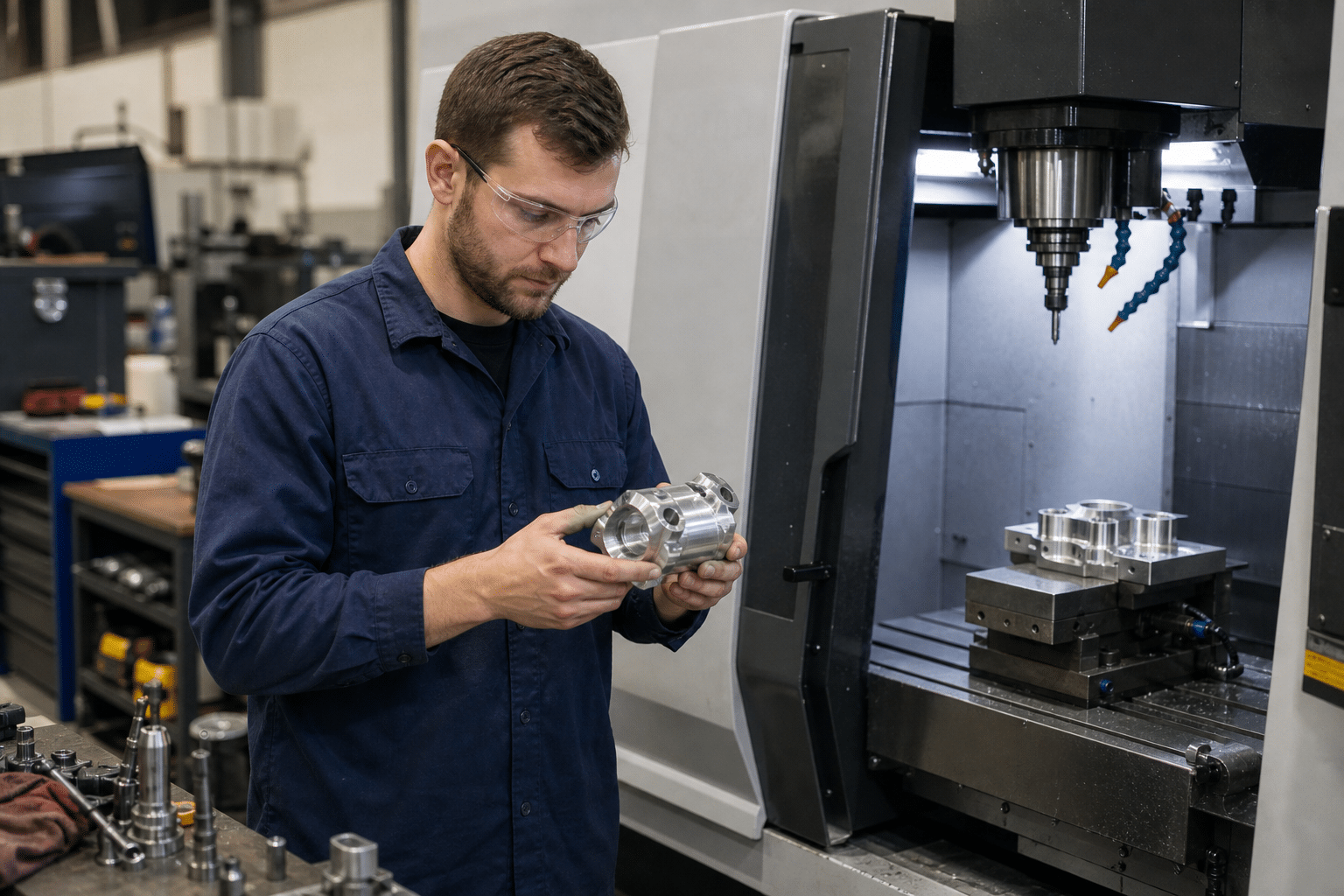
A CNC machinist sets up and runs computer-controlled machine tools to make parts that match a drawing and its tolerances. The work may include tooling, workholding, offsets, first-piece inspection, measurement, finishing, and troubleshooting. It is more involved than loading a program: the machinist has to understand how the material, tool, machine, and process affect the finished part.
The title covers more than one level of responsibility. A new hire may load parts and monitor a cycle. A setup machinist may select tools, set work offsets, and prove out a job. An experienced machinist may edit programs, work to very tight tolerances, inspect the finished part, and help solve a recurring production problem. Read the posting closely before comparing one CNC machinist job with another.
The first part earns attention: The machinist checks critical dimensions, surface condition, tool wear, burrs, and the relationship between the setup and the drawing. If a dimension moves, the response may be a documented offset, a tool change, or a setup review rather than quietly passing a questionable part forward.
What does a CNC machinist do?
CNC machinists set up and operate machines that cut, drill, turn, mill, or shape material. The U.S. Bureau of Labor Statistics describes machinists as workers who use blueprints, CAD or CAM files, machine tools, and measuring equipment to produce precision parts. CNC is one part of that occupation, not a separate BLS salary category.
Typical work includes:
- reading a blueprint, work order, or CAD/CAM file;
- choosing cutting tools, inserts, workholding, and measuring equipment;
- loading raw material and securing it correctly in the machine;
- setting tool length, work coordinates, offsets, feeds, and speeds;
- running a first piece or prove-out cycle under the shop’s procedure;
- checking dimensions with calipers, micrometers, gauges, or other inspection tools;
- making an approved offset correction when a measurement drifts;
- watching for tool wear, chips, coolant problems, vibration, or an unusual finish;
- recording inspection results and production information;
- cleaning the work area and reporting machine or quality problems.
The job is not simply pressing Cycle Start. A good machinist understands what the program is trying to do and notices when the part, sound, measurement, or machine behavior does not match the plan.
CNC operator, setup machinist, or programmer?
Employers use these titles differently, but the usual differences look like this:
| Role | Main responsibility | What may be outside the role |
|---|---|---|
| CNC machine operator | Load parts, start cycles, monitor the machine, and perform basic checks | Full job setup, program creation, complex troubleshooting |
| CNC setup machinist | Prepare tools, workholding, offsets, programs, and first-piece checks | Engineering process design or broad production scheduling |
| CNC machinist | Set up and run jobs, measure parts, correct routine problems, and meet specifications | Advanced program development may belong to a programmer |
| CNC programmer | Create or edit code and toolpaths, often with CAD/CAM software | Running every machine or managing the entire shop |
| Tool and die maker | Build precision tools, molds, and dies, often with deeper fitting and programming work | Routine high-volume production only |
One person may do several of these jobs in a small shop. In a larger plant, each role can be separated. Ask whether the employer wants a production operator, a setup person, or someone who can program from a drawing. That distinction changes the training plan and the likely pay.
Where do CNC machinists work?
Machine shops and factories hire CNC machinists to make parts for transportation equipment, machinery, medical devices, energy systems, defense, and general manufacturing. The finished product may be a small bracket, a custom replacement part, a mold component, or a batch of identical production parts.
The work setting matters. A prototype shop may involve one-off jobs, frequent drawing changes, and more manual measurement. A production shop may repeat the same part for weeks but expect fast, consistent inspection and tool changes. An aerospace or medical supplier may have stricter traceability and documentation. A job in a smaller shop may offer more variety while asking one person to do setup, operation, inspection, and cleanup.
Skills that matter on the shop floor
Blueprint and measurement skills
You need to read dimensions, tolerances, symbols, notes, and revision information. Measurement is not an occasional final check. It guides setup, confirms the first piece, and helps identify tool wear before a full batch is rejected.
Mechanical judgment
The machine does not remove the need to understand material, cutting tools, workholding, and the way a part is supported. Vibration, poor chip control, a damaged insert, or a weak setup can affect the result.
Computer comfort
CNC controls, CAD/CAM software, digital work instructions, inspection software, and production systems are common. You do not need to arrive as a programmer for an entry-level role, but you should be willing to learn the interface and understand the logic behind a program.
Patience and repeatability
Precision work can feel slow when you are new. The same measurement has to mean the same thing each time, and a small shortcut can create a large scrap problem. People who like visible, exact results often enjoy this part of the job.
Communication
Machinists work with engineers, quality inspectors, maintenance workers, supervisors, and other operators. A clear note about a tool change, drawing issue, or recurring defect can save the next shift a great deal of time.
How do you become a CNC machinist?
There is no single required route. The BLS says machinists typically need a high school diploma or equivalent and are commonly trained on the job. Technical schools, community colleges, employer programs, and apprenticeships can all be useful.
Common routes include:
- Starting as a machine operator and taking on setup tasks as you qualify.
- Completing a certificate or two-year program in machining, manufacturing technology, or CNC operation.
- Entering an employer-sponsored apprenticeship with paid on-the-job training and related instruction.
- Moving into machining from fabrication, maintenance, welding, drafting, inspection, or military technical work.
- Building specific credentials in CNC mill or lathe operation, setup, or programming.
The National Institute for Metalworking Skills lists credentials such as CNC Mill Operations, CNC Lathe II, and CNC Mill Programming, Setup, and Operations. A credential can document a skill, but it does not replace shop experience or guarantee that an employer uses the same machine control, software, or tolerance system.
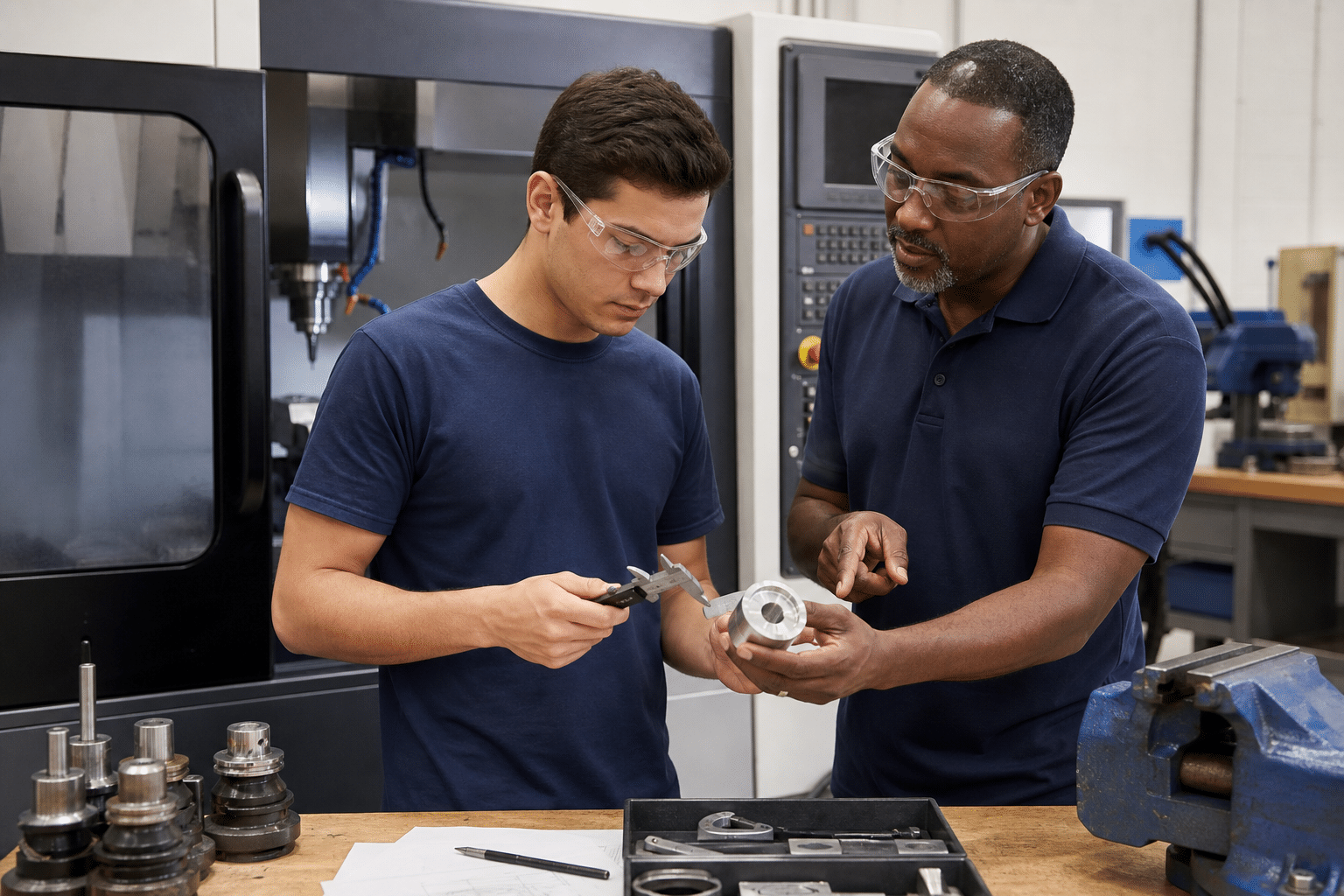
Before paying for school, compare the curriculum with local job postings. Look for blueprint reading, machining math, GD&T basics, CNC controls, tooling, inspection, CAD/CAM, shop safety, and real lab time. Ask how much time students spend at a machine rather than watching demonstrations.
Our guide to machinist apprenticeships covers the paid-training question in more detail. You can also compare the broader decision with our guide to trade school programs.
Because measurement is part of CNC work, it also helps to understand the neighboring role of a quality control inspector. The two jobs often work together, even when the shop keeps setup and final inspection separate.
Pay: what number should you use?
There is no official national BLS occupation called CNC machinist. The closest direct benchmark is the BLS machinists category within its profile for machinists and tool and die makers.
| BLS benchmark, May 2025 | Median annual wage | How to use it |
|---|---|---|
| Machinists | $58,750 | A reasonable national benchmark for machinist work, including CNC work |
| Tool and die makers | $64,050 | A separate benchmark for more specialized tool, mold, and die work |
| Machinists and tool and die makers combined | $59,620 | A broad combined category, not a CNC-specific offer |
| CNC tool programmers | $68,120 | A related subgroup with greater programming responsibility |
| CNC tool operators | $50,690 | A related subgroup that may be closer to production operation |
These figures are context, not a promise that every CNC machinist job pays the machinist median. Pay changes with setup responsibility, programming, industry, location, union coverage, shift premium, overtime, inspection skill, and the tolerance or material involved. The BLS reports that machinists had a $58,750 median wage in May 2025, with the lowest 10 percent below $39,200 and the highest 10 percent above $80,010.
The outlook also needs a careful reading. BLS projects the combined machinists and tool and die makers occupation to decline 1 percent from 2025 to 2035, while projecting about 30,400 openings per year on average, mostly from replacement needs. For machinists specifically, BLS projects a small increase. Automation changes the work, but it does not make setup, measurement, troubleshooting, and process knowledge irrelevant.
Safety and working conditions
CNC machining is indoor industrial work, but it is not risk-free. You may stand for much of a shift, repeat hand movements, lift stock or fixtures, work around noise and flying chips, handle coolant, and move between machines. Some shops run nights or weekends.
OSHA’s machine-guarding standard requires protection from hazards such as points of operation, rotating parts, flying chips, and sparks. The employer’s procedures control how a particular machine is operated, cleaned, cleared, and maintained. Safety glasses, hearing protection, appropriate clothing, and training are part of the job rather than optional extras.
Ask about:
- the size and weight of the parts you will move;
- whether machines run coolant and how the shop manages it;
- how chips are removed and machines are cleaned;
- the normal shift, overtime, and weekend schedule;
- whether a new employee is assigned one machine or several;
- who is allowed to alter a program or offset;
- how quality holds and machine faults are handled.
Is CNC machining a good second career after 40?
It can fit someone who likes tools, measurement, computers, and work that rewards accuracy. Experience in maintenance, welding, fabrication, quality control, drafting, automotive repair, or industrial production can help you understand the environment faster.
The trade-off is that early progress may be gradual. You might start with loading parts, deburring, housekeeping, or basic inspection before earning setup responsibility. That is not a dead end. It is often how a shop learns whether you can follow the drawing, protect the equipment, and produce consistent work.
The schedule and physical setting deserve an honest look. Standing, repetitive hand work, noise, coolant, and lifting can be tiring. A clean inspection room, prototype shop, or programming role may feel different from a high-volume production cell. Visit the shop or ask to shadow someone if the employer allows it.
Use our career-change roadmap after 40 to compare the starting wage, training costs, commute, schedule, and time needed to reach setup or programming work.
Questions to ask before enrolling or applying
- Will I train on CNC mills, lathes, or both?
- Does the role involve loading, setup, programming, inspection, or all four?
- Which control, CAD/CAM system, and measuring equipment does the shop use?
- How are new hires trained and signed off on machine tasks?
- Is the first job paid training, a production operator role, or a machinist position?
- What sizes and weights of material must employees move?
- Are nights, weekends, overtime, or rotating shifts normal?
- Which credentials help with hiring here, and which are not required?
Bottom line
CNC machinists make precision parts, but the day-to-day job depends heavily on the employer. One posting may describe a machine operator who monitors a repeat cycle. Another may expect a setup machinist who reads drawings, adjusts offsets, inspects parts, and solves problems at the machine.
Training can begin with a paid operator role, a technical program, an apprenticeship, or related industrial experience. The BLS machinist benchmark was $58,750 in May 2025, but CNC-specific pay depends on responsibility and shop context. If you enjoy careful work, tangible results, and the logic of turning a drawing into a part, CNC machining may be worth exploring.
Sources
- BLS: Machinists and Tool and Die Makers
- BLS: Metal and Plastic Machine Workers
- NIMS: Machining Credentials
- NIMS: CNC Mill Operations Credential Overview
- OSHA: General Requirements for All Machines
\n
Reviewed September 3, 2026: CNC machinist training should match the machines, controls, materials, and tolerances used by local employers. Ask about setup, inspection, programming, and hands-on practice rather than choosing by course length alone. Compare CNC programming with shop-floor machining.
\n