A fire alarm technician installs, tests, services, and troubleshoots systems that detect fire and notify occupants or responders. The work may involve panels, initiating devices, notification appliances, batteries, wiring, monitoring, and documentation. It combines low-voltage technical work with code-aware testing, customer communication, and the responsibility to report a system that is not functioning as required.
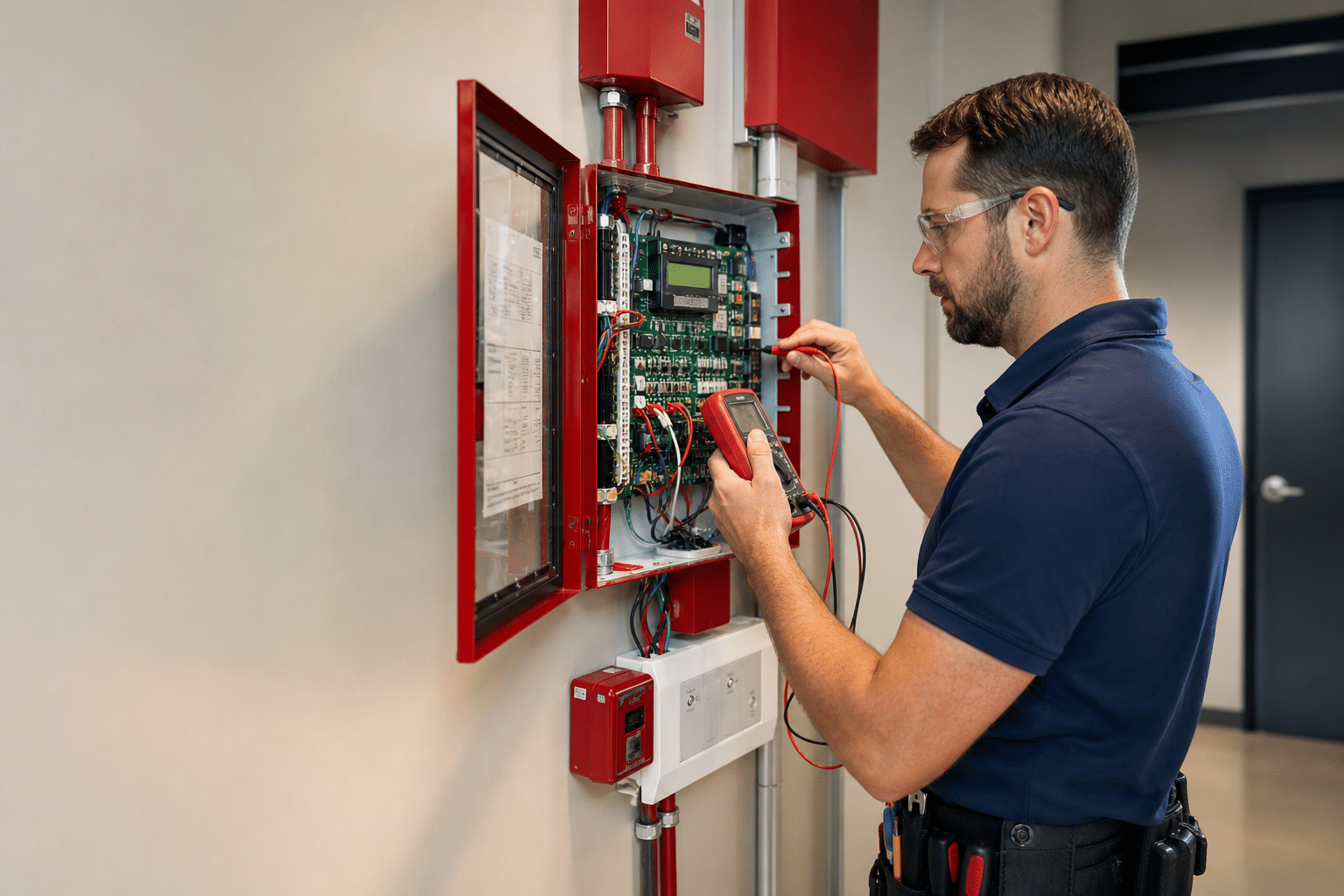
A fire alarm technician installs, tests, services, and troubleshoots systems that detect fire and notify occupants or responders. The work may involve panels, initiating devices, notification appliances, batteries, wiring, monitoring, and documentation. It combines low-voltage technical work with code-aware testing, customer communication, and the responsibility to report a system that is not functioning as required.
A fire alarm technician installs, tests, troubleshoots, and services the systems that warn people when a building detects smoke, heat, flame, or another fire condition. The work sits in the low-voltage and life-safety world. It includes wiring and devices, but also programming, documentation, code requirements, customer communication, and careful testing.
It is easy to confuse this job with electrical work or security installation. There is overlap, but the day-to-day work is different. A technician may spend a morning replacing a failed notification appliance, an afternoon tracing a ground fault, and the next day testing every device in a school or office building.
If you are considering a career change, the appeal is clear: technical work, a mix of field and diagnostic tasks, and several ways to build experience. The catch is that licensing and certification rules vary by state and by the kind of system being serviced.
A panel trouble signal needs investigation: The technician may check batteries, circuits, devices, power, programming, wiring, and recent changes to the building before clearing the condition. The service record should explain what was tested and whether the system was restored, left impaired, or referred for further correction.
Fire alarm technician at a glance
| Question | Short answer |
|---|---|
| Main work | Install, program, inspect, test, maintain, and repair fire alarm systems |
| Typical settings | Commercial buildings, schools, hospitals, industrial sites, apartments, and construction projects |
| Main skills | Wiring, electronics, troubleshooting, reading plans, documentation, and customer communication |
| Common entry route | Employer training, a low-voltage or electrical program, an apprenticeship, or related field experience |
| Certification | Depends on the state, employer, system, and job function; NICET is one recognized path |
| National pay reference | BLS reported a $57,400 mean annual wage for Security and Fire Alarm Systems Installers in May 2023 |
The title covers a wide range of jobs. An installer on a new construction crew may pull cable and mount devices. A service technician may spend more time reading panel history, testing circuits, and explaining an issue to a building manager. A technician who programs systems needs a deeper understanding of software, device addressing, and manufacturer-specific panels.
What does a fire alarm technician do?
The work usually falls into five connected areas:
- Install cable, conduit, boxes, detectors, pull stations, notification appliances, modules, panels, and batteries.
- Program or configure a fire alarm control panel and its connected devices.
- Test devices, circuits, batteries, signals, and notification equipment.
- Diagnose faults such as open circuits, shorts, ground faults, failed batteries, communication problems, and incorrect device addresses.
- Record test results, repairs, deficiencies, and system changes for the customer and the authority having jurisdiction.
On a service call, the first problem reported is not always the real problem. A panel may show a trouble signal because of a weak battery, a damaged cable, a device removed during a renovation, or a communication failure. The technician has to work through the evidence rather than simply reset the panel and leave.
Some jobs also include access control, security cameras, intrusion alarms, emergency communications, or mass notification systems. That can make the work more varied, but it also means the job description should be read carefully. A security technician and a fire alarm technician may share low-voltage skills without having the same certification or legal authority.
Installation, inspection, testing, and service are different
Employers sometimes use one title for several specialties. Ask which kind of work a job actually includes.
| Work type | What the technician may spend most of the day doing |
|---|---|
| Installation | Running cable, mounting devices, terminating conductors, labeling, and preparing a new system |
| Programming | Setting device addresses, zones, sequences, notification rules, and panel settings |
| Inspection and testing | Activating devices, checking signals, recording results, and identifying deficiencies |
| Service and repair | Tracing faults, replacing parts, correcting wiring, restoring communication, and retesting |
| Monitoring or communications | Checking signals between the protected premises, communicator, and monitoring station |
The split matters when you compare wages or training. A helper on an installation crew may enter with limited experience. A service technician who can diagnose a complex panel issue usually needs more time in the field.
Is a fire alarm technician an electrician?
Usually, no. The jobs can overlap, and some people move between them, but they are separate occupations.
The Bureau of Labor Statistics describes Security and Fire Alarm Systems Installers as workers who install, program, maintain, and repair security and fire alarm wiring and equipment in accordance with relevant codes. Its description also separates the occupation from electricians, who handle a broader range of electrical wiring.
An electrician may install power distribution, lighting, motors, controls, and other electrical systems. A fire alarm technician focuses on detection, notification, signaling, and related life-safety equipment. A technician still needs electrical knowledge, but a fire alarm credential does not automatically give someone an electrician license.
The reverse is also true. An electrician may have useful wiring experience without being authorized to inspect, certify, or program every fire alarm system in a particular state. Always check the local rule and the employer’s license requirements.
Fire alarm technician vs. fire sprinkler installer
The two trades work on the same life-safety goal, but they work on different systems.
A fire alarm technician works with detection and signaling: smoke detectors, heat detectors, pull stations, control panels, notification devices, and communication paths. A fire sprinkler installer works with water-based suppression systems: pipe, fittings, valves, sprinkler heads, hangers, and testing of the piping network.
On a large project, the systems may share plans, inspections, and coordination meetings. The tools, training, and daily physical work are still different. Someone who prefers electronics and fault-finding may prefer fire alarm work. Someone who prefers pipefitting, layout, and larger mechanical assemblies may prefer sprinkler installation.
Where do fire alarm technicians work?
Work settings can change from one call to the next. Common sites include:
- Office buildings and retail spaces
- Schools, universities, and hospitals
- Apartment buildings and hotels
- Warehouses and manufacturing plants
- Construction and renovation sites
- Fire alarm service companies and security integrators
The job is often indoors, but it is not always clean or comfortable. Technicians may use ladders, work above ceilings, crawl into tight spaces, kneel for long periods, and carry test equipment. Construction work can mean dust, heat, noise, unfinished floors, and changing access to the system.
Service work can also involve customer deadlines and after-hours calls. A system trouble signal in a hospital or occupied building may need attention outside a normal shift. Ask about on-call rotation, travel, lift access, and whether the position is mostly new installation or service before accepting an offer.
How to become a fire alarm technician
There is no single national route. A realistic entry plan often looks like this:
Start with electrical and low-voltage basics
Learn basic electricity, circuits, hand tools, cable types, test equipment, and safe work practices. A technical program can help, but it is not the only route. Some employers hire helpers and teach the system work on the job.
Apply for helper or trainee roles
Search for titles such as fire alarm helper, low-voltage trainee, fire alarm installer, service trainee, or security systems technician. Read the duties closely. A role that includes troubleshooting and inspections may offer a better learning path than a job limited to pulling cable.
Build field experience
Keep notes on the systems you work on, the devices you test, the manufacturers you encounter, and the problems you learn to diagnose. Documentation matters in this trade. Employers want people who can leave a clear test report, not only someone who can make a connection.
Check state and local requirements
Some jurisdictions license individuals, some regulate the company, and some do both. The rules may change depending on whether the work is residential, commercial, installation, inspection, or design. Texas, for example, has separate fire alarm licenses and company registration requirements. Its residential technician license covers a narrower scope than the license used for a company Alarm Certificate of Registration.
Consider an apprenticeship or structured program
Use the Apprenticeship.gov job finder to look for registered opportunities and related employers. Not every fire alarm job is a registered apprenticeship, so also check local contractors, electrical associations, fire protection companies, and union programs.
What certifications can help?
Certification is not the same thing as a state license. It may show training or experience, but it does not replace a license when a state requires one.
NICET offers a Fire Alarm Systems certification program with levels that cover work such as design, installation, maintenance, and inspection. The program uses exams and industry experience, and credentials must be maintained through recertification. The exact level that makes sense depends on your role and experience.
Other credentials may relate to inspection and testing, fire protection, manufacturer systems, or a state fire marshal’s office. Before paying for a course, identify the job you want and read the requirements from the licensing authority or employer. A certificate with an attractive title may have little value for the work available in your area.
What tools and skills do you need?
The trade rewards people who can move between physical work and careful diagnosis. Useful skills include:
- Reading wiring diagrams, floor plans, riser diagrams, and device schedules
- Using a multimeter and other test equipment correctly
- Identifying components and following manufacturer instructions
- Tracking wires, addresses, zones, and panel history
- Writing clear service and inspection reports
- Explaining a fault to a customer without hiding uncertainty
- Working carefully around occupied buildings and other contractors
Computer comfort helps. Modern panels and communicators have programming menus, software tools, event logs, and networked components. You do not need to be a software developer, but you do need patience with configuration and documentation.
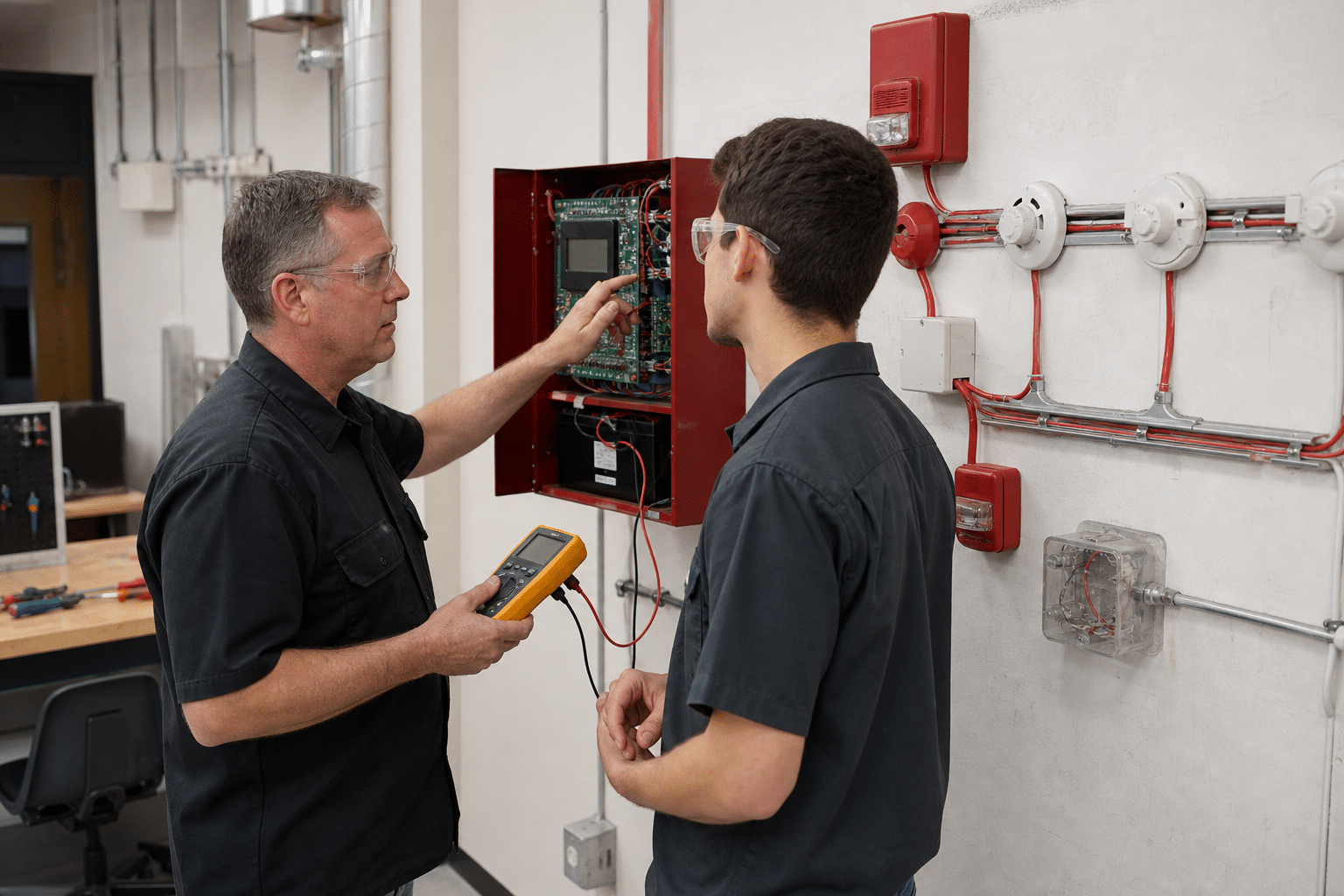
A fire alarm technician installs, tests, services, and troubleshoots systems that detect fire and notify occupants or responders. The work may involve panels, initiating devices, notification appliances, batteries, wiring, monitoring, and documentation. It combines low-voltage technical work with code-aware testing, customer communication, and the responsibility to report a system that is not functioning as required.
Fire alarm technician salary and job outlook
Fire alarm technician pay is difficult to reduce to one national number because the title is not always reported separately. The BLS 2023 Occupational Employment and Wage Statistics profile for Security and Fire Alarm Systems Installers reported 83,540 jobs and a mean annual wage of $57,400. It also reported a mean hourly wage of $27.59.
That is a useful benchmark, not a guaranteed salary for every technician. Pay can move with location, service responsibility, overtime, travel, licensing, programming ability, union coverage, and whether the job includes security systems. BLS state data for May 2023 showed annual mean wages ranging from $50,050 in North Carolina to $75,180 in Minnesota among the states listed on the profile.
The broader installation, maintenance, and repair group includes security and fire alarm systems installers. BLS reports training and work-experience patterns for that larger group, but its group figures should not be treated as a fire alarm-specific growth forecast. For a local decision, compare current job postings, state requirements, and wages in the metro areas where you could realistically work.
Is the work physically demanding?
It is usually less physically heavy than pipefitting or structural construction, but it is still hands-on. Expect some combination of ladder work, overhead work, kneeling, lifting boxes or batteries, pulling cable, moving test equipment, and working in awkward spaces.
The mental side can be just as tiring. A fault that appears intermittently may require methodical testing across several devices or circuits. The technician may also have to explain why a system cannot simply be silenced and forgotten.
Is it a good career change after 40?
It can be a good fit if you like practical troubleshooting and can tolerate learning a specialized system over time. Previous experience in electrical work, networking, construction, HVAC controls, security, telecommunications, or industrial maintenance can transfer well.
Age itself is not the main question. The better questions are whether you can work from ladders and above ceilings, whether you are comfortable starting below your eventual target wage, and whether you want service calls and customer interaction. If the answer is yes, a helper or trainee role can be a sensible test before committing to a long program.
People coming from fiber optic technician work may already understand cable handling, labeling, testing, and documentation. Someone with an instrumentation technician background may have an easier time with sensors, signals, and troubleshooting. A short online trade school course can fill gaps, but it should support hands-on experience rather than replace it.
Questions to ask before taking a job
Ask these questions during an interview:
- Is the position installation, service, inspection, programming, or a mixture?
- Which manufacturers and panel platforms will I work on?
- Is the company paying for licensing, NICET preparation, or manufacturer training?
- Is there an on-call schedule or regular overnight work?
- How much travel and ladder work should I expect?
- Will I work under a licensed technician while I build experience?
- What records or certifications do I need before I can test systems independently?
The answers tell you more than the job title. Two companies can advertise for a fire alarm technician while offering very different levels of training and responsibility.
Bottom line
A fire alarm technician combines low-voltage installation, electronics, testing, documentation, and customer service. It is a specialized trade with several entry points, but the license and certification path depends on the state and the work scope.
For a career changer, the safest first move is usually to compare local trainee openings, check the state fire marshal or licensing authority, and ask what experience the employer will actually provide. The work can lead to service, inspection, programming, project coordination, or broader fire protection roles. It rewards accuracy more than bravado.
Official sources
- BLS: Security and Fire Alarm Systems Installers
- BLS: Installation, maintenance, and repair occupations
- NICET: Fire Alarm Systems certification
- Apprenticeship.gov: Apprenticeship Job Finder
- Texas Department of Insurance: Fire alarm registration, license, and test information
Related guides: Solar Installer: Duties, Training, Certification and Career Fit and Elevator Mechanic Salary: Pay by Experience, Industry and Location.
\n
Reviewed September 3, 2026: Fire alarm technician work combines wiring, testing, documentation, code requirements, and customer or inspection coordination. Check which credentials and systems local employers use. Compare it with building automation work.
\n