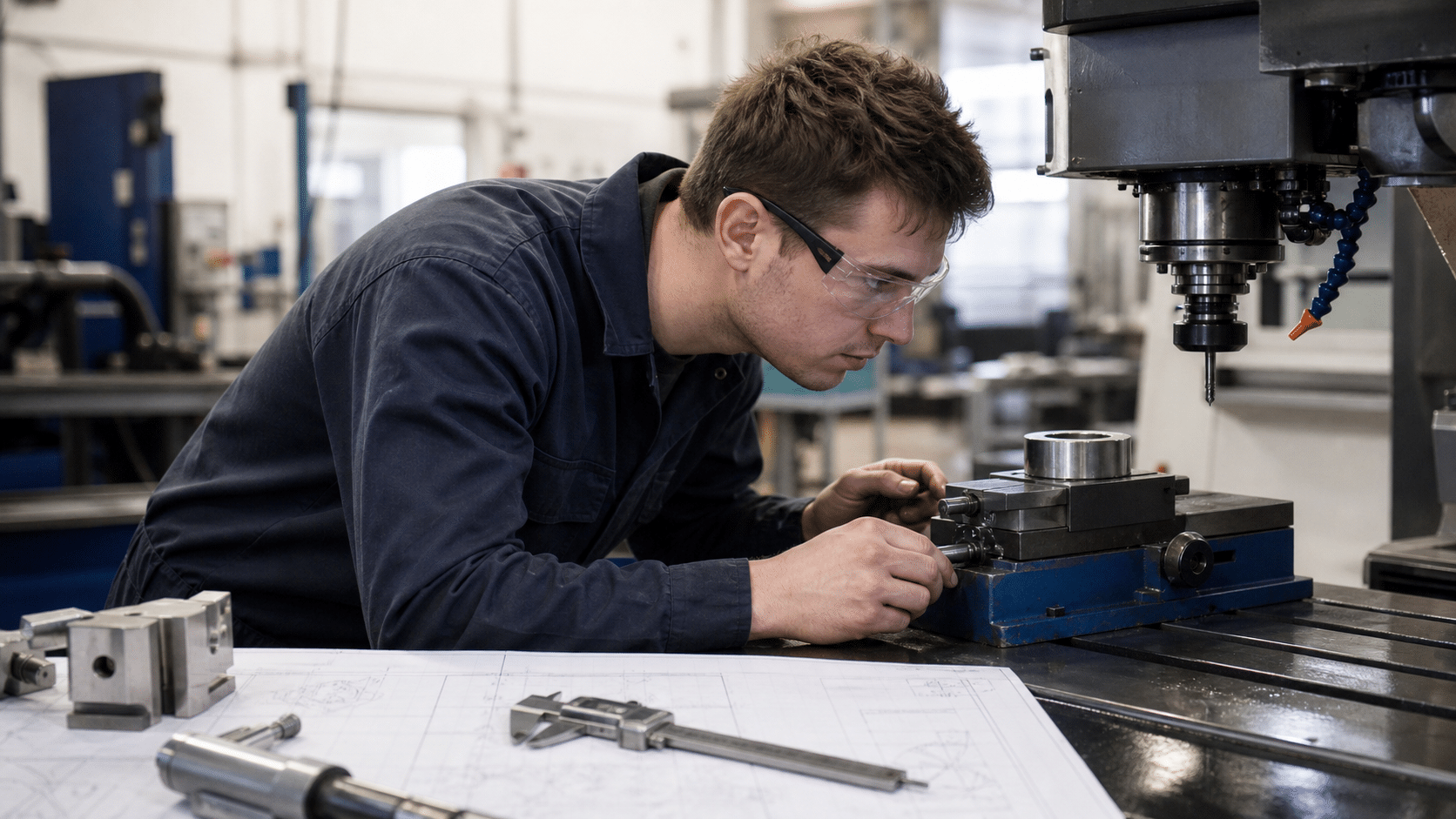
A machinist apprenticeship combines paid or supervised shop work with technical instruction in blueprint reading, machining math, CNC technology, measurement, and safety. The value of the program depends on the machines, mentors, wage progression, classroom schedule, and real work apprentices perform. It is a route into precision manufacturing, not simply a short certificate.
The work is precise rather than mysterious. Machinists set up and operate equipment that produces metal parts, instruments, and tools. Depending on the shop, that can mean manual lathes and mills, CNC machining centers, grinders, computerized measuring equipment, or a mix of older and newer machines.
The route is worth investigating if you like tangible work, technical problem-solving, and the satisfaction of making a part that has to fit exactly. It also demands patience. A small error in a setup, measurement, tool offset, or drawing can turn an expensive piece of material into scrap.
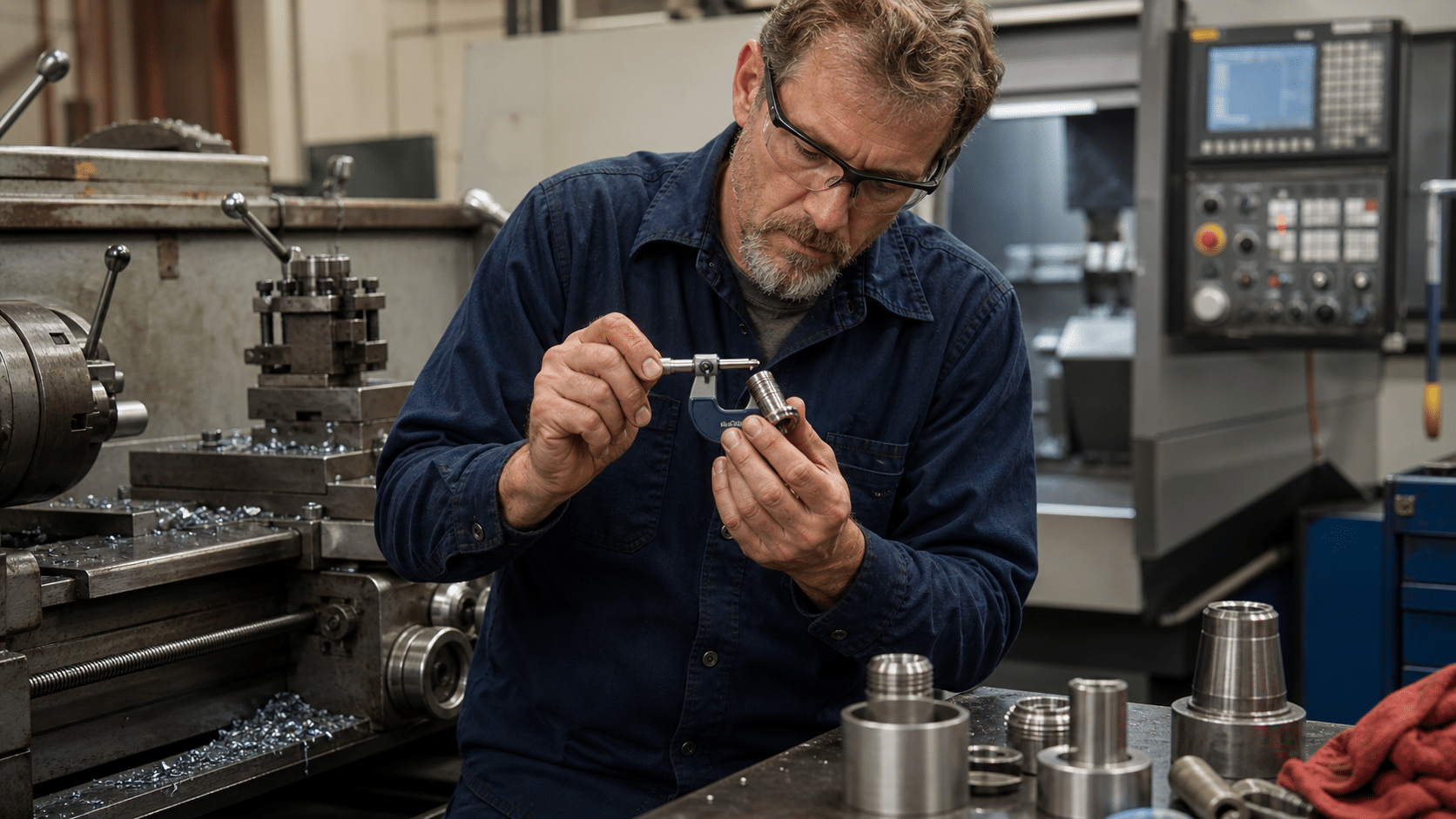
Ask what the first year looks like: Apprentices may begin with measurement, deburring, material handling, tool care, and basic machine operation before moving into setup or CNC work. Confirm how skills are signed off, which equipment is available, and whether the employer rotates apprentices through more than one process.
What does a machinist do?
Machinists turn a drawing, model, or digital program into a finished part. They select and secure the material, prepare the machine, choose tools, set speeds and feeds, monitor the cut, and measure the result.
Typical duties can include:
- reading blueprints, engineering drawings, and work instructions;
- measuring stock and checking dimensions with calipers, micrometers, gauges, and other tools;
- setting up lathes, mills, grinders, CNC machines, or machining centers;
- loading tooling, fixtures, programs, and material;
- entering or adjusting CNC offsets within the shop’s procedures;
- cutting, drilling, boring, turning, milling, and finishing metal parts;
- inspecting parts during and after production;
- documenting measurements and reporting defects or machine problems;
- changing worn tools and helping maintain the work area;
- working with engineers, programmers, quality staff, and other operators.
The U.S. Bureau of Labor Statistics (BLS) describes machinists as workers who set up and operate machine tools to produce precision metal parts, instruments, and tools. The occupation is broader than standing at a CNC control and pressing cycle start. A machinist is expected to understand how the machine, material, tooling, drawing, and inspection result fit together.
Machinist, CNC operator, and tool-and-die maker
Job titles can overlap, especially in smaller shops. Before you apply, read the duties rather than relying on the title alone.
| Role | Main focus | What can vary |
|---|---|---|
| Machinist | Set up, operate, and inspect precision-machined parts | May work with manual, CNC, or both types of equipment |
| CNC operator | Run assigned computer-controlled machines and monitor production | Some roles are mainly loading and unloading; others include setup |
| CNC machinist | Set up and run CNC equipment and troubleshoot the process | May also edit offsets, read code, and inspect first pieces |
| Tool-and-die maker | Build and repair dies, molds, gauges, and specialized tooling | Often requires additional precision fitting and technical experience |
| Machine operator | Run production equipment according to a defined process | Usually has a narrower setup and programming scope |
Our welder certification guide covers a different entry route. Welding experience can help you understand metal and shop safety, but it does not replace the measurement, machine setup, and drawing skills required in machining.
How a machinist apprenticeship works
An apprenticeship combines paid work with structured instruction. You learn from experienced workers while gradually taking on more difficult setups and parts. The exact length and wage progression depend on the sponsor and the written agreement.
Training may include:
- shop math, fractions, decimals, angles, and basic geometry;
- blueprint reading, symbols, tolerances, and geometric dimensioning concepts;
- material identification and metalworking principles;
- manual lathe, mill, drill press, and grinder operation;
- CNC machine setup and basic program understanding;
- tooling, workholding, speeds, feeds, and tool wear;
- calipers, micrometers, gauges, surface plates, and inspection routines;
- CAD/CAM exposure or computer-controlled manufacturing;
- quality documentation, traceability, and nonconformance procedures;
- lockout, machine guarding, PPE, lifting, chemical, and housekeeping rules.
The BLS says machinists typically gain competency through on-the-job training or an apprenticeship. Some programs are sponsored by an employer, while others are connected to a union, contractor group, community college, or technical school. Ask who employs you, who provides the instruction, and what credential you receive at the end.
There is also an important status question. The current Apprenticeship.gov machinists occupation page identifies machinists under O*NET code 51-4041.00 but says the occupation is not currently approved for use in a Registered Apprenticeship Program. That wording does not prove that every machinist training job is unregistered or illegitimate. It does mean you should ask a sponsor to explain its registration status, standards, related instruction, and credential before treating the position as a federally registered apprenticeship.
Requirements to apply
The usual entry baseline is a high school diploma or equivalent. Employers and programs may also look for reliable attendance, basic math, mechanical interest, drug-screen or background-check eligibility, and the ability to work safely around machinery.
Helpful preparation can include:
- algebra, geometry, technical math, or shop classes;
- blueprint reading or drafting coursework;
- CAD, CAM, CNC, welding, or metalworking exposure;
- experience with hand tools and measuring tools;
- a community-college certificate in machining or manufacturing;
- maintenance, fabrication, military, or industrial experience;
- comfort standing, concentrating, and repeating precise tasks for a shift.
You do not need to arrive knowing how to program every CNC machine. You do need to be ready to learn carefully, ask questions before making a risky change, and record what you measure. Employers value consistency because the same setup may need to produce hundreds of parts within a narrow tolerance.
Age is not a reason to dismiss the path. A career changer may bring useful habits from maintenance, construction, quality control, automotive work, or technical service. The practical questions are whether the starting wage works for your budget, whether you can handle the schedule, and whether the local shops offer a real progression instead of an open-ended entry-level job.
How to find a legitimate program
Start with local manufacturers, community and technical colleges, state apprenticeship offices, union training organizations, and the Apprenticeship.gov search tools. Search by location and occupation, then contact the sponsor directly. Job boards can help you discover employers, but the employer’s written terms should control your decision.
Before applying, ask for clear answers to these questions:
- Is this a registered apprenticeship, an employer training program, or a school-based certificate with a work placement?
- Who is the employer during the training period?
- What is the starting wage and how are increases earned?
- How much related instruction is required, and who pays for it?
- Which machines and inspection tools will I actually use?
- Will I learn setup, offsets, troubleshooting, and print reading, or mainly loading and unloading?
- What credential or recognized experience will I have when the program ends?
- Are tools, PPE, tuition, testing, and transportation included or deducted?
- Which shifts are common, and how often are nights or weekends required?
- What percentage of trainees move into a machinist or CNC machinist role?
The last question is especially useful. A program can sound attractive while offering little opportunity to move beyond repetitive machine operation.
What does a machinist apprentice earn?
Apprentices normally earn less than fully trained machinists at the beginning. Pay may increase as you demonstrate setup, inspection, programming, troubleshooting, and other competencies. There is no single national first-year rate that should be treated as an offer.
The BLS reported a $58,750 median annual wage for machinists in May 2025, or about $28.25 per hour when converted to a 40-hour week. The lowest 10 percent earned less than $39,200, while the highest 10 percent earned more than $80,010.
| BLS measure for machinists | May 2025 figure |
|---|---|
| Median annual wage | $58,750 |
| Approximate hourly equivalent | $28.25 |
| Lowest 10 percent | Less than $39,200 |
| Highest 10 percent | More than $80,010 |
These are occupation-wide wages, not apprentice wages. Your first offer may be lower, and the full package may include health insurance, retirement contributions, paid time off, shift premiums, or tuition support. Compare the total package and ask whether overtime or a night shift is required to reach the advertised annual figure.
Location and industry matter. A shop making aerospace, medical, energy, or specialized industrial components may have different requirements and pay than a high-volume production facility. Use CareerOneStop or state labor-market data to compare local wages after you have identified the exact job title.
Work schedule and shop conditions
Many machinists work full time. The BLS notes that overtime, nights, and weekends may be common when a facility runs machines for extended periods. A new apprentice may have less choice over shift assignment than an experienced employee.
The environment can include:
- standing for long periods and moving around a production floor;
- machine noise, vibration, coolant, chips, and metalworking fluids;
- repetitive lifting of stock, fixtures, or finished parts;
- close visual attention to measurements and surface condition;
- strict housekeeping around chips, spills, tools, and moving equipment;
- protective eyewear, hearing protection, safety footwear, and other PPE.
Machine tools can cause serious injuries when guards, procedures, or attention fail. Follow the shop’s training, guarding, lockout, lifting, chemical, and PPE requirements. Never reach into a moving machine or improvise a shortcut because a part is behind schedule.
Skills that make you valuable
The strongest apprentices build more than machine familiarity. They learn to see the whole process and communicate when something is wrong.
Important skills include:
- accurate measurement and tolerance control;
- reading drawings and identifying the critical features of a part;
- understanding how material, tooling, and cutting conditions interact;
- basic CNC and CAD/CAM literacy;
- troubleshooting a dimensional or surface-finish problem;
- documenting work and following revision-controlled instructions;
- keeping a clean, organized, and safe workstation;
- communicating clearly with a lead, programmer, inspector, or engineer.
Computer skills matter more as shops connect CNC equipment, inspection systems, and production records. That does not make hands-on ability less important. It makes it more valuable when you can connect the digital instruction to the actual machine and part.
Job outlook for machinists
The BLS reports about 288,300 machinist jobs in 2025 and projects 1 percent growth from 2025 to 2035 for machinists. The broader group of machinists and tool-and-die makers is projected to decline 1 percent over the same period. Across that combined group, the BLS projects about 30,400 openings per year, on average, largely because workers retire or leave the occupation.
Those figures describe the national occupation, not the guarantee from one school or employer. Automation may limit growth in some routine tasks, while manufacturers still need people who can set up, monitor, maintain, inspect, and improve computer-controlled processes. Demand can also differ sharply by region and industry.
The more useful question is what kind of machinist a local employer needs. A person who can read prints, set up a machine, measure a first piece, adjust an offset within procedure, and explain a process problem has more options than someone trained only to load parts.
Our industrial maintenance technician guide is a useful comparison if you prefer diagnosing and repairing factory equipment rather than making precision components. If you want a broader electrical route, see the industrial electrician guide. For large industrial vessels and metal structures, compare the boilermaker apprenticeship guide.
Is machining a good second career after 40?
Machining can suit a mid-career worker who prefers focused, practical work and is willing to rebuild income gradually while learning. Previous experience with tools, mechanics, quality checks, maintenance, fabrication, or technical documentation may help.
The trade-offs should be explicit:
- apprentice pay can be below your previous wage;
- shift work may affect sleep and family routines;
- standing, noise, coolant, and repetitive movements are part of many jobs;
- mistakes can be costly, so the learning curve rewards patience;
- some shops offer a clear path while others keep entry-level workers on narrow tasks;
- a certificate alone does not guarantee a setup or programming role.
Before changing careers, ask to tour a shop or speak with someone who completed the program. Review the wage schedule against your financial runway, then compare the training’s actual equipment and outcomes with local job postings. Our career-change roadmap after 40 can help you evaluate the transition more broadly.
Bottom line
A machinist apprenticeship can provide a structured entry into precision manufacturing through supervised work, technical instruction, and progressive responsibility. The core path is learning to read the job, prepare the machine, control the process, and prove the finished part meets its requirements.
The BLS reported a $58,750 median wage for machinists in May 2025, but an apprentice starts below the experienced occupation’s figures. Confirm the sponsor, registration status, wage increases, shift expectations, equipment, and end credential before accepting an offer. For someone who enjoys exact work and wants a hands-on technical career, machining can be a credible second-act option—provided the local program teaches more than basic machine loading.
Sources
- U.S. Bureau of Labor Statistics: Machinists and Tool and Die Makers
- Apprenticeship.gov: Machinists occupation, O*NET 51-4041.00
- Apprenticeship.gov: Search apprenticeship opportunities
- CareerOneStop: Find local career and wage information
\n
Reviewed September 3, 2026: A machinist apprenticeship should be judged by the equipment, supervision, instruction, and wage progression it offers. Ask whether the program leads to setup, inspection, CNC, or maintenance work before applying. Compare it with CNC machinist work.