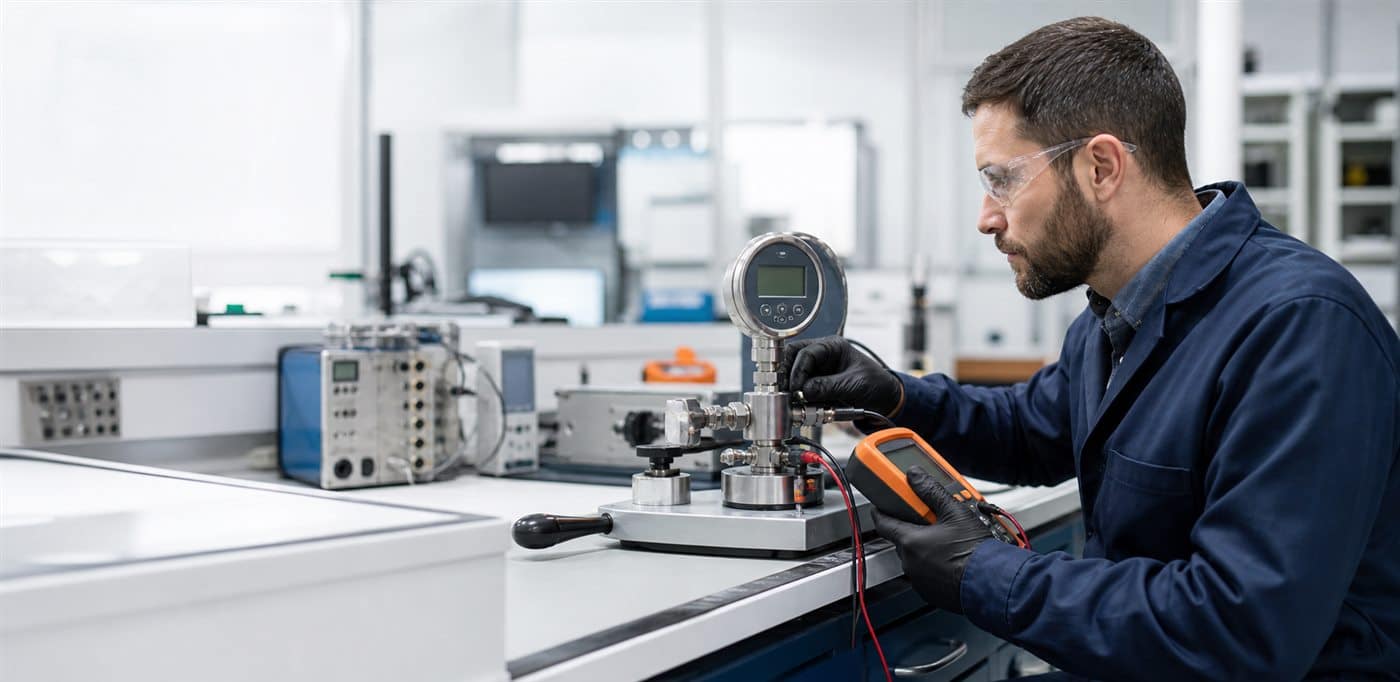
A calibration technician checks whether measuring instruments give results that can be trusted. The work may involve temperature, pressure, electrical, dimensional, or laboratory equipment, along with standards, procedures, records, and adjustments. Calibration is not simply making a number look right; it is proving how an instrument performed and documenting what happens when it is outside tolerance.
That sounds simple until you consider what depends on the measurement. A factory may use a pressure gauge to control a process. A hospital may rely on a device to monitor equipment. An aerospace supplier may need every test result tied to a documented standard. A small error can become a bad product, a failed inspection, or a maintenance decision based on the wrong information.
Calibration is therefore part hands-on technical work and part disciplined recordkeeping. You use tools, cables, fixtures, software, procedures, and reference standards. You also have to stop when the evidence is unclear and ask for help instead of forcing a pass.
A failed calibration creates a question: The technician checks the standard, environment, setup, instrument history, and observed error before deciding whether to adjust, label, remove, or escalate the equipment. The record should show the before-and-after result and which measurements may have been affected.
Calibration technician at a glance
| Question | Short answer |
|---|---|
| Main work | Test, compare, adjust, maintain, and document measurement devices |
| Common equipment | Gauges, meters, scales, thermometers, pressure instruments, electrical testers, and process sensors |
| Common settings | Manufacturing plants, calibration laboratories, repair shops, healthcare facilities, and research sites |
| Typical entry route | Technical education, a related maintenance job, or employer training with supervision |
| Common education | Associate degree or other postsecondary technical training, although some enter with a high school diploma |
| Certification | Optional credentials exist; requirements depend on the employer and program |
| BLS benchmark | $67,820 median annual wage in May 2025 for calibration technologists and technicians |
The job title can cover several types of work. One employer may run a controlled calibration laboratory. Another may send technicians to customer sites. A third may combine calibration with repair, preventive maintenance, field service, or quality documentation.
What does a calibration technician do?
The daily routine changes with the instrument and the industry, but the basic sequence is familiar:
- Read the work order, procedure, range, tolerance, and environmental requirements.
- Inspect the instrument for damage, contamination, loose connections, or missing parts.
- Select the correct reference standard, fixture, cable, adapter, or software.
- Check that the reference equipment is suitable for the measurement.
- Apply known inputs and compare the instrument’s output with the reference.
- Record readings, conditions, serial numbers, equipment IDs, and as-found results.
- Adjust the instrument when the procedure permits it.
- Repeat the test and document the as-left result.
- Label, release, quarantine, repair, or escalate the device according to the result.
- Write a report another technician or auditor can understand.
BLS describes the occupation as inspecting, adjusting, and testing measurement devices against standards. It also lists preventive maintenance, recording results, and coordinating service schedules among the regular duties.
The work is not always about turning a screw until two numbers match. You may need to determine whether the reference is appropriate, whether the test setup introduces an error, whether the device is stable, and whether the result falls within the allowed tolerance.
What is calibration, in plain English?
Calibration compares an instrument with a known reference. The goal is to understand how closely the instrument measures and to document that relationship.
Calibration is not exactly the same as adjustment. Calibration produces evidence about the instrument’s performance. Adjustment changes the instrument so it may perform closer to the required value. A technician may perform both, but not every procedure allows an adjustment.
Calibration is also different from a quick functional check. A functional check may confirm that a device turns on or responds. A calibration procedure usually asks for measurements at defined points, under stated conditions, with a reference whose own status is controlled.
The result can show that the device is within tolerance, outside tolerance, unstable, damaged, or in need of a higher-level review. The correct answer is not always pass or fail. Sometimes the report needs to show the actual readings and explain what happens next.
What equipment do calibration technicians handle?
The tools depend on the employer’s industry and the technician’s specialty.
Electrical and electronic instruments
Electrical calibration can involve digital multimeters, insulation testers, oscilloscopes, power supplies, signal generators, frequency counters, and other test equipment. You may compare voltage, resistance, current, frequency, timing, or signal output with a reference.
The setup matters. A wrong cable, poor connection, unsuitable range, or noisy environment can produce a result that looks precise but is not useful. Good technicians learn to question the setup before blaming the instrument.
Mechanical and dimensional equipment
Mechanical work may include torque tools, calipers, micrometers, pressure gauges, scales, load cells, force gauges, and dimensional references. Some devices are small enough for a bench. Others are heavy, awkward, or connected to a larger machine.
This work calls for steady handling and attention to contact, alignment, cleanliness, and temperature. A measurement made with a dirty surface or a misaligned fixture may not represent the device’s real performance.
Temperature, pressure, flow, and process instruments
Industrial plants use instruments to measure conditions inside a process. A calibration technician may work with temperature probes, transmitters, pressure sensors, flow meters, level instruments, and related devices.
The technician may work in a lab, in a plant, or at a customer’s site. Field work can add access, weather, production schedules, and safety permits to the technical task.
Laboratory and healthcare equipment
Calibration work also exists in laboratories, healthcare, electronics, research, and precision repair. The instrument may be a scale, analyzer, test fixture, monitor, or specialized device used to control or verify another system.
The industry changes the consequences of an error. The basic habits remain: use the right reference, follow the procedure, record what happened, and escalate results that do not fit.
Calibration technician vs. related technical jobs
Calibration overlaps with instrumentation, quality, maintenance, and NDT, but the center of the work differs.
| Role | Main focus | Typical difference |
|---|---|---|
| Calibration technician | Measurement accuracy and documented comparison with a reference | Focuses on whether instruments produce reliable readings |
| Instrumentation technician | Sensors, control loops, valves, signals, and process automation | Often installs, troubleshoots, and maintains the system around the measurement |
| Quality inspector | Whether a part or process meets drawings and specifications | Inspects the product or process; may use calibrated tools without being the calibration owner |
| NDT technician | Finding flaws in materials without damaging them | Uses method-specific inspection techniques such as ultrasonic or magnetic particle testing |
| Maintenance technician | Keeping machinery and facilities running | Repairs equipment broadly; calibration may be one assigned task |
| Field service technician | Installing, troubleshooting, and repairing equipment at customer sites | Travel and customer support are central; calibration may be part of the service |
Our guide to instrumentation technician work covers the control-system side of measurement. The NDT technician guide explains a different use of instruments: looking for defects inside materials or structures.
Calibration can be a bridge into these fields, but a few months handling test equipment does not make someone qualified for every instrument or control system.
How to become a calibration technician
There is no single national license that every calibration technician must hold. BLS says technicians typically need an associate degree or other postsecondary technical training, while some enter with a high school diploma and learn on the job.
Route 1: Start in an entry-level technical role
Look for titles such as calibration trainee, calibration assistant, test technician, quality technician, lab technician, electrical test technician, or equipment technician. The first job may involve cleaning instruments, preparing setups, entering data, moving equipment, checking labels, and working under an experienced technician.
Ask how the employer documents training. You want to know which types of instruments you will see, how supervision works, and when you can perform tasks independently. A job that says "calibration" but offers no procedure training or technical feedback may not build the experience you need.
Route 2: Study electronics or an engineering technology
Community colleges and technical schools may offer programs in electronics engineering technology, electrical technology, instrumentation, metrology, or a related field. BLS specifically notes coursework such as circuitry, metrology, and engineering in programs that prepare people for this occupation.
You do not necessarily need a four-year engineering degree. You do need enough math, electrical or mechanical knowledge, and practical training to understand what the test setup is doing.
Before enrolling, ask how much time students spend with real instruments. A class that explains calibration terms but never lets you build a setup, take readings, and write a report is limited preparation.
Our online trade school guide explains how to compare online theory with hands-on requirements. Calibration programs need a realistic plan for lab practice.
Route 3: Transfer from maintenance, healthcare, or manufacturing
BLS notes that some technicians enter after working in the industry where a measurement device is used. A healthcare technician might move toward calibration of medical equipment. A maintenance worker may already understand gauges, motors, sensors, and troubleshooting. An electronics technician may be comfortable with meters, circuits, and test procedures.
The transferable experience helps, but it does not replace instrument-specific training. You still need to learn the reference equipment, tolerance rules, documentation system, and quality requirements used by the new employer.
Route 4: Build experience in a calibration laboratory
A calibration lab can provide repeated practice across a range of instruments. You may start with simple devices and build toward more complex electrical, pressure, temperature, dimensional, or force work.
Ask whether the lab lets new technicians see the whole process. Good experience includes intake, inspection, setup, measurement, adjustment, review, reporting, labeling, and release. Data entry alone is not the same as learning calibration.
Do you need calibration technician certification?
Usually, the employer decides. Certification can help, but it is not automatically required for every calibration job.
ASQ offers the Certified Calibration Technician, or CCT, credential. ASQ describes the CCT as covering the testing, calibration, maintenance, and repair of electrical, mechanical, electromechanical, analytical, and electronic measuring, recording, and indicating instruments.
ASQ’s current requirements include five years of full-time paid experience in the CCT Body of Knowledge. A technical school diploma or degree can provide an experience waiver of up to two years, subject to ASQ’s rules. The exam is based on the Body of Knowledge and is offered in English.
That credential may make sense for an experienced technician who wants an independent certification. It may not be the right first purchase for someone who has never worked with measurement equipment. Read local job postings first. Some employers care more about hands-on instrument experience, electronics knowledge, customer-site work, or a company qualification.
Do not assume that one certification covers every specialty. A technician who is strong with electrical meters may need additional training for pressure, temperature, dimensional, pharmaceutical, aerospace, or medical equipment work.
What does NIST have to do with calibration?
NIST is the National Institute of Standards and Technology. Its calibration services are designed to help makers and users of precision instruments achieve high levels of measurement quality and productivity.
For a technician, the practical lesson is that a reference is not just a nicer instrument. It is part of a measurement system with its own identification, condition, and documented relationship to a standard. The employer’s procedures explain how that reference is selected and used.
NIST can be an important source for standards and measurement information, but technicians should follow the procedures and quality system of the employer, laboratory, customer, or regulated industry. A web page about calibration does not replace supervised practical training.
What skills matter most?
BLS lists communication, critical thinking, attention to detail, dexterity, physical strength, and technical skills among the important qualities for the occupation. That combination describes the work well.
You need to:
- Read a procedure without skipping the conditions that seem inconvenient.
- Use a meter, gauge, fixture, or software interface carefully.
- Understand basic electricity, mechanics, temperature, pressure, or dimensional measurement.
- Keep track of units, ranges, tolerances, and significant readings.
- Notice when a result looks wrong, even if the screen displays a number.
- Write a report that another person can audit later.
- Explain a failed or uncertain result without turning it into an argument.
- Lift or move equipment safely when the job requires it.
The technical part can be taught. The harder habit is respecting the evidence. If the setup was wrong, the cleanest-looking report in the world will not rescue the measurement.
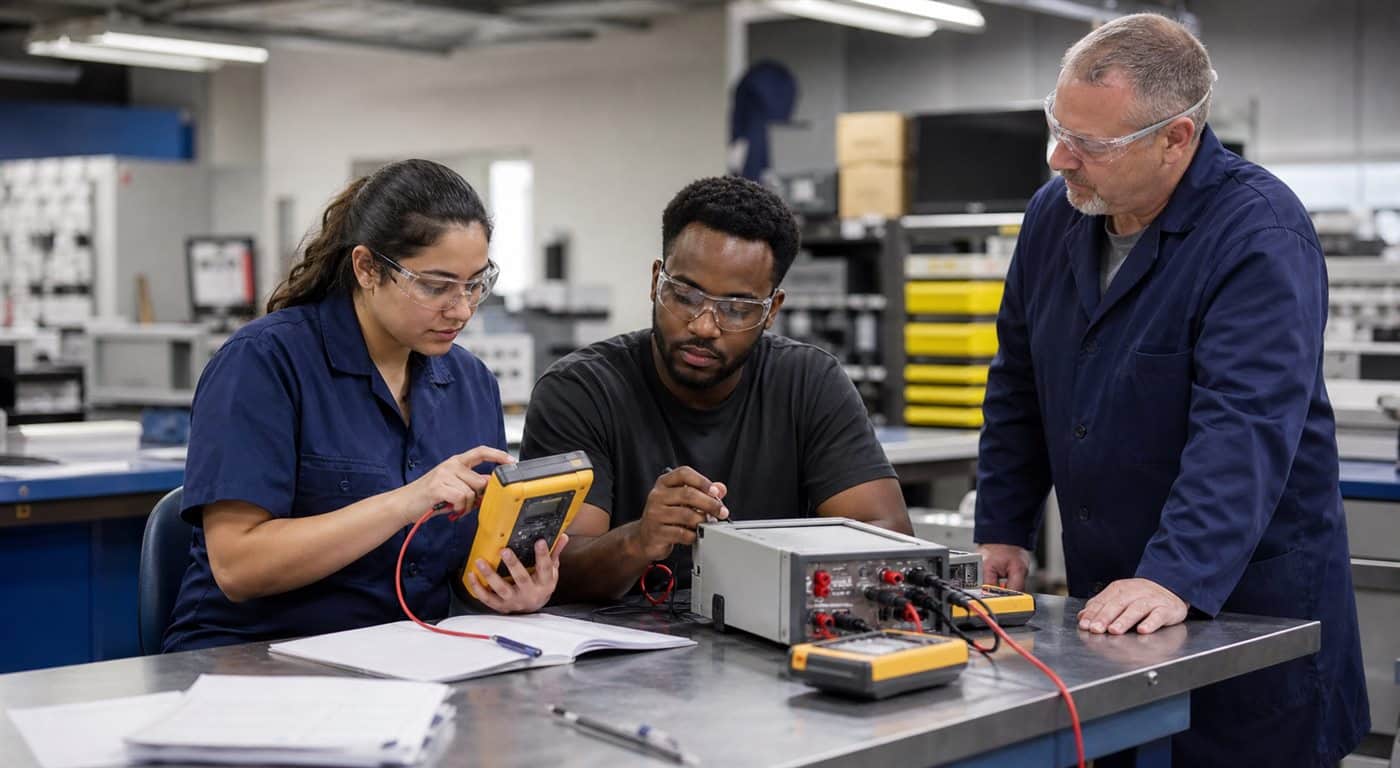
Where do calibration technicians work?
BLS reports that calibration technologists and technicians held about 17,000 jobs in 2025. The largest industry groups included manufacturing, testing laboratories and services, electronic and precision equipment repair and maintenance, merchant wholesalers of durable goods, and research and development.
The setting affects the feel of the job:
| Setting | What the work may involve |
|---|---|
| Manufacturing plant | Supporting production equipment, process instruments, and scheduled calibration work |
| Calibration laboratory | Bench testing, controlled procedures, reports, reference standards, and repeatable setups |
| Field service | Driving to customer sites, working around production schedules, and adapting to different equipment |
| Healthcare or laboratory | Supporting specialized instruments and careful documentation |
| Research and development | Testing unusual or high-precision equipment and helping develop measurement methods |
Some technicians work mostly at a bench. Others walk through a plant, climb access platforms, enter controlled areas, or travel between customer sites. Ask where the work happens before assuming that calibration means a quiet laboratory.
How much does a calibration technician make?
BLS reports a $67,820 median annual wage for calibration technologists and technicians in May 2025. The lowest 10 percent earned less than $46,680, and the highest 10 percent earned more than $106,550.
Those figures describe the occupation nationally. They are not a promise about a first job, a particular state, or a certification premium.
BLS also reports different median wages by major industry:
| Industry | May 2025 median wage |
|---|---|
| Research and development in the physical, engineering, and life sciences | $85,900 |
| Manufacturing | $73,760 |
| Electronic and precision equipment repair and maintenance | $61,940 |
| Testing laboratories and services | $60,840 |
| Merchant wholesalers, durable goods | $60,760 |
Compare more than the headline salary. Check shift premiums, overtime, travel, per diem, benefits, training costs, customer-site expectations, and how often you will handle complex equipment. A lower starting wage with documented training may be more useful than a higher wage that leaves you doing unrelated warehouse work.
Is calibration work physically demanding?
It can be, although it is usually less physically intense than construction or emergency repair. The physical demand depends on the equipment and the setting.
Bench work may involve standing, reaching, fine hand movements, and long periods of concentration. Plant or field work can add ladders, awkward access, walking, lifting, heat, noise, or time around moving machinery. BLS notes that technicians may need physical strength to lift heavy equipment or machinery.
The job also has a visual and mental demand. You may read small displays, compare readings, trace cables, inspect connectors, and repeat a test until the result makes sense. If you prefer constant movement and visible repair work, a pure calibration lab may feel slow. If you like finding why a number is wrong, the pace may suit you.
Is calibration work dangerous?
The hazards come mainly from the workplace and the equipment, not from the word calibration. A technician may work around loud machinery, electrical energy, hot surfaces, pressure, chemicals, lifting equipment, or production systems.
BLS specifically mentions exposure to loud or dangerous machinery in manufacturing and toxic materials in laboratories. Employers may require hearing protection, gloves, eye protection, masks, electrical safety practices, lockout procedures, or other controls.
Ask during an interview:
- What equipment and hazards will I handle most often?
- Which tasks require lockout, permits, or a second person?
- What training occurs before I work in the plant or field?
- Who reviews a failed calibration result?
- How are reference standards stored, checked, and protected?
- How much of the work happens around live production?
The best employer can answer those questions clearly. A vague safety answer is a reason to slow down before accepting the job.
Calibration technician or instrumentation technician?
The two careers can share tools and vocabulary, especially around sensors, signals, and process equipment. Calibration focuses on measurement accuracy and evidence. Instrumentation focuses more on installing, maintaining, configuring, and troubleshooting the system that uses those measurements.
A calibration technician may test a pressure transmitter on a bench. An instrumentation technician may install that transmitter, connect it to a control loop, configure the signal, and troubleshoot why the plant is not responding correctly.
Some employers combine the roles. Read the job posting carefully. Look for words such as loop checks, PLCs, control valves, commissioning, process systems, preventive maintenance, reference standards, tolerance, as-found, and as-left data. The mix tells you more than the title.
Is calibration a good career change after 40?
It can be a sensible option for someone who likes technical work but wants a more controlled environment than construction or emergency repair. Prior experience with maintenance, electronics, laboratory work, quality, healthcare equipment, manufacturing, or aviation can shorten the learning curve.
The transition still takes patience. An employer may start you with simpler instruments, supervised setups, data entry, or inspection tasks. A certificate alone does not prove that you can calibrate equipment safely and produce defensible records.
Ask yourself:
- Do I enjoy careful measurement more than improvisational repair?
- Can I follow a procedure and still notice when the conditions are wrong?
- Am I comfortable repeating a test instead of rushing to a conclusion?
- Do I want bench work, plant work, field service, or a mixture?
- Can I accept a trainee wage while building instrument experience?
- Am I willing to keep learning as equipment and software change?
Our career change after 40 roadmap can help you compare the income gap, training time, and first-job plan. If you prefer broader equipment repair, compare this path with medical equipment repairer work and industrial maintenance technician work.
How to compare calibration training programs
Before paying tuition, ask for specifics:
- Which measurement types are taught: electrical, pressure, temperature, dimensional, force, or another specialty?
- How many hours are spent using actual instruments?
- Do students create setups, take readings, adjust equipment, and write reports?
- Are reference standards identified and controlled in the lab?
- Does the program teach units, tolerances, uncertainty, traceability, and documentation?
- Which entry-level jobs do graduates apply for?
- Are tools, exam fees, PPE, and lab charges included in the price?
- Can the school explain its relationship with employers or calibration labs?
Be cautious with programs that promise certification or a high salary without explaining the work experience behind the credential. A short course may introduce the field. It does not automatically make you an independent calibration technician.
How to read a calibration technician job posting
Start with the instruments, not the title. Look for:
- Electrical calibration, electronic test equipment, or meter work
- Pressure, temperature, flow, torque, force, or dimensional calibration
- Laboratory, plant, field service, or customer-site work
- Preventive maintenance and repair
- Quality records, calibration software, asset tracking, or audit support
- Travel, overtime, shift work, cleanroom rules, or production support
- Required education, military experience, electronics knowledge, or certification
Then ask what success looks like after 90 days. Will you be learning procedures under a senior technician, or are you expected to handle customer equipment alone? The answer tells you whether the job is a real entry route.
Bottom line
A calibration technician protects the quality of decisions made with measurement equipment. The work suits people who enjoy instruments, repeatable procedures, troubleshooting, and records that have to stand up later.
BLS reports a $67,820 median wage in May 2025 and 5% projected employment growth from 2025 to 2035 for the occupation. Those are useful national benchmarks, not a guarantee. Your actual path will depend on the instruments you learn, the industry you enter, the training you receive, and whether the job gives you documented experience.
Start by reading local job postings and identifying the equipment they mention. Then choose a technical program, trainee role, or related field that lets you practice with real instruments. Certification can come later, once you understand which credential your target employers actually value.
Sources
- U.S. Bureau of Labor Statistics: Calibration Technologists and Technicians
- ASQ: Calibration Technician Certification (CCT)
- NIST: Calibrations
\n
Reviewed September 3, 2026: Calibration work depends on the instruments, tolerance requirements, documentation system, and industry. Check which equipment you would handle and whether certification is expected. Compare it with instrumentation technician work.
\n