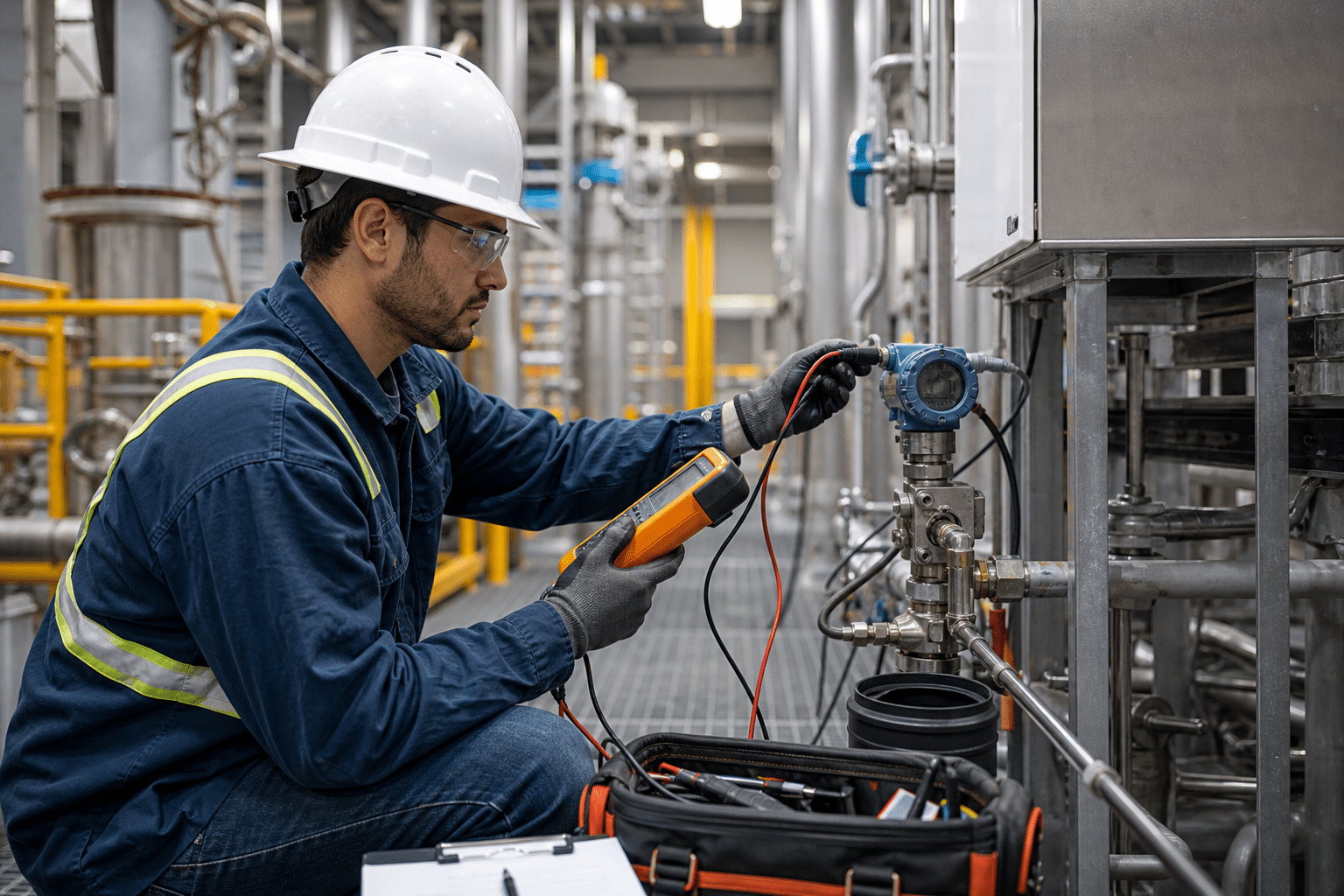
An instrumentation technician keeps measurement and control devices accurate enough for a plant or facility to run safely. The work may involve sensors, transmitters, control valves, wiring, calibration records, and troubleshooting a signal that does not match what the process is doing. The role sits between field equipment, electrical systems, and automated controls.
The title is broader than it sounds. One employer may use instrumentation technician for a plant maintenance role. Another may call the same kind of work an I&C technician, controls technician, calibration technician, or electrical and instrumentation technician. The equipment and industry matter as much as the title.
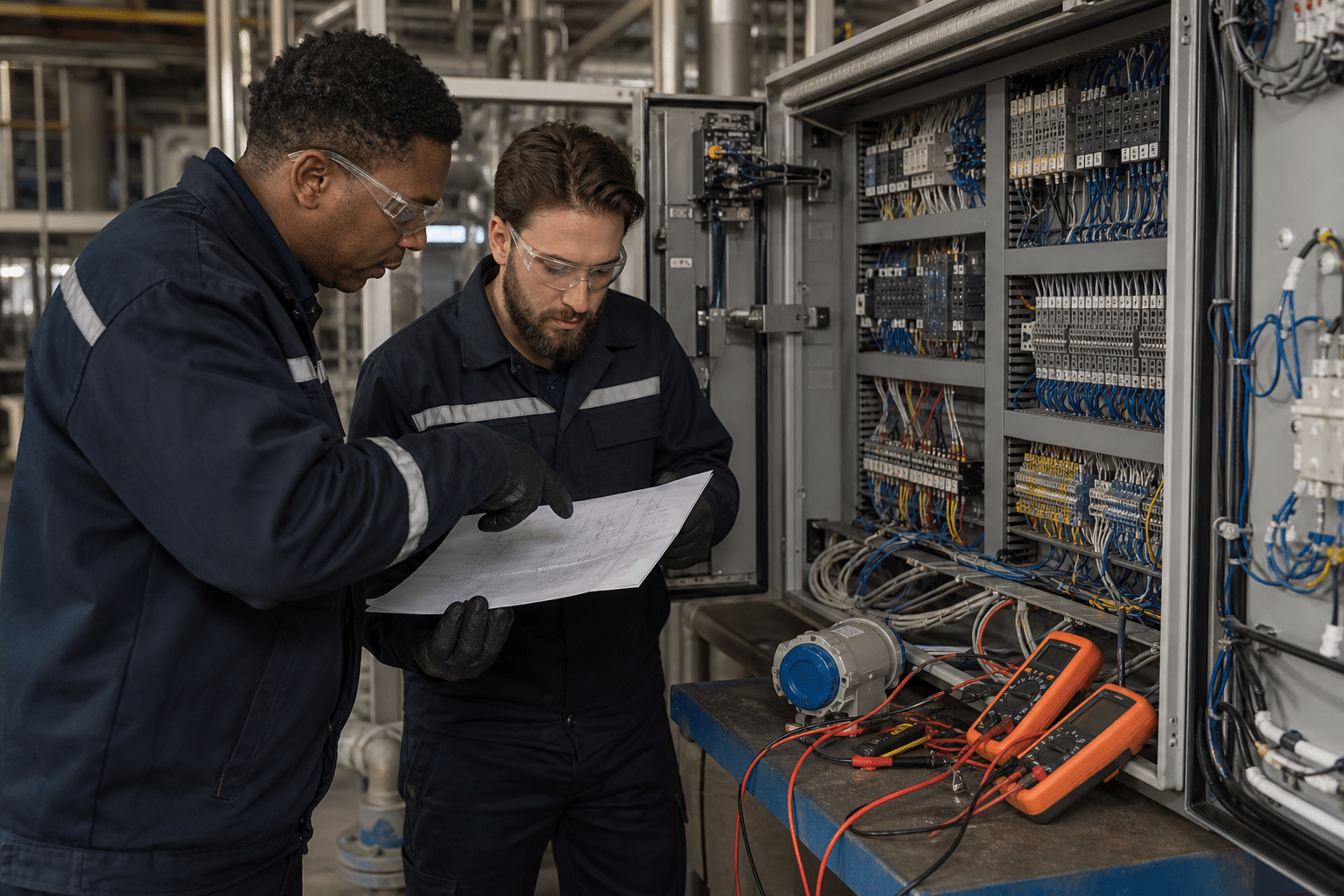
Start with the signal path: If a pressure reading looks wrong, the technician does not replace the transmitter automatically. They compare the field condition with the control-room value, check the wiring and loop, test the instrument against a known reference, and document the adjustment or fault.
What does an instrumentation technician do?
Instrumentation technicians install, test, maintain, and troubleshoot devices that measure or control a process. Those devices can measure pressure, temperature, flow, level, vibration, speed, or chemical conditions. They may also operate a valve, motor, pump, damper, or other final control element after receiving a signal from a controller.
The U.S. Department of Energy’s profile for an instrumentation and controls technician describes work with valves, pumps, motors, generators, control circuits, and SCADA systems in a hydropower setting. The same basic skills appear in manufacturing, water treatment, chemical processing, power generation, food production, and other industrial environments.
Typical duties include:
- reading instrument drawings, wiring diagrams, loop sheets, and installation specifications;
- mounting and wiring sensors, transmitters, switches, and control equipment;
- calibrating an instrument against a known standard;
- testing a signal from the field device to the control system;
- troubleshooting electrical, pneumatic, mechanical, or communication problems;
- recording test results and documenting repairs;
- working with electricians, operators, engineers, and maintenance planners.
The work is hands-on, but it is not only about tools. A good technician has to understand what a reading means in the process. A transmitter can be wired correctly and still report the wrong value because of a plugged impulse line, a bad calibration, a damaged sensor, or a problem farther upstream.
Instrumentation technician versus industrial electrician
There is overlap between the two trades, especially around wiring, motors, control panels, and electrical safety. The emphasis is different.
| Role | Main focus | Common work examples |
|---|---|---|
| Instrumentation technician | Measurement, calibration, signals, and process control | Test a pressure loop, calibrate a transmitter, troubleshoot a control valve |
| Industrial electrician | Power distribution, wiring, equipment connections, and electrical systems | Install feeders, repair motors, terminate conductors, test circuits |
| Controls technician | Automation hardware, PLCs, HMIs, networks, and machine logic | Diagnose an I/O fault, modify a control panel, check a PLC input |
| Control engineer | Process design, control strategy, specifications, and system architecture | Design a control loop, select equipment, approve a change |
These boundaries move from company to company. An instrumentation technician may work closely with PLCs and industrial networks, while an industrial electrician may handle a large amount of motor control and instrumentation wiring. Read the job description instead of relying on the title alone.
For a fuller look at the neighboring trade, see our guide to industrial electrician work and training. Our industrial electrician salary guide also shows why national benchmarks need to be read alongside the actual job duties.
The equipment you may work on
Instrumentation work becomes easier to understand when it is tied to a process. Here are common groups of equipment:
Sensors and transmitters
Sensors detect a condition. A transmitter converts that measurement into a signal that a control system can use. Common signals include 4-20 mA, digital communication, and pneumatic output. Technicians verify the device’s range, wiring, configuration, and response.
Control valves and final elements
A controller can calculate a response, but the process still needs a device to act on it. Control valves, dampers, variable-frequency drives, relays, and motor starters are examples of final elements. A technician may check the signal, stroke a valve, inspect its position feedback, or investigate why it is not responding as expected.
PLC, DCS, and SCADA systems
Programmable logic controllers, distributed control systems, and supervisory control and data acquisition systems collect signals and use logic to monitor or control a process. The instrumentation technician may not design the system, but they often test I/O points, verify alarms, trace communication faults, and confirm that field devices match the drawings.
Calibration equipment
Depending on the plant, the tool kit may include a multimeter, loop calibrator, pressure source, temperature simulator, process meter, communicator, hand tools, and test leads. The point is not to own every tool. It is to use the correct reference, follow the procedure, and record what the instrument did before and after adjustment.
What skills matter most?
Instrumentation employers usually want a mix of electrical, mechanical, mathematical, and documentation skills.
Reading technical information
You may need to follow a loop diagram, compare a terminal number with a wiring schedule, identify a component on a P&ID, or use a manufacturer’s manual. A person who enjoys finding a mismatch between a drawing and a real panel often fits this work well.
Measurement and troubleshooting
Calibration is not guesswork. You compare a device with a known reference, note the error, make an adjustment if allowed, and confirm the result. Troubleshooting requires the same patience. Start with the symptom, test one part of the chain at a time, and avoid replacing components without evidence.
Basic electronics and electricity
You do not have to be an electrical engineer, but you need to understand voltage, current, resistance, continuity, polarity, grounding, signal types, and safe testing practices. Some jobs also require familiarity with pneumatics, hydraulics, motors, or hazardous-area equipment.
Writing and communication
Technicians leave records for the next shift. Clear notes about the condition found, the test performed, the adjustment made, and the remaining issue can prevent a repeat call. Communication also matters when an operator sees a process symptom that is not obvious from the instrument panel.
Safety discipline
Industrial sites can involve stored energy, process pressure, chemicals, rotating machinery, hot surfaces, and electrical hazards. The right response is procedural, not heroic. Site orientation, lockout/tagout, permits, electrical boundaries, confined-space rules, and fall protection may all apply depending on the task.
How do you become an instrumentation technician?
There is no single national path. Employers commonly look for one of these starting points:
- An associate degree or technical program in instrumentation, electronics, electrical technology, process control, or a related field.
- A high school diploma plus plant maintenance, electrical, mechanical, military, or controls experience.
- An employer trainee role or apprenticeship that combines paid work with classroom instruction.
- A progression from industrial electrician, maintenance technician, electrical technician, or calibration work.
The DOE profile for I&C technicians lists an associate degree, recognized technical training, equivalent military training, or a high school diploma with relevant experience as possible backgrounds. It also describes a period of on-the-job training and notes that direct experience with instrumentation, PLCs, and computer systems can matter.
A school can help you build the basics, but the equipment in a classroom will not match every plant. Before enrolling, ask whether the program includes actual wiring, calibration, control loops, PLC practice, technical drawings, and troubleshooting. A course made mostly of theory may not prepare you for a field job by itself.
If you want to compare formats, our online trade school guide explains which skills can be learned online and which still need a lab, shop, or employer site.
What is the pay for an instrumentation technician?
There is no single BLS occupation that captures every job using the title instrumentation technician. That is why salary pages can look inconsistent. The same title may be mapped to electrical and electronic engineering technicians, calibration technicians, electrical technicians, or another industrial occupation.
Use related official benchmarks as context rather than as a guaranteed quote:
| Official benchmark | Median annual wage, May 2025 | Why it is relevant |
|---|---|---|
| Electrical and electronic engineering technologists and technicians | $78,190 | Includes work with electrical instruments, testing equipment, calibration, and repair |
| Calibration technologists and technicians | $67,820 | Focuses on inspecting, adjusting, and testing measurement devices |
| DOE I&C technician profile, hydropower context | $63,640-$100,000 profile range | Specific I&C profile, not a national wage table for every instrumentation job |
The BLS benchmarks are better for understanding related occupations than for predicting one employer’s offer. Pay can change with industry, location, shift, travel, union status, clearance or site requirements, and the amount of PLC or controls responsibility in the job.
Read the compensation section carefully. Ask whether the number is hourly base pay, an annualized wage, an estimated total, or a range that includes overtime. A role with night shifts and callouts may show a higher annual total while asking more of your personal time.
Where do instrumentation technicians work?
Instrumentation technicians work in places where processes need to be measured and controlled. Examples include:
- manufacturing and process plants;
- utilities and power generation;
- chemical and pharmaceutical production;
- water and wastewater facilities;
- food and beverage plants;
- oil, gas, and petrochemical operations;
- equipment manufacturers and field service companies.
The setting changes the job. A factory technician may spend most of the week inside a plant on preventive maintenance. A field-service technician may drive to customer sites and work with several types of equipment. A utility role may involve strict qualification steps, planned outages, and 24-hour operations.
Is instrumentation a good second career after 40?
It can be a good fit if you like technical problem-solving and want work that rewards careful thinking. The trade is less about brute strength than many construction jobs, but it still involves ladders, awkward positions, tools, plant noise, protective equipment, and occasional outdoor work.
The bigger question is your starting point. Someone with electrical, mechanical, military, maintenance, HVAC, or automation experience may have useful pieces already. Someone starting from zero should allow time for basic electrical theory, drawings, measurement, and safe industrial habits before expecting a high-responsibility role.
Before committing, look at real job postings in your area and note the repeated requirements. Then speak with a training provider or employer about the gap between a certificate and independent field work. Our career-change roadmap after 40 can help you compare that investment with the schedule and physical demands you can actually sustain.
Questions to ask before accepting a job
Use the interview to find out what the title hides:
- Is the role mainly calibration, electrical maintenance, controls, commissioning, or field service?
- Which systems are used: PLC, DCS, SCADA, or a plant-specific platform?
- What training is provided, and how long is the supervised period?
- Are employees expected to troubleshoot energized equipment, or are tasks assigned under an electrical safety program?
- Is the position day shift, rotating shift, or on call?
- How much travel, overtime, shutdown work, or confined-space work is typical?
- Which credentials, licenses, or medical requirements are needed at the site?
Those answers will tell you more than a generic job title or a salary headline.
Bottom line
An instrumentation technician keeps the measurements and controls of an industrial process trustworthy. The work combines calibration, wiring, electronics, mechanical understanding, technical drawings, troubleshooting, and safety discipline.
The title covers several related jobs, so compare the duties before comparing pay. Official benchmarks range across nearby occupations, while the actual offer depends on the industry, location, shift, travel, and level of controls responsibility. If you enjoy finding why a signal is wrong and fixing the problem methodically, instrumentation may be a strong way into industrial technology without starting with a four-year engineering degree.
Sources
- U.S. Department of Energy: Instrumentation and Controls Technician
- BLS: Electrical and Electronic Engineering Technologists and Technicians
- BLS: Calibration Technologists and Technicians
- O*NET: Electrical and Electronic Engineering Technologists and Technicians
\n
Reviewed September 3, 2026: Instrumentation work can sit in a plant, utility, laboratory, or service team. Ask which sensors, control systems, calibration tasks, and safety rules the employer uses. The newer instrumentation technician guide covers the same career from a current entry perspective.