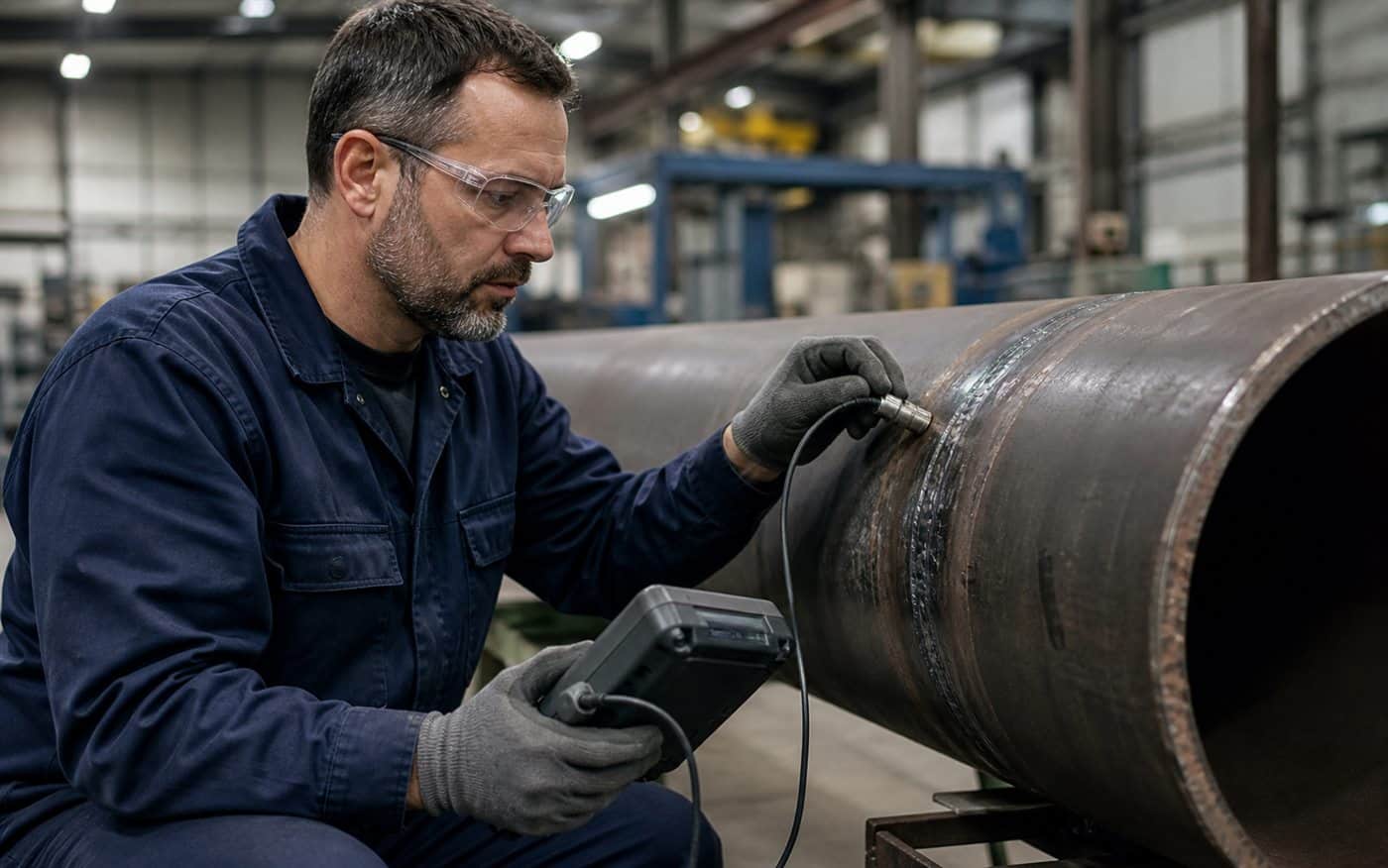
An NDT technician uses nondestructive testing methods to find flaws or changes in materials and components without damaging the item being examined. The method may be visual, magnetic particle, dye penetrant, ultrasonic, radiographic, or another specialized process. Training and certification are method-specific, so the employer, industry, and level of responsibility matter.
This is a technical inspection career, not one single job with one universal training path. An NDT technician may work in aerospace, power generation, manufacturing, oil and gas, shipbuilding, rail, construction, or maintenance. One person may spend most of the day using ultrasonic equipment. Another may specialize in magnetic particle or liquid penetrant testing. An industrial radiographer works with a different set of hazards and controls.
The job rewards careful people. A technician has to prepare the part, calibrate equipment, follow a procedure, interpret indications, document the result, and know when a finding needs review. The work is often hands-on, but the report can be just as important as the inspection itself.
The method must match the question: A surface-breaking flaw, internal discontinuity, coating problem, or weld concern may require different equipment and preparation. The technician follows the procedure, records the settings and indications, and avoids treating an uncertain signal as either a defect or a clean result without the required review.
NDT technician at a glance
| Question | Short answer |
|---|---|
| Main work | Inspect materials and components for flaws without destroying them |
| Common methods | Visual, liquid penetrant, magnetic particle, ultrasonic, radiographic, and eddy-current testing |
| Common settings | Manufacturing plants, aircraft facilities, refineries, power plants, shipyards, labs, and field sites |
| Useful background | Welding, machining, mechanical work, quality control, electronics, aviation, or military maintenance |
| Typical entry route | Trainee or assistant role, employer training, technical school, or apprenticeship |
| Common credentials | Method-specific Level I or Level II qualification under an employer’s written practice or a recognized certification program |
| Pay benchmark | O*NET reports a $78,350 median annual wage for the broader parent group, not for NDT technicians alone |
The title may appear as NDT technician, NDT inspector, NDE technician, NDT specialist, industrial radiographer, or non-destructive testing specialist. Read the method, industry, travel, and certification requirements before comparing two job offers.
What does an NDT technician do?
The work depends on the inspection method and the product. A technician checking a weld in a fabrication shop may have a different day from one inspecting aircraft parts or pipeline welds in the field.
Typical duties include:
- Read drawings, inspection procedures, codes, specifications, and work orders.
- Identify the material, weld type, geometry, thickness, and inspection area.
- Clean, prepare, and mark the part before testing.
- Select, set up, and calibrate the inspection equipment.
- Perform one or more approved NDT methods.
- Look for indications that may represent cracks, lack of fusion, porosity, corrosion, inclusions, or other discontinuities.
- Compare results with the applicable acceptance criteria.
- Record equipment settings, calibration checks, test conditions, findings, and disposition.
- Communicate results to a Level III, supervisor, quality team, engineer, customer, or repair crew.
The technician does not usually decide on a repair by personal preference. The report describes what the method found and how the finding compares with the governing procedure or specification. An engineer, inspector, code, customer, or responsible authority may determine what happens next.
What does nondestructive testing actually test?
NDT methods use different physical effects. No method sees everything, and the same part may need more than one test.
Visual testing
Visual testing is often the first step. The technician looks for surface conditions, corrosion, dents, weld profile problems, cracks, distortion, or other visible issues. Tools may include lighting, mirrors, magnifiers, borescopes, cameras, and measuring instruments.
Visual testing sounds simple until access is poor or the acceptance criteria are exact. Lighting, surface cleanliness, eyesight, angles, and documentation all affect the result.
Liquid penetrant testing
Liquid penetrant testing can reveal surface-breaking flaws on suitable nonporous materials. The surface is cleaned, penetrant is applied, excess penetrant is removed, and a developer helps make indications visible.
The method does not reveal a flaw that never reaches the surface. It also depends heavily on preparation. Oil, paint, roughness, or leftover penetrant can interfere with the result.
Magnetic particle testing
Magnetic particle testing uses a magnetic field and particles to reveal surface or near-surface discontinuities in ferromagnetic materials. It is common for certain steel components and welds.
The material must be suitable for magnetization, and the field direction matters. A crack that runs in an unfavorable direction may be harder to detect. The technician has to understand the method rather than treat the equipment as a simple pass or fail button.
Ultrasonic testing
Ultrasonic testing sends high-frequency sound waves into a material. The technician uses a probe, couplant, and instrument to look for reflections or measure thickness. The method can find internal flaws that cannot be seen from the surface.
Ultrasonic work calls for calibration, probe selection, surface contact, signal interpretation, and a good understanding of geometry. Weld configuration, access, surface condition, and flaw orientation can affect what the instrument shows.
Radiographic testing
Radiographic testing uses X-rays or gamma radiation to create an image of internal features. It can be useful for welds, castings, and other components, but it brings a different level of planning and hazard control.
OSHA’s radiation guidance explains that industrial radiography can use X-rays or radioactive gamma sources. Radiation work requires trained personnel, controlled areas, monitoring, procedures, and compliance with applicable federal and state rules. A beginner should never treat an industrial radiography assignment as ordinary camera work.
Eddy-current and other methods
Eddy-current testing uses electromagnetic induction to detect certain surface and near-surface conditions in conductive materials. Other NDT work can include leak testing, infrared or thermal testing, acoustic emission, vibration analysis, fiber-optic inspection, and advanced ultrasonic methods.
Employers often hire around a method or industry need. A job may ask for ultrasonic thickness experience, aircraft inspection, weld inspection, radiography, rope access, or a combination of methods.
NDT technician vs. related jobs
NDT overlaps with several technical careers, but the center of the work is different.
| Role | Main focus | How it differs from NDT |
|---|---|---|
| NDT technician | Method-specific inspection and interpretation of indications | Tests the part without damaging it and reports against a procedure or code |
| Welder | Joining and repairing metal | Makes or repairs the weld that NDT may later inspect |
| Quality inspector | Checks whether work meets drawings, specifications, or quality procedures | May coordinate multiple inspections and documents, including NDT results |
| Instrumentation technician | Sensors, measurement, calibration, and control loops | Usually maintains process measurement systems rather than inspecting welds or structures |
| Mechanical engineer | Designs, analyzes, or approves equipment and repairs | May define the inspection method or evaluate its engineering significance |
| Coating inspector | Checks surface preparation and protective coating application | Focuses on coating condition, thickness, adhesion, and environmental conditions |
An NDT technician may work beside welders and quality inspectors every day. That does not make the jobs interchangeable. An experienced welder may understand weld defects but still need formal training and qualification to perform ultrasonic or radiographic testing.
Our guides to welder certification, instrumentation technician work, and industrial painting cover related technical paths.
How to become an NDT technician
There are several entry routes in the United States. The most useful choice depends on the method, industry, employer, and location you are targeting.
Route 1: Start as an assistant or trainee
Many employers train new workers under supervision. An assistant may prepare parts, move equipment, maintain records, help with setup, observe inspections, and learn the company’s procedures before performing qualified tasks.
This route can be a good fit for someone with mechanical, welding, aviation, military, machining, or quality-control experience. The first job may not carry the full NDT technician title. Search for NDT trainee, NDT assistant, inspection assistant, quality technician trainee, or radiography assistant where appropriate.
Ask whether the training hours and work experience will be documented. If they are not, it may be harder to show that you meet a later certification requirement.
Route 2: Complete a technical program
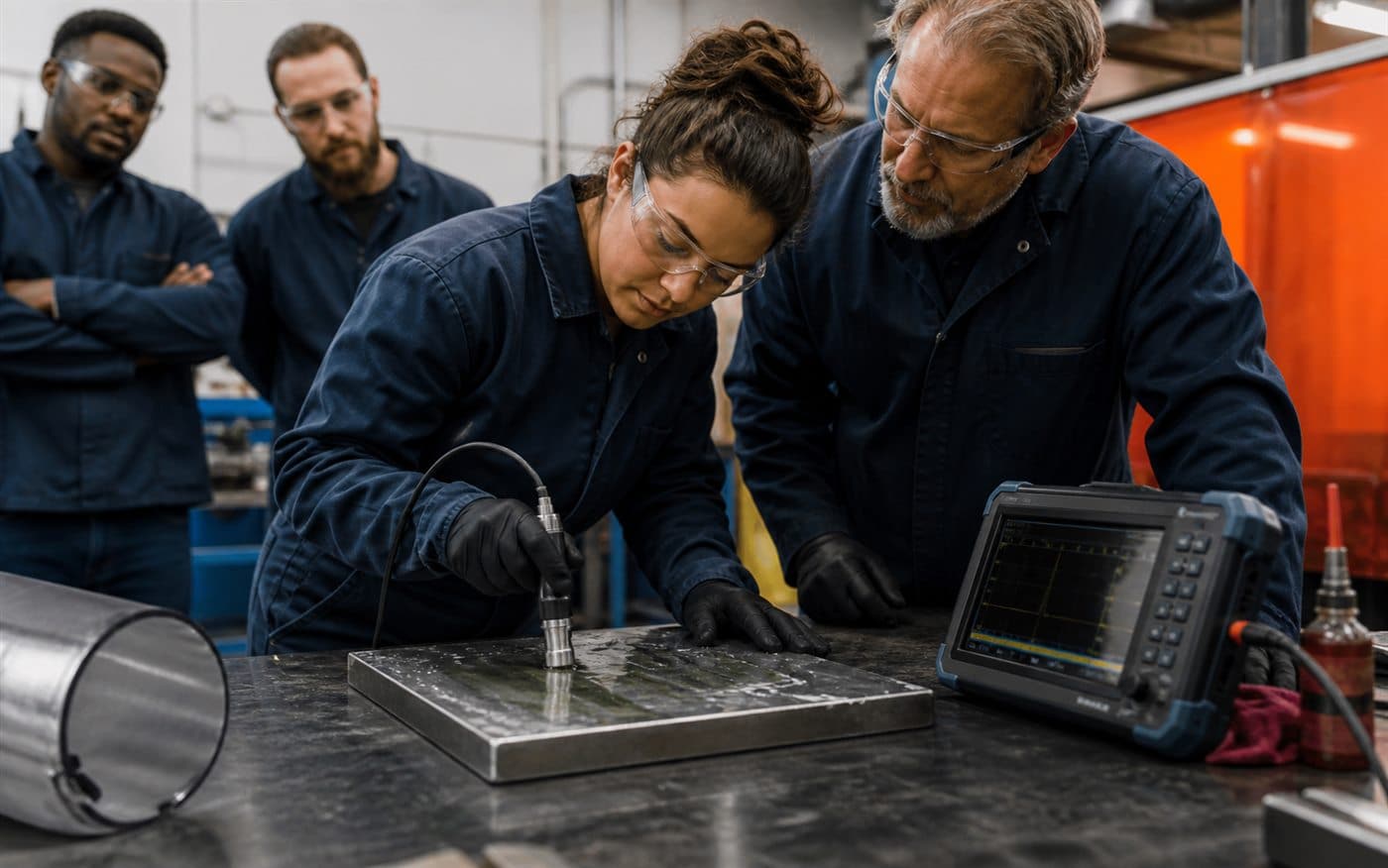
Technical schools and community colleges offer NDT programs that introduce several methods and provide lab practice. A good program should let students handle instruments, prepare specimens, read indications, and write reports.
Ask about the program’s practical hours, method coverage, instructor experience, employer relationships, and certification preparation. A course that only shows slides about ultrasonic testing is not the same as supervised practice with calibrated equipment.
Our online trade school guide can help you compare online theory with hands-on requirements. NDT is a field where the lab component matters.
Route 3: Enter an apprenticeship
Apprenticeship.gov lists Non-Destructive Testing Specialists under O*NET code 17-3029.01. The listing confirms that the occupation is recognized in the apprenticeship system, but it does not mean that every city has an active program.
Search Apprenticeship.gov, aerospace manufacturers, shipyards, inspection companies, unions, community colleges, and large industrial employers. Ask whether the program includes method training, supervised experience, classroom instruction, and a path to the employer’s written practice.
Route 4: Transfer from another technical field
NDT employers may value experience with welding, fabrication, machining, mechanical repair, electronics, quality systems, or military equipment. Those backgrounds can make materials, drawings, tools, and industrial discipline feel familiar.
The transferable skill is not the same as an NDT qualification. You still need to learn the chosen method, equipment, procedure, interpretation rules, and documentation requirements.
What do Level I, Level II, and Level III mean?
The levels describe increasing responsibility, but the exact requirements come from the employer’s written practice, customer requirements, industry rules, and the certification scheme being used.
Level I work is generally performed under supervision. A Level I technician may set up equipment, follow a procedure, collect readings, and record data within the limits of the qualification.
Level II technicians usually have a wider range of responsibility. They may select techniques within an approved procedure, interpret results, prepare reports, train junior staff, and work with less direct supervision.
Level III personnel commonly handle procedure development, method oversight, training, examinations, audits, and technical decisions. The title does not mean the same thing as an engineering license, and it does not make a person qualified in every NDT method.
ASNT explains that employer-based certification under an SNT-TC-1A-style program depends on the employer’s written practice. That document sets the training, experience, examination, and vision requirements used by that company. Another employer may use a different written practice or a third-party certification route.
Before enrolling in a program, ask which certification system it prepares you for. "NDT certified" is incomplete without the method, level, industry, and certifying organization.
Do you need ASNT certification?
Sometimes. The answer depends on the employer and contract.
ASNT offers Level II certification programs, while many companies certify personnel through an employer-based program. Customers, regulators, insurers, unions, and employers may prefer or require one route for a particular type of work.
Do not buy a certificate before reading local job postings. Look for the exact methods employers request, such as UT, MT, PT, RT, VT, or ET. Check whether the job requires Level I, Level II, a card from a specific organization, documented hours, or the ability to pass a company exam.
Vision requirements are also common. NDT work often requires near vision, color differentiation, or other visual ability depending on the method and written practice. The employer or certification program should explain how this is evaluated.
What skills matter most?
The technical equipment gets attention, but the everyday work depends on habits that are less glamorous.
Useful skills include:
- Reading procedures, drawings, codes, and acceptance criteria
- Understanding basic materials, welds, corrosion, and manufacturing processes
- Calibrating and checking instruments before use
- Distinguishing a real indication from noise, geometry, or poor setup
- Recording results clearly enough for another person to audit
- Working carefully around aircraft, pressure equipment, pipelines, vessels, or other high-value parts
- Communicating findings without exaggerating or hiding uncertainty
- Learning a method deeply instead of collecting shallow exposure to many methods
O*NET describes the occupation as requiring inspection, interpretation, documentation, problem-solving, and technical accuracy. That matches the practical reality. NDT is part hands-on measurement and part disciplined reasoning.
How much does an NDT technician make?
NDT technicians do not have a clean, standalone BLS wage line in the sources used for this article. O*NET places Non-Destructive Testing Specialists in a broader parent group called Engineering Technologists and Technicians, Except Drafters, All Other.
O*NET reports a $78,350 median annual wage for that broader group in 2025, about 67,300 workers in 2024, slower-than-average projected growth of 1% to 2%, and about 5,700 projected openings. Those figures are a proxy, not an NDT-specific salary. The parent group includes other technical occupations with different education, industries, and pay.
| Pay factor | Why it can change an NDT offer |
|---|---|
| Method | UT, RT, ET, advanced ultrasonic, and other specialties can have different requirements and premiums |
| Level | A qualified Level II usually carries more responsibility than a trainee or Level I worker |
| Industry | Aerospace, energy, shipbuilding, manufacturing, and field inspection use different pay structures |
| Travel | Per diem, travel time, rotation, and shutdown work may change total compensation |
| Shift | Nights, weekends, callouts, and outage work can affect earnings |
| Certification system | Employer-based and third-party credentials may open different job pools |
Job postings often advertise hourly pay, overtime, per diem, or project rates rather than a simple salary. Compare base pay with travel expectations, benefits, qualification costs, and the amount of time away from home.
Is NDT work dangerous?
The risk depends on the method and the worksite. NDT technicians may work around pressure equipment, aircraft, industrial machinery, chemicals, high temperatures, heights, confined spaces, or heavy components.
Radiographic testing adds ionizing-radiation hazards. OSHA’s radiation guidance explains that industrial radiography can use X-rays or radioactive gamma sources. The work requires strict control of the area, monitoring, procedures, and trained personnel. A company that cannot explain its radiation-safety program is not offering a small training gap. It is showing a serious problem.
Other methods can involve solvents, electrical equipment, magnets, high-pressure cleaning, lifting, noise, or access equipment. Personal protective equipment helps, but it does not replace hazard assessment, lockout procedures, ventilation, fall protection, confined-space rules, or qualified supervision.
The right interview question is not "Is NDT safe?" Ask which method you will perform, which hazards come with it, how the work is supervised, and what training happens before you enter the work area.
Is NDT physically demanding?
It can be, but the physical profile varies more than the job title suggests.
Shop work may involve standing, walking, lifting equipment, cleaning parts, and reaching around large components. Field inspection can mean climbing ladders, entering tight areas, carrying equipment, kneeling, or working outside in heat and cold. Aerospace or laboratory work may have more controlled conditions but still require long periods of concentration and precise hand work.
Some technicians spend more time interpreting data and writing reports as they gain experience. Others prefer field inspection and travel. Ask how much of the position is setup, scanning, climbing, reporting, driving, or overnight work.
Is NDT a good career change after 40?
It can suit a career changer who likes evidence, machinery, and rules that have a reason behind them. A background in welding, industrial maintenance, aviation, fabrication, quality, electronics, or military maintenance can help you understand the environment faster.
The transition may be frustrating if you expect a short certificate to produce an independent inspection job immediately. Employers and customers care about documented training, experience, method knowledge, vision requirements, and the ability to produce defensible reports.
Ask yourself:
- Do I enjoy careful measurement more than improvisational repair?
- Can I repeat a procedure exactly and still notice when conditions are wrong?
- Am I willing to start as a trainee or assistant?
- Can I work around industrial hazards without taking shortcuts?
- Am I comfortable with travel, shutdowns, shift work, or field assignments?
For the larger decision, see our career change after 40 roadmap.
How to compare NDT training programs
Before paying tuition, ask for the details in writing.
- Which methods are taught?
- How many hours are classroom, lab, and supervised field experience?
- Which certification or employer written practice does the program support?
- Are the instruments current and available for every student to use?
- Do students inspect real or realistic specimens with known indications?
- Does the program teach reports, procedures, calibration, and acceptance criteria?
- What employers hire graduates, and for which methods?
- Are travel, vision exams, PPE, test fees, and renewal costs included?
Be wary of a course that promises a Level II credential without explaining method-specific training, experience, examinations, or the certifying system. The phrase "NDT certification" is not enough detail to compare programs.
How to read an NDT job posting
Look for the method before the title. "NDT technician" could mean ultrasonic thickness work, weld inspection, aircraft testing, radiography, or a general trainee position.
Terms such as "Level II," "written practice," "SNT-TC-1A," "NAS 410," "ASNT," "UT thickness," "MPI," "LPI," "RT," "rope access," "API," or "shutdown" tell you more about the real job. If the listing includes several methods, ask which one takes most of the week.
Also check the practical conditions:
- How much travel is expected?
- Is the work shop-based, field-based, or both?
- Are nights and weekends common?
- Who pays for training, examinations, and certification renewals?
- Will I work under a Level II or Level III supervisor?
- Are reports written on paper, a tablet, or specialized software?
- What happens when the inspection finds a defect?
The last question matters. A good employer can explain how results are reviewed, escalated, documented, and protected from pressure to pass a part that does not meet the procedure.
Bottom line
NDT technicians help companies find flaws before a small problem becomes a failure. The work combines instruments, materials, procedures, judgment, and documentation. It is a strong fit for someone who prefers methodical inspection to guesswork.
The entry path is usually method-specific and supervised. Start with a credible employer, apprenticeship, or hands-on technical program. Learn how the certification system works before paying for a course, and compare the method, industry, travel, hazards, and reporting responsibility behind every job title.
Sources
- O*NET: Non-Destructive Testing Specialists
- Apprenticeship.gov: Non-Destructive Testing Specialists
- ASNT: NDT Technician career path
- ASNT: Employer-based certification programs
- ASNT: NDT Level II certification
- OSHA: Ionizing radiation hazards
\n
Reviewed September 3, 2026: NDT training is method-specific. Ask which inspection method, employer sector, classroom hours, practical experience, and certification path the program supports. See quality control inspection for a related route.
\n