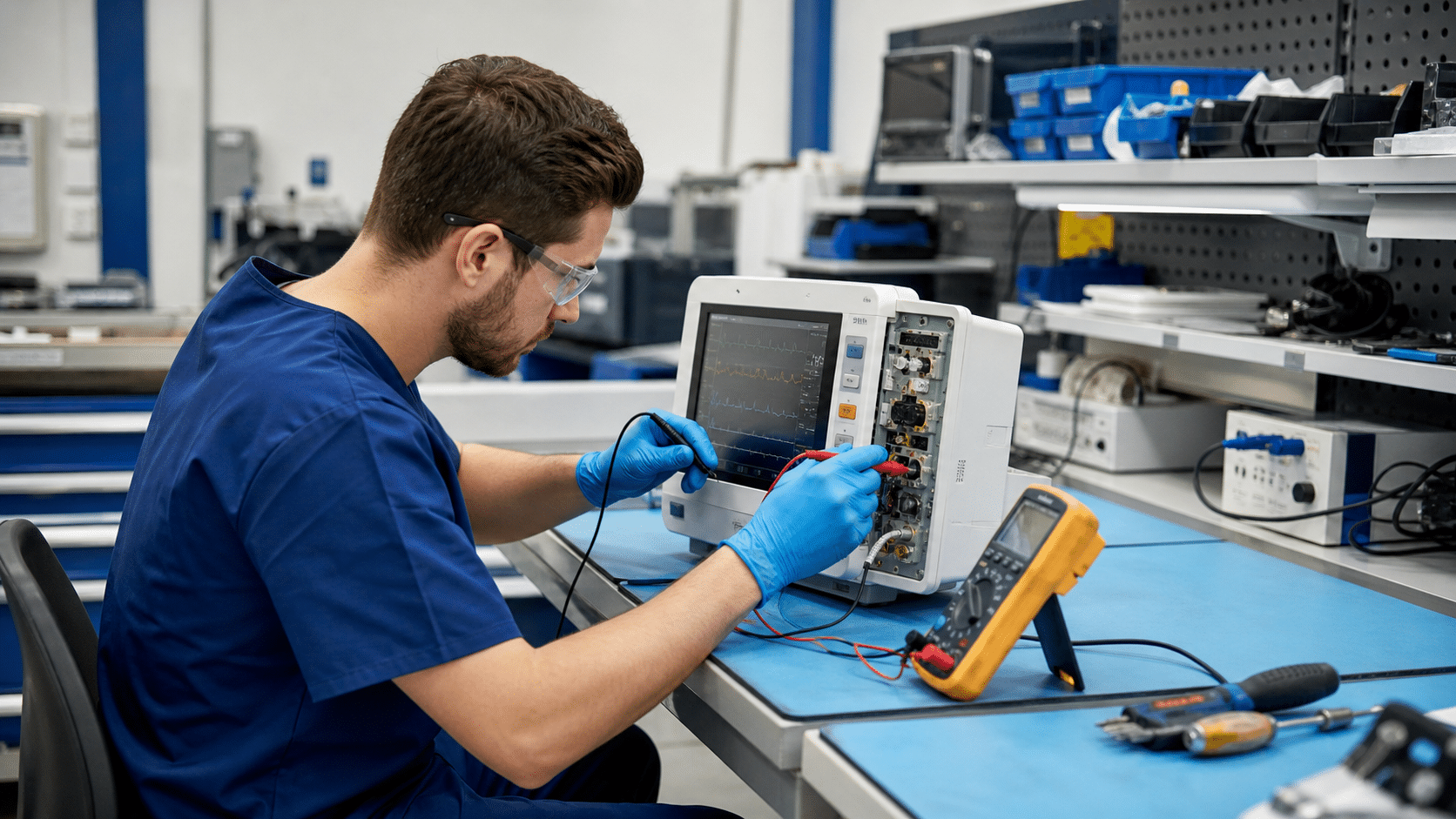
A medical equipment repairer keeps patient-care equipment working safely and reliably. The work can include installation, testing, calibration, preventive maintenance, troubleshooting, software updates, and repair records for equipment used in hospitals, clinics, laboratories, or home care. It is a technical healthcare career, not clinical care, so the role requires equipment knowledge, documentation, and careful communication with users.
The occupation is also commonly called biomedical equipment technician or BMET. Some repairers work on a broad range of hospital equipment. Others specialize in patient monitors, imaging systems, anesthesia machines, laboratory equipment, dental equipment, or a particular manufacturer’s product line.
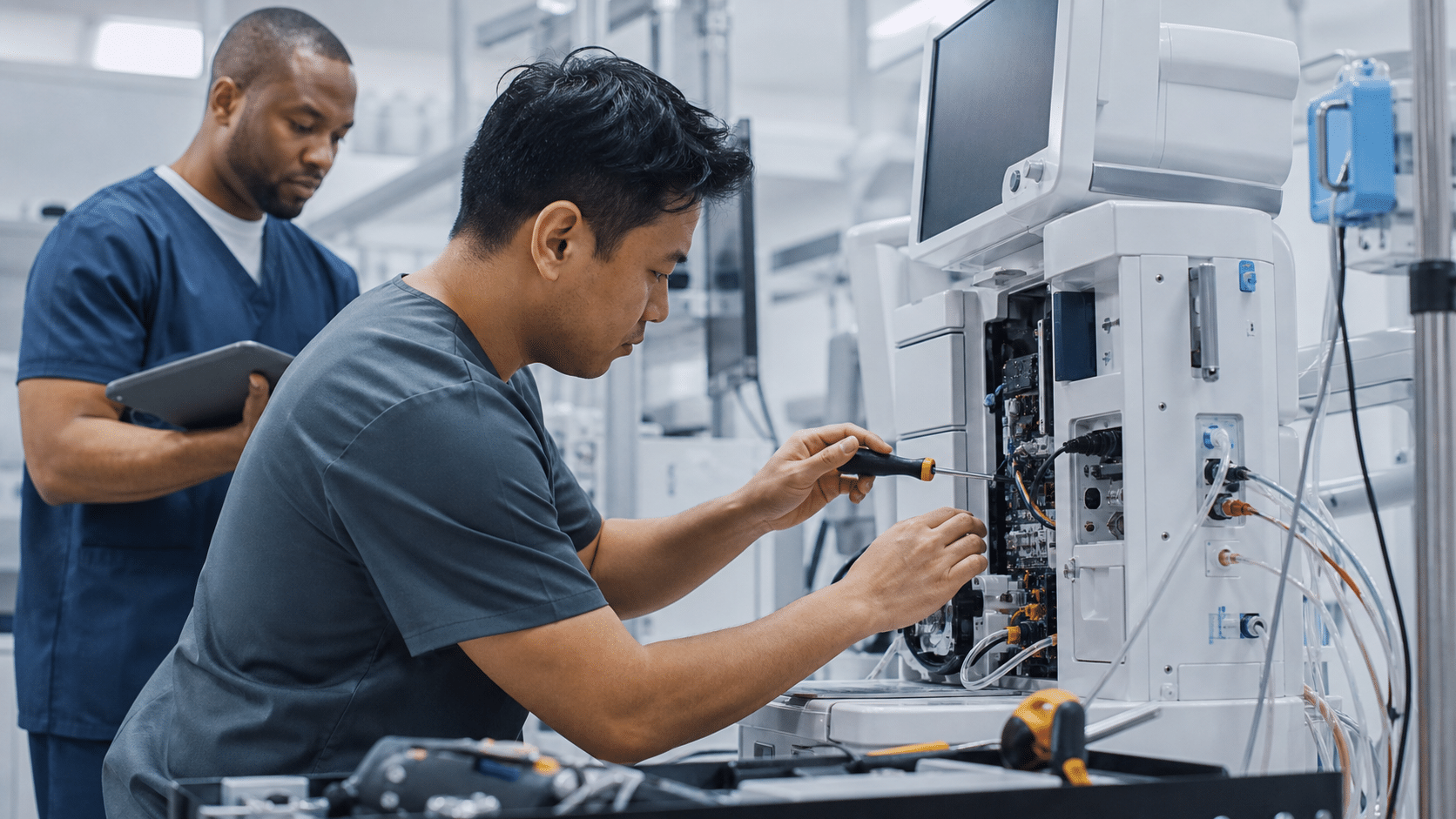
A device complaint needs a controlled check: The repairer confirms the model and symptom, reviews the service history, performs the approved test, and separates a hardware fault from a setup, software, or user issue. The equipment should return to service with a record that explains what was tested and why it is safe to use.
What does a medical equipment repairer do?
The repairer’s job is to understand how a device should operate, identify what is wrong, and restore it to the manufacturer’s and facility’s requirements. The work combines electronics, mechanics, hydraulics, software, documentation, and communication with clinical or facilities staff.
Typical duties include:
- installing medical equipment;
- testing and calibrating parts and systems;
- diagnosing faults with meters, analyzers, computers, and manufacturer software;
- repairing or replacing components;
- performing preventive maintenance and service;
- documenting inspections, repairs, and calibration results;
- explaining equipment operation to users;
- recommending replacement or new equipment when appropriate.
The equipment can range from patient monitors and defibrillators to ventilators, anesthesia machines, imaging equipment, electric beds, wheelchairs, and operating-room systems. The BLS notes that some repairers also work with the IT department when medical devices connect to networks, electronic health records, or other digital infrastructure.
The work is not about guessing until a device starts again. A repairer follows technical specifications, service manuals, testing procedures, and facility policies. The record of what was tested and changed matters almost as much as the repair itself.
Medical equipment repairer versus BMET
In everyday job postings, medical equipment repairer and biomedical equipment technician often describe the same general occupation. BMET is a common industry title, while the BLS uses medical equipment repairers in its occupational data.
| Title or role | Main focus | What can vary |
|---|---|---|
| Medical equipment repairer | Install, maintain, test, and repair patient-care equipment | Equipment mix and employer |
| Biomedical equipment technician | Technical service of biomedical and electronic equipment | Often used as the job title for the same occupation |
| Imaging equipment specialist | Service imaging systems and related components | May require manufacturer-specific training |
| Clinical engineering technician | Support equipment management in a healthcare system | May include inventory, compliance, and department coordination |
| Field service technician | Travel to customer sites for installation and repair | Territory, travel, and on-call rules |
Read the duties before assuming that every BMET role involves the same equipment or schedule. A hospital position may involve patient areas and facility rounds. A manufacturer or third-party service company may involve more driving, customer communication, and equipment-specific training.
Our instrumentation technician guide covers calibration and measurement in industrial settings. Medical equipment repair shares some diagnostic habits, but the equipment, documentation, and patient-facing environment are different.
Where medical equipment repairers work
Medical equipment repairers work in hospitals, clinics, ambulatory healthcare facilities, equipment rental companies, manufacturers, and professional or commercial equipment wholesalers. Some work in a hospital biomedical department. Others travel between customer sites as a field service technician.
The BLS reports that professional and commercial equipment and supplies merchant wholesalers employed the largest share of workers in 2025, followed by electronic and precision equipment repair and maintenance, hospitals, rental and leasing services, and ambulatory healthcare services.
The work setting can be a workshop, an operating room, a patient room, a diagnostic department, a warehouse, or a service vehicle. Repairers working around patients may need personal protective equipment and may be exposed to germs or other health risks. A device failure can be urgent, especially when a department depends on it for scheduled care.
What is the schedule like?
Most repairers work full time and often work during the day. The BLS also notes that some are on call during evenings and weekends. The schedule depends on the equipment, the employer, and whether the role supports a hospital or a service territory.
Ask whether on-call work is rotating, how quickly a technician must respond, and whether travel time is paid. A field-service position may involve long drives, overnight travel, or a vehicle and mileage policy. A hospital role may keep you at one campus but require fast response when critical equipment is unavailable.
The pressure is practical rather than theatrical. The technician may need to communicate clearly while a department waits for a device to return to service. Good documentation and calm troubleshooting are valuable because the cost of a rushed or unexplained repair can be high.
Education and entry requirements
The BLS lists an associate degree or certificate in biomedical technology or a related field as the typical preparation. Relevant programs may cover electronics, anatomy and physiology, medical terminology, computer systems, electrical safety, test equipment, and troubleshooting.
The associate-degree path is common, but it is not the only route. Some workers enter with a high school diploma plus relevant training or experience. Military biomedical-equipment experience, avionics, electronics, electromechanical repair, instrumentation, or industrial maintenance can provide useful foundations.
Employers may also consider whether a candidate can:
- read technical manuals and schematics;
- use a multimeter and other diagnostic equipment;
- work carefully with small parts and connectors;
- record test results accurately;
- explain technical information to nontechnical staff;
- respect patient privacy, facility access, and infection-control rules;
- travel or participate in an on-call rotation.
The online trade school guide explains why online coursework can build theory but may not replace hands-on practice with test equipment and real devices.
How BMET training works
New workers usually observe experienced repairers for several months and help with basic tasks before becoming more independent. The BLS emphasizes that each piece of equipment is different, so the technician must learn the specifications, operating manual, maintenance schedule, and testing requirements for each system.
Training may come from a community college, employer, apprenticeship, equipment manufacturer, or third-party service company. Manufacturer training can be especially important for specialized systems, but it does not necessarily qualify someone to service every brand or equipment category.
Before enrolling or accepting a trainee role, ask:
- Which equipment categories will the program cover?
- How much of the training is hands-on?
- Are lab hours included, and what equipment is available?
- Does the employer provide manufacturer training after hiring?
- How are repairs reviewed before independent work?
- What documentation and compliance systems will I learn?
- Is travel, on-call work, or patient-area access part of the role?
Someone with a strong electronics or maintenance background may learn the diagnostic side quickly, but healthcare equipment adds its own documentation, safety, privacy, and user-training expectations.
Certification and licensing
The BLS says professional certification is not mandatory, although it can demonstrate competency. Requirements are not identical across employers or equipment specialties. Before paying for a certification, check which credentials appear in the job postings you want and whether the employer recognizes them.
Certification should also be separated from authorization to work on a particular device. A hospital, manufacturer, or service contractor may require equipment-specific training, internal qualification, or documented experience even when a national certification is not legally required.
There is no single license that makes someone qualified to repair every medical device. The employer’s policies, manufacturer instructions, facility rules, and applicable regulations determine what work can be performed and how it must be documented. If the position includes networked equipment, ask how cybersecurity and software-update responsibilities are handled.
Medical equipment repairer salary
The BLS reported a median annual wage of $61,660 in May 2025, or about $29.64 per hour as an hourly equivalent. The lowest 10 percent earned less than $38,490, while the highest 10 percent earned more than $98,280.
| BLS measure | May 2025 figure |
|---|---|
| Median annual wage | $61,660 |
| Approximate hourly equivalent | $29.64 |
| Lowest 10 percent | Less than $38,490 |
| Highest 10 percent | More than $98,280 |
The figures cover a broad occupation. Pay can change with employer type, specialization, travel, overtime, on-call responsibilities, manufacturer training, and experience. A field-service job may use a different compensation structure from a hospital biomedical department.
The BLS reports these industry medians for May 2025:
| Industry | Median annual wage |
|---|---|
| Hospitals | $75,390 |
| Professional and commercial equipment and supplies merchant wholesalers | $63,050 |
| Electronic and precision equipment repair and maintenance | $62,430 |
| Ambulatory healthcare services | $61,510 |
| Rental and leasing services | $45,020 |
An industry median is not a guaranteed offer. Compare the base salary with travel pay, vehicle policy, overtime, benefits, training costs, and the time required to reach independent work.
Job outlook and technology
The BLS projects employment of medical equipment repairers to grow 13 percent from 2025 to 2035, much faster than the average for all occupations. It projects about 8,200 openings per year, on average, over the decade.
The demand is tied to the growing amount and complexity of equipment used to diagnose, monitor, and treat patients. More devices also mean more calibration, preventive maintenance, software updates, network coordination, and replacement decisions.
Technology changes the work, but it does not remove the need for careful technicians. The strongest candidates may need to understand electronics, mechanical assemblies, software, connectivity, cybersecurity basics, and the documentation that supports safe equipment use. That is a wider skill set than simply replacing a failed part.
Safety and patient-facing work
Medical equipment repair is not clinical care, but the repairer works in an environment where equipment can affect patient care. Follow the employer’s procedures, manufacturer instructions, and required training. Do not work beyond your authorization or improvise with a device because a department is under time pressure.
The BLS notes possible exposure to germs, diseases, and other health risks when working around patients. Installation and repair may also require lifting heavy equipment, working in tight spaces, and using protective equipment. A technician should ask how the employer handles infection control, equipment isolation, electrical safety, and access to patient areas.
Documentation is a safety skill. A clear service record tells the next technician what was found, what was tested, what was replaced, and what still needs attention. Communication with nurses, clinicians, facilities teams, IT staff, and managers is part of the job even when the repair itself is highly technical.
Is this a good second career after 40?
It can be a strong option for someone who enjoys troubleshooting but wants a healthcare setting rather than a factory or construction site. Experience in electronics, instrumentation, industrial maintenance, aviation, telecommunications, or the military can transfer in useful ways.
The transition may still require formal study, especially if local employers prefer an associate degree or biomedical certificate. You may also need to become comfortable with hospital access rules, patient-area etiquette, on-call work, and detailed documentation.
Before enrolling, compare the total cost and lab access with actual local job postings. Ask employers which credentials they prefer, whether they hire trainees, and how much manufacturer training is provided after hiring. The career-change roadmap after 40 can help you compare the training timeline with your financial runway.
If you prefer industrial sensors and calibration, the instrumentation technician guide may be closer to your interests. If you prefer broad factory equipment, compare the industrial maintenance technician guide. If you prefer electrical systems and controls, see the industrial electrician guide.
Questions to ask before applying
Use these questions to evaluate a school or job posting:
- Which devices or equipment categories will I service?
- Is the role hospital-based, field service, manufacturer-based, or rental-based?
- Is an associate degree required, preferred, or replaceable by experience?
- What hands-on lab or supervised training is included?
- Which certifications or manufacturer qualifications matter here?
- How much travel, lifting, on-call work, and weekend coverage is expected?
- Will I work in patient rooms or clinical departments?
- How are service records, calibration results, and software changes documented?
- What training covers infection control, electrical safety, and privacy?
- What does the compensation package include beyond the base wage?
The answers will tell you whether the position is a true technical training path or a general equipment-support job using a more specialized title.
Bottom line
A medical equipment repairer, often called a BMET, installs, tests, calibrates, maintains, and repairs equipment used in healthcare. The usual preparation is an associate degree or certificate in biomedical technology, but relevant military, electronics, electromechanical, or maintenance experience can open other entry routes.
The BLS reports a median wage of $61,660 in May 2025 and projects 13 percent growth from 2025 to 2035. The work calls for technical accuracy, documentation, communication, and respect for patient-facing safety rules. For a second career, the best opportunity is the one with clear equipment training, realistic on-call expectations, and a credential employers actually recognize.
Sources
- U.S. Bureau of Labor Statistics: Medical Equipment Repairers
- O*NET OnLine: Medical Equipment Repairers
- CareerOneStop: Medical Equipment Repairers
\n
Reviewed September 3, 2026: Medical equipment repair is technical healthcare work, not patient care. Compare the equipment, travel, on-call expectations, electronics background, and employer training before enrolling. See biomedical equipment technician work for the related title.