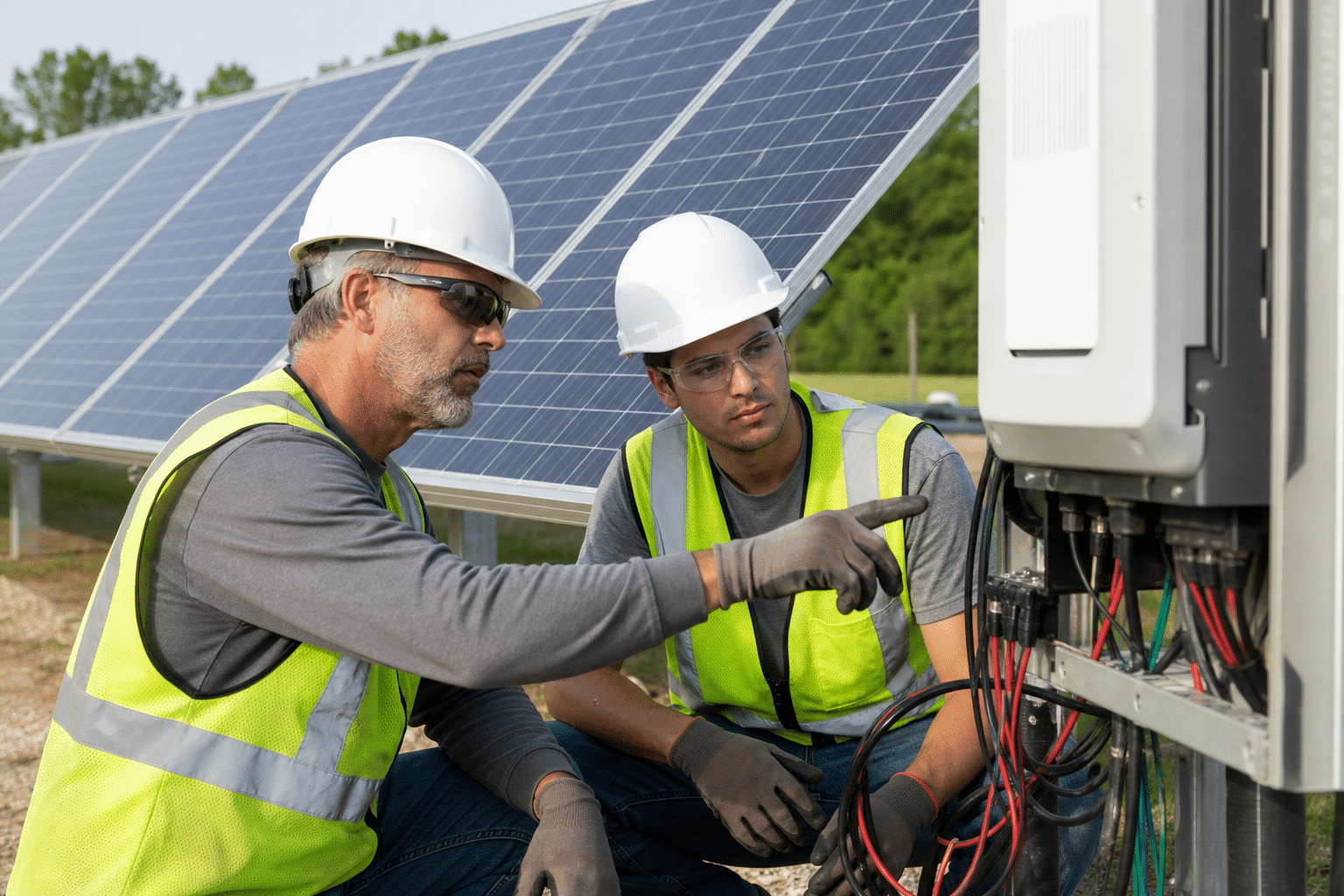
A solar installer assembles and installs photovoltaic systems on roofs, structures, and ground-mounted sites. The work can include layout, racking, modules, wiring, inverters, grounding, weather sealing, lifting, fall protection, and commissioning checks. The job is physically demanding and detail-sensitive because the electrical work and the roof or site work have to meet at the same time.
The roof creates its own constraints: The installer may need to work around access points, roof condition, shading, conduit routes, weather, and the structural plan while keeping wiring protected and organized. A panel can be mounted correctly and still leave a problem if penetrations, grounding, labels, or cable management are incomplete.
A practical look at solar installation work
A solar installer assembles and installs photovoltaic systems on roofs, structures, and ground-mounted sites. The work can include layout, racking, modules, wiring, inverters, grounding, weather sealing, lifting, fall protection, and commissioning checks. The job is physically demanding and detail-sensitive because the electrical work and the roof or site work have to meet at the same time.
A solar installer, often called a solar photovoltaic (PV) installer, helps build and commission systems that turn sunlight into electricity. The work can include roof preparation, racking, panel placement, conduit, wiring, equipment checks, and documentation. The exact boundary between an installer and a licensed electrician depends on the employer, the project, and state or local rules.
That distinction matters if you are changing careers. You do not necessarily need a four-year degree to enter solar installation, but you do need to be comfortable with tools, measurements, outdoor work, heights, and a safety-first pace. This guide explains the main entry routes, the role of certification, realistic pay information, and the questions worth asking before you enroll in a program.
Solar installer at a glance
| Question | Short answer |
|---|---|
| What is the job? | Installing, testing, and maintaining solar PV equipment on homes, businesses, and larger sites. |
| Typical starting point | High school diploma or equivalent, basic construction ability, and employer training. |
| Degree required? | Usually no. Technical courses, an apprenticeship, or related trade experience can help. |
| Certification | NABCEP credentials are voluntary professional certifications, not a universal state license. |
| BLS median pay | $53,140 per year in May 2025 for solar photovoltaic installers. |
| BLS outlook | 37% projected growth from 2025 to 2035, with about 4,200 openings per year. |
| Main tradeoff | Strong projected demand, but the work is physical and may involve roofs, heat, travel, or changing schedules. |
The Bureau of Labor Statistics (BLS) counted 31,100 solar photovoltaic installer jobs in 2025 and projects about 42,400 in 2035. Those numbers describe the occupation nationally, not a guaranteed wage or opening in your town.
What does a solar installer do?
Installation is a sequence of small decisions. A crew has to place equipment accurately, protect the building, make clean connections, and leave a system that can be inspected and serviced later.
Common duties may include:
- reviewing a plan, roof layout, equipment list, and work order;
- checking the work area and preparing materials;
- measuring and installing roof attachments, rails, racking, or ground-mount supports;
- lifting and securing PV modules in the planned layout;
- routing conduit and conductors according to the crew’s role and the applicable requirements;
- helping install inverters, disconnects, rapid-shutdown equipment, batteries, or monitoring hardware;
- weatherproofing penetrations and checking that mounts are secure;
- using meters and other test equipment under the direction of qualified personnel;
- correcting installation issues found during inspection or commissioning; and
- recording serial numbers, photos, test results, and changes to the job file.
Some installers concentrate on the mechanical side of a project. Others are trained for more electrical work or move into service and commissioning. A job title alone does not tell you what you will be allowed or expected to do. Ask the employer how responsibilities are divided between the installation crew, the electrician, the designer, and the inspector.
Solar installer versus related roles
Solar work has several lanes. Knowing the difference can keep you from paying for training aimed at the wrong job.
Solar PV installer
The installer works on the physical build: mounting systems, modules, wiring pathways, equipment, and jobsite completion. Entry-level positions may be called installer, installation assistant, solar laborer, or PV installer.
Solar technician or service technician
The technician diagnoses faults, replaces components, checks monitoring data, and returns to systems that are already operating. This path can involve more troubleshooting and electrical measurement than a new-installation position.
Electrician
An electrician may be responsible for parts of the AC-side connection, service equipment, permits, or final electrical work. Licensing is jurisdiction-specific. Solar training can complement an electrical career, but it does not automatically replace an electrical apprenticeship or license.
Solar designer, estimator, or salesperson
These roles may use site measurements and system knowledge, but they are not the same as installing panels. They may be a better fit if you prefer customer conversations, drafting, calculations, or project coordination over ladders and heavy materials.
Where solar installers work
Residential rooftop work is the image most people have in mind. Crews may also install systems on commercial roofs, carports, agricultural buildings, and ground-mounted arrays. Larger projects can involve repeated work across a broad site, while residential work often means adapting to different roofs and customer properties every day.
Operations and maintenance creates another setting. Instead of building a new system, you may inspect modules, trace a fault, replace a damaged component, or help verify that production has returned to normal.
The setting affects the job more than the word solar suggests. A residential crew may drive between several addresses. A utility-scale crew may work outdoors on one large site for weeks. A service technician may spend more time troubleshooting and documenting than mounting equipment.
How to become a solar installer
There is no single national school or license that every new installer must complete. Most people enter through one of four routes.
1. Start with an employer
Many companies train entry-level hires on their installation methods. This can be the most direct route if you already have construction, roofing, warehouse, electrical, HVAC, or mechanical experience.
Look for an employer that explains the training plan, pay progression, equipment you will handle, and who supervises electrical tasks. A job posting that says entry level should still tell you whether it expects roofing experience, a driver’s license, travel, or ladder work.
2. Take a short technical course
Community colleges, technical schools, and workforce programs may offer PV fundamentals, electrical basics, construction safety, or solar installation courses. A useful class should include hands-on practice or a clear lab component, not just a list of online videos.
Short training can help you speak the language of the trade and show an employer that you understand basic concepts. It does not guarantee a job, and a certificate of completion is not the same thing as a professional certification or a state license.
If you are comparing programs, our guide to online trade school options can help you think through hands-on requirements, lab access, cost, and employer recognition.
3. Find an apprenticeship
The U.S. Department of Labor lists solar photovoltaic installers under occupation code 47-2231.00. Apprenticeships can combine paid on-the-job learning with related instruction, but programs differ by sponsor and location.
Before applying, ask who the sponsor is, whether the position is paid from the first day, how wage increases work, how much classroom instruction is required, and which tasks apprentices actually perform. Also ask whether the training leads to a credential that local employers recognize.
4. Build from an adjacent trade
Roofers, carpenters, electricians, HVAC technicians, industrial maintenance workers, and construction laborers may already have useful habits: reading a plan, staging materials, working safely, and finishing a job neatly. The gaps may be PV system knowledge, electrical fundamentals, and the employer’s installation standards.
Our guides to industrial electrician work and industrial maintenance technician careers show how related technical skills can lead to different work environments. They are not substitutes for solar-specific training, but they can help you compare paths.
Training that actually helps
A good beginner foundation covers more than the names of solar components. You should expect to learn:
- safe use of hand tools, power tools, ladders, and material-handling equipment;
- measurements, layout, roof and ground-mount hardware, and torque practices;
- the difference between PV modules, racking, inverters, disconnects, batteries, and monitoring equipment;
- basic DC and AC concepts and why polarity, grounding, and conductor routing matter;
- how to read a simple plan, equipment label, one-line diagram, or installation manual;
- weatherproofing, cable management, labeling, and cleanup;
- how inspections and commissioning fit into the project; and
- how to stop and ask for qualified guidance when a task falls outside your role.
You do not need to know every code article before your first day. You do need to respect the fact that solar equipment can remain energized in daylight and that mistakes can create electrical, fall, fire, or property hazards. Training should make those risks concrete and give you a clear chain of supervision.
Do you need solar installer certification?
Certification and licensing are different questions. NABCEP offers voluntary professional certifications for people working in renewable energy. Its credentials include the PV Installation Professional (PVIP) and PV Installer Specialist (PVIS), among others.
The PVIP certification is designed to validate competence across PV system design, installation, operations, commissioning, and maintenance. It is not an automatic substitute for a state or local license, permit requirement, or employer qualification. A beginner may start with foundational training or an entry-level credential, then build documented experience before pursuing a board certification.
NABCEP’s requirements change by credential. The Board Eligible PVIP route, for example, combines classroom training, work experience, and an exam, with a period to complete the experience requirement. Read the current requirements before paying an application or exam fee. Passing an exam by itself does not mean that you hold every certification or authorization needed for a job.
Ask a training provider exactly what its credential is called, who issues it, whether it includes hands-on work, and how employers in your area view it. Be cautious with any school that presents a short course as a universal solar license.
Solar installer salary and job outlook
The BLS reports a May 2025 median annual wage of $53,140 for solar photovoltaic installers. The lowest 10 percent earned less than $41,600, while the highest 10 percent earned more than $79,970. These are national occupation figures, not an entry-level promise.
Pay can change with experience, region, union status, travel, overtime, commercial versus residential work, service responsibility, and the employer’s bonus structure. Some solar sales jobs advertise higher earning potential, but commission income should not be compared directly with an installation wage.
The projected outlook is unusually strong: BLS projects 37 percent growth from 2025 to 2035 and about 4,200 openings per year. That is a useful signal that the occupation is expanding, but it does not remove the need to check local employers. Search for actual openings in your area and compare starting pay, travel, benefits, seasonal patterns, and advancement routes.
The physical side of the work
Solar installation can involve climbing, working on sloped or elevated surfaces, carrying panels and racking, kneeling, reaching, gripping tools, and spending long periods outside. Heat, cold, wind, glare, dust, and wet conditions can affect the day. A ground-mount job may reduce roof exposure but can still require lifting, walking, and repetitive installation work.
If you are considering a career change after 40, treat a realistic jobsite preview as part of your research. Ask to shadow a crew if the company allows it, or take an introductory hands-on class. Your goal is not to prove that you can tolerate one difficult day. It is to learn whether the normal pace, body positions, commute, and weather exposure are sustainable for you.
Experience can help in other ways. People coming from construction, facilities, manufacturing, logistics, electrical work, or maintenance may bring strong habits around tools, documentation, and troubleshooting. The transition still requires learning PV equipment and the employer’s safety process, but you are not starting from zero.
For a broader career-change framework, see our practical roadmap for changing careers at 40.
Questions to ask before accepting a job
| Topic | Question to ask |
|---|---|
| Daily work | How much of the job is rooftop, ground-mount, warehouse, driving, or service work? |
| Electrical scope | Which tasks can an entry-level installer perform, and who signs off on electrical work? |
| Training | What happens during the first 30, 60, and 90 days? |
| Pay | What is the starting wage, when are reviews held, and is overtime common or seasonal? |
| Travel | How far do crews travel, and are mileage, lodging, or per diem covered? |
| Equipment | Does the company provide fall-protection equipment, tools, and work vehicles? |
| Advancement | Can installers move into service, crew leadership, electrical work, estimating, or project coordination? |
These questions are more useful than asking whether solar is a “hot industry.” They connect the national outlook to the job you would actually take.
Is solar installation a good second-act career?
Solar installation can be a good fit if you want practical work, a visible product, and a path that can begin without a four-year degree. The projected demand is attractive, and related construction or technical experience can shorten the learning curve.
It is a weaker fit if you want mostly indoor work, predictable temperatures, minimal lifting, or little travel. It is also not the right choice to make from a salary headline alone. Compare the physical demands and local job quality with alternatives such as electrical, HVAC, maintenance, or fiber work.
The best first step is usually modest: talk to two local employers, inspect a training syllabus, and find out whether you can observe or try the work safely. Then choose the entry route that gives you both real practice and a credible next step.
Related guides: Elevator Mechanic Salary: Pay by Experience, Industry and Location and Diesel Mechanic Apprenticeships: Paid Training, Requirements and What to Expect.
Sources
- U.S. Bureau of Labor Statistics: Solar Photovoltaic Installers
- U.S. Bureau of Labor Statistics: Occupational Projections and Characteristics
- NABCEP: Board Certifications
- NABCEP: Frequently Asked Questions
- NABCEP: Board Eligible PV Installation Professional
- Apprenticeship.gov: Solar photovoltaic installers
\n
Reviewed September 3, 2026: Solar installer work varies by roof, ground mount, electrical scope, weather, travel, and crew structure. Ask about safety training, certification, and the actual installation tasks before enrolling. See industrial electrical work.
\n