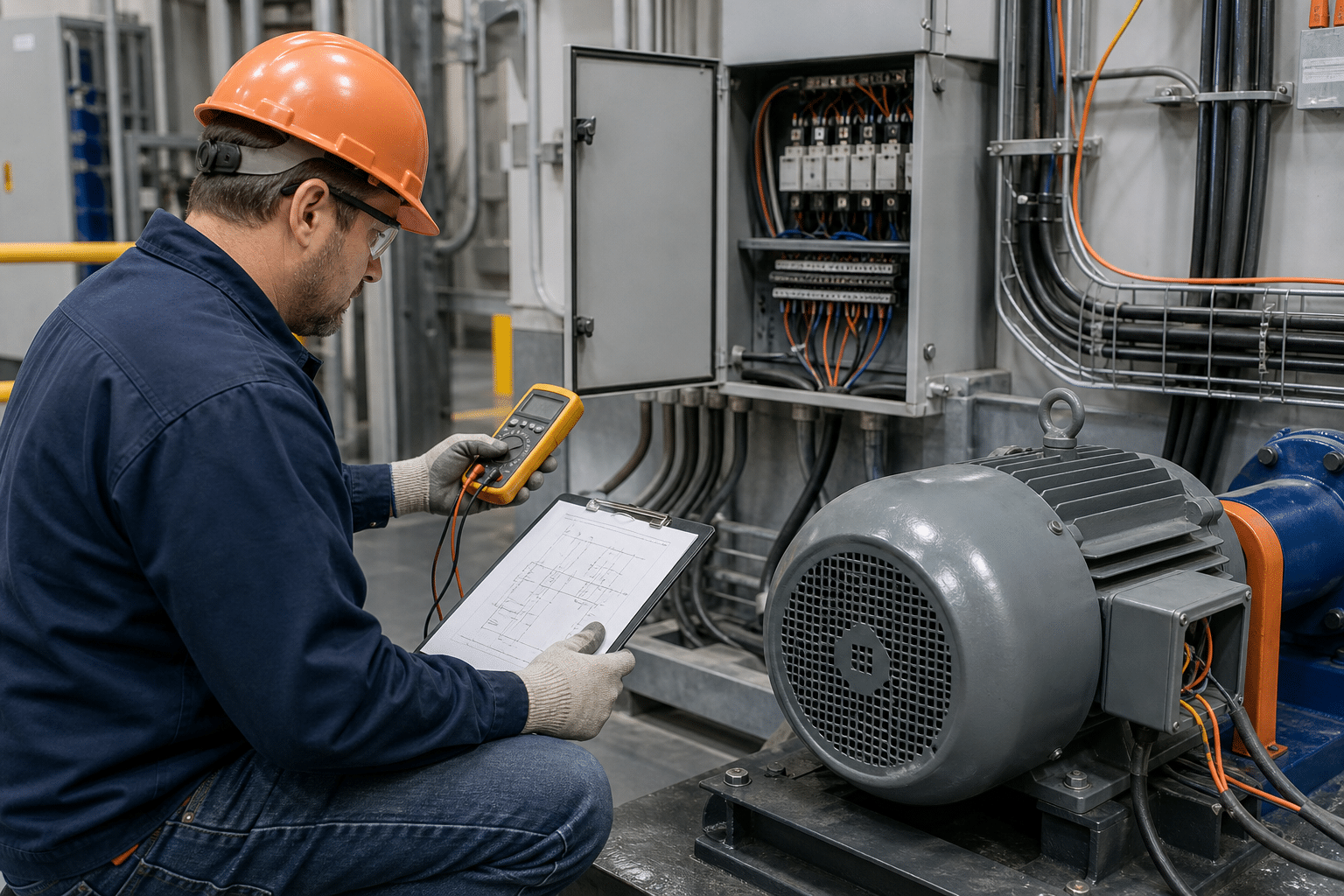
An industrial electrician works on the electrical systems that keep factories, processing plants, warehouses, and production equipment operating. The job may include installation, preventive maintenance, motor controls, sensors, panels, troubleshooting, and safe isolation before work begins. The right training route depends on whether you want maintenance, construction, controls, or a blend of those tasks.
That is different from saying “industrial electrician” is one tightly regulated job title everywhere in the United States. Employers may use related titles such as maintenance electrician, electrical technician, controls technician, or industrial maintenance technician. Read the duties in the job posting, because the title alone will not tell you whether the work is mostly installation, troubleshooting, preventive maintenance, or a mix.
This guide explains the day-to-day work, the skills that matter, the main entry routes, licensing questions, pay data, and the trade-offs for someone considering a career change after 40.

Look at the equipment list in the posting: Mentions of VFDs, PLC inputs, motor starters, safety circuits, and preventive maintenance point toward plant troubleshooting. Mentions of conduit, cable pulls, terminations, and new installations point toward construction or project work. That distinction matters when choosing training.
Industrial electrician at a glance
| Question | Practical answer |
|---|---|
| Main purpose | Install, maintain, test, and repair electrical systems used by industrial equipment |
| Common equipment | Motors, disconnects, control panels, sensors, variable-frequency drives, conveyors, pumps, and production machinery |
| Typical entry routes | Helper or trainee work, technical school, employer program, or apprenticeship |
| License | Depends on the state, local authority, employer, and type of electrical work |
| Work pattern | Often full time; shifts, planned shutdowns, overtime, or on-call work may apply |
| First-job test | Can you work safely, read basic diagrams, use measurements, and explain a troubleshooting step? |
What does an industrial electrician do?
The U.S. Bureau of Labor Statistics describes electricians as workers who install, maintain, and repair power, lighting, communications, and control systems. In a factory or plant, the same foundation is applied to equipment that has to run reliably and safely.
A normal week might include:
- installing conduit, cable, disconnects, panels, or control wiring;
- checking motors, starters, relays, sensors, and protective devices;
- reading electrical drawings, manuals, work orders, and equipment histories;
- using meters and other test instruments to narrow down a fault;
- replacing damaged components or correcting a wiring problem;
- working with mechanical or maintenance staff during a machine repair; and
- testing the equipment and recording what was found and changed.
The balance varies by employer. A new production line may create more installation and commissioning work. An older plant may need more preventive maintenance and breakdown response. A food-processing site, paper mill, warehouse, water facility, or automotive plant will expose you to different equipment and rules.
Some jobs also touch controls and automation. You may learn to identify a sensor, follow a control circuit, check a motor starter, or understand what a programmable controller is reporting. That does not mean every industrial electrician programs PLCs or repairs every electronic component. Ask what the role actually owns and what is handled by controls engineers, instrumentation staff, or outside contractors.
How the job differs from residential electrical work
Both jobs require electrical theory, safe work habits, code awareness, and careful testing. The setting changes the problems you solve.
| Industrial electrical work | Residential electrical work |
|---|---|
| Motors, production machinery, controls, sensors, and plant distribution | Service panels, branch circuits, lighting, outlets, and home systems |
| Planned shutdowns, shift work, and production deadlines are common | Schedules often follow construction, service calls, or remodeling work |
| You may work beside maintenance, operators, mechanics, and engineers | You may work with homeowners, builders, inspectors, and other residential trades |
| Noise, machine guarding, stored energy, and site procedures matter every day | Occupied homes, ladders, crawl spaces, and customer communication shape the work |
Neither path is automatically easier. If you like tracing a fault through a system and learning how equipment behaves, industrial work may suit you. If you prefer visible installations that change from one home or construction site to the next, residential work may be a better fit.
Skills employers look for
Electrical fundamentals
You should be willing to learn voltage, current, resistance, circuits, motors, grounding, overload protection, and safe testing. You do not need to memorize every industrial component before applying, but you must take the basics seriously. Sloppy electrical work can damage equipment or hurt someone.
Diagram reading and measurement
Industrial troubleshooting often starts with a drawing and a symptom. You may need to follow a circuit, identify a terminal, compare a reading with the expected value, and decide what to test next. Employers also care about whether you write down readings and explain your reasoning.
Mechanical awareness
Electrical faults do not always begin in the electrical part of a machine. A jammed conveyor, worn bearing, loose coupling, overheated motor, or failed sensor can create symptoms that cross trade boundaries. You may not repair every mechanical problem, but understanding the system helps you avoid guessing.
Safety judgment
Industrial equipment can contain electrical, mechanical, hydraulic, pneumatic, thermal, and other forms of stored energy. OSHA’s lockout/tagout standard requires employers to use procedures that prevent unexpected energization, startup, or release of stored energy during servicing and maintenance.
In practical terms, a beginner needs training on the employer’s energy-control procedure, machine guarding, required protective equipment, and stop-work rules. A safety certificate does not give someone permission to open every panel or work on every machine. Authorization comes from the employer’s procedures, training, and supervision.
Communication
Production work is shared work. The next shift needs to know what failed, what was tested, which part was replaced, and what still needs attention. Clear notes can be as useful as a good repair.
How to become an industrial electrician
There is no single national route. Start with the jobs available near you, then choose training that matches those jobs.
1. Start as a helper or trainee
Search for industrial electrical helper, maintenance electrician trainee, electrical technician trainee, electromechanical technician, or production maintenance roles. This route lets you test the workplace before paying for a long program.
Look for evidence of real instruction. Ask which systems you will learn, who supervises your work, how skills are reviewed, and whether pay changes as your responsibilities grow. A job that says “training provided” may be a structured entry route, or it may mean that you are expected to learn by watching whoever has time.
2. Attend technical school or community college
Useful programs may be called industrial electricity, electrical technology, mechatronics, electromechanical technology, or industrial maintenance. Compare the lab time and equipment, not just the course title.
For this target, look for practice with motor controls, electrical measurements, schematics, conduit or wiring methods, industrial safety, sensors, and basic automation. Ask local employers which credentials they recognize. A program with employer connections and supervised lab work can be more useful than a cheaper course that leaves you with no way to demonstrate practical skills.
Before paying a deposit, use our guide to choosing a trade school without overpaying. Our online trade school guide explains why online lessons are usually stronger when paired with lab practice or employer training.
3. Apply for an apprenticeship
Registered Apprenticeship programs can combine paid work, a mentor, related classroom instruction, progressive wage increases, and a portable credential. The exact sponsor, wage schedule, classroom provider, and occupation standard vary.
Use Apprenticeship.gov’s career-seeker resources and its job finder, then read each employer’s listing carefully. Some opportunities may be listed under electrician, maintenance electrician, electrical technician, or industrial maintenance rather than industrial electrician.
Our guide to electrician apprenticeships covers the general application questions. An industrial program may add requirements related to shift work, mechanical aptitude, algebra, tools, driving, or plant safety.
4. Build from related maintenance work
Some people enter through industrial maintenance, equipment repair, facilities, or machine operation and add electrical skills over time. That can work when the employer has clear boundaries and training. It becomes risky when a worker is asked to troubleshoot electrical equipment without the authority or instruction to do it safely.
Our guide to the industrial maintenance technician role explains the overlap. The two paths can share equipment and troubleshooting habits, but an industrial electrician may face more electrical installation, testing, and code-related responsibility.
Licensing and certification questions
Most states require electricians to be licensed, but the requirements can vary by state and locality. A factory employee, electrical contractor, maintenance technician, and independent contractor may not face the same rules.
Before enrolling, ask the employer or licensing authority:
- Is a state or local electrical license required for this position?
- Does supervised industrial experience count toward a license?
- Who is responsible for permits, inspections, and code compliance?
- Which tasks may an unlicensed trainee perform?
- Are additional credentials required for controls, high voltage, forklifts, confined spaces, or other site work?
Do not assume that a generic online certificate replaces an apprenticeship, license, employer qualification, or documented hours. The useful credential is the one connected to the work you want to do and recognized by the employer or authority that controls that work.
Pay and outlook: how to read the numbers
There is no single national BLS category called industrial electrician. The closest broad benchmark is the electrician occupation. BLS reported a median annual wage of $63,190 for electricians in May 2025, with a 9% projected employment increase from 2025 to 2035.
BLS also reported a $74,550 median for electricians in manufacturing in May 2025. That figure describes electricians classified in that industry; it is not a guaranteed industrial electrician salary. Actual offers depend on location, experience, shift, overtime, union status, plant type, license, and the systems you can troubleshoot.
Compare the offer itself. Write down base pay, shift differential, overtime rules, benefits, commute, tools, training time, probation, and the expected schedule. A plant that runs around the clock may pay more for nights or shutdown work, but the schedule may not fit your life.
For broader context, see our electrician salary guide. Use it as a benchmark, not as a promise for a particular employer.
What changes after 40?
Age does not remove the need for training, but it can change the money and schedule questions. You may have a mortgage, family responsibilities, or a current wage that is hard to replace. A lower starting wage can be manageable if the training is short and the progression is clear. It can be a bad fit if the employer expects years of low-paid work with no defined next step.
The physical side also deserves an honest look. Industrial electricians may stand, climb, kneel, reach, carry tools, work in awkward spaces, and spend time around noise or heat. Shift work and planned shutdowns can affect sleep and family routines.
Previous experience can still help. Maintenance habits, construction work, equipment operation, military technical work, customer communication, inventory control, or careful documentation can make you a stronger trainee. Explain the connection on your resume instead of assuming an employer will see it.
Our career-change roadmap for people over 40 can help you compare training time, cash flow, and the first paid job before you resign.
A practical 30-day test
Days 1-7: Save 15 local job postings using industrial electrician, maintenance electrician, electrical technician, controls technician, and industrial maintenance. Mark the repeated skills, shifts, licenses, and pay ranges.
Days 8-14: Pick one gap to close, such as basic electrical theory, motor controls, diagram reading, or measurement. Identify two local programs and two employers with entry-level openings.
Days 15-21: Ask employers or program staff specific questions about supervision, tools, schedule, licensing, and the tasks a trainee may perform. If possible, attend an information session or tour a lab.
Days 22-30: Apply for a helper or trainee job, an apprenticeship, or a hands-on program. Compare the total cost and the time before your first credible paycheck. Keep your current income until the transition math works.
Bottom line
Industrial electrician can be a good second-career direction for someone who likes electrical systems, machines, and methodical troubleshooting. The work is more than wiring. It can involve controls, production pressure, documentation, safety procedures, and a schedule built around the plant.
Start with real local job postings. Then choose the shortest credible route that gives you supervised practice and a clear next step. That will tell you more than a generic certificate or a salary headline.
Sources
- U.S. Bureau of Labor Statistics: Electricians – duties, work environment, training, licensing, pay, and outlook; checked September 1, 2026.
- U.S. Bureau of Labor Statistics: Industrial Machinery Mechanics, Machinery Maintenance Workers, and Millwrights – overlapping industrial equipment duties and training; checked September 1, 2026.
- Apprenticeship.gov: Career Seekers – Registered Apprenticeship features and how to search; checked September 1, 2026.
- OSHA: 29 CFR 1910.147, control of hazardous energy – lockout/tagout requirements during servicing and maintenance; checked September 1, 2026.
This article is for career research. Licensing rules, job duties, wages, and training requirements vary by state, employer, and worksite. Confirm current requirements with the relevant authority or employer before enrolling or accepting an offer.
\n
Reviewed September 3, 2026: Industrial electrician duties vary between plant maintenance, construction, controls, and equipment repair. Check the employer's actual work mix, license expectations, and shift schedule before comparing offers. See the industrial electrician guide.
\n