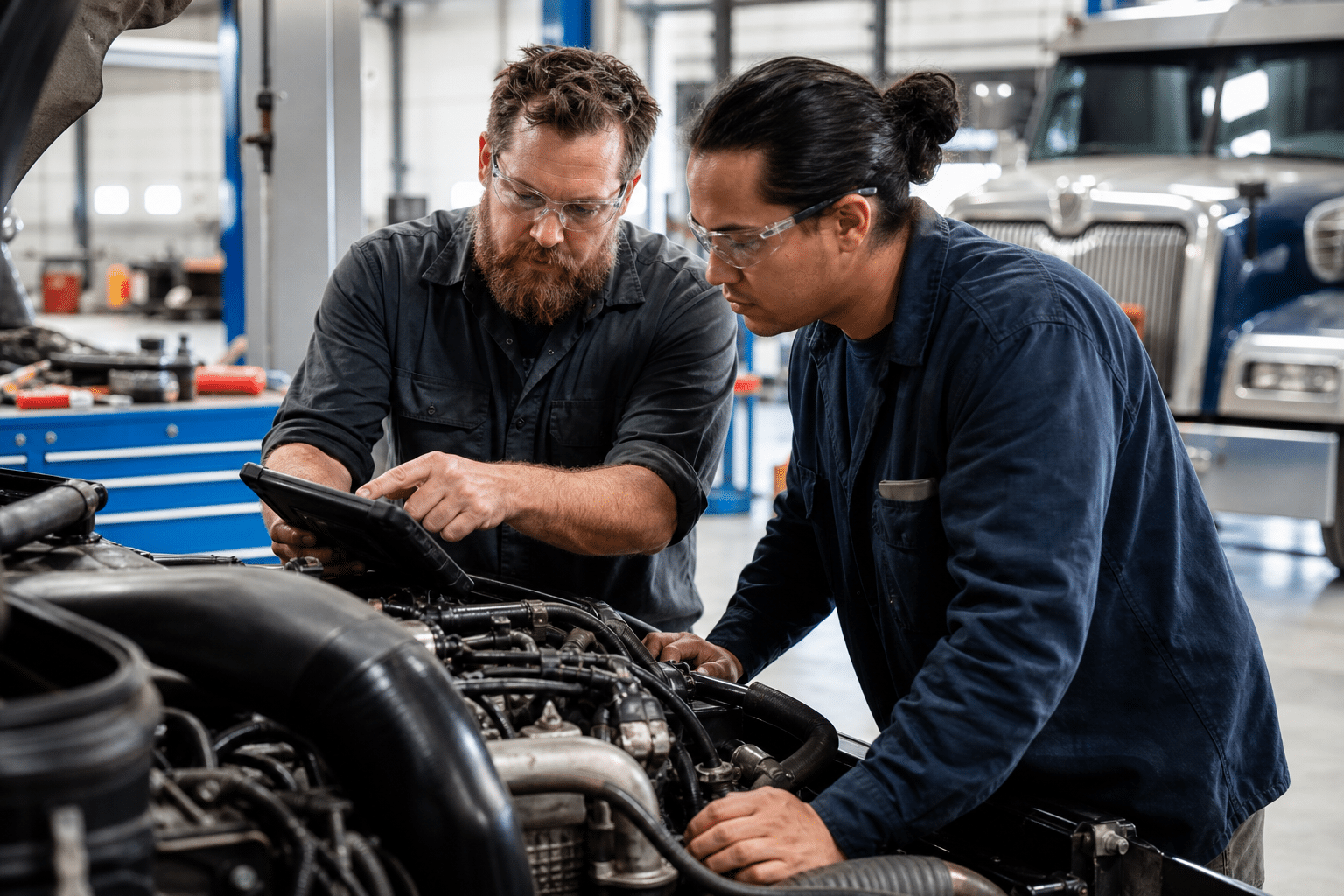
A diesel mechanic apprenticeship can let a career changer learn heavy-duty repair while earning a wage. The phrase covers several arrangements, though: a Registered Apprenticeship, an employer’s structured training plan, and a school-to-shop placement are not the same thing. The sponsor, equipment, supervision, wage steps, and written skill standards matter more than the label alone.
The important detail is that “apprenticeship” can describe several different arrangements. A paid entry-level job with a training plan is not automatically a Registered Apprenticeship. A school program that helps you find a shop placement is not the same as an employer-sponsored apprenticeship either.
This guide explains how to compare the options, what employers usually look for, how to search, and which questions can save you from accepting a vague training promise.
Ask what the first 90 days include: A serious program should be able to explain the machines you will work on, who supervises you, which tasks you may perform, how training is recorded, and when the next pay increase occurs. If the answer is only “you will learn on the job,” the program may be an ordinary entry-level position rather than an apprenticeship.
What a diesel mechanic apprenticeship actually is
A diesel mechanic apprenticeship is a structured path into the repair and maintenance of diesel-powered trucks, buses, construction equipment, agricultural machines, or other heavy equipment. Instead of learning only from a textbook, you develop skills while working under supervision.
A well-defined program normally answers four questions:
- Who employs or sponsors you?
- Which skills will you learn, and in what order?
- What classroom or related instruction is included?
- How will your pay and responsibilities change as your skills improve?
The U.S. Department of Labor describes Registered Apprenticeship as paid work experience with a mentor, progressive wage increases, related classroom instruction, and a portable credential. Those features are useful benchmarks even when you are comparing a private employer training program that is not registered.
The title alone is not enough. Read the job posting, ask for the training outline, and confirm whether the employer is offering a registered program, an internal trainee position, or a school-employer partnership.
Registered Apprenticeship versus an employer trainee job
These paths can overlap in day-to-day work, but the documentation and outcome may be different.
| Path | What you may receive | What to verify |
|---|---|---|
| Registered Apprenticeship | Paid work, a mentor, related instruction, progressive wages, and a portable credential | The sponsor, registration status, wage schedule, instruction provider, and completion record |
| Employer trainee position | A paid shop job with in-house coaching and increasing responsibility | The written training plan, review dates, pay progression, and who signs off on skills |
| School-to-employer program | Classroom preparation followed by a placement or paid work experience | Whether the placement is guaranteed, who pays tuition, and whether you become an employee |
| Entry-level shop job | A chance to learn through supervised work, sometimes with tuition help | How much structured instruction exists beyond “watch and learn” |
The Apprenticeship.gov job finder uses labels such as Registered Occupation and Registered Partner. Those labels can help you evaluate a listing, but you should still contact the employer or sponsor with questions about the specific opening.
One useful safeguard is to ask what record you will have when the program ends. A certificate of completion from a registered program is different from a manager’s note saying you worked in the shop for a year. Both experiences can help, but they should not be presented as the same credential.
What you learn on the job
The first months are usually about safe routines, inspection, tool control, and learning how the shop moves work from a service writer to a technician. You may begin with preventive maintenance and support tasks before taking on more complicated diagnostic work.
Training commonly develops across these areas:
- Preventive maintenance, lubrication, filters, belts, hoses, and fluid checks
- Brakes, wheels, suspension, steering, and air systems
- Electrical testing, starting and charging systems, wiring diagrams, and sensors
- Engine systems, fuel delivery, cooling, emissions, and aftertreatment
- Drivetrains, transmissions, differentials, and power takeoff equipment
- Digital service information, scan tools, work orders, and repair documentation
- Inspection standards, customer communication, parts identification, and quality checks
The exact mix depends on the fleet. A bus garage may emphasize uptime, passenger safety, and scheduled inspections. A truck dealership may expose you to several manufacturers. A construction or agricultural shop may involve hydraulics, attachments, and equipment that works far from a paved service bay.
Ask whether apprentices rotate through different systems or spend most of the program doing oil changes and tire work. Basic tasks matter, but a good plan shows how you will progress beyond them.
How paid training usually works
Registered Apprenticeship programs are paid jobs, and the Department of Labor describes progressive wage increases as apprentices develop new skills. The starting wage and the size and timing of increases vary by employer, state, occupation, and program.
Do not rely on a verbal promise that “you will make more later.” Request the wage schedule in writing. It should explain:
- Starting hourly pay and whether overtime is available
- The skills, hours, or reviews tied to each increase
- Whether classroom time is paid
- Health insurance, retirement, paid time off, tool allowances, and uniforms
- Any tuition, exam, or repayment obligations
- The pay and job title expected after completion
Some job listings advertise an hourly range while others show an annual estimate. Compare the guaranteed base pay first. A higher number can depend on overtime, a shift premium, bonus production, or travel that you may not want.
For broader context, see our diesel mechanic salary guide. It can help you place an offer in context, but an apprenticeship wage should be judged against the actual schedule, benefits, and skill progression for that employer.
Typical entry requirements
There is no single national checklist for every diesel mechanic apprenticeship. Employers set their own requirements, and state or program rules can add others. Common expectations include:
- A high school diploma, GED, or equivalent preparation
- The ability to read instructions, complete basic math, and use measurements
- A valid driver’s license, especially when moving vehicles around a yard
- Reliable attendance and the ability to work a full shop schedule
- Comfort with hand tools, safety procedures, and mechanical problem-solving
- A willingness to learn electrical and computer-based diagnostics
Some employers ask for a clean driving record, a background check, a drug screen, or a commercial driver’s license. Those conditions are employer-specific. A CDL may be useful for certain jobs, but it is not a universal prerequisite for learning diesel repair.
You may also see “no experience required” next to a preference for basic mechanical experience. That is not necessarily a contradiction. It can mean the employer will teach the occupation but expects you to show interest through personal projects, shop classes, military maintenance, farm work, automotive repair, or an introductory course.
If you are changing careers after 40, your previous work can still be relevant. Troubleshooting, documenting work, working around customers, following procedures, managing inventory, or supervising a crew are useful habits in a repair shop. Explain the connection instead of assuming the employer will find it.
How long does an apprenticeship take?
There is no single answer. Length depends on the equipment, the program standard, the number of on-the-job hours, the related instruction, and whether progress is measured by time, demonstrated competencies, or both.
A credible listing should tell you what “completion” means. Look for a target duration or skill framework, review points, and a description of the final credential. If the employer cannot explain what happens after the training period, treat the role as an entry-level job with informal coaching rather than a complete apprenticeship pathway.
You should also ask what happens if work slows down, your mentor leaves, or you miss classroom time. A resilient program has more than one trainer and a process for recording the skills you have already completed.
Where to find diesel mechanic apprenticeships
Start with the Apprenticeship.gov Job Finder. Search several terms because employers may use diesel technician, heavy-duty technician, fleet mechanic, bus technician, service technician, or equipment mechanic instead of the exact phrase “diesel mechanic apprenticeship.” Filter by location, then read the employer’s own posting before applying.
Also check:
- Truck and bus fleets, transit agencies, school districts, waste haulers, and delivery companies
- Truck dealerships, independent heavy-duty repair shops, and service networks
- Construction, mining, agricultural, rental, and public-works equipment dealers
- Community colleges and technical schools with employer partnerships
- State workforce agencies and American Job Centers
- Unions or industry associations in transportation, equipment, or public services
The Department of Labor lists diesel mechanic as a high-demand transportation apprenticeship occupation and points career seekers toward its occupation and job-finder tools. Availability changes by location, so a search that is empty today is a reason to contact local employers directly, not proof that no path exists.
When searching for “diesel mechanic apprenticeship near me,” include nearby cities and the types of equipment you would accept. A fleet 30 minutes away may provide a stronger mentor and clearer wage progression than a vague listing five minutes from home.
Questions to ask before you accept an offer
Use the first conversation to test whether the program is organized. You do not need to sound suspicious; you need enough information to make a fair comparison.
| Question | Why it matters |
|---|---|
| Who is my employer or sponsor? | Clarifies who pays you and who is responsible for training |
| Is this a Registered Apprenticeship? | Separates a registered program from an internal trainee job |
| Who will mentor me when my supervisor is absent? | Shows whether training depends on one person |
| Which systems will I learn in the first six months? | Reveals whether the plan includes more than helper work |
| How are skills recorded and reviewed? | Gives you evidence of progress and completed training |
| Is classroom instruction required, and who pays for it? | Prevents surprises about tuition, travel, or unpaid time |
| What is the starting wage and written progression? | Lets you compare the real offer rather than a promise |
| What tools must I provide? | Helps you estimate the cost of starting |
| What job title and pay should I expect after completion? | Tests whether the program leads to a defined next step |
If answers are vague, ask for an email or document that describes the program. A serious employer should be able to explain the basics clearly.
Tools, school and out-of-pocket costs
An apprenticeship may reduce tuition risk, but it is not automatically free. You might need work boots, eye protection, a starter tool set, transportation, licensing fees, or classroom materials. Some employers provide tools, reimburse approved purchases, or let apprentices build a set gradually.
Before you compare an apprenticeship with diesel mechanic school, write down the full cost of both paths. Include lost income during school, commuting, tools, uniforms, testing, and the value of benefits. Then compare the type of equipment, instructor access, employer connections, and credential each option provides.
School can be the better fit when you need a broad foundation before applying or when local employers want prior lab practice. An apprenticeship can be the better fit when you learn by doing, need income, and have access to a shop with real coaching. A hybrid route can work too: a short certificate followed by paid shop training.
Safety and supervision matter
Heavy equipment can injure people when a vehicle is not secured, a load is unsupported, or stored energy is released unexpectedly. A beginner should not be pushed into unfamiliar work without instruction, the right equipment, and supervision.
Ask how the shop handles vehicle support, lockout and tagout, lifting equipment, batteries, compressed air, hot surfaces, chemicals, and road testing. You should know who can stop a job when conditions are unsafe.
Good safety training is practical. It explains the shop’s procedures, demonstrates them, and gives you a way to ask questions without being treated as slow. Personal protective equipment is important, but it does not replace a safe work process.
Is an apprenticeship a good career-change route?
It can be, especially if you want to earn while building a technical skill. The tradeoff is that the first stage may be physically demanding and less specialized than the job you imagine at the end. You may spend time cleaning work areas, handling parts, recording inspections, and learning routine service before you diagnose complex failures.
The best fit is someone who can be patient with the progression and curious about the reasons behind a repair. You do not need to know every engine system on day one. You do need to show up, follow safety rules, ask precise questions, and keep track of what you learn.
Before applying, compare the schedule with your actual life. Early shifts, weekend coverage, seasonal overtime, outdoor work, and emergency roadside calls can affect family responsibilities. Ask about the normal schedule and the busiest seasons rather than assuming the job is a standard weekday role.
Apprenticeship, certification and the next step
An apprenticeship gives you structured experience, but it does not automatically award every industry certification. Depending on your target job, you may later pursue manufacturer training, state-required credentials, or ASE testing. ASE’s T Series covers medium-heavy truck systems, including diesel engines, brakes, electrical and electronic systems, and other areas.
Keep copies of evaluations, completed skill checklists, class records, and certificates. Those documents make it easier to explain your experience when you apply to another fleet or move into a more specialized role.
For a wider entry-roadmap, read how to become a diesel mechanic. If your interests lean toward machinery outside road transport, our guide to heavy equipment operator certification covers a related but different career path. An operator moves and uses equipment; a diesel technician diagnoses and repairs it.
A simple application checklist
Before you apply, prepare a one-page resume that connects your past experience to the shop. Include maintenance, troubleshooting, tools, safety, customer service, inventory, military equipment, farm machinery, automotive work, or technical classes.
Have these items ready:
- A short explanation of why you want diesel repair specifically
- Your available schedule and transportation plan
- Any transcript, certificate, tool list, or project photos that show hands-on interest
- Two or three questions about pay, mentoring, instruction, and progression
- A realistic plan for boots, basic tools, and commuting costs
After an interview, compare offers on paper. A slightly lower starting wage may be reasonable if the program provides paid instruction, strong benefits, a documented wage ladder, and broad equipment exposure. A higher wage may be less attractive if training is undefined and you are expected to buy expensive tools immediately.
The bottom line
A diesel mechanic apprenticeship can be one of the more practical ways to learn heavy-duty repair while earning income. The quality of the experience depends less on the word “apprenticeship” and more on the structure behind it: a real mentor, useful equipment, safe supervision, related instruction, recorded progress, and a clear wage path.
Use Apprenticeship.gov to search, contact local fleets and dealers, and ask every sponsor to explain the program in writing. Then compare the apprenticeship with school and entry-level shop work using the same questions. That process will help you find a first job that builds a real career foundation instead of simply putting a trainee label on routine labor.
Sources and further reading
- U.S. Department of Labor: Career seekers and Registered Apprenticeship, accessed August 31, 2026.
- U.S. Department of Labor: Apprenticeship Job Finder, accessed August 31, 2026.
- U.S. Department of Labor: Transportation industry apprenticeships, accessed August 31, 2026.
- U.S. Department of Labor: Bus and Truck Mechanics and Diesel Engine Specialists, accessed August 31, 2026.
- U.S. Bureau of Labor Statistics: Diesel Service Technicians and Mechanics, accessed August 31, 2026.
- ASE: Medium-Heavy Truck Certification Tests, T Series, accessed August 31, 2026.
This article is for career research and comparison. Program terms, wages, licensing rules, and hiring requirements vary by employer and location; confirm current details with the program sponsor before enrolling or accepting an offer.
Related guides: How to Get an HVAC License: Requirements, Experience and State Rules and Plumber vs HVAC Technician: Which Trade Is a Better Fit?.
\n
Reviewed September 3, 2026: A diesel apprenticeship should be judged by paid work, supervision, equipment, classroom instruction, wage progression, and the credentials employers recognize. Compare it with diesel mechanic school before choosing a route.
\n