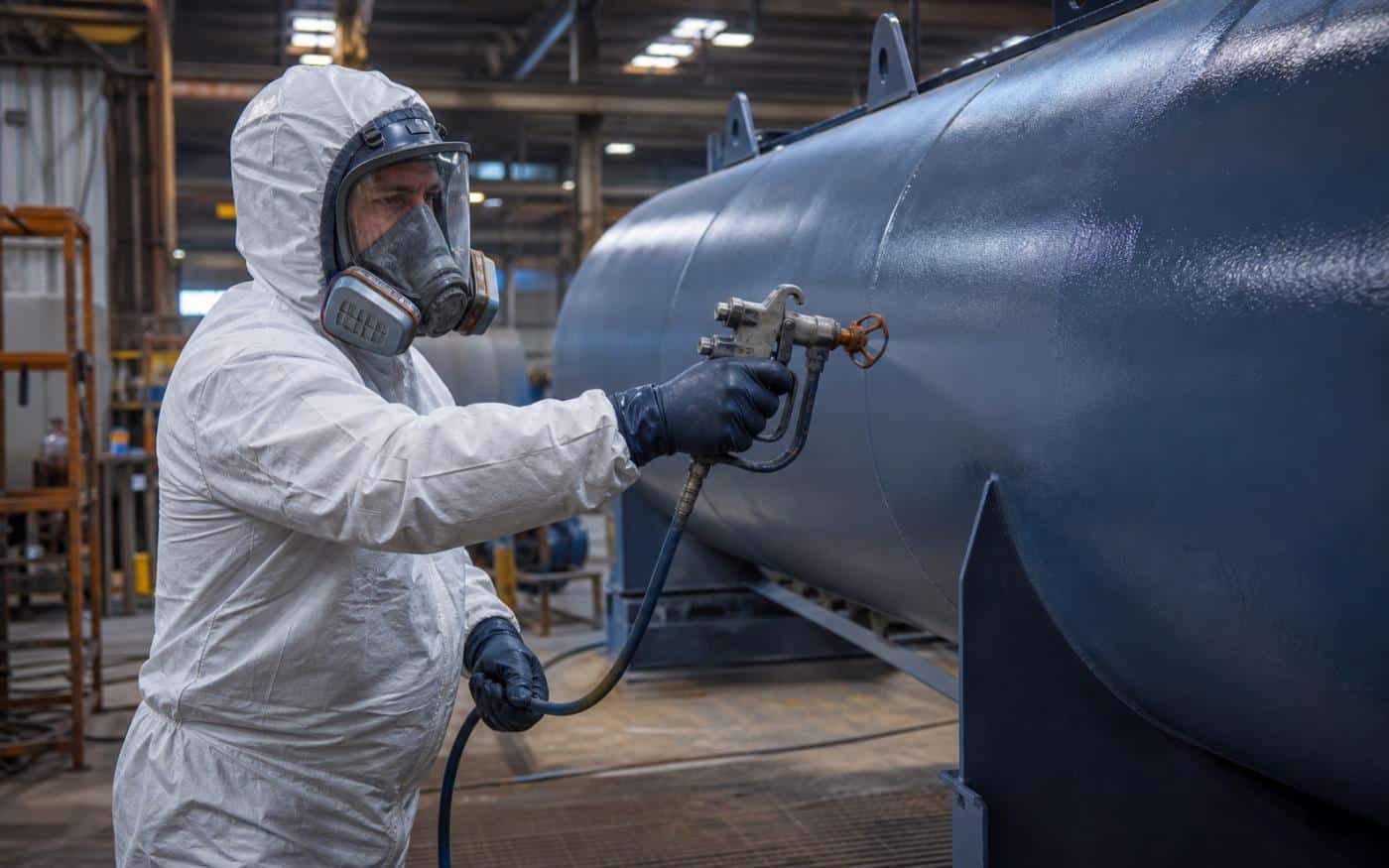
An industrial painter prepares surfaces and applies coatings that protect steel, equipment, tanks, structures, and other assets from corrosion, heat, chemicals, wear, or weather. The work includes surface preparation, mixing, spray or brush application, thickness checks, ventilation, and respiratory or fall protection. The final coating depends as much on preparation and conditions as on the paint itself.
That makes industrial painting different from painting a bedroom or an office wall. The coating may be chosen to resist corrosion, chemicals, heat, water, abrasion, or heavy use. A painter may need to meet a written specification, measure surface conditions, control overspray, and document the finished work.
The title covers several settings. One employer may paint fabricated steel inside a shop. Another may send crews to bridges, water towers, ships, refineries, power plants, or manufacturing sites. Some jobs are mostly spray application. Others include abrasive blasting, scaffolding, rope access, hydroblasting, or inspection support.
Surface condition controls the result: The painter checks cleanliness, profile, moisture, temperature, recoat timing, and the coating specification before application. A finish can look good on day one and still fail early if the surface was damp, contaminated, or prepared to the wrong profile.
Industrial painter at a glance
| Question | Short answer |
|---|---|
| Main work | Prepare surfaces and apply protective or decorative coatings to industrial equipment and structures |
| Common materials | Primers, epoxies, urethanes, specialty coatings, sealers, and linings |
| Common settings | Fabrication shops, factories, bridges, water towers, ships, tanks, plants, and construction sites |
| Useful background | Painting, construction, blasting, equipment operation, welding, maintenance, or safety work |
| Typical entry route | Employer training, helper role, apprenticeship, coating school, or supervised shop work |
| Common credentials | Employer-specific training, safety credentials, and specialty qualifications required by the site or coating system |
| Pay benchmark | BLS reported a $49,400 median annual wage for construction and maintenance painters in May 2025. This is a broad benchmark, not an industrial-painter guarantee. |
The work suits someone who can stay patient through repetitive preparation. A coating can look fine from a distance and still fail because the surface was dirty, damp, too cold, too rough, or insufficiently prepared. Industrial painters learn to care about the steps that are easy for an outsider to miss.
What does an industrial painter do?
The task list depends on the project, coating system, site rules, and level of responsibility. A painter in a fabrication shop may work on parts and structural steel. A field crew may move from one shutdown or maintenance project to another.
Common duties include:
- Read work orders, coating specifications, product data sheets, drawings, and safety procedures.
- Inspect steel, concrete, machinery, tanks, piping, or other surfaces before work begins.
- Remove rust, mill scale, old coatings, dirt, grease, salts, and loose material.
- Prepare surfaces with hand tools, power tools, abrasive blasting, water blasting, or approved chemical methods.
- Protect nearby equipment, openings, finished surfaces, workers, and the public from dust and overspray.
- Mix primers, paints, thinners, catalysts, and other materials according to the product instructions.
- Apply coatings with brushes, rollers, conventional spray guns, airless sprayers, or plural-component equipment.
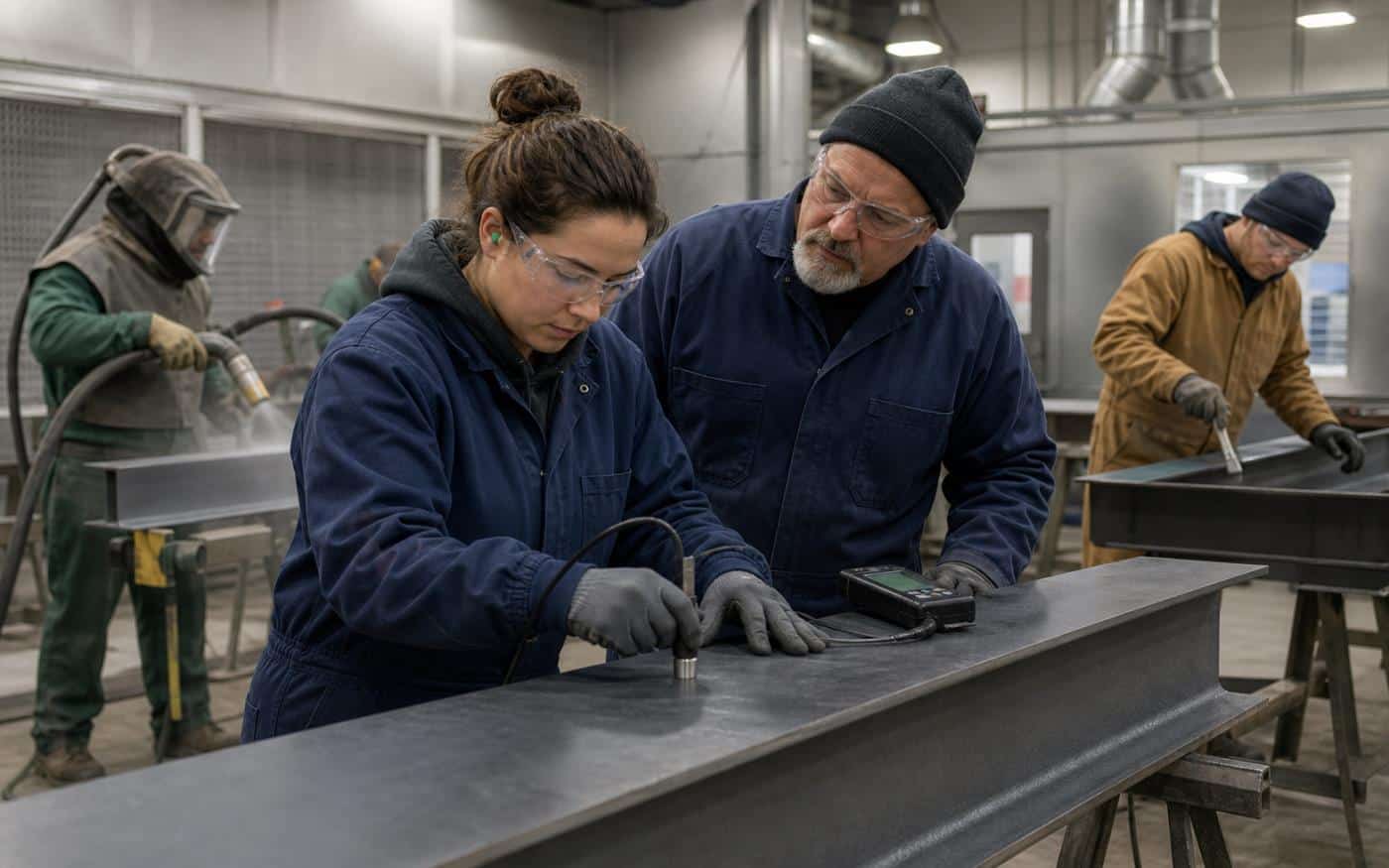
- Monitor wet-film or dry-film thickness and check coverage, runs, holidays, pinholes, and other defects.
- Clean equipment, dispose of materials correctly, and record what was applied and where.
The painter may also help set up scaffolding, lifts, ventilation, lighting, hoses, compressors, blast pots, containment sheeting, and fall-protection equipment. Those tasks are not secondary. If the work area is poorly prepared, the coating job and the safety plan can fail together.
Industrial painting is mostly preparation
People notice the spray gun. Experienced painters spend a great deal of time preparing the substrate.
A typical sequence might include removing oil and dirt, scraping loose coating, grinding edges, blasting rust, vacuuming dust, checking surface cleanliness, and confirming that the steel is dry enough to coat. The exact process depends on the specification and the material.
Surface profile matters too. Some coatings need a certain texture so they can bond to the substrate. Too little profile can weaken adhesion. Too much can leave peaks that are difficult to cover. A painter may use visual standards, surface-profile comparators, or other inspection tools depending on the employer and project.
Weather can change the plan on outside work. Temperature, humidity, wind, and condensation affect application and curing. A crew may have to stop even when the surface looks fine because the conditions are moving outside the product’s allowed range.
What equipment do industrial painters use?
The equipment varies from a small shop to a large bridge or marine project. Common tools include:
- Brushes, rollers, spray guns, airless pumps, hoses, and tips
- Air compressors, blast pots, abrasive media, and dust-collection equipment
- Grinders, needle guns, scrapers, vacuum systems, and pressure washers
- Wet-film and dry-film thickness gauges
- Moisture meters, surface-temperature tools, hygrometers, and dew-point instruments
- Lifts, scaffolds, ladders, tarps, containment walls, and ventilation equipment
- Respirators, protective suits, gloves, eye protection, hearing protection, and fall-protection gear
The tool is only part of the skill. A painter has to choose the right setup for the coating, substrate, access, finish requirement, and work environment. A high-pressure spray system can cover a large area quickly, but it can also create overspray, injection hazards, and a poor finish if the operator is careless.
Industrial painter vs. other painting and trade jobs
The names overlap, but the work can feel very different.
| Role | Main focus | Typical difference from industrial painting |
|---|---|---|
| Industrial painter | Protective coatings on equipment, steel, structures, vehicles, and industrial surfaces | More attention to substrate preparation, specifications, containment, and coating performance |
| Commercial painter | Interior and exterior finishes on offices, businesses, and other buildings | More emphasis on appearance, production pace, and occupied-building coordination |
| Residential painter | Interior and exterior finishes on homes and apartments | More direct customer interaction and smaller work areas |
| Blaster or surface-preparation technician | Abrasive blasting, water blasting, cleaning, and substrate preparation | May specialize in preparation before another crew applies the coating |
| Coating inspector | Measures and documents whether the work meets the specification | More inspection and reporting, less direct application |
| Welder or fabricator | Cuts, joins, and shapes metal | May create the steel that an industrial painter prepares and protects |
The line is not always clean. Many industrial painters blast, paint, inspect their own work, and help with containment. A job posting may use terms such as painter, blaster, coating applicator, industrial coating specialist, or painter helper.
Our guides to industrial maintenance technician work and welder certification cover neighboring skills that can transfer into industrial coating work.
How to become an industrial painter
Most people enter through supervised work rather than a four-year degree. BLS says painters typically learn on the job, and that no formal education is usually required for the broad construction and maintenance painter occupation. Specialty projects can add site-specific requirements.
Route 1: Start as a helper
A helper may move materials, mask surfaces, clean equipment, set up containment, prepare tools, and learn how the crew works. That first role can be physical and repetitive, but it teaches the parts of the job that determine whether a coating lasts.
Look for titles such as painter helper, industrial painter trainee, coating helper, blast crew helper, or shop painter. Ask whether the employer provides paid safety training and whether you will learn both surface preparation and coating application.
Route 2: Enter an apprenticeship
Painting apprenticeships may be sponsored by contractors, unions, joint labor-management programs, or employers. Apprenticeship.gov has also recognized an apprenticeable occupation called Painter, Industrial Coating and Lining Application Specialist.
An apprenticeship can combine paid field work with related instruction. The details vary. Some programs lean toward commercial painting, while others emphasize industrial coatings, blasting, linings, bridges, tanks, or marine work. Read the curriculum before assuming that any painter apprenticeship leads to the same job.
Route 3: Take a coating or painting program
Some technical schools offer short programs in industrial painting, surface preparation, spray application, or corrosion control. A useful program should give you equipment practice alongside the coating terminology.
Ask whether the program includes substrate preparation, mixing, spray technique, thickness measurement, safety procedures, and inspection. Ask how many hours are hands-on and what equipment students actually use. Our online trade school guide explains how to separate useful hybrid training from programs that are mostly marketing.
Route 4: Transfer from another trade
Construction laborers, welders, blasters, maintenance workers, equipment operators, and mechanics may already have useful habits. They may understand jobsite safety, tools, material handling, drawings, or industrial schedules.
The missing piece is usually coating-specific practice. A good employer may accept related experience, then train the worker on product handling, spray equipment, surface standards, containment, and quality documentation.
Do industrial painters need certification?
There is no single national certificate that every industrial painter must hold. Requirements can come from the employer, the site owner, the union, the coating manufacturer, the state, or the contract specification.
Possible requirements include site orientation, hazard communication, respiratory-protection training, fall protection, aerial-lift training, confined-space training, abrasive-blasting training, or a qualification tied to a particular coating or inspection method.
Lead-paint removal and abatement can trigger separate rules and certifications. A general painter credential does not automatically authorize lead abatement, work in a confined space, or any other regulated activity. Ask which credentials are required for the specific job and who pays for them.
Industrial painting safety is part of the trade
This is not a job where safety can be reduced to wearing a mask. OSHA identifies hazards in painting and paint removal that include toxic materials, flammable or explosive mists, particulates, and vapors. The controls can include work procedures, ventilation, facility design, protective clothing, and respiratory protection.
Spray booths and local exhaust can reduce exposure and fire risk in shop settings. Field work may require containment, mechanical ventilation, atmospheric testing, ignition control, and a plan for nearby workers or the public. The right controls depend on the material and the space.
Respirator selection is not a personal guess. OSHA’s guidance emphasizes hazard assessment and the requirements of its respiratory-protection standard. Facial hair, fit testing, cartridge choice, medical evaluation, and maintenance can matter. If an employer treats respiratory protection as an afterthought, that is useful information about the job.
Other questions to ask before accepting a position:
- Will I work at height, in tanks, or in other confined spaces?
- Which coatings and solvents are used most often?
- How is ventilation provided and checked?
- Is abrasive blasting done by the same crew?
- How are overspray, dust, and waste contained?
- Is the work seasonal, travel-heavy, or tied to shutdowns?
- Who supplies and maintains respirators, suits, harnesses, and other PPE?
The OSHA spray-operations guidance and OSHA painting and coatings eTool are useful references, but they do not replace the employer’s site-specific training.
How much does an industrial painter make?
The phrase "industrial painter salary" sounds precise, but national data do not isolate every version of the job. A painter working on a bridge, a painter in a fabrication shop, and a painter on a marine shutdown may have different pay structures.
The closest current BLS benchmark is the construction and maintenance painter occupation. BLS reported a $49,400 median annual wage in May 2025. The lowest 10 percent earned less than $37,440, and the highest 10 percent earned more than $78,810. BLS also reported about 326,900 jobs in 2025, projected 3 percent growth through 2035, and about 24,900 openings per year.
That category includes industrial painters, but it also includes commercial and residential painting work. It is a benchmark, not a guarantee for the industrial specialty.
| Pay question | What to check |
|---|---|
| Hourly rate | Is the posted number base pay, a range, or a temporary project rate? |
| Overtime | Are shutdowns, nights, weekends, or long travel days common? |
| Per diem | Is lodging or food support offered for out-of-town projects? |
| Union package | Are health coverage, pension, and training included separately from the wage? |
| Skill premium | Does blasting, high-pressure spray, specialty lining, or inspection responsibility change the rate? |
| Seasonality | Will the work continue through winter or between major projects? |
Search results for industrial painting jobs often show hourly offers in the high teens, twenties, and above, but listings vary by state, experience, overtime, and specialty. Compare several local postings rather than using a single online salary page as a promise.
Is industrial painting hard on the body?
It can be. BLS describes painting as physically demanding, with bending, kneeling, reaching, climbing, lifting, and uncomfortable positions. Industrial painters may work outdoors, in shops, on scaffolds, from lifts, or inside large structures.
The job can also be hard in less obvious ways. Protective clothing gets hot. Respirators make communication and breathing feel different. Hoses and spray equipment can be awkward. Blasting creates noise and vibration. A crew may repeat the same motion for hours while trying to maintain a consistent finish.
The exact demands depend on the work. A shop painter may have better access and more predictable conditions. A field painter may travel, work outside, climb, and set up containment. A painter on tanks, bridges, ships, or shutdown projects may have a very different week from someone coating parts on a production line.
Is industrial painting a good career change after 40?
It can be a practical option for someone who prefers visible, hands-on work and does not mind learning through repetition. Previous work in construction, fabrication, maintenance, warehousing, equipment operation, or safety can help.
The trade is less suitable if you strongly dislike chemical odors, protective clothing, ladders, travel, outdoor conditions, or work that depends on exact preparation. It is also worth being honest about respiratory or mobility concerns with a qualified health professional before choosing a job with coatings, dust, heights, or confined spaces.
Age itself is not the deciding factor. The questions that matter more are:
- Can I work safely and steadily for several hours at a time?
- Am I willing to start as a helper while I build trade-specific proof?
- Can I follow product instructions instead of improvising with chemicals?
- Do I care about the preparation and inspection work, not just the visible finish?
- Does the local market offer stable work or only short shutdown projects?
For the larger planning question, use our career change after 40 roadmap.
How to choose an industrial painting job
Two jobs with the same title can offer very different lives. Before accepting, ask:
- What percentage of the week is prep, blasting, spraying, inspection, and cleanup?
- Are projects in one shop or spread across the country?
- What are the normal hours and overtime expectations?
- What coatings and application methods are used?
- How much work happens at height or in confined spaces?
- Does the employer train new workers or expect prior spray experience?
- Is the role permanent, seasonal, project-based, or shutdown-based?
- Which safety credentials are required before the first shift?
Pay attention to the answer about preparation. A job that describes only spraying may still require extensive masking, grinding, blasting, and cleanup. A job that mentions "coating specialist" may involve more documentation and inspection than a basic painter role.
Bottom line
Industrial painting is a protective trade. The finished color matters, but the real value is the surface preparation, coating selection, application control, and documentation that help equipment and structures resist damage.
Most people can enter without a four-year degree, but that does not mean the work is casual. You need to learn how materials behave, how to prepare a surface, how to control exposure, how to work around equipment and other crews, and how to stop when conditions are unsafe.
For a career changer, the most credible first step is usually a supervised helper role, a real apprenticeship, or a hands-on program with industrial equipment. Compare the training, travel, safety practices, and pay structure before you compare job titles.
Sources
- U.S. Bureau of Labor Statistics: Painters, Construction and Maintenance
- U.S. Bureau of Labor Statistics: Painting and Coating Workers
- Apprenticeship.gov: Industrial Coating and Lining Application Specialist bulletin
- OSHA: Spray Operations – Controlling Hazards
- OSHA: Spray Operations – Standards
- OSHA: Shipyard Painting and Other Coatings eTool
\n
Reviewed September 3, 2026: Industrial painting involves surface preparation, coatings, respiratory protection, height, weather, and production pace. Ask about the actual site conditions and training before comparing pay. See the industrial painter guide.
\n