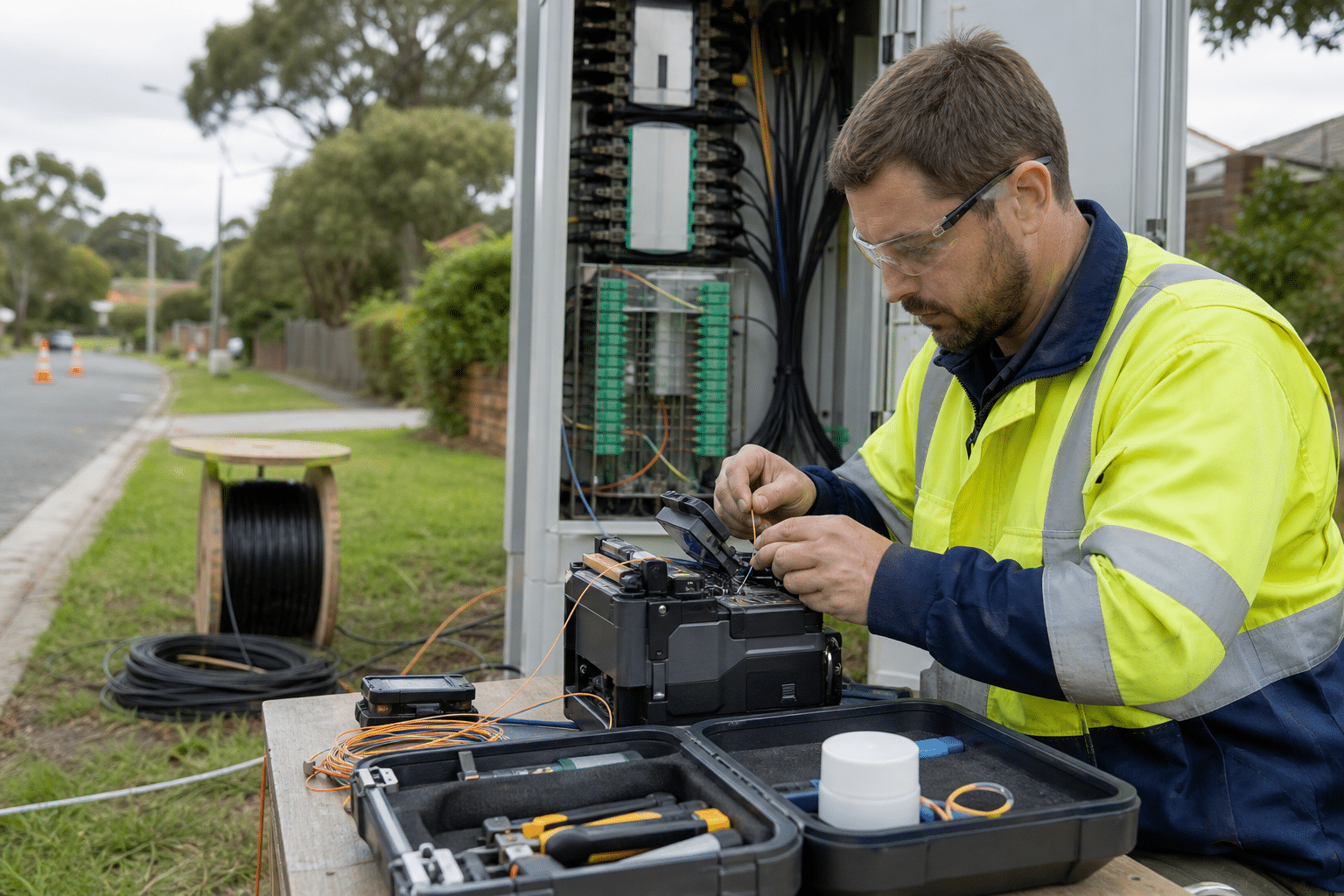
A fiber optic technician installs, splices, tests, and repairs the fiber links that carry data and communications. The work may involve cable routes, closures, connectors, fusion splicing, power meters, OTDR traces, customer sites, and outdoor construction conditions. Accuracy matters because a connection can pass a basic check and still create loss or reflection that appears farther down the network.
The work can happen in a training lab, a data center, a central office, a neighborhood utility enclosure, a construction site, or a customer’s building. Some technicians spend most of their time indoors. Others work outside, climb ladders or poles, travel between sites, and deal with weather and traffic.
There is no single national license called a fiber optic technician license. Employers may ask for experience, safety training, a commercial driver’s license, or an industry certification such as the FOA Certified Fiber Optic Technician credential. The exact requirement depends on the job.
The test trace tells part of the story: The technician compares the expected route with the OTDR result, checks connectors and splice points, confirms labels and slack, and documents where the loss or reflection occurs. A clean handoff makes the next repair faster when the fault is not at the visible endpoint.
Fiber optic technician at a glance
| Question | Practical answer |
|---|---|
| Main work | Install, splice, test, troubleshoot, repair, and document fiber optic cable and connections |
| Common settings | Outside plant, telecom construction, data centers, central offices, customer premises, and repair work |
| Core tools | Fusion splicer, cleaver, optical power meter, visual fault locator, and OTDR |
| Common entry routes | Employer training, short technical program, apprenticeship, or related telecom/electrical experience |
| Common certification | FOA CFOT, with specialist credentials available for some tasks |
| BLS pay reference | $66,200 for telecommunications technicians and $74,330 for telecommunications line installers in May 2025 |
| Work pattern | Full time, with travel, outdoor work, nights, weekends, or on-call duty possible |
The BLS categories are broader than the exact title searched by job seekers. Use them as reference points, not as a promise that every fiber technician earns the same wage.
What does a fiber optic technician do?
The work changes with the network and the employer. A residential installation technician may bring a drop cable to a home, terminate it, test the connection, and explain the equipment to the customer. An outside-plant technician may work in a handhole, cabinet, aerial strand, or underground conduit. A data center technician may focus on patching, cleaning, labeling, testing, and troubleshooting short runs in a controlled room.
Typical tasks include:
- reading route plans, splice diagrams, work orders, and test requirements;
- preparing cable, removing jackets, cleaning fibers, cleaving them, and protecting the splice;
- using a fusion splicer or mechanical connector where the job requires it;
- testing loss and continuity with an optical power meter, light source, or visual fault locator;
- using an OTDR to estimate where a break, bad splice, or high-loss event occurs;
- installing cable in conduit, innerduct, trays, buildings, poles, or utility enclosures;
- documenting splice locations, test results, cable routes, photos, and repairs.
Fiber is unforgiving of careless handling. Dust, a poor cleave, a sharp bend, a damaged connector, or an incorrect record can create a problem that appears far away from the original work. Good technicians slow down for the small steps that are easy to skip.
Fiber optic technician versus related job titles
Job titles are inconsistent. A fiber optic technician may install and test cable, while a fiber splicer focuses more heavily on joining fibers and building splice closures. A fiber optic installer may perform customer or construction installation. A telecommunications line installer may work on copper, coaxial, and fiber systems, depending on the employer.
Network technician is broader still. It may mean structured cabling, switches, wireless equipment, or data center work rather than outside fiber construction. Read the task list before assuming two jobs are equivalent.
The BLS groups many of these workers under telecommunications technicians or telecommunications line installers and repairers. That is useful for national context, but it does not separate every fiber specialization. An offer from a data center, a broadband contractor, and a tower or line crew may carry similar words and very different working conditions.
The main work environments
Outside plant and construction
Outside-plant, or OSP, work follows the network beyond the building. Technicians may place or repair fiber in conduit, cabinets, handholes, aerial routes, or buried infrastructure. The work can involve traffic control, weather, uneven ground, lifting, kneeling, and travel between locations.
Some crews install new routes. Others respond to outages or damage. A storm, road project, utility strike, or construction mistake can turn a planned day into urgent repair work.
Buildings and data centers
Indoor work is usually more controlled, but it still demands precision. Technicians may install trays, route patch cords, clean connectors, test links, and compare results with a design or commissioning requirement. Data center work can involve strict access rules, documentation, change windows, and a low tolerance for accidental disconnection.
Customer premises
Residential and business installation adds a customer-service element. A technician may enter attics, crawl spaces, basements, or utility rooms. The job can combine fiber work with routers, network terminals, grounding questions, and explaining what the customer can expect from the connection.
How to become a fiber optic technician
There is no single path that fits every employer. Many technicians start with a high school diploma or equivalent and receive on-the-job training. A short course can help someone learn the vocabulary and basic handling before applying. An apprenticeship can combine paid work with structured instruction.
Start with an employer
An entry-level installer, cable technician, field technician, or helper role may provide the first practical experience. Look for a posting that names the equipment, training period, supervisor, travel expectations, and progression. Ask whether the job includes fiber handling and testing or mainly trenching, pulling, cleanup, and general construction.
This distinction matters. Construction experience can be useful, but it is not the same as learning to cleave, splice, test, and interpret an OTDR trace.
Attend a short technical program
Community colleges and workforce programs may teach fiber basics, splicing, testing, outside-plant practices, or structured cabling. Compare the time spent with live equipment rather than choosing by course title alone.
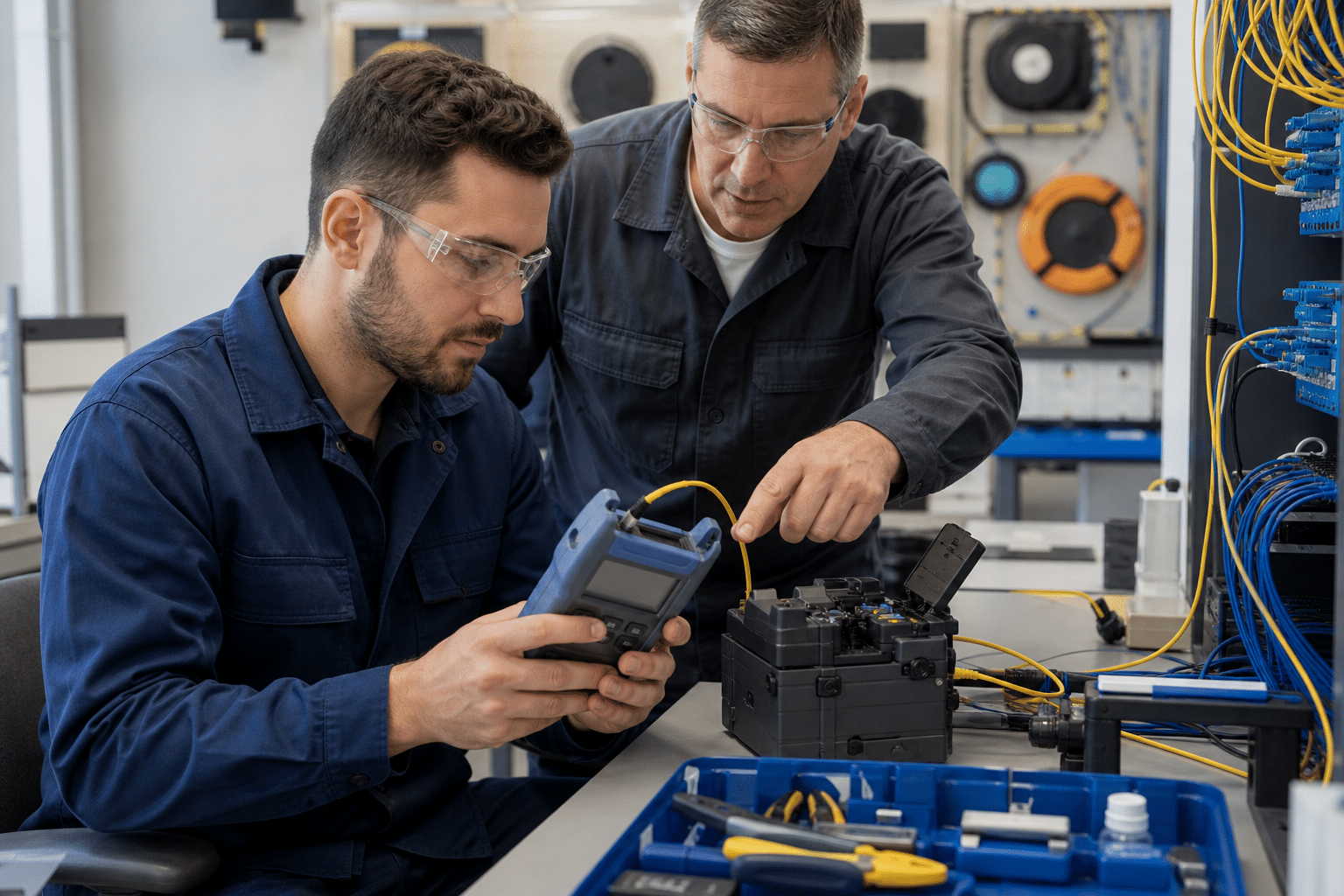
Ask whether students practice with a fusion splicer, cleaver, power meter, and OTDR. Ask how many students share each device. Find out whether consumables, tools, testing, and certification fees are included.
Online study can explain terminology and theory, but it cannot give you the hand control needed for clean preparation and splicing. Our guide to online trade school and hands-on practice covers that difference in more detail.
Enter an apprenticeship
Apprenticeship.gov lists Fiber Optic Technician among telecommunications apprenticeship occupations. The Department of Labor also describes fiber optic bootcamp training that includes fundamentals, fusion and mechanical splicing, OTDR testing, outside-plant work, and a possible connection to an apprenticeship occupation.
That does not make every program using the word apprenticeship equivalent. Ask who the sponsor is, whether the work is paid, what related instruction is included, how progress is recorded, and which tasks the apprentice will actually perform. Confirm whether the program prepares you for the employer’s job or a recognized industry credential.
For a broader comparison of paid routes, see our lineman apprenticeship guide. Fiber work shares some field conditions with utility construction, but the tools and technical tasks are different.
What does a fiber optic technician need to know?
The basic theory is approachable. Light travels through the fiber core, and the technician’s job is to preserve the path and keep loss within the required limit. The practical details take repetition.
Training usually covers cable types, connectors, splice closures, bend limits, cleaning, inspection, route planning, test methods, and safe handling. A technician also needs to read diagrams and follow a work order without improvising a connection that cannot be documented later.
Testing deserves special attention. A power meter can help measure loss when used with a suitable light source. A visual fault locator can help identify continuity or a visible break. An OTDR sends a test signal and analyzes reflections to estimate events along the fiber. It is useful, but the trace still needs to be interpreted in context. A test instrument does not fix a bad connection by itself.
Technicians also need ordinary field skills: safe ladder use, vehicle and worksite awareness, hand tools, weather preparation, basic electrical awareness, and clear communication with crew members, customers, and supervisors.
Is CFOT certification required?
The Fiber Optic Association describes CFOT, or Certified Fiber Optic Technician, as its primary certification for fiber optic technicians. FOA says the credential covers broad knowledge and skills that can apply to design, installation, operation, outside plant, premises, and manufacturing.
CFOT can help an employer see that a candidate has studied the fundamentals. It does not replace hands-on practice, an employer’s training, a safety qualification, or a state or local requirement that may apply to a particular worksite. FOA also offers specialist certifications for more specific areas.
Before paying for a credential, read the job postings in your target area. Some employers prefer CFOT. Others care more about documented splicing and testing experience, a clean driving record, or the ability to work on their schedule. A certification is most useful when it matches the job you want.
Fiber optic technician salary and job outlook
There is no single BLS wage line for every worker who uses the title fiber optic technician. The closest national references are broader telecommunications occupations.
The BLS reported a May 2025 median annual wage of $66,200 for telecommunications technicians. It reported $74,330 for telecommunications line installers and repairers. The line-installer group is closer to some outside-plant roles, but it can still include work beyond fiber.
The BLS projects overall employment for telecommunications technicians to decline 3 percent from 2025 to 2035, while still estimating about 20,300 openings per year on average. The BLS notes that newer telecommunications structures and technologies, including fiber optic cables, can require less frequent repairs and maintenance. These figures describe the broad occupation, not a forecast for one fiber specialization.
Job-board pay can look different because it may reflect overtime, travel pay, per diem, storm work, night shifts, bonuses, or a narrow location. Compare base wage, mileage, tools, benefits, on-call expectations, and time away from home.
What are the working conditions?
Fiber work can be neat and technical one day, then muddy and uncomfortable the next. Outside crews may work beside roads, in heat or cold, around construction equipment, or in cramped utility spaces. Indoor technicians may spend long periods standing, kneeling, reaching, or working above a ceiling grid.
Height and access conditions vary. Some jobs involve ladders, bucket trucks, rooftops, poles, or confined spaces. A safe employer should explain training, fall protection, traffic control, personal protective equipment, and the process for stopping work when conditions are unsafe.
Schedules can change during outages or project deadlines. Ask whether the position is local, regional, or national. Ask how often overnight travel occurs and whether emergency callouts are part of the role.
Is fiber optic work a good career after 40?
It can be a strong fit for someone who likes precise hands-on work and does not mind learning a new set of tools. Experience in electrical work, industrial maintenance, low-voltage systems, construction, automotive diagnostics, or network support can transfer well.
The field still has its own learning curve. A person who is comfortable with tools may need time to develop clean fiber preparation, splice technique, test interpretation, and careful connector handling. The work rewards patience more than bravado.
The physical reality matters. If you are considering a career change, visit a training lab or talk with a field technician before paying tuition. Ask what a normal day looks like in the specific segment you want. Data center work may be cleaner but more controlled. OSP construction may offer more variety but more travel and weather exposure.
Our career change at 40 roadmap can help you compare the training cost, lost income, and first-job conditions. If you prefer equipment troubleshooting over communications infrastructure, compare the role with industrial maintenance technician work. If your interest is electrical systems in factories, our industrial electrician guide is a different route with different hazards and credentials.
Questions to ask before accepting a first job
Use the interview to find out what the title hides:
- How much of the week involves splicing and testing rather than pulling cable or general labor?
- Which instruments will I use, and who trains me on them?
- Is the work inside, outside, residential, commercial, data center, or mixed?
- How much travel, overnight work, on-call duty, and storm response is expected?
- Does the employer pay for safety training, tools, certification, and continuing education?
- What does the wage become after the initial training period?
- How are test results, splice records, and completed work reviewed?
The answers will tell you more than the phrase “high-speed fiber career” in a job advertisement.
Bottom line
A fiber optic technician installs and maintains a communications network through careful physical work, precise testing, and reliable records. The entry barrier is often lower than in a heavily licensed trade, but the job is not effortless. Clean splicing, accurate testing, safe field behavior, and good documentation take practice.
Employer training, a short hands-on course, and apprenticeship are all reasonable starting points. CFOT can support the application, but it is not a universal license or a substitute for the work itself. The BLS wage references are useful, but they cover broader telecom groups and should be compared with the actual shift, travel, and overtime in an offer.
If you want a technical field with visible results and you can tolerate field conditions or careful repetitive work, fiber is worth exploring. Start by choosing the environment first, then choose the training that matches it.
Sources
- U.S. Bureau of Labor Statistics: Telecommunications Technicians – duties, education, work conditions, May 2025 pay, and 2025–2035 outlook; checked September 1, 2026.
- U.S. Bureau of Labor Statistics: Occupational Projections and Worker Characteristics – occupational comparison and 49-9052 telecommunications line installer data; checked September 1, 2026.
- Apprenticeship.gov: Telecommunications – Fiber Optic Technician and related telecommunications apprenticeship occupations; checked September 1, 2026.
- Apprenticeship.gov: Fiber Optic Bootcamp – example curriculum covering splicing, OTDR testing, OSP work, and apprenticeship articulation; checked September 1, 2026.
- The Fiber Optic Association: CFOT Certification – certification scope, prerequisites, and training topics; checked September 1, 2026.
\n
Reviewed September 3, 2026: Fiber optic technician work can involve installation, testing, splicing, customer sites, construction, or network maintenance. Check the actual tools, travel, and certification expectations with local employers. Compare it with telecommunications technician work.