An electromechanical technician works where mechanical equipment, electrical power, sensors, motors, controls, and moving assemblies meet. The job may involve installation, testing, maintenance, troubleshooting, or support for automated equipment. It is broader than a single trade title, so the employer’s machinery and the balance between mechanical and electrical work should be clear.
The title is used across factories, engineering services, research labs, energy companies, transportation equipment, and field-service teams. Some jobs are close to industrial maintenance. Others focus on building and testing prototypes. Read the posting carefully before assuming that every electromechanical technician spends the day repairing production equipment.
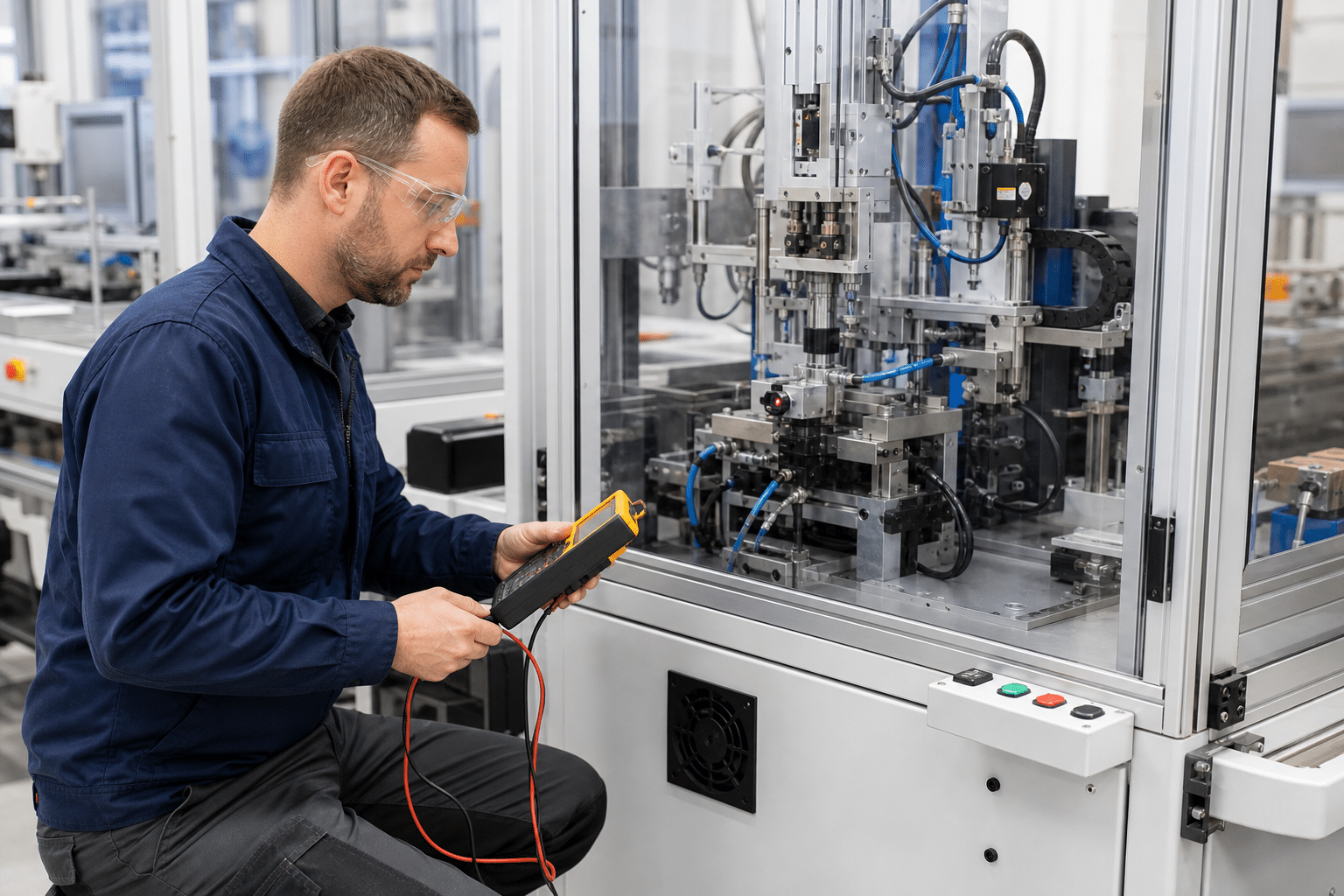
The fault may cross disciplines: A conveyor that will not run could have a mechanical jam, motor issue, sensor problem, drive fault, or control signal failure. The technician checks the system in a safe sequence and records the evidence instead of assuming the problem belongs to only one specialty.
What does an electromechanical technician do?
The U.S. Bureau of Labor Statistics describes this occupation as operating, testing, and maintaining electromechanical or robotic equipment. Technicians combine mechanical knowledge with electrical and electronic circuitry. They may work from engineering drawings, assemble components, measure parts, test performance, and document the results.
Common tasks include:
- reading blueprints, schematics, wiring diagrams, and assembly instructions;
- assembling motors, drives, sensors, actuators, control panels, and mechanical parts;
- installing or adjusting hydraulic and pneumatic components;
- using meters, test instruments, and software to check performance;
- operating, testing, or maintaining robotic and automated equipment;
- verifying dimensions with precision measuring tools;
- finding faults in wiring, sensors, mechanical alignment, or control signals;
- replacing components under an approved procedure;
- recording test results and explaining problems to engineers or supervisors;
- helping improve a prototype, production cell, or maintenance procedure.
The work often moves between a bench, a machine, and a computer. A technician may spend part of the morning wiring a control box, then test the finished assembly and write a short report about what happened.
How is the job different from nearby careers?
Titles overlap, especially in smaller companies. The center of the work is usually different, though.
| Role | Main focus | Typical difference |
|---|---|---|
| Electromechanical technician | Assemble, test, maintain, and troubleshoot systems with mechanical and electrical parts | Moves between both sides of the system |
| Mechatronics technician | Work with automation, robotics, sensors, drives, and controls | Often emphasizes automated production equipment |
| Industrial maintenance technician | Keep production machines running through preventive maintenance and repair | Usually has more responsibility for uptime and repairs |
| Industrial electrician | Install, test, and maintain electrical power, wiring, and controls | Electrical installation and code requirements are central |
| Electrical engineering technician | Help design, test, and document electrical equipment and systems | May spend more time with engineering projects and electronics |
| Automation engineer | Design system architecture, controls strategy, and technical solutions | Usually requires a bachelor’s degree and engineering responsibility |
An employer may call a role electromechanical even when it is mainly maintenance. Ask how much time goes to assembly, controls, robotics, preventive maintenance, field service, documentation, and troubleshooting.
Where do electromechanical technicians work?
Factories use technicians to install and test automated production equipment. Engineering-service companies may send them to customer sites to commission systems or investigate a failure. Research and development teams may need help building prototypes, taking measurements, and running tests. Transportation equipment, computer and electronic products, machinery manufacturing, and scientific research all appear in the BLS profile.
The setting can change the feel of the job. A production role may involve shift work and urgent faults. A prototype role may involve more bench work, drawing changes, and conversations with engineers. A field-service role may include travel, customer contact, and irregular hours. These are different lifestyles under one title.
Skills that make the work manageable
Reading technical information
Blueprints, schematics, diagrams, manuals, and test procedures are part of ordinary work. You do not need to know every symbol on day one, but you need to be willing to follow a drawing instead of guessing.
Mechanical and electrical basics
The useful skill is not just knowing one trade. It is seeing how the parts affect one another. A sensor problem may come from wiring, alignment, power, software, or the mechanical action being measured.
Measurement and troubleshooting
Technicians use meters, gauges, test fixtures, calipers, software, and other instruments. Good troubleshooting narrows the problem step by step. Replacing parts at random is expensive and teaches you very little.
Clear notes and reports
Engineers and the next shift need to know what was tested, what changed, and what remains uncertain. Concise records can matter as much as the repair itself.
Comfort with tools and computers
The job can involve hand tools, soldering equipment, power tools, PLC interfaces, robotic controls, data collection software, and maintenance systems. You will probably use both a screwdriver and a screen in the same shift.
How do you become an electromechanical technician?
The BLS says an associate degree or postsecondary certificate is typical. Community colleges and technical schools offer programs in electromechanics, mechatronics, industrial maintenance, robotics, and related subjects. The best program depends on the jobs available near you.
Common routes include:
- Completing a certificate in electromechanics, mechatronics, robotics, or industrial maintenance.
- Earning a two-year associate degree with courses in algebra, electronics, mechanics, controls, and troubleshooting.
- Starting as a maintenance helper, assembly technician, machine operator, or electrical trainee.
- Moving from industrial maintenance, electrical work, HVAC, automotive repair, military systems, or machine building.
- Entering employer training or a Registered Apprenticeship when a suitable program is available.
Apprenticeship.gov lists the occupation under electro-mechanical and mechatronics technologists and technicians. That route can be attractive if the employer provides supervised work and related instruction. It is still important to check the actual sponsor, wage progression, schedule, and training content.
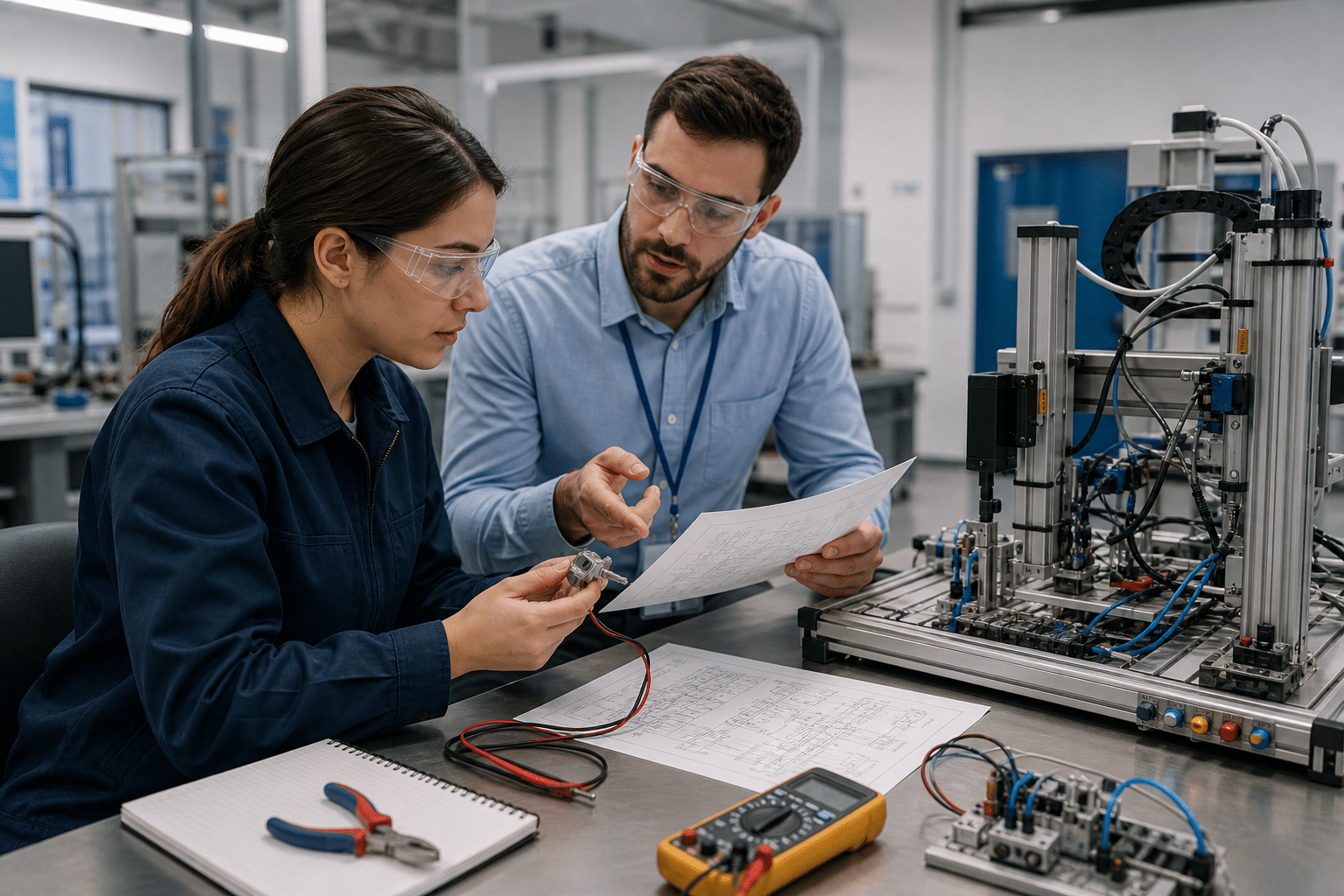
Before enrolling, compare the lab equipment with local job postings. Look for motors, sensors, pneumatics, hydraulics, PLCs, robotics, electrical safety, mechanical drawings, and testing. A program with a broad title may be mostly theory, while an employer may want hands-on experience with a specific control platform.
Our guides to industrial maintenance, industrial electrician work, and building automation cover related routes. You can also use our guide to trade school programs when comparing costs.
Pay and job outlook
There is no single salary number for every job titled electromechanical technician, but the BLS occupation is a useful national benchmark.
| BLS benchmark, May 2025 | Figure | How to read it |
|---|---|---|
| Median annual wage | $73,900 | Half earned more and half earned less in the occupation |
| Lowest 10 percent | Below $47,840 | A lower-end national reference, not a guaranteed starting wage |
| Highest 10 percent | Above $109,890 | An upper-end reference across the occupation |
| Scientific research and development | $101,580 | Median for one industry, not every technician job |
| Transportation equipment manufacturing | $78,270 | Median for one major industry |
| Machinery manufacturing | $64,700 | Median for one major industry |
The BLS projects 3 percent employment growth from 2025 to 2035 and about 1,400 openings per year on average. It also notes that automation can work in both directions: more automated systems may increase the need for technicians, while better equipment and testing can reduce some tasks.
These figures do not describe every employer using the title. A field-service role may add travel or overtime. A maintenance role may have shift premiums. A prototype role may pay differently from a production support role. Compare the actual duties, location, schedule, and benefits with the national benchmark.
Safety and working conditions
Electromechanical technicians may work near energized equipment, moving machinery, stored hydraulic or pneumatic energy, robots, noise, and industrial chemicals. The risk depends on the equipment and the task. Employers should provide procedures, training, guarding, and appropriate protective equipment.
OSHA’s machine-guarding requirements address hazards such as points of operation, rotating parts, and flying material. Lockout/tagout may apply when equipment is serviced and unexpected movement or stored energy could injure someone. A screen command or emergency stop is not a substitute for the site’s isolation and verification procedure.
Ask an employer:
- Is the work mostly assembly, testing, maintenance, or field service?
- Which voltages, machines, robots, and controls will I handle?
- Are shifts fixed, rotating, or on call?
- How much travel is expected?
- Who is allowed to modify a PLC program or electrical design?
- What training must be completed before independent work?
Is electromechanical work a good second career after 40?
It can suit someone who likes understanding how parts interact and does not mind moving between physical work and technical documentation. Experience in maintenance, electrical work, HVAC, automotive systems, manufacturing, or military equipment can transfer well.
The training may ask for more math and electronics than a basic machine operator role. That is manageable for many career changers, but it is worth taking an introductory class before committing to a two-year program. Ask a school to show you the lab and the actual course sequence.
The schedule also matters. A factory technician may work nights. A field technician may travel or respond to customer problems. A prototype technician may have a more regular schedule but a higher expectation for documentation and testing. The job title alone does not tell you which life you are choosing.
Use our career-change roadmap after 40 to compare training cost, income timing, commute, travel, and the first role you could realistically obtain.
Questions to ask before applying
- What equipment will I install, test, repair, or maintain?
- Does the employer want mechanical, electrical, controls, or robotics experience first?
- Which tools and software will I use every day?
- Is an associate degree required, preferred, or replaceable by experience?
- Are there paid training or apprenticeship options?
- How much of the job is at a bench, on a plant floor, or at a customer site?
- What does a new hire learn during the first 90 days?
- What role comes next: senior technician, controls specialist, maintenance lead, or engineering support?
Bottom line
An electromechanical technician helps machines work as systems. The job can include assembly, testing, robotics, controls, maintenance, and reports. That variety is useful if you like troubleshooting, but it also means you must read the employer’s description carefully.
The closest BLS benchmark had a $73,900 median annual wage in May 2025, with 3 percent projected growth through 2035. It is a benchmark for a broad occupation, not a promise for every job using the title. If you enjoy practical equipment and the logic of finding where a system has stopped behaving, this can be a strong technical route to investigate.
Sources
- BLS: Electro-mechanical and Mechatronics Technologists and Technicians
- Apprenticeship.gov: Electro-Mechanical and Mechatronics Occupation
- OSHA: General Requirements for All Machines
- OSHA: Control of Hazardous Energy
\n
Reviewed September 3, 2026: Electromechanical technician roles differ by factory, test lab, field service team, and equipment. Check the balance of mechanical work, wiring, controls, documentation, and troubleshooting before choosing training. See mechanical technician work.