A sheet metal worker cuts, forms, joins, installs, or repairs metal used in buildings, equipment, ductwork, roofs, and specialty systems. The work may begin with drawings and measurements, then move through fabrication, lifting, fastening, sealing, and field adjustment. It combines shop precision with jobsite conditions, physical handling, and the need to make parts fit in the real space.
That range is the first thing to understand. Sheet metal work is related to HVAC, welding, roofing, and fabrication, but it is not identical to any of them. The employer’s work mix matters more than the title.
The drawing is not the whole job: A worker may discover that a duct route meets another trade, a wall is out of square, or a field dimension differs from the plan. The useful response is to measure, communicate the change, and make the adjustment without creating a leak, unsafe edge, or later access problem.
What does a sheet metal worker do?
The U.S. Bureau of Labor Statistics says sheet metal workers fabricate or install products made from thin metal sheets. Common materials include steel, aluminum, and copper. Depending on the specialty, a worker may:
- read drawings, measurements, and layout marks;
- measure and mark flat stock or finished pieces;
- cut, bend, shape, punch, drill, or fasten metal;
- use shears, brakes, rollers, saws, lasers, presses, and hand tools;
- join pieces with screws, rivets, solder, welding, or other methods;
- fabricate duct sections, fittings, panels, enclosures, flashing, or custom parts;
- install ductwork, roofing, siding, gutters, or other products;
- repair leaks, damaged sections, supports, or ventilation components;
- check dimensions, airflow-related fit, appearance, and workmanship;
- document measurements or explain changes to a supervisor, contractor, or customer.
The job rewards careful layout. A small error at the marking stage can become a bad fit several steps later. The work is hands-on, but it also requires reading a drawing and thinking about how pieces will meet in three dimensions.
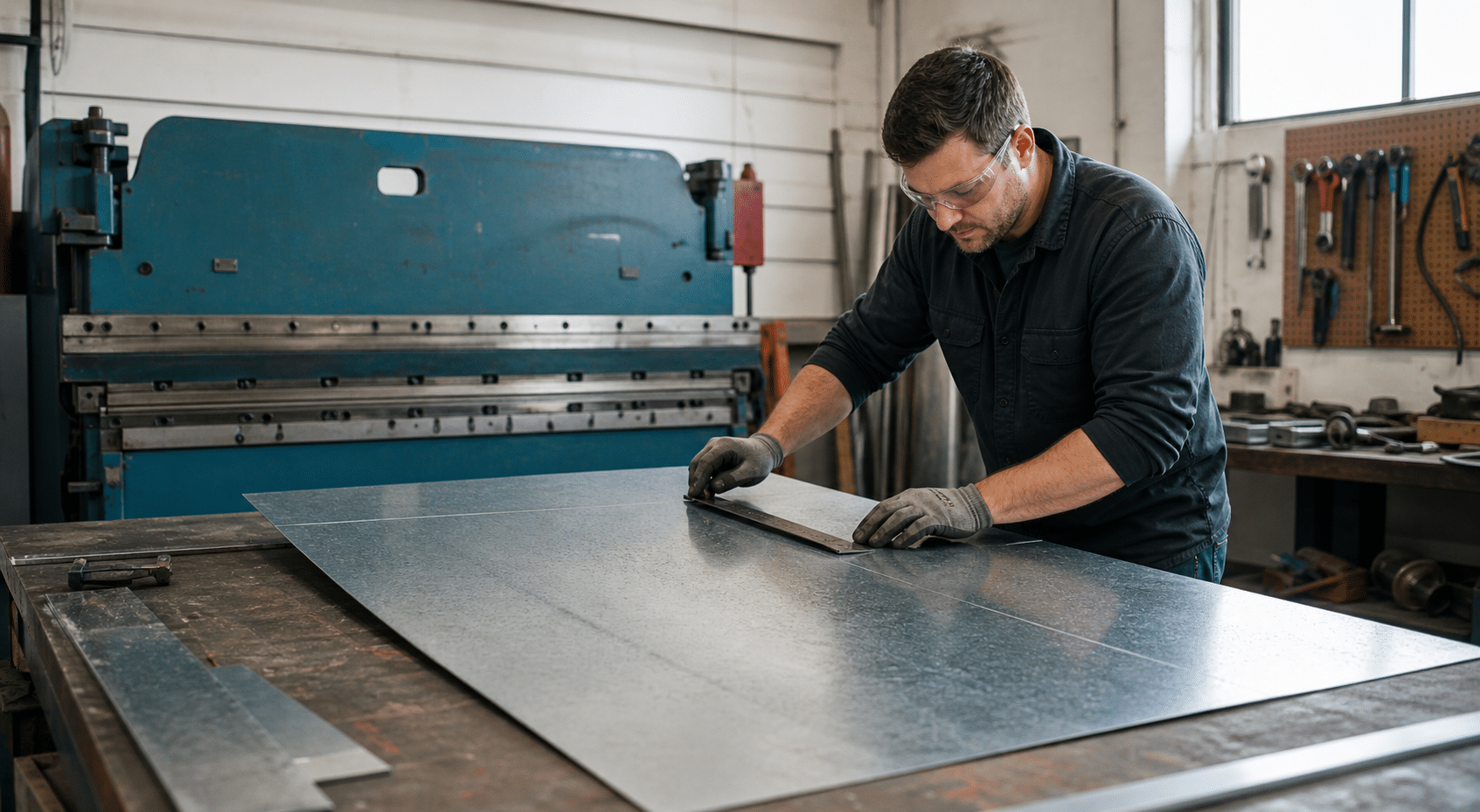
Four kinds of sheet metal work
Fabrication and precision work
Fabrication workers make parts in a shop or factory. They may use computer-controlled saws, lasers, shears, presses, and forming equipment. Some use computer-aided drafting and design systems or perform limited programming on the equipment. The environment may be more controlled than a construction site, although the work can become repetitive and still involves lifting, noise, sharp edges, and machines.
Construction installation
Installation workers put in HVAC ducts and other sheet metal products on new construction or renovation projects. They measure runs, hang supports, connect sections, seal joints, and work around other trades. The job can involve ladders, lifts, rooftops, tight spaces, kneeling, bending, and changing weather.
Maintenance and repair
Maintenance sheet metal workers repair and clean ventilation systems, correct leaks, replace damaged sections, and help systems use less energy. The work may take place in a school, hospital, factory, office building, or industrial facility. Access and coordination with building occupants can be as important as the metal repair itself.
Testing and balancing
Testing and balancing specialists adjust duct systems so rooms receive the intended airflow. This can involve measurements, dampers, drawings, and coordination with HVAC technicians or building operators. It is a more measurement-heavy path and may suit someone who likes troubleshooting but wants less cutting and installation.
Sheet metal worker versus related jobs
| Role | Main focus | How it differs |
|---|---|---|
| Sheet metal worker | Fabricate, install, maintain, or test sheet metal products | Works with the metal parts and their fit in a system |
| HVAC technician | Diagnose and service heating, cooling, refrigeration, and controls | Focuses more on equipment operation and refrigeration or electrical systems |
| Welder | Join metal through welding processes | May weld sheet metal, but does not necessarily lay out or install the whole system |
| Pipefitter | Layout, fabricate, and install piping systems | Works with pipe, fittings, valves, and process systems rather than mainly flat sheet |
| Roofer | Install and repair roofing systems | May use sheet metal flashing, but roofing is the central trade |
| Industrial painter | Prepare and coat industrial surfaces | Works with surface preparation and coatings rather than forming metal |
Our guides to HVAC technician salary, HVAC apprenticeships, pipefitting, and industrial painting can help you compare nearby routes.
Skills and tools that matter
Sheet metal workers need more than strength. The most useful skills are practical and repeatable:
- measuring and checking dimensions before cutting;
- reading shop drawings, plans, and layout instructions;
- visualizing bends, seams, clearances, and installation sequence;
- using hand tools and powered equipment without rushing;
- understanding fasteners, sealants, joints, and supports;
- communicating when a drawing, field condition, or existing installation does not match;
- working cleanly around other trades and occupied spaces.
Tools vary by specialty. A shop may use a brake, shear, roller, press, punch, laser, spot welder, drill press, or CNC equipment. An installer may carry snips, crimpers, seamers, drills, levels, layout tools, and lifting equipment. Testing and balancing work adds airflow instruments and documentation.
How do you become a sheet metal worker?
The BLS lists a high school diploma or equivalent as the typical entry-level education. Construction sheet metal workers often learn through an apprenticeship. Manufacturing workers may learn on the job or attend a technical school. There is no single route that fits every employer.
Common entry paths include:
- Applying for a sheet metal apprenticeship with a contractor, union, or joint labor-management program.
- Starting as a helper or material handler and learning layout, tools, and safe work practices under supervision.
- Completing a technical program in sheet metal, HVAC, welding, fabrication, or manufacturing.
- Moving from HVAC, welding, pipefitting, roofing, construction, maintenance, fabrication, or industrial assembly.
- Beginning in a fabrication shop and adding installation or testing skills later.
Apprenticeship.gov lists sheet metal workers as a recognized occupation. The actual sponsor, wage progression, classroom hours, work location, and scope of training still need to be checked before applying. A short course can teach tools and basic layout; it does not automatically make someone ready for every construction or fabrication task.
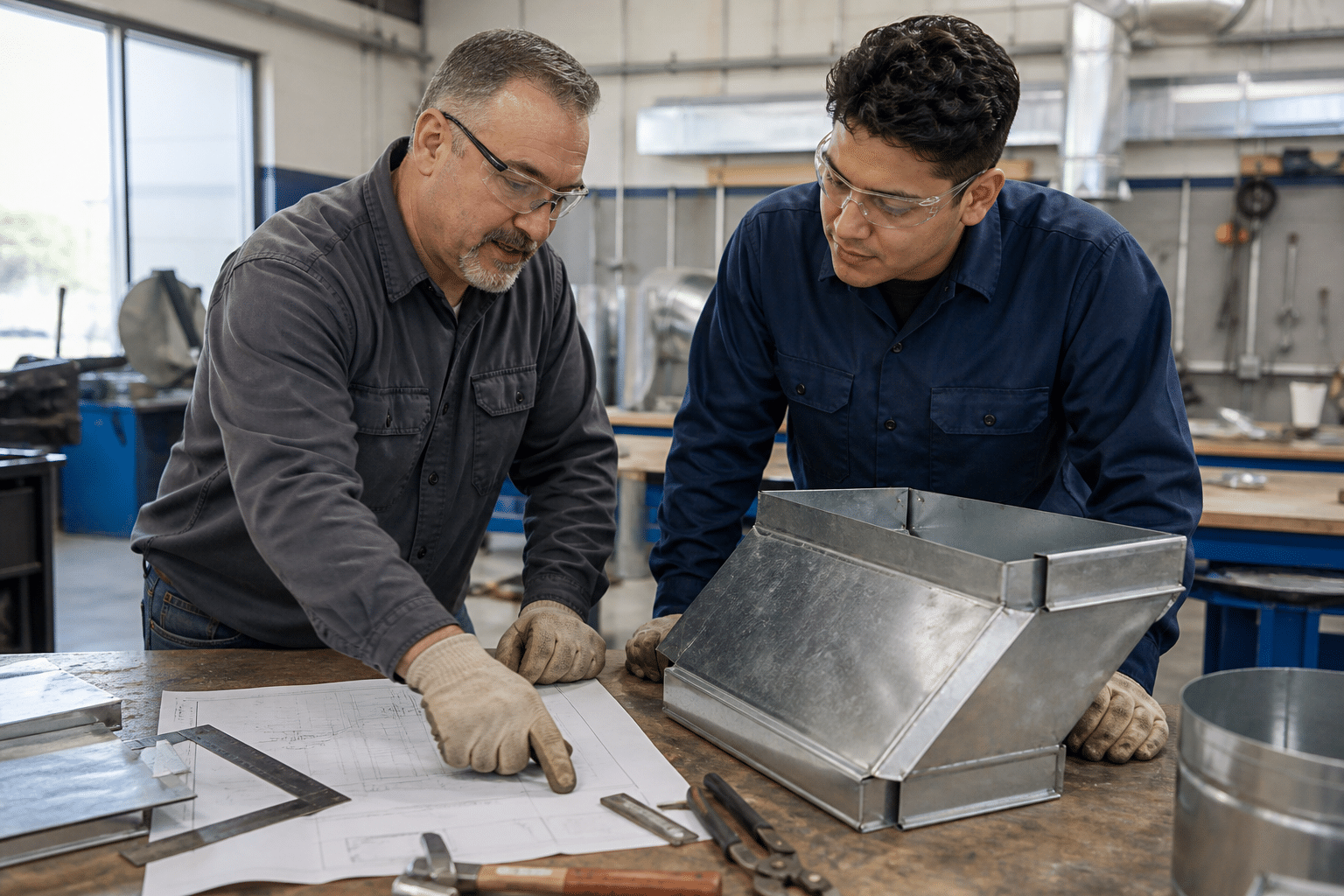
Before paying for school, look at local postings. Do employers want duct installation, architectural metal, precision fabrication, welding, CAD, testing and balancing, or industrial maintenance? The answer should guide the program you choose.
Pay and job outlook
The BLS reported a median annual wage of $61,800 for sheet metal workers in May 2025. The lowest 10 percent earned less than $38,630, while the highest 10 percent earned more than $105,650. These are national occupational figures, not a promise for an apprentice or a particular city.
| BLS benchmark, May 2025 | Figure | How to read it |
|---|---|---|
| Median annual wage | $61,800 | Half earned more and half earned less |
| Lowest 10 percent | Below $38,630 | Lower-end national reference |
| Highest 10 percent | Above $105,650 | Upper-end national reference |
| Government median | $70,640 | One industry grouping |
| Specialty trade contractors | $63,100 | One industry grouping |
| Manufacturing | $51,570 | One industry grouping |
The occupation had about 131,100 jobs in 2025. Employment is projected to grow 3 percent from 2025 to 2035, with about 9,800 openings a year on average. The BLS points to continuing installation and maintenance needs for energy-efficient HVAC systems, while prefabrication and automation can reduce some tasks in other settings.
Apprentice pay is usually below the fully trained rate and increases as skills develop. Ask whether a posting shows the starting rate, the journey-level rate, overtime, benefits, or a combination of all of them.
Safety and working conditions
Sheet metal work has real hazards: sharp edges, cuts, burns, noise, dust, heavy materials, ladders, lifts, scaffolds, awkward positions, and weather exposure. Construction installation can add work at height and tight spaces. Shop work can add machine guarding, pinch points, flying material, and repetitive tasks.
OSHA’s machine-guarding requirements cover hazards such as points of operation and rotating parts. OSHA’s fall-protection rules may apply to construction work at height. The exact procedure depends on the equipment, site, and task.
Ask an employer:
- How much work is in a shop, on a construction site, or in occupied buildings?
- How often will I climb, kneel, lift, crawl, or work outdoors?
- Which machines and joining methods will I learn?
- Are apprentices allowed to work at height, and under what supervision?
- What ventilation, guarding, fall protection, and personal protective equipment are provided?
- Are shifts, travel, overtime, or seasonal changes part of the job?
Is sheet metal work a good second career after 40?
It can fit someone who likes visible results, measurement, practical problem-solving, and a mix of shop or field work. Previous experience in HVAC, welding, construction, maintenance, fabrication, or technical drawing can help.
The physical side deserves an honest trial. Spend time in a shop or talk with an employer before assuming the work will be light because the material is thin. Installation may involve awkward positions, ladders, weather, and lifting. Fabrication may be more controlled but can still involve standing and repetitive handling.
Use our career-change roadmap after 40 to compare apprentice pay, training cost, commute, schedule, recovery time, and the first job you could realistically obtain.
Questions to ask before applying
- Does the company fabricate, install, maintain, or test sheet metal systems?
- What materials and gauges will I handle?
- Will I learn layout, CAD, welding, duct installation, or testing and balancing?
- Is the route an apprenticeship, helper job, school placement, or qualified position?
- What tools must I buy, and what tools does the employer provide?
- How much work is indoors, outdoors, at height, or in tight spaces?
- What are the normal hours and overtime expectations?
- What skills should I be able to demonstrate after the first 90 days?
Bottom line
Sheet metal work covers several different jobs. Fabrication may suit someone who likes machines and precise layout. Installation may suit someone who likes construction and visible progress. Maintenance and testing add troubleshooting and building-system work.
The BLS median was $61,800 in May 2025, with projected employment growth of 3 percent through 2035. The useful next step is not to rely on that national number. Visit a local shop, read real postings, and compare the apprenticeship or training route with the work you actually want to do.
Sources
- BLS: Sheet Metal Workers
- Apprenticeship.gov: Sheet Metal Workers
- OSHA: General Requirements for All Machines
- OSHA: Fall Protection
- AWS: Sheet Metal Worker Career Profile
\n
Reviewed September 3, 2026: Sheet metal work can include fabrication, duct installation, layout, welding, and job-site coordination. Compare apprenticeship and school routes with the work local contractors actually perform. See carpenter apprenticeships for a similar paid-training decision.