An aircraft mechanic inspects, maintains, repairs, and records work on aircraft and their systems. The job may involve airframes, engines, hydraulics, electrical systems, flight controls, interiors, or specialized equipment. FAA rules, approved maintenance data, documentation, and the exact A&P pathway matter as much as mechanical skill.
In the United States, the credential most people mean by “licensed aircraft mechanic” is an FAA Aviation Mechanic certificate. It can carry an Airframe rating, a Powerplant rating, or both. The two ratings are commonly called an A&P certificate.
The career can suit someone who likes mechanical systems, written procedures, and responsibility. It is a poor fit for anyone expecting a quick online course to lead straight to unrestricted aircraft maintenance work.
Aircraft mechanic at a glance
| Question | Practical answer |
|---|---|
| Main work | Inspect, maintain, troubleshoot, repair, and document aircraft systems and components |
| Common settings | Airlines, repair stations, manufacturers, fixed-base operators, general aviation, and government facilities |
| Main FAA ratings | Airframe (A), Powerplant (P), or both (A&P) |
| Common training routes | FAA-certificated AMTS, documented on-the-job experience, or qualifying military experience |
| FAA experience route | 18 months for one rating, or 30 months of concurrent experience for both ratings |
| BLS median wage | $79,870 for aircraft mechanics and service technicians in May 2025 |
| Work schedule | Often full time, with possible nights, weekends, holidays, and long shifts |
The FAA sets the requirements for its certificate. Employers set their own hiring requirements, aircraft qualifications, drug-screening rules, background checks, and shift conditions. Those are separate questions.
What does an aircraft mechanic do?
The exact work depends on the aircraft, employer, rating, and level of supervision. A mechanic may perform scheduled inspections, replace worn parts, troubleshoot an electrical fault, service a hydraulic system, inspect flight-control surfaces, or help return an aircraft to service under the rules that apply to the job.
The work usually includes more documentation than an outsider expects. A task is not finished simply because a component looks repaired. The mechanic has to use the right maintenance data, follow the required sequence, record what was done, and identify any inspection or sign-off required by the employer or regulation.
Some jobs are repetitive. That is not necessarily a weakness. Repeated inspections give a technician a chance to spot small changes before they become larger problems. Other jobs are less predictable, especially in line maintenance, field service, or repair stations handling varied aircraft.
Aircraft mechanics can work on:
- airframes, structures, doors, landing gear, and flight-control systems;
- engines, propellers, fuel systems, and related powerplant components;
- electrical systems, instruments, radios, and digital equipment;
- inspections, troubleshooting, scheduled maintenance, and repair records.
An aircraft mechanic does not automatically work on every system just because the job title contains the word mechanic. The certificate rating, the employer’s authorization, the aircraft type, the maintenance data, and the technician’s demonstrated knowledge all matter.
Aircraft mechanic, AMT, A&P, and avionics technician
These labels overlap, but they are not interchangeable in every job posting.
An Aviation Maintenance Technician, or AMT, is a broad term for a person working in aircraft maintenance. An aircraft mechanic is often used in the same way. An A&P mechanic holds both FAA ratings, Airframe and Powerplant. A mechanic may hold only one rating.
An avionics technician focuses more heavily on electrical, communication, navigation, instrument, and electronic systems. The Bureau of Labor Statistics reports avionics technicians separately from aircraft mechanics and service technicians. Some employers combine the work, while others maintain distinct teams.
When comparing jobs or schools, read the curriculum and the actual duties. A program described as aviation maintenance may prepare students for an Airframe rating, a Powerplant rating, avionics work, or a combination. The name alone is not enough.
How to become an aircraft mechanic
The FAA recognizes more than one route. The most common civilian option is an FAA-certificated Aviation Maintenance Technician School, often called an AMTS or Part 147 school. Another route is practical experience gained through qualifying employment. Military aviation maintenance experience may also help, but the FAA still evaluates the evidence and the requirements for the rating sought.
Route 1: FAA-certificated AMTS
An AMTS teaches the knowledge and practical skills needed for the Airframe and/or Powerplant ratings. The FAA says most Part 147 schools expect a high school diploma or GED, and estimates that many programs take about 18 to 24 months depending on the rating or ratings.
Graduating from an approved school does not mean a student automatically receives an A&P certificate. It gives the graduate a way to establish eligibility for the FAA knowledge tests, assuming the other requirements are met. The candidate still has to pass the required knowledge, oral, and practical tests.
Compare schools by looking past the brochure. Ask:
- How much supervised work happens on real aircraft or appropriate training equipment?
- Does the program cover Airframe, Powerplant, or both?
- What tools, safety equipment, testing fees, and uniforms cost extra?
- What is the total calendar time, including breaks and prerequisites?
- Does the school explain how its graduation document is used in the FAA testing process?
- Which employers hire graduates, and are those claims specific and current?
The cheapest tuition is not always the cheapest route. Add transport, tools, housing, lost income, testing, and the time required before the first paid job.
Route 2: documented on-the-job experience
The FAA also allows qualifying practical experience. For one rating, the general requirement is 18 months of practical experience with the procedures, tools, materials, and equipment used to construct, maintain, or alter the relevant airframe or powerplant. For both ratings, the requirement is 30 months of concurrent experience.
The important word is practical. Time spent near aircraft is not automatically the same as time performing eligible maintenance tasks. The FAA recommends keeping detailed records, including the task, time spent, and validation by a certificated mechanic or supervisor.
This route can cost less than school, but it is harder to navigate. A new worker may start in a helper, cleaner, parts, or entry-level maintenance role and gradually gain access to qualifying tasks. Before relying on the route, ask the employer how experience is assigned, supervised, documented, and reviewed by the local FAA office.
Route 3: military aviation maintenance
Military experience can be valuable because it may include structured technical training and real maintenance work. It still needs to be documented. The FAA may review service records, occupational codes, training records, evaluations, and other evidence before deciding whether the experience supports testing eligibility.
Do not assume that a military job title maps perfectly to a civilian A&P rating. Civilian certification covers a broad body of knowledge, so the applicant may need to document or demonstrate areas that were not part of the military specialty.
What is an A&P certificate?
The FAA issues an Aviation Mechanic certificate with an Airframe rating, a Powerplant rating, or both. A person does not have to obtain both ratings, although many airline and maintenance employers use A&P as a preferred or required credential for broader work.
The basic requirements include being at least 18 years old, being able to read, write, speak, and understand English, meeting the experience or school requirement, and passing the prescribed tests. The FAA says there is no general education requirement for the certificate itself, even though employers and schools may ask for a diploma or GED.
The testing path includes knowledge exams and oral and practical exams. If eligibility is based on personal experience rather than an AMTS graduation certificate, the applicant generally works with an FAA Aviation Safety Inspector through a Flight Standards District Office. The FAA uses Form 8610-2 in that process. A mechanic applicant also needs an FAA Tracking Number before taking the knowledge tests.
The details matter because a certificate is not a shortcut around employer procedures. Employers may require additional aircraft-specific training, recurrent training, inspection authorization, or experience with a particular maintenance system.
Are aircraft mechanic apprenticeships available?
Some employers and programs use apprenticeship language for aircraft maintenance training. Apprenticeship.gov lists aircraft mechanics and service technicians among related occupations and describes work activities that can be included in on-the-job training.
Still, ask what the program actually provides. A useful program should identify the employer, supervisor, wage schedule, training hours, related instruction, safety process, and documentation. It should also explain whether completion supports an FAA-certificated path or simply provides employer training.
The word apprenticeship does not automatically mean that a program replaces an FAA-certificated AMTS or satisfies every A&P requirement. Verify the sponsor, the agreement, and the route to the certificate before leaving another job or paying a deposit.
For a broader discussion of paid training, see our guide to online trade school and hands-on practice. Aircraft maintenance is a field where online lessons can support study, but they cannot replace the practical experience required for the work.
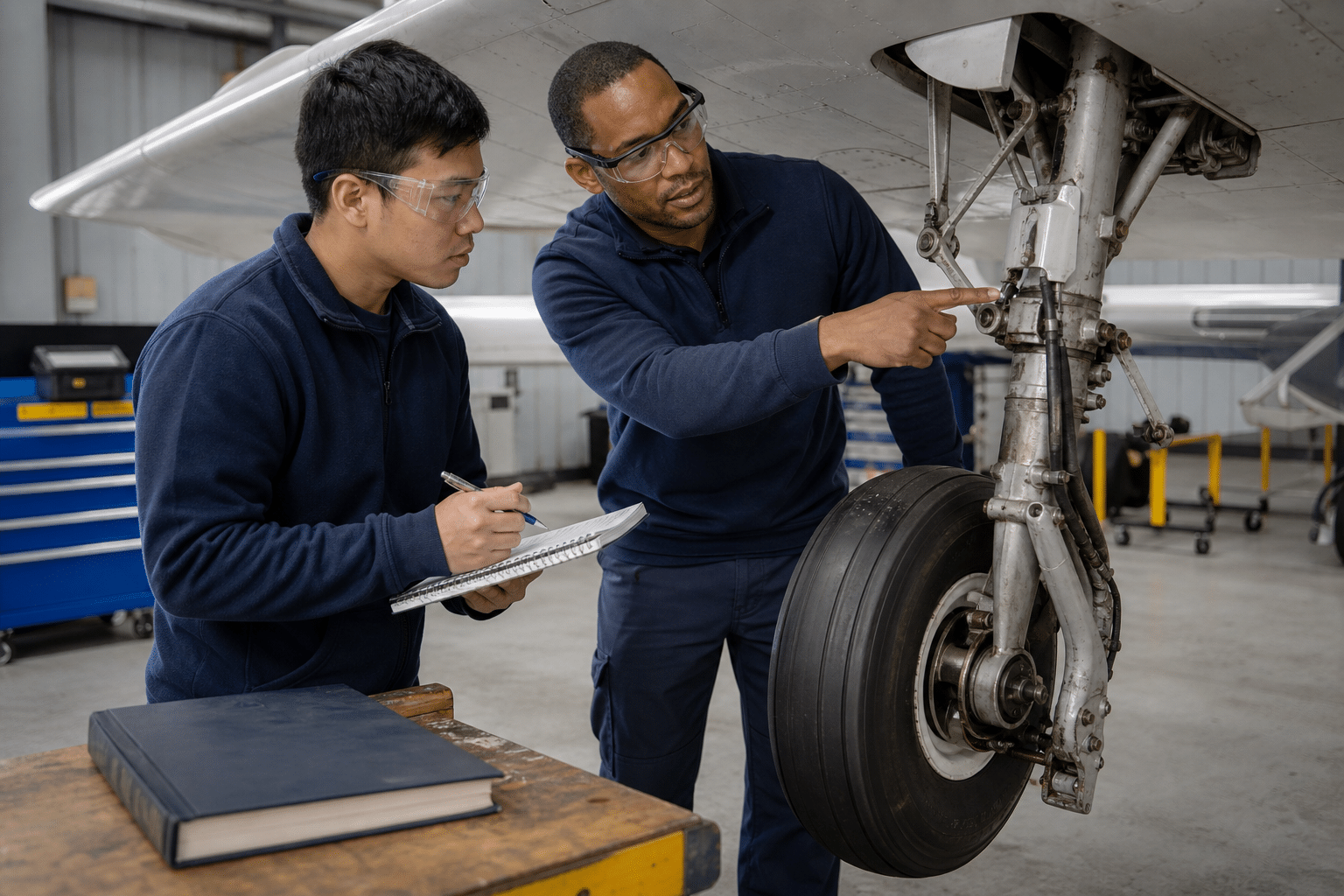
A maintenance task ends with evidence: The mechanic identifies the aircraft and task, uses the approved procedure, checks the result, and records the work within the allowed authority. A repair that feels complete but lacks the correct inspection or sign-off is not ready to return to service.
Aircraft mechanic salary and job outlook
The BLS reported a May 2025 median annual wage of $79,870 for aircraft mechanics and service technicians. The lowest 10 percent earned less than $48,780, while the highest 10 percent earned more than $128,890. The same BLS profile reports an $82,280 median for avionics technicians.
Those figures are useful context, not a promise for a new graduate. Pay changes with the employer, aircraft type, location, shift, overtime, experience, union agreement, and whether the worker holds the ratings the job requires.
The BLS projects 6 percent employment growth for the broader aircraft and avionics equipment mechanics and technicians group from 2025 to 2035, with about 13,100 openings per year on average. Many openings will come from people leaving the occupation or retiring, not only from new industry growth.
The highest number on a job board may include overtime or a difficult night shift. Compare base pay, shift differential, benefits, commute, required tools, and the training agreement before comparing two offers.
What are the working conditions?
Aircraft maintenance can be physically demanding without looking like heavy construction. Mechanics may work on ladders, scaffolds, under aircraft, in tight spaces, or in awkward positions. The environment may be loud because of aircraft engines and equipment. Work can also involve standing, kneeling, reaching, lifting components, and using tools for long periods.
Schedules vary by employer. Airlines and repair stations may need coverage at night, on weekends, and on holidays. A person who wants a predictable Monday-to-Friday schedule should ask about the actual shift before accepting a training offer.
The safety culture matters. Look for employers and schools that explain lockout procedures, fall protection, hearing protection, chemical handling, foreign-object-debris control, and the process for stopping work when instructions or conditions are unclear.
Is aircraft maintenance a good career after 40?
It can be, especially for someone bringing useful habits from industrial maintenance, automotive repair, electronics, the military, or quality-controlled manufacturing. The transferable skills are practical: reading technical information, using measurement tools, following a sequence, documenting work, and admitting when a result needs another check.
Age does not remove the need to build aviation-specific knowledge. A career changer may still need to study aircraft systems, regulations, materials, electrical theory, documentation, and the limits of the certificate. English-language technical reading is part of the job, not a side task.
The physical side deserves an honest trial. Visit a school, talk with a working mechanic, or ask for a job-shadow opportunity if possible. Notice how you feel after standing, climbing, reaching, and working around noise for several hours. A career change is expensive enough without discovering the physical mismatch after enrollment.
Our career change at 40 roadmap can help structure the decision. If your interest is broader industrial troubleshooting rather than aviation, compare it with industrial maintenance technician work. If you prefer medical equipment, our medical equipment repairer guide covers a related technical path with a different work environment.
A practical first-job plan
Start by choosing the work setting you actually want. Airline line maintenance, heavy maintenance, general aviation, helicopter work, manufacturing, and repair stations do not offer the same schedule or training experience.
Then compare the route:
| If your priority is… | Start by comparing… |
|---|---|
| A defined classroom and shop sequence | FAA-certificated AMTS programs |
| Earning while learning | Employer entry roles and documented OJT |
| Using previous aviation service | FAA guidance for military experience and records |
| Faster employment | Local employers, repair stations, and parts or maintenance support roles |
| Broader certification | A program or job path that supports both Airframe and Powerplant ratings |
Before committing, write down the time to eligibility, total out-of-pocket cost, lost income, likely first-job wage, shift, commute, and next credential. That simple comparison will tell you more than a school slogan.
Bottom line
Aircraft mechanic is a serious technical career with a clear federal certification route and several ways to build the required experience. The strongest candidates are comfortable with hands-on work, technical reading, detailed records, and a workplace where “close enough” is not an acceptable finish.
An FAA-certificated AMTS is the most structured civilian route. OJT can reduce tuition but requires careful documentation and a trustworthy employer. Military experience can help, but it still needs an FAA review. The salary outlook is solid in the BLS data, but the first job may pay much less than the national median and may include inconvenient shifts.
If you want aviation work and are willing to learn the rules behind the tools, the field is worth investigating. If you mainly want a short online course or a job with no documentation burden, choose a different path.
Sources
- Federal Aviation Administration: Become an Aviation Mechanic – certificate ratings, age, English, experience, exams, and common questions; checked September 1, 2026.
- Federal Aviation Administration: Experience Requirements to Become an Aircraft Mechanic – AMTS, OJT, documentation, military experience, and indicative program duration; checked September 1, 2026.
- Federal Aviation Administration: Aircraft Maintenance Technician Schools – Part 147/AMTS role and eligibility documentation; checked September 1, 2026.
- Federal Aviation Administration: Become a Mechanic Frequently Asked Questions – Form 8610-2, FSDO/ASI process, testing, and experience questions; checked September 1, 2026.
- U.S. Bureau of Labor Statistics: Aircraft and Avionics Equipment Mechanics and Technicians – May 2025 pay, work conditions, outlook, and openings; checked September 1, 2026.
- Apprenticeship.gov: Aircraft Mechanics and Service Technicians – related occupation titles and OJT activities; checked September 1, 2026.
- eCFR: 14 CFR Part 65, Subpart D – federal mechanic certification rules; checked September 1, 2026.
\n
Reviewed September 3, 2026: Aircraft mechanic training should match the aircraft, maintenance setting, FAA requirements, and employer pathway. Ask how practical experience is earned and how the A&P route fits the job you want. Compare it with aircraft mechanic pay.