
An air quality technician collects and interprets measurements that help explain conditions inside buildings or at environmental sites. Depending on the employer, the work may involve ventilation checks, particulate or moisture measurements, sampling, equipment calibration, and written reports. The role requires technical care because a number is useful only when the instrument, location, timing, and comparison standard are clear.
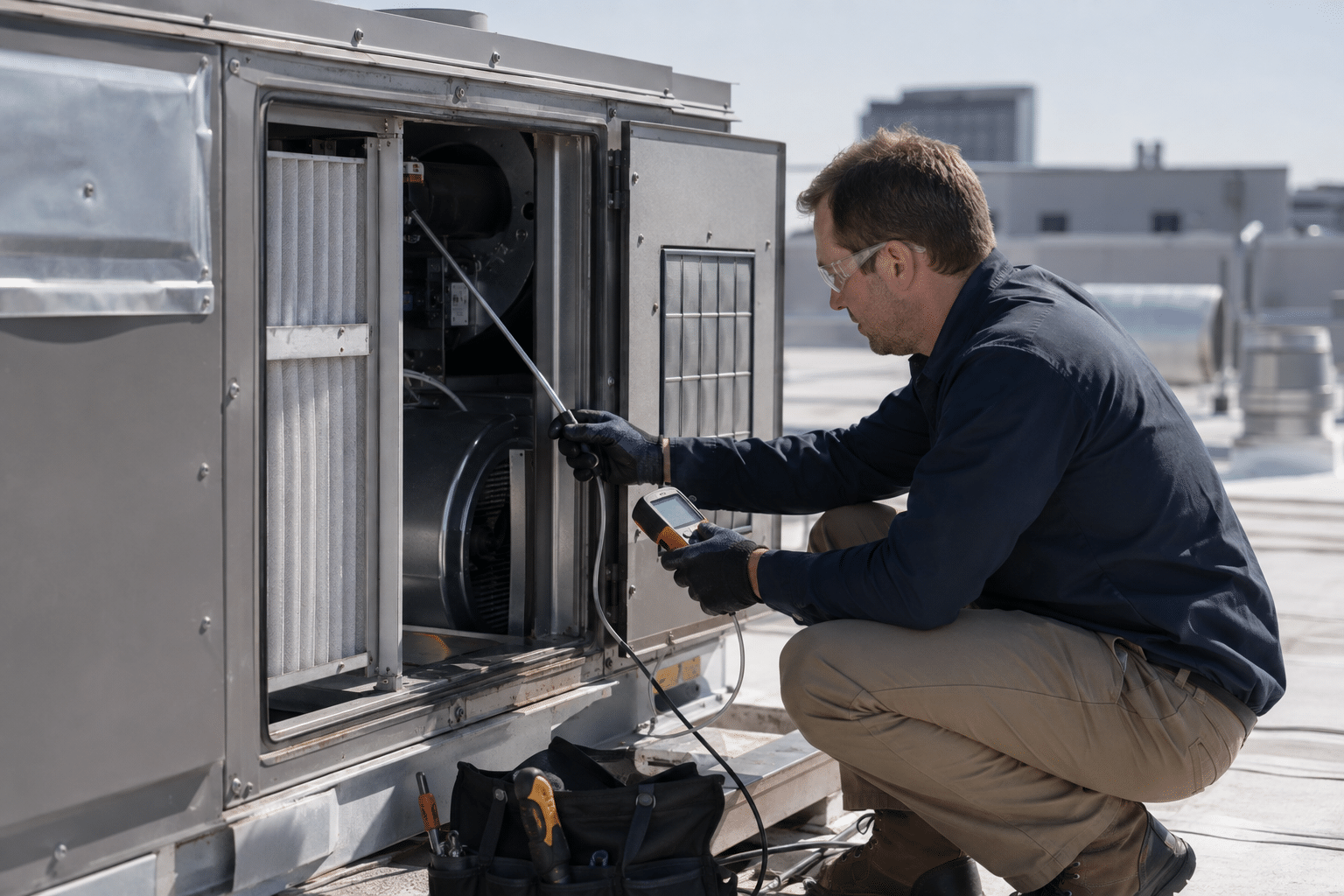
Why context matters: A high reading in one room does not automatically identify the source of a problem. The technician may compare indoor and outdoor conditions, note HVAC operation, inspect moisture clues, repeat the measurement, and document where the sample was taken. That process helps the client decide whether the next step is cleaning, ventilation work, repair, or specialist testing.
What does an air quality technician do?
Typical duties may include inspecting rooms and mechanical spaces, recording temperature and humidity, checking airflow, measuring carbon dioxide or particulate matter, collecting samples, and documenting odors, moisture, dust, or visible damage. Technicians may also review HVAC records, interview occupants, and help a senior investigator identify likely pollutant sources.
Good work is methodical. A single reading rarely explains a building problem. The technician compares locations, conditions, equipment operation, occupant reports, and the timing of complaints. Results may lead to ventilation changes, moisture control, filtration, cleaning, or a specialist assessment.
Training and credentials
There is no single national license for every air quality technician. Employers may ask for a high school diploma, an associate degree in environmental science or HVAC, laboratory experience, or previous field work. Training commonly covers sampling equipment, calibration, chain of custody, personal protective equipment, and report writing.
The EPA’s Building Air Quality guidance treats an indoor air investigation as a process that can include an initial walkthrough, review of HVAC information, occupant interviews, source identification, sampling, and evaluation of possible solutions. That is a useful reminder that a meter reading is evidence, not a diagnosis.
Some jobs require state credentials, asbestos or mold training, OSHA safety training, or a certification tied to a particular testing method. Check the local posting and the substance being sampled before paying for a course.
Pay and work conditions
Air quality technician is not always separated in national wage tables. Pay depends on the employer, region, travel, laboratory duties, and whether the role sits in environmental consulting, facilities, public health, or industrial hygiene. Compare several local postings and look for overtime, mileage, and field allowances.
The work can suit someone who likes investigation and careful notes. It may involve crawlspaces, rooftops, occupied buildings, unpleasant odors, protective equipment, and conversations with people who are worried about their health. Technicians should avoid making medical claims and should refer health questions to qualified clinicians.
Could it fit after 40?
Experience in HVAC, building maintenance, laboratory work, environmental services, safety, or facilities can transfer. A career changer does not need to know every contaminant on day one, but must be willing to follow sampling procedures exactly. The less glamorous part, report writing, is often what makes the field useful.
Start by reading postings from environmental firms, school districts, hospitals, and facility contractors. Ask whether new hires collect samples, operate instruments, or mainly support a senior consultant. That answer tells you how quickly you will gain field responsibility.
For related paths, compare our guides to industrial hygienist, HVAC controls technician, and environmental technician.
What the work looks like in practice
A air quality technician usually balances scheduled work with problems that cannot be predicted from a calendar. The scheduled side may include inspections, readings, preventive tasks, site visits, customer appointments, or a review of records from the previous shift. The unscheduled side may begin with an alarm, a complaint, a weather event, a failed test, or a result that does not match expectations. The first professional habit is to confirm the condition before changing anything.
Because the work supports indoor-environment firms, laboratories, public agencies, schools, and industrial sites, communication is part of the technical job. A worker may coordinate with a supervisor, customer, contractor, operator, dispatcher, engineer, or emergency team. A good handoff explains what was observed, what was checked, what action was taken, and what still needs attention.
Equipment and records
The tools used by a air quality technician may include sampling pumps, particulate meters, moisture meters, calibration checks, chain-of-custody forms, and reports. The exact list varies, but the principle is consistent: select an appropriate tool, use it according to the procedure, and record enough information for another person to understand the result. A useful result depends on where, when, and how the sample was collected, not just on the number displayed by an instrument That is why a reading without location, time, condition, or method can be less useful than a shorter record made carefully.
Field notes should connect each sample or reading to the instrument, location, time, weather or process conditions, calibration checks, and any deviation from the method. A clean-looking number is not automatically valid. Detailed records allow reviewers to decide whether unusual data reflects pollution, equipment trouble, or handling.
Training and the first months
Air quality technician duties can center on ambient monitors, emissions testing support, industrial sampling, instrument calibration, or data review. Ask which pollutants and methods the team uses, what field work trainees may perform, and who validates results before they enter a compliance or public dataset.
Relevant preparation may include environmental science, basic chemistry, sampling procedures, instrument operation, and quality assurance. The employer should teach the exact methods and chain-of-custody rules used by its program. Ask whether required certifications or medical clearances are completed before field assignment.
Safety and working conditions
A air quality technician may face moving equipment, electricity, pressure, traffic, heights, weather, chemicals, confined areas, or unfamiliar properties. The correct response is to follow the hazard assessment, use the required PPE, isolate equipment when required, and stop when the real condition does not match the work plan. Production pressure or a customer deadline does not remove the need for a safe method.
Field days may begin early and include rooftop access, roadside stations, industrial areas, weather, ladders, compressed gases, or long drives. Laboratory or office days can require sustained attention to calibration and data flags. Ask for the real split between settings and the protective equipment involved.
Career change after 40
This path can suit someone who brings reliability, practical judgment, customer awareness, or careful documentation from another field. The most transferable skill is often the ability to notice a change, ask a precise question, and complete the record. field sampling and evidence-based reporting can be learned, but it is easier when you already respect procedures and understand the consequences of a rushed decision.
New technicians gain credibility by following the method even when a site is inconvenient. Prepare equipment before travel, label samples immediately, and document a failed calibration instead of trying to rescue questionable data. Scientific honesty and careful handling matter more than producing a complete-looking spreadsheet.
Advancement and fit
With experience, a air quality technician may move toward industrial hygienist assistant, environmental specialist, laboratory analyst, or project coordinator. Advancement depends on demonstrated competence, additional education, employer structure, and sometimes licensing. Before accepting a job, ask what the previous person moved on to and whether internal postings or tuition support are available.
Questions to ask before applying
- What does this title mean at this employer, and which tasks are outside the role?
- What are the normal schedule, travel, physical, and emergency expectations?
- Which tools, software, records, and safety qualifications are required?
- How are new workers trained and approved for independent work?
- What is the realistic next step after the first year?