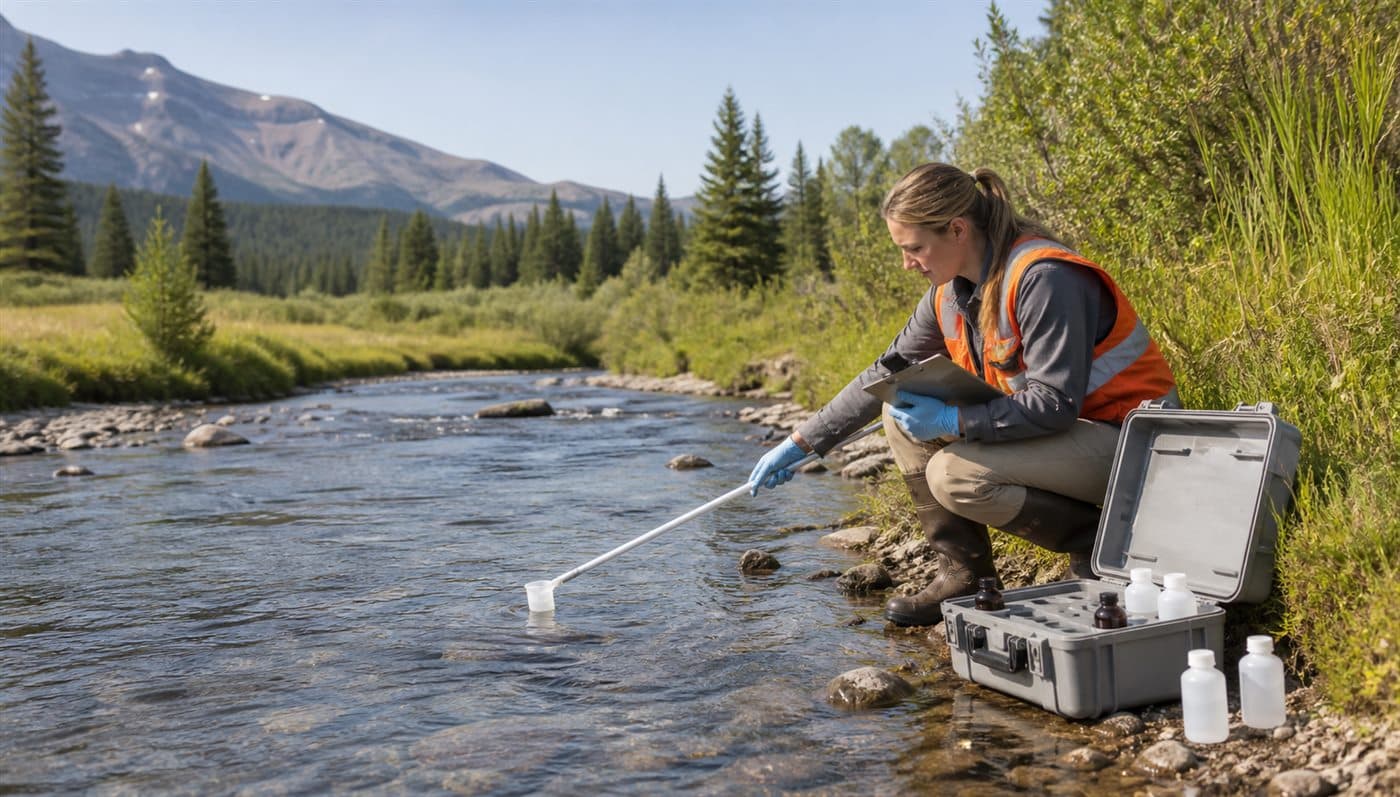
An industrial hygienist looks for workplace exposures that could harm people over time or during an incident. The work may involve air sampling, noise measurements, chemical reviews, ventilation, heat, ergonomics, and written recommendations. It combines field measurement with interpretation: the goal is not just to collect a number, but to understand how workers encounter the hazard and what control could reduce it.
What does an industrial hygienist do?
The work combines observation, measurement, interpretation, and communication.
| Area | Typical work |
|---|---|
| Exposure assessment | Identify who may be exposed, how, and for how long |
| Sampling | Collect air, surface, noise, or other measurements using a defined method |
| Data review | Compare results with applicable limits and professional guidance |
| Controls | Recommend engineering, administrative, or personal-protection measures |
| Incident response | Investigate an unexpected release, complaint, or exposure |
| Reporting | Explain findings and track corrective actions |
Industrial hygiene is broader than handing out personal protective equipment. The strongest control may be ventilation, substitution, enclosure, isolation, or a process change. PPE still matters, but it is not the only answer.
How do you become an industrial hygienist?
Industrial hygienist is a specialization rather than one single BLS occupation. Employers may seek education in industrial hygiene, occupational health, chemistry, biology, environmental science, engineering, or a related field. A bachelor’s degree is common for professional roles; technician and assistant positions may have different requirements.
Experience as an occupational safety technician, environmental technician, laboratory worker, nurse, maintenance professional, or process operator can help you understand workplace conditions. It does not replace the science, sampling methods, or regulations required for the role.
Training may include toxicology, ventilation, exposure limits, statistics, sampling strategy, respiratory protection, noise, ergonomics, and report writing. Check the experience and education requirements for the credential or employer you are considering.
Where do industrial hygienists work?
Industrial hygienists work in factories, construction, healthcare, laboratories, government, consulting, and transportation. They may spend one day reviewing records and another walking a plant, observing a task, collecting samples, or discussing a control with workers.
Fieldwork can involve noise, heat, chemicals, dust, heights, confined spaces, or contaminated areas. Safety training and the right protective equipment are essential. A hygienist must also understand the limits of an instrument and avoid presenting a rough screening measurement as a complete exposure study.
Industrial hygienist pay and outlook
The closest BLS benchmark is occupational health and safety specialists and technicians. In May 2025, the BLS reported median annual wages of $90,150 for occupational health and safety specialists and $61,560 for technicians. Employment for the combined group is projected to grow 19% from 2025 to 2035.
These figures are benchmarks for a broader occupational group, not a universal industrial hygienist salary. Pay depends on education, certification, consulting or public employment, industry, travel, responsibility, and whether the role is a technician, specialist, or manager.
Is it a good second career after 40?
It may suit someone who enjoys practical science, careful investigation, and conversations about how work is really done. A former trade worker may notice hazards that are invisible in a policy document. The transition still requires learning exposure science, regulations, statistics, and professional reporting.
Before paying for a program, read local postings and ask whether employers hire technicians, assistants, or entry-level specialists. Compare the education requirement, field conditions, travel, and credential expectations. A safety role can be a first step, but it is not automatically the same work.

One reading rarely answers the whole question: The hygienist may compare a sample with the task, duration, ventilation, protective equipment, and other workers’ exposure. A useful report explains the method and uncertainty, then connects the result to a control such as substitution, enclosure, ventilation, work practice, or protective equipment.
Bottom line
Industrial hygienists turn workplace observations and measurements into exposure controls. The career combines science with field judgment and clear communication. Start by matching your existing experience to a realistic entry role, then build the technical training that employers in your area request.
Related guides: Nuclear Technician: Duties, Training, Pay and Career Fit and Energy Auditor: Duties, Training, Pay and Career Fit.
Build a defensible exposure assessment
Industrial hygiene begins with the work, not the sampling pump. Observe the task, materials, duration, controls, worker position, and routes of exposure before selecting a method. Review safety data, process changes, complaints, and earlier results. A measurement collected at the wrong time or location can look precise while missing the exposure employees actually experience.
Document the instrument, calibration, sample identification, flow, times, conditions, protective equipment, and anything that changed during the task. Keep field observations with the laboratory result. When data is limited, state the limitation and recommend what should be checked next. Do not turn one short sample into a broad claim about every shift or employee.
Understand the professional path
Roles range from field technician to industrial hygienist positions that expect substantial science education and professional judgment. Ask whether the job involves sampling support, program management, regulatory interpretation, ventilation review, or emergency response. Credentials may help later, but supervised experience is central. Career changers should compare travel, respirator use, plant access, report deadlines, and the need to explain unwelcome findings to managers and workers.
Prepare to explain results to both workers and managers. Start with the task and exposure route, then describe what the measurement can and cannot show. Avoid burying the practical meaning under statistics. When controls are needed, consider elimination, substitution, enclosure, ventilation, work practice, and protective equipment in the context of the process. Personal protective equipment may be necessary, but it should not become the automatic answer to every problem. Ask how recommendations are assigned, funded, and checked after installation. An exposure assessment has little value if the report sits unread. Follow-up may require repeat monitoring, worker feedback, maintenance checks, or review of changed production conditions. The strongest hygienists stay curious when the numbers and the workplace story do not agree.
Keep a field notebook that separates worker statements, your observations, instrument readings, and later conclusions. This simple discipline makes reports easier to defend and prevents memory from quietly filling gaps.
Schedule follow-up after controls change; exposure conditions can return when production rate, material, maintenance, or worker position changes.
Sources
- U.S. Bureau of Labor Statistics: Occupational Health and Safety Specialists and Technicians
- OSHA: Industrial Hygiene
Reviewed September 3, 2026: Industrial hygienist work may include exposure sampling, noise, ventilation, chemicals, heat, ergonomics, and written recommendations. Check the mix of field work, analysis, and reporting before choosing training. See occupational safety technician work.