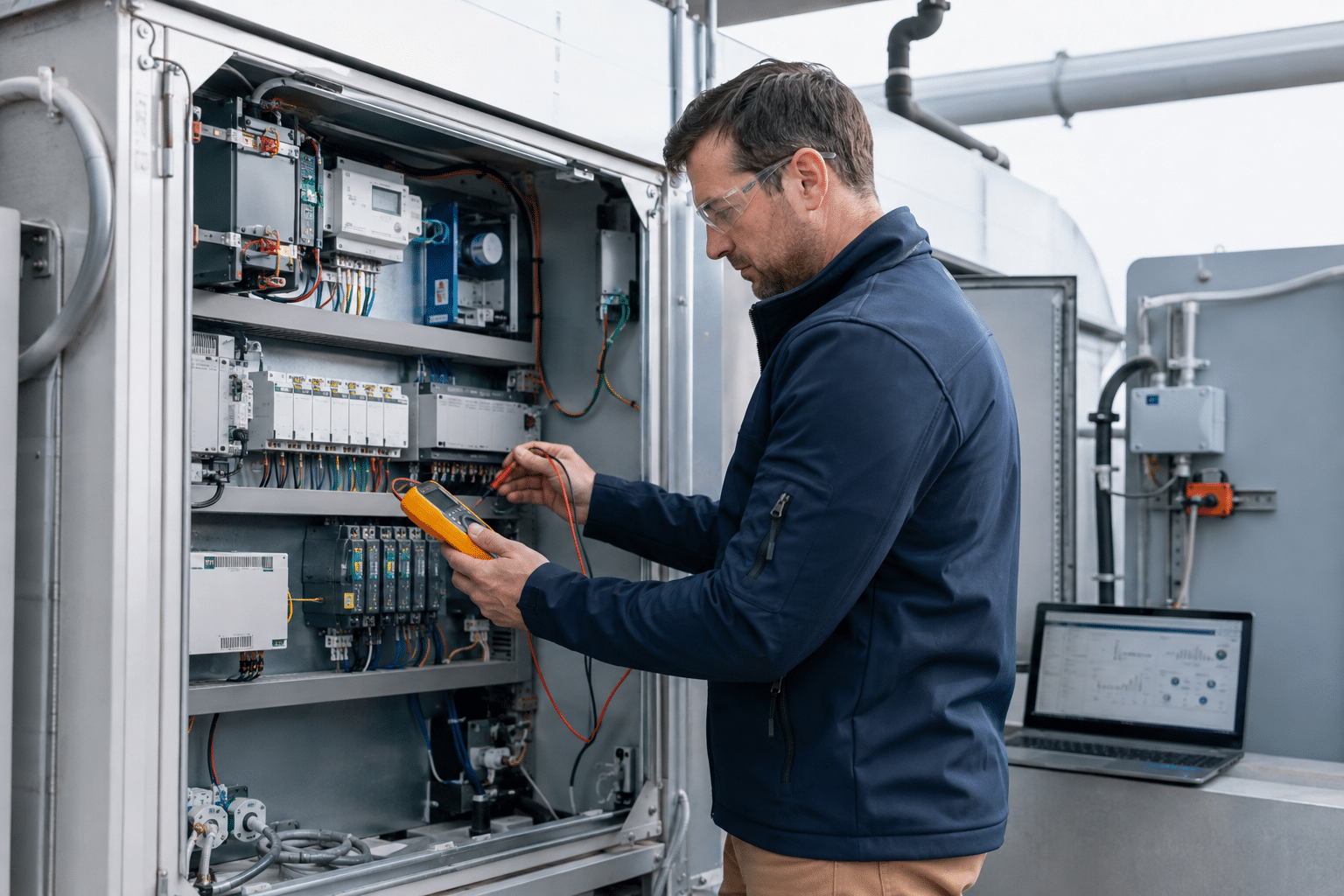
An HVAC controls technician works on the sensors, controllers, networks, and software that tell heating and cooling equipment what to do. The role is different from general HVAC service because the fault may sit in a temperature reading, a control sequence, a communication link, or the mechanical equipment itself. The work rewards people who can move between wiring, screens, measurements, and conversations with building operators.
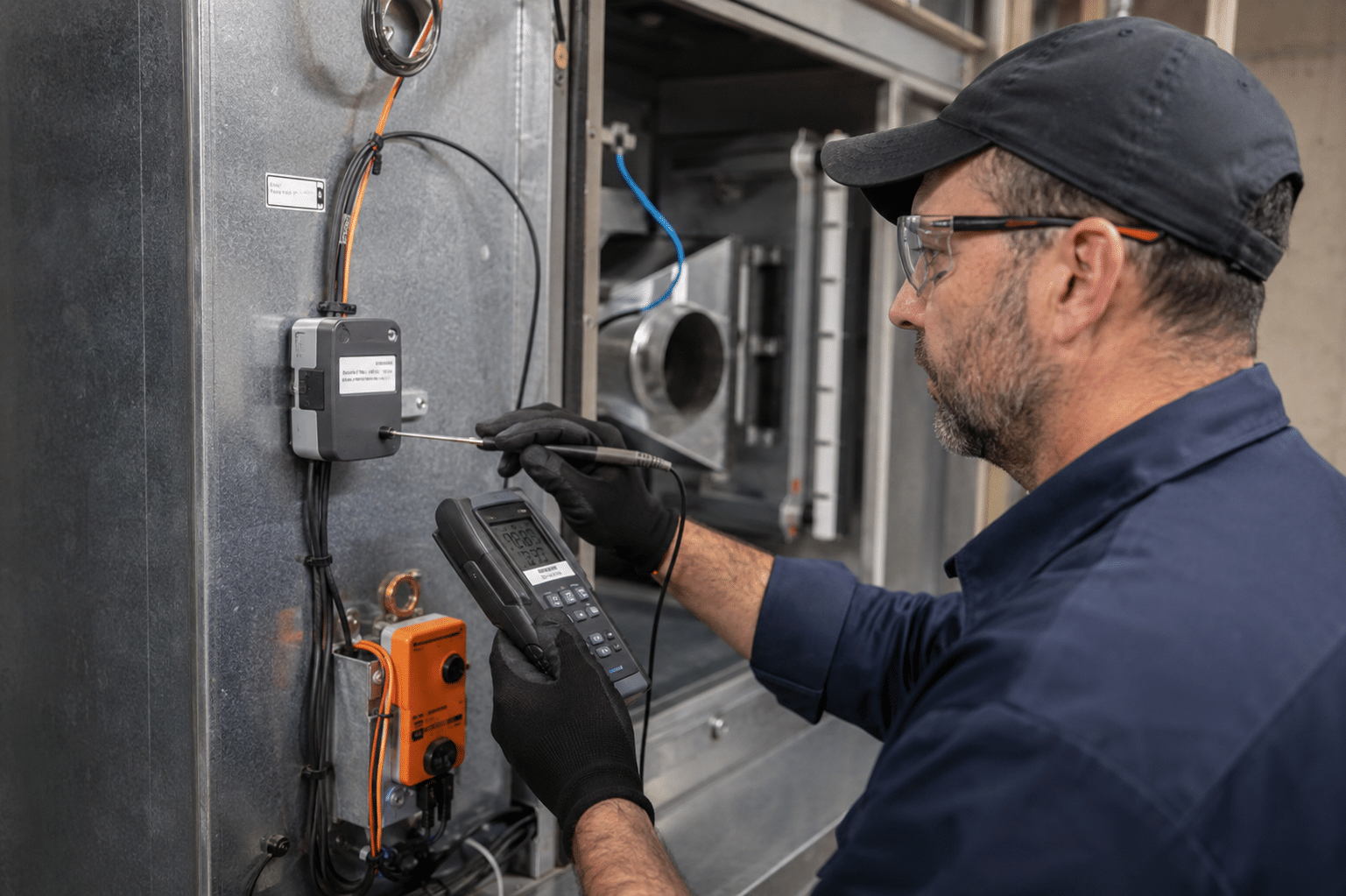
A useful troubleshooting example: If a building zone is too warm, the technician may check the room sensor, setpoint, damper command, actuator, air temperature, and controller trend before replacing a part. The visible symptom is in the room, but the cause may be in the control logic or the network.
What does an HVAC controls technician do?
The title covers several kinds of work. A technician may:
- Test temperature, pressure, humidity, and airflow sensors.
- Check relays, actuators, valves, dampers, controllers, and communication wiring.
- Compare the control sequence with what the equipment is actually doing.
- Use a laptop or building automation interface to review alarms, trends, and setpoints.
- Support startup, commissioning, preventive maintenance, and service calls.
- Record changes so the next technician can understand what happened.
The Department of Energy describes building controls as systems that manage building equipment and notes that technicians may repair and sustain those controls. The work is practical. A bad reading from one sensor can make a whole air-handling system behave strangely.
Training and certification
Many people enter through HVAC service, electrical work, facilities maintenance, or an employer’s controls-training program. A technical certificate can help, but hands-on experience with schematics, meters, low-voltage wiring, motors, and mechanical systems matters just as much for many entry jobs.
Training usually adds control logic, networking, sequence of operations, commissioning, and safe troubleshooting. Refrigerant work brings separate EPA requirements, and state or local licensing rules may apply to the HVAC portion of the job. Do not assume a controls course replaces a license required for other HVAC work.
Pay and job outlook
HVAC controls technician is not a separate BLS wage category. The closest broad benchmark is heating, air conditioning, and refrigeration mechanics and installers. BLS reported a 2025 median annual wage of $61,010 and projects 11 percent employment growth from 2025 to 2035. Those numbers are a proxy, not a promise for controls specialists.
Commercial construction, retrofits, energy management, and the replacement of older equipment can create demand for people who understand both field hardware and computerized systems. Pay varies with travel, programming ability, union coverage, and responsibility for commissioning.
Is this career a good fit after 35?
This path can suit someone who likes solving problems without doing the same repair every day. It rewards patience. You may spend an hour tracing a signal or comparing a trend log before changing a part.
The work still involves ladders, mechanical rooms, awkward access, and customer or facility pressure. You need to explain technical findings in plain language and keep learning as platforms change. Experience in HVAC, electrical maintenance, IT networking, or industrial controls can shorten the learning curve.
How to explore the field
Read local job postings closely. Some employers want a service technician who can learn the controls platform; others want a programmer or commissioning specialist. Compare the path with controls technician, instrumentation technician, and energy auditor roles.
What the work looks like in practice
A HVAC controls technician usually balances scheduled work with problems that cannot be predicted from a calendar. The scheduled side may include inspections, readings, preventive tasks, site visits, customer appointments, or a review of records from the previous shift. The unscheduled side may begin with an alarm, a complaint, a weather event, a failed test, or a result that does not match expectations. The first professional habit is to confirm the condition before changing anything.
Because the work supports commercial buildings, plants, hospitals, campuses, and building-automation service operations, communication is part of the technical job. A worker may coordinate with a supervisor, customer, contractor, operator, dispatcher, engineer, or emergency team. A good handoff explains what was observed, what was checked, what action was taken, and what still needs attention.
Equipment and records
The tools used by a HVAC controls technician may include sensors, controllers, actuators, variable-frequency drives, thermostats, trend logs, and building automation software. The exact list varies, but the principle is consistent: select an appropriate tool, use it according to the procedure, and record enough information for another person to understand the result. A complaint about temperature may come from a sensor, schedule, damper, valve, network point, or equipment problem That is why a reading without location, time, condition, or method can be less useful than a shorter record made carefully.
A good service note records the affected equipment, commanded and actual values, sensor readings, overrides, sequence conditions, network status, and result after correction. Screenshots are useful only when labeled with context. Clear records help operators understand whether the issue was mechanical, electrical, programming, or scheduling.
Training and the first months
HVAC controls training should identify the building automation platforms, sensors, actuators, networks, and mechanical systems used by the employer. Ask whether entry-level staff start with point checks, wiring, commissioning support, or service calls, and who reviews software changes before they affect occupied spaces.
Useful foundations include HVAC operation, low-voltage electricity, control diagrams, networking, and logical troubleshooting. Manufacturer courses can be valuable once they match the installed platform. Ask whether the employer pays for platform training and provides a safe test environment before trainees edit a live building.
Safety and working conditions
A HVAC controls technician may face moving equipment, electricity, pressure, traffic, heights, weather, chemicals, confined areas, or unfamiliar properties. The correct response is to follow the hazard assessment, use the required PPE, isolate equipment when required, and stop when the real condition does not match the work plan. Production pressure or a customer deadline does not remove the need for a safe method.
Controls technicians divide time among mechanical rooms, rooftops, ladders, office laptops, and customer meetings. Ask about travel, after-hours commissioning, hot or cold equipment areas, live electrical panels, and pressure to restore comfort quickly. The role suits people who can move between physical and analytical work.
Career change after 40
This path can suit someone who brings reliability, practical judgment, customer awareness, or careful documentation from another field. The most transferable skill is often the ability to notice a change, ask a precise question, and complete the record. building systems, troubleshooting, and a mix of field and computer work can be learned, but it is easier when you already respect procedures and understand the consequences of a rushed decision.
A common beginner mistake is assuming that a software command proves the equipment moved. Compare the screen with physical operation and follow the sequence from sensor to controller to actuator. Remove temporary overrides, explain changes to the building operator, and verify comfort after the system has had time to respond.
Advancement and fit
With experience, a HVAC controls technician may move toward controls specialist, building-automation programmer, commissioning technician, or service supervisor. Advancement depends on demonstrated competence, additional education, employer structure, and sometimes licensing. Before accepting a job, ask what the previous person moved on to and whether internal postings or tuition support are available.
Questions to ask before applying
- What does this title mean at this employer, and which tasks are outside the role?
- What are the normal schedule, travel, physical, and emergency expectations?
- Which tools, software, records, and safety qualifications are required?
- How are new workers trained and approved for independent work?
- What is the realistic next step after the first year?