An avionics technician installs, tests, troubleshoots, and maintains the electronic systems used on aircraft. The work may involve navigation, communication, radar, displays, sensors, wiring, databases, and system checks. It is a focused aviation electronics path where documentation, approved procedures, and the exact aircraft platform matter as much as general electronics ability.
The job is technical, but it is not the same as designing aircraft electronics. Avionics technicians install, inspect, test, adjust, troubleshoot, and repair systems under detailed maintenance procedures. A small wiring or configuration mistake can have consequences, so documentation is part of the job rather than paperwork added at the end.
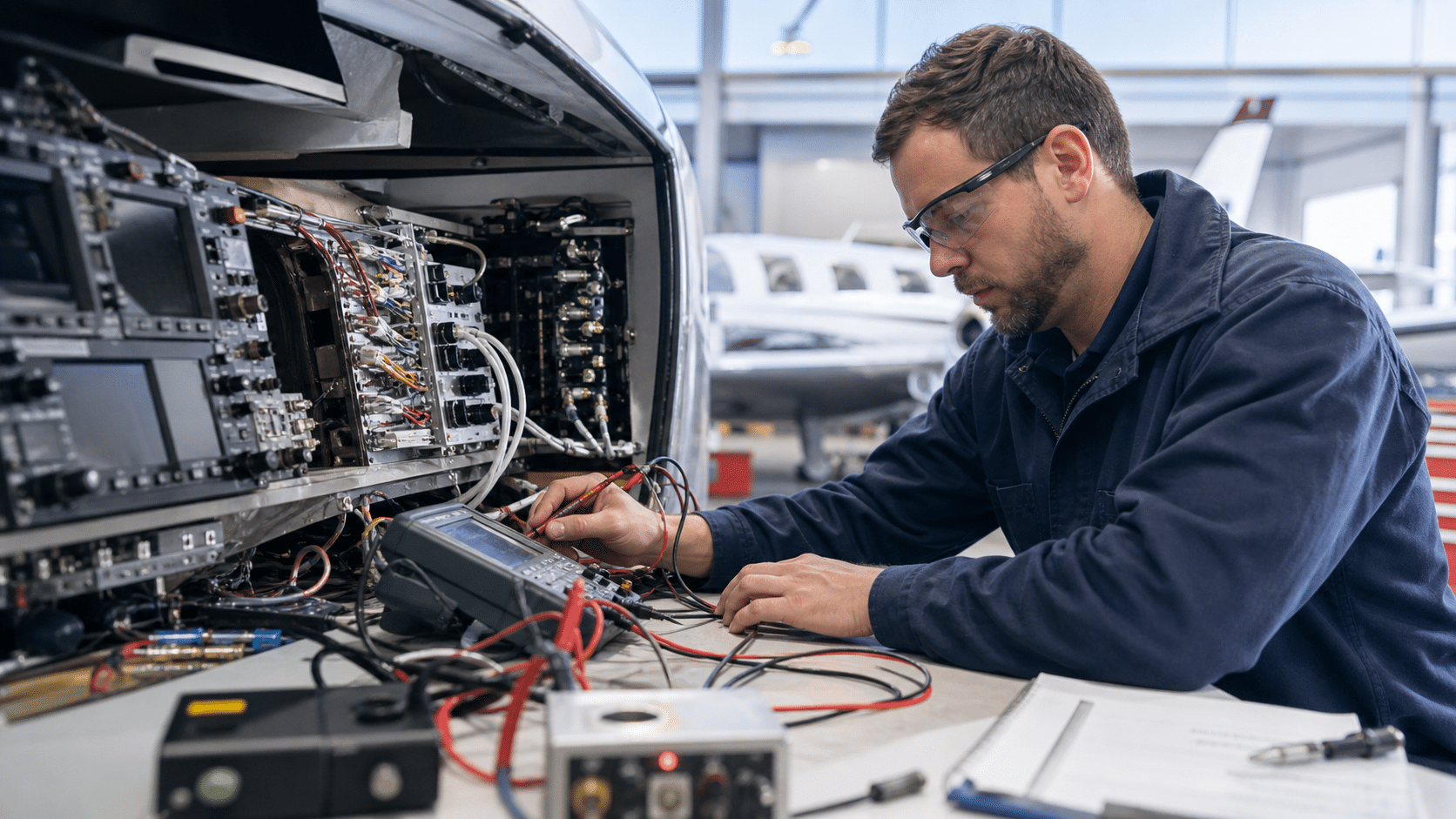
A system fault can cross several boxes: A failed display may be caused by power, wiring, a data bus, a sensor, a configuration, or the display itself. The technician uses the aircraft manual and approved test equipment to isolate the fault, records the work, and signs off only within the allowed authority.
What does an avionics technician do?
Typical duties include:
- Testing electronic systems with circuit testers, voltmeters, and other instruments.
- Troubleshooting communication, navigation, radar, display, and flight-instrument problems.
- Reading wiring diagrams, schematics, maintenance manuals, and test procedures.
- Installing instrument panels, wiring, antennas, junction boxes, or replacement units.
- Repairing or replacing malfunctioning components.
- Loading or configuring approved software and databases when the job requires it.
- Performing functional tests after installation or repair.
- Recording inspections, test results, parts, and corrective work.
Some technicians work on the aircraft in a hangar or at the flight line. Others work on components at a bench or in an electronics shop. The title can cover line maintenance, component repair, aircraft upgrades, manufacturing, military systems, or space vehicles.
Avionics technician versus related work
| Role | Main focus | Typical difference |
|---|---|---|
| Avionics technician | Aircraft electronic and instrument systems | Works with communication, navigation, radar, displays, and wiring |
| Aircraft mechanic | Mechanical and electrical aircraft systems | Often works on structures, engines, brakes, hydraulics, and general maintenance |
| A&P mechanic | Airframe and powerplant certification | Has FAA ratings for broad aircraft maintenance duties |
| Electronics technician | Electronic equipment across industries | May work in factories, labs, or repair shops rather than aircraft |
| Calibration technician | Measurement accuracy and test standards | Focuses on test equipment and traceable measurements across industries |
Our guides to aircraft mechanic careers, calibration technician work, and electromechanical technician jobs can help you compare the paths.
Tools and skills
Avionics technicians may use multimeters, circuit testers, oscilloscopes, signal generators, soldering tools, crimpers, wiring tools, test sets, software interfaces, and precision hand tools. The equipment depends on the aircraft, employer, and approved maintenance procedure.
Useful foundations include:
- Basic electricity, electronics, digital systems, and computer hardware.
- Reading schematics, wiring diagrams, pinouts, manuals, and technical instructions.
- Careful soldering, crimping, connector work, and wire routing where authorized.
- Methodical fault isolation instead of guessing at replacement parts.
- Accurate measurements, test records, and maintenance log entries.
- Comfort working in tight spaces, on ladders, or around aircraft on the ground.
- Clear communication with mechanics, inspectors, engineers, pilots, and supervisors.
The work rewards patience. An intermittent fault may require comparing a wiring diagram with test data, checking a connector, reviewing a maintenance history, and repeating the test under the correct conditions.

Training and FAA requirements
The FAA says many aviation maintenance technicians obtain skills and experience at an FAA-certified Aviation Maintenance Technician School. The FAA describes programs that last about 18 to 24 months and cover tools, equipment, electronics, physics, mathematics, and related aircraft subjects.
For the airframe and powerplant certificates, the FAA lists minimum age, English, experience, and written, oral, and practical exam requirements. Completion of an FAA-approved school can substitute for the experience requirement for the relevant exams.
Avionics is slightly different. The FAA explains that there is no separate universal avionics certificate. Avionics technicians may build experience through military training, technical school, or work for an avionics manufacturer. Some hold an airframe rating, some work under supervision, and employers may authorize specific aircraft or systems. A communications role may also involve FCC requirements.
Before paying for school, ask whether the program is FAA approved, which exams it supports, how much bench and aircraft lab time it includes, and where graduates are hired. A general electronics certificate may be useful, but it does not automatically authorize aircraft maintenance.
Avionics technician pay and outlook
BLS reports about 19,800 avionics technician jobs in 2025. The median annual wage was $82,280 in May 2025. BLS projects 9% growth from 2025 to 2035, with about 1,900 additional jobs.
| BLS category | 2025 jobs | May 2025 median pay | 2025-35 projection |
|---|---|---|---|
| Avionics technicians | 19,800 | $82,280 | 9% growth |
BLS reports about 13,100 openings per year for the broader aircraft and avionics equipment category, which also includes aircraft mechanics. It is not an avionics-only openings figure. The same BLS page reports avionics median wages of $99,620 in air transportation, $90,720 in aerospace product and parts manufacturing, and $88,100 in professional, scientific, and technical services in May 2025.
Those numbers are national benchmarks. Entry pay depends on the aircraft, repair station, location, shift, overtime, military experience, and the systems you can work on.
Work environment and safety
Avionics technicians work in hangars, repair stations, manufacturing facilities, laboratories, or on airfields. BLS notes that shifts can include nights, weekends, and holidays. The work may involve noise, vibration, ladders, awkward positions, weather exposure, and strict deadlines.
Aircraft maintenance follows FAA rules and employer procedures. Do not treat a school lab or a general electronics course as permission to work independently on an aircraft. Ask how the employer controls tools, parts, software, configuration changes, inspections, and return-to-service decisions.
Is avionics a good career change after 40?
It can fit someone who likes electronics, careful diagnosis, and regulated work. Experience in electronics repair, industrial controls, radio systems, computers, quality inspection, or the military can transfer. The transition may still require a substantial training period and a willingness to start under supervision.
The work is not always clean bench work. You may kneel inside a fuselage, reach overhead, work around aircraft noise, or take a night shift to meet a maintenance deadline. Compare the training cost, local airport or repair-station demand, schedule, and exam path before leaving your current job. Our career-change roadmap after 40 can help you map the decision.
Questions to ask before enrolling or applying
- Is the job line maintenance, component repair, installation, manufacturing, or military support?
- Which FAA ratings, employer authorizations, or FCC requirements apply?
- How much hands-on aircraft and bench time is included in training?
- Does the schedule include nights, weekends, holidays, or overtime?
- Which aircraft, avionics platforms, software, and test sets are used?
- What work can a new hire perform under supervision, and how is progression measured?
Bottom line
Avionics technician is a focused electronics career inside aviation. It combines troubleshooting, precise installation, testing, records, and strict procedures. The FAA path is not one universal avionics certificate, so verify the school’s approval, the employer’s authorizations, and the actual first job before spending money.
Sources
- BLS: Aircraft and Avionics Equipment Mechanics and Technicians
- FAA: How to Become an Aviation Maintenance or Avionics Technician
- OSHA: Aviation
- Apprenticeship.gov: Occupations
\n
Reviewed September 3, 2026: Avionics work is more focused than general aircraft maintenance and may involve testing, wiring, navigation, communication, or electronic systems. Check FAA expectations and employer training before enrolling. See electronics technician work.
\n