An automation technician keeps automated production equipment operating by working across sensors, PLCs, drives, robots, networks, and mechanical devices. The role overlaps with controls and robotics work, but the actual job may focus on troubleshooting, programming support, preventive checks, or production recovery. Read the posting for the equipment and level of software access.
The title is broad. One employer may mean a PLC-focused controls technician. Another may use it for a technician who supports robots, conveyors, packaging equipment, or process controls. The job description matters more than the title.
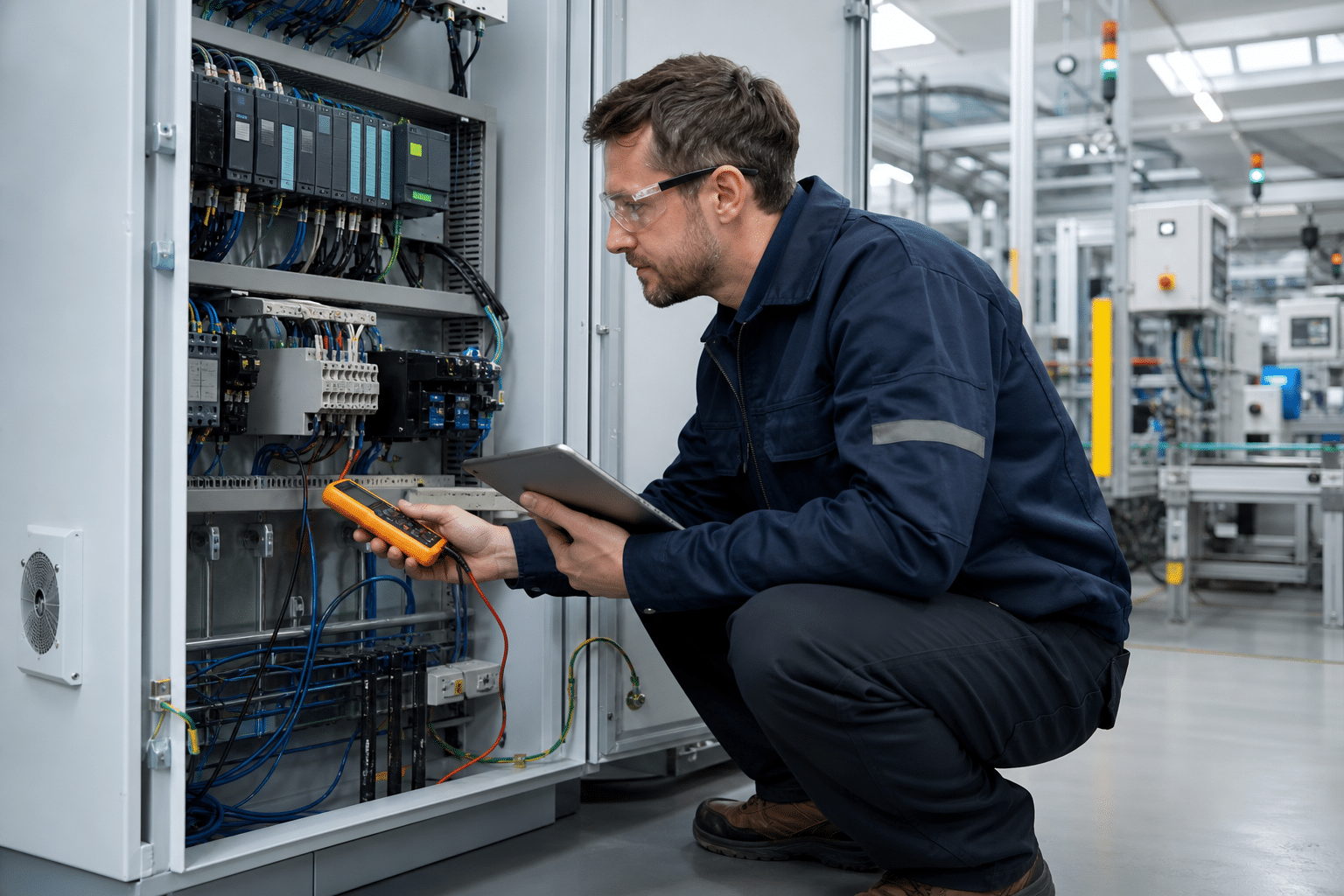
A stopped cell needs a safe sequence: The technician checks the alarm history, safety circuit, sensors, air or power supply, controller inputs, and the physical machine before forcing a reset. The goal is to restore production without hiding the condition that caused the stop.
What does an automation technician do?
Common duties include reading schematics, testing sensors and motors, monitoring PLC inputs and outputs, working with HMIs and drives, supporting robot cells, completing preventive maintenance, and documenting faults. Some jobs focus on maintenance. Others involve commissioning, where technicians help install, wire, test, and start new equipment.
- Read electrical drawings, panel layouts, and equipment manuals.
- Test sensors, switches, relays, valves, motors, and safety circuits.
- Help diagnose PLC logic and HMI alarms.
- Work with VFDs, industrial networks, conveyors, and automated handling equipment.
- Record repairs, parts, settings, and equipment status.
In a small plant, one person may cover most of this list. In a large facility, controls, electrical, mechanical, and engineering work may be divided among teams.
Automation technician versus similar roles
| Role | Main focus | Typical difference |
|---|---|---|
| Automation technician | Automated equipment and controls | Hands-on testing, troubleshooting, and support |
| Industrial electrician | Power, wiring, and distribution | Often more emphasis on installation and code work |
| Electromechanical technician | Mechanical and electrical equipment | May support motors, drives, robotics, and assemblies |
| Building automation technician | HVAC and building controls | Works with building management systems |
| Controls engineer | System design and advanced programming | Usually owns architecture and engineering decisions |
Compare our guides to industrial electrician work, electromechanical technician careers, and building automation technician jobs before choosing a path.
Equipment and skills
You do not need to master every platform before applying. Employers often care more about safe troubleshooting, logical thinking, and the ability to learn their equipment.
- Basic AC/DC electricity and safe meter use.
- Sensors, relays, contactors, motors, and motor starters.
- PLC concepts: inputs, outputs, logic, faults, and backups.
- HMI navigation and alarm histories.
- VFD setup and common motor-control problems.
- Mechanical basics such as alignment, belts, bearings, and pneumatics.
- Clear handoffs between maintenance, production, and engineering.
The best technicians know when to stop and escalate. A recurring fault may be a programming issue, a wiring problem, a failing component, or an operating condition. Guessing can create downtime or a safety risk.
Training and entry routes
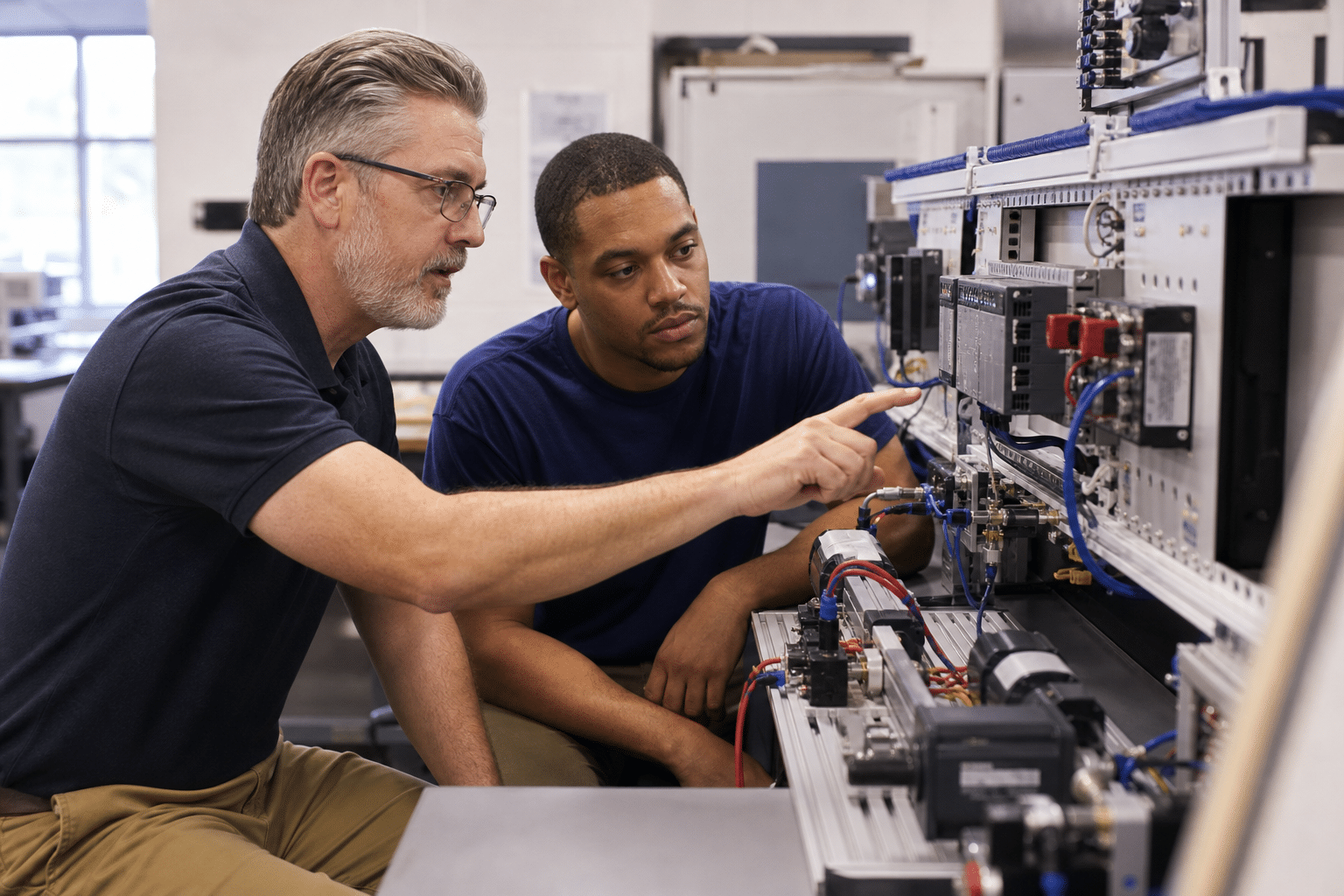
Many people enter through industrial maintenance, electrical, mechatronics, robotics, or instrumentation programs. A community-college certificate can be enough for some entry-level jobs; other employers prefer an associate degree or plant experience.
Look for lab time covering PLCs, motor controls, industrial sensors, pneumatics, electrical drawings, and troubleshooting. Employer training and apprenticeships can also help. Search Apprenticeship.gov’s occupation resources and compare the actual skills taught.
ISA offers optional certificates and certifications related to automation and control. There is no universal ISA credential required for every automation technician job, so check the employer’s requirements before paying for one.
Automation technician pay: a useful benchmark
The title is used across several industries, so one salary number can mislead. The BLS electro-mechanical and mechatronics technologists and technicians category is a broad comparison, not an exact match for every automation technician.
| BLS comparison category | May 2025 median pay | 2025 jobs | 2025-35 projection |
|---|---|---|---|
| Electro-mechanical and mechatronics technologists and technicians | $73,900 | 15,700 | 3% growth |
BLS reports about 1,400 annual openings for that comparison category. Offers depend on industry, location, shift premium, overtime, travel, controls platform, and whether the role includes commissioning. BLS also reports a broader electrical and electronic engineering technician category with a $78,190 median in May 2025, but that group includes jobs that are not automation roles.
Compare several local postings. Ask whether training is paid, how often the role is on call, and whether overtime is routine or occasional.
Work environment and safety
Automation technicians may work in a factory, distribution center, food plant, utility, warehouse, or integrator shop. Conditions can include noise, production pressure, moving equipment, heat, dust, awkward access, and rotating shifts. Some positions require nights, weekends, or rapid response during a line stoppage.
OSHA’s robotics guidance points to machine guarding, PPE, noise, and lockout/tagout requirements. Its lockout/tagout standard addresses unexpected energization or stored energy during servicing. Site training and authorization always control what you may do.
Is automation a good career change after 40?
It can fit people who enjoy structured problem-solving and can tolerate production environments. Electrical, mechanical, maintenance, HVAC controls, production supervision, and technical-support experience may transfer well.
Before enrolling, visit a lab or talk with a local employer. Ask to see a typical shift schedule and find out how much of the job is troubleshooting versus installation, paperwork, or programming. Use our career-change roadmap after 40 to test the decision before committing to a program.
Questions to ask before accepting a job
- Which PLC, HMI, drive, and robot platforms are used?
- Is the role first shift, rotating shift, on call, or travel based?
- What electrical, mechanical, and programming work is expected?
- Who trains new hires, and is training paid?
- What safety qualifications are required before independent work?
Bottom line
Automation technician is a flexible job title for hands-on work with controlled machines. The strongest entry plan combines electrical fundamentals, a lab-based controls program, and real troubleshooting practice. Compare duties, schedule, and training support in each posting, then use BLS comparison data as context rather than a promise of pay.
Sources
- BLS: Electro-mechanical and Mechatronics Technologists and Technicians
- BLS: Electrical and Electronic Engineering Technologists and Technicians
- OSHA: Robotics standards
- OSHA: Lockout/Tagout
- ISA: Certification
- Apprenticeship.gov: Occupations
\n
Reviewed September 3, 2026: Automation technician jobs vary between PLC troubleshooting, robot cells, sensors, drives, commissioning, and production support. Ask which systems the employer uses and compare the route with controls technician work.
\n