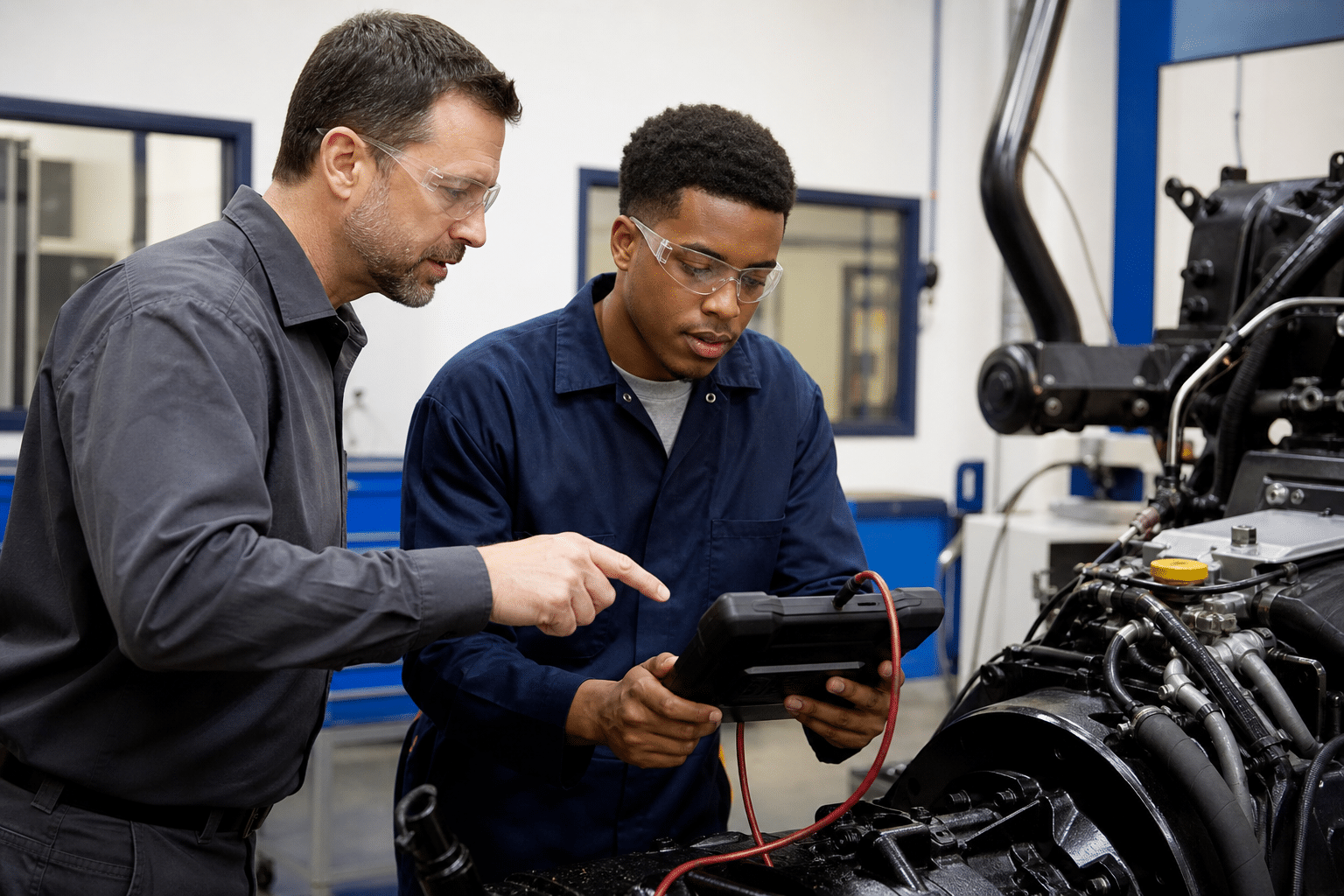
A controls technician troubleshoots the electrical and computer-based systems that tell industrial equipment what to do. The work may involve sensors, motors, PLC inputs, HMIs, drives, networks, and control logic. The role sits between hands-on electrical work and software-based diagnosis, so the technician must understand both the signal and the machine response.
The role sits between hands-on maintenance and industrial automation. It is not automatically an engineering job, and it is not simply an electrician role with a different title.
What does a controls technician work on?
The equipment depends on the plant. Common systems include programmable logic controllers, variable-frequency drives, motor starters, sensors, relays, safety circuits, HMIs, industrial networks and control panels. A technician may read a wiring diagram, check voltage, trace an input, replace a failed component and test the machine under an approved procedure.
| System | Technician’s likely task |
|---|---|
| PLC | Check inputs, outputs, fault codes and program-controlled sequences |
| Sensor | Test wiring, mounting, signal and calibration |
| HMI | Interpret alarms and confirm whether the fault is field-side or software-side |
| Motor control | Check starters, drives, overloads and safe restart conditions |
| Safety circuit | Verify the fault and restore the system only under approved procedures |
Controls work rewards patience. Guessing and swapping expensive parts is a poor substitute for tracing the signal.
Controls technician vs related careers
An automation technician may work across controls, robotics and production systems. An instrumentation technician often focuses on measurement, calibration and process control. An industrial electrician may install, maintain and troubleshoot power and control wiring. An electromechanical technician may combine motors, mechanics, electronics and automation.
Our automation technician guide gives the broader automation picture. Compare the instrumentation technician guide if measurement and process loops interest you more than machine sequencing.
How do you enter the field?
Start with the skills employers actually test: electrical safety, AC and DC fundamentals, reading schematics, industrial sensors, motor controls, basic PLC logic and disciplined troubleshooting. A two-year technical program can provide a structured foundation, while a maintenance helper job may give you supervised exposure to real equipment.
Some employers train electricians or maintenance technicians into controls. Others want prior PLC, drive or manufacturing experience. A short online course can explain concepts, but it cannot replace safe work on energized or moving equipment. Ask whether a program includes a real lab, a recognized credential and a path to supervised employment.
Pay and BLS benchmarks
There is no single BLS occupation called controls technician. Employers use the title across several occupations. The BLS describes commercial and industrial electrical and electronics equipment repairers as workers who adjust, test, repair or install equipment such as industrial controls and transmitters. For that broader group, use the BLS wage table attached to the exact occupation, not a salary claim attached to a job title.
That distinction matters. A controls technician in a factory may be paid under an electrician, maintenance, electronics repair or engineering-technician structure. Compare the actual duties, shift and required experience before comparing salary numbers.
Safety and troubleshooting
Controls systems connect low-voltage signals to machines that can move, cut, heat, press or rotate. OSHA’s lockout/tagout rules apply when servicing equipment with hazardous energy. A technician must understand when a diagnostic check is allowed, when power must be isolated and who can authorize a restart.
Ask an employer about electrical safety training, arc-flash procedures, machine guarding, lockout/tagout and changes to PLC programs. Good controls work includes documentation and controlled testing, not just getting the line running again.
Is controls work a realistic change after 40?
This path can suit someone coming from electrical work, industrial maintenance, HVAC controls, instrumentation, automotive diagnostics or technical support. Your advantage is often the habit of finding causes instead of replacing parts at random.
The learning curve is real. You may need to read unfamiliar diagrams, understand basic programming logic and work around production pressure. Plants can also run nights and weekends. Compare the first job’s shift, travel, training support and pay with your current situation.
The best first step is often a supervised maintenance or electrical role that exposes you to controls. Build a small skills checklist: read a schematic, use a meter safely, identify a sensor failure, follow a PLC sequence and document the repair. That is more useful than collecting course names without practical evidence.
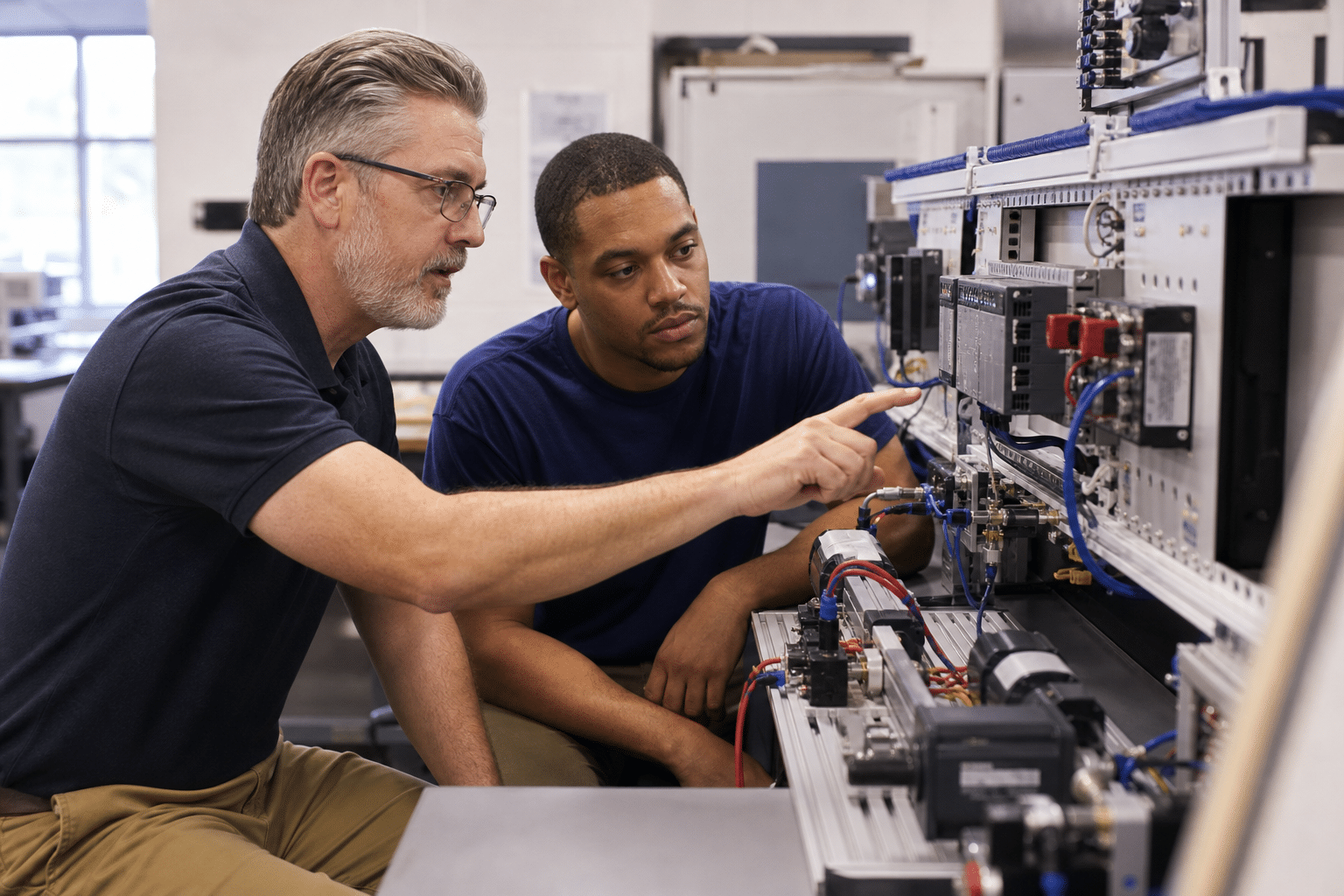
The alarm is not always the cause: A high-temperature message could come from the process, sensor wiring, input card, scaling, or control logic. The technician checks the signal path and the physical condition before changing a program or replacing a component, then documents the test so the next shift knows what was ruled out.
Bottom line
Controls technician is a strong fit if you like electrical systems, logic and methodical troubleshooting. It is a poor fit if you want work with little documentation, no production pressure or no continuing learning. Treat the title as a starting point, then inspect the equipment, training and safety expectations behind the posting.
Learn the signal path before chasing the software
Controls work can sound like a programming job, but many faults begin far from the controller. A loose terminal, failed sensor, blocked actuator, bad power supply, or incorrect field setting can produce the same alarm as a logic problem. Good technicians work outward from the symptom and verify each part of the signal path before changing a program.
That is why basic electrical and mechanical skills remain useful even in a highly automated building or plant. If you are training for this field, practice reading a drawing, identifying an input and output, and explaining what should happen when a device changes state. The software becomes easier once the physical process makes sense.
At an interview, ask which controls platforms are used and who is allowed to modify logic. A junior role with clear boundaries is usually a better place to learn than a job that expects you to solve everything alone. Compare the position with automation technician work and building automation work to find the setting that fits you.
- BLS: Electrical and Electronics Installers and Repairers – industrial controls duties and occupation context; checked September 2, 2026.
- OSHA: Control of Hazardous Energy – lockout/tagout principles; checked September 2, 2026.
- Apprenticeship.gov – registered apprenticeship and OJT routes; checked September 2, 2026.
Reviewed September 3, 2026: Controls technician duties depend on the PLCs, sensors, drives, HMIs, and process equipment in the facility. Check whether the job is mainly maintenance, commissioning, service, or production support. See building automation work.