A wastewater operator manages the processes and equipment used to treat wastewater before discharge or reuse. The work may include pumps, screens, aeration, clarifiers, chemicals, samples, control systems, rounds, and state-required records. It is public-service work with hands-on mechanical and process responsibilities, often including nights, weekends, or emergency response.
A treatment upset needs more than one test: The operator may compare flow, dissolved oxygen, temperature, solids, chemical feed, equipment status, and recent trends before changing the process. The shift record should make clear what was observed, what was adjusted, and what later sample or reading confirmed the response.
A clear look at wastewater operator work
A wastewater operator manages the processes and equipment used to treat wastewater before discharge or reuse. The work may include pumps, screens, aeration, clarifiers, chemicals, samples, control systems, rounds, and state-required records. It is public-service work with hands-on mechanical and process responsibilities, often including nights, weekends, or emergency response.
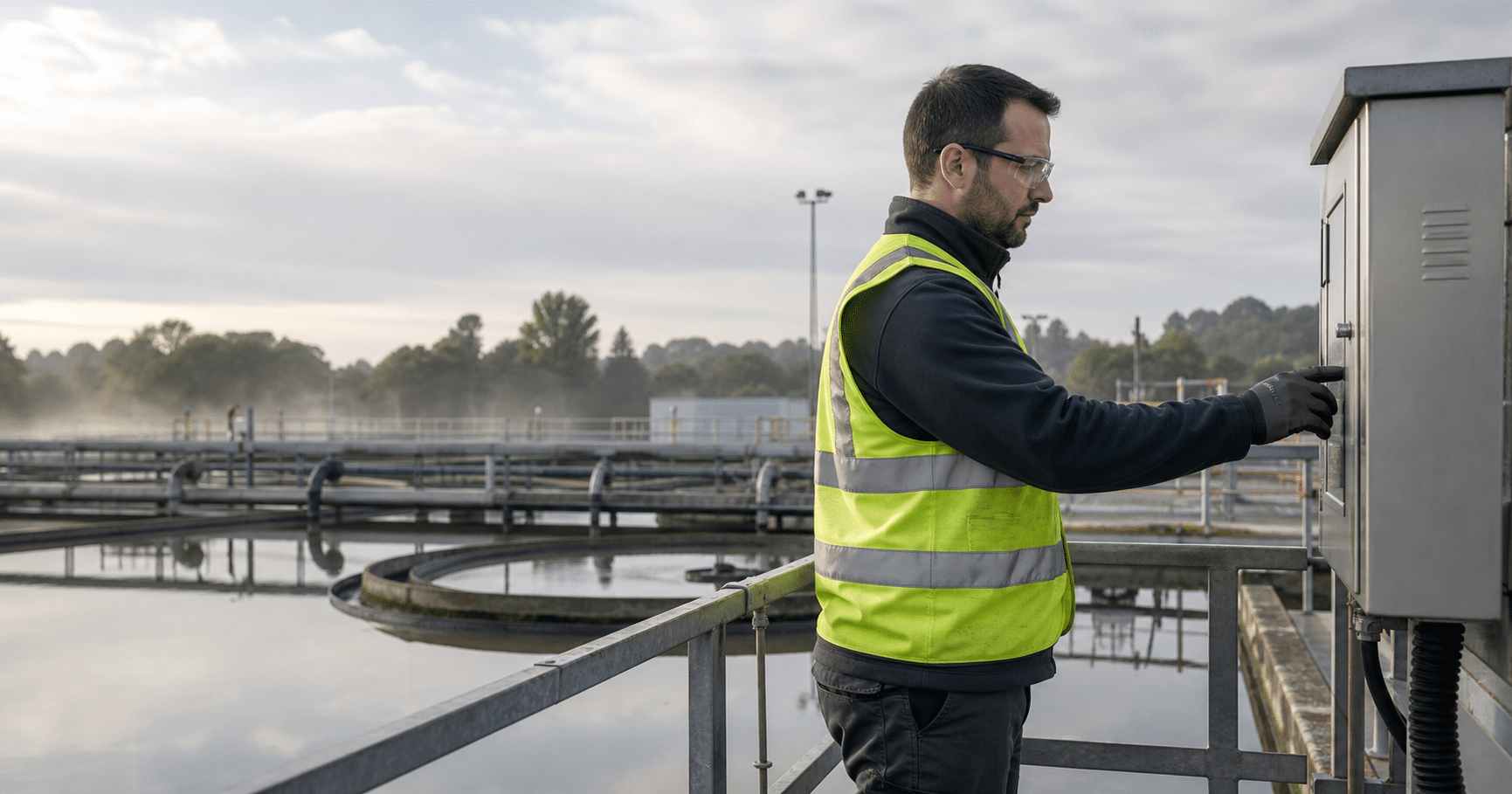
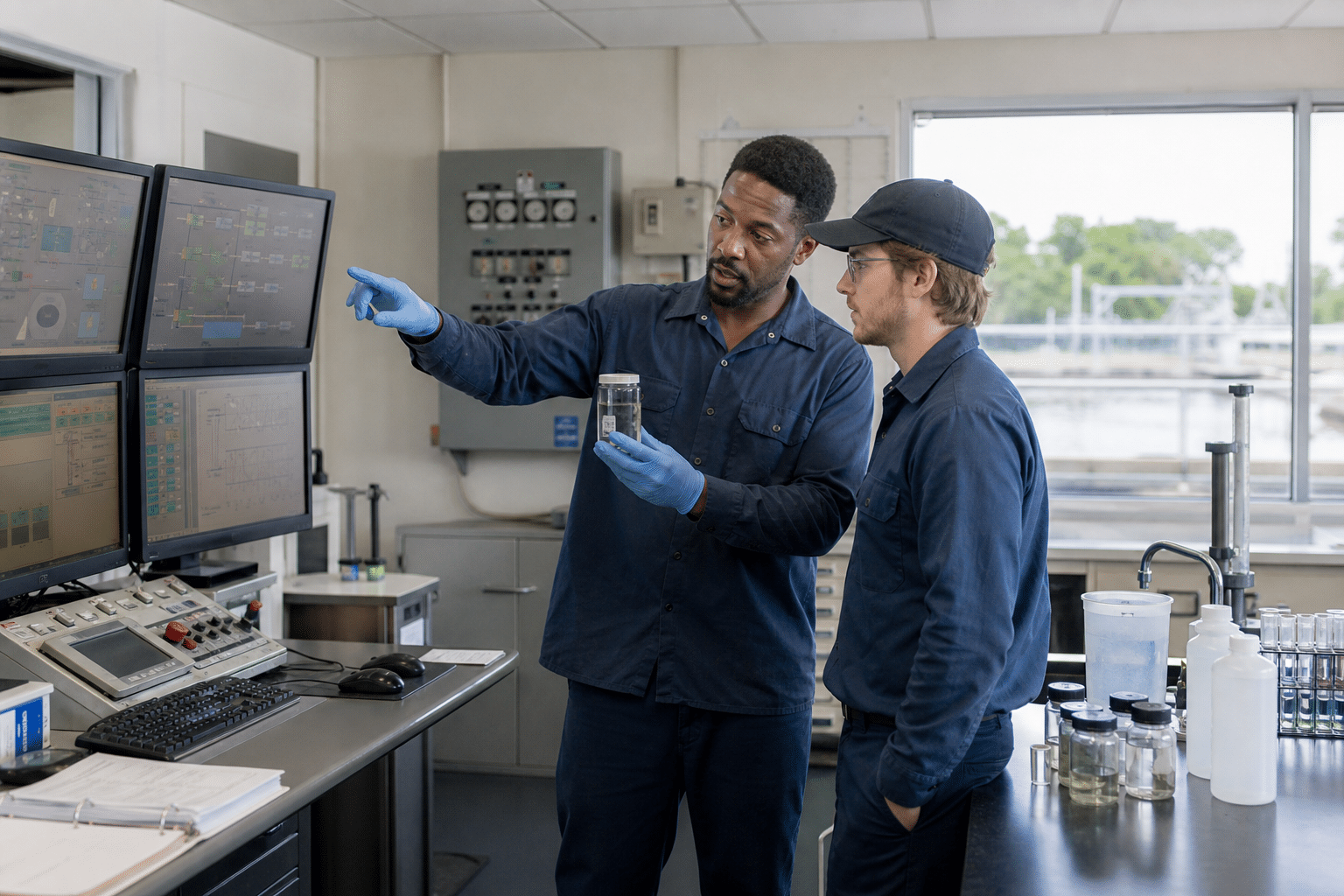
A wastewater operator monitors and controls the equipment that treats used water before it returns to the environment. The work combines process control, sampling, documentation, equipment checks, and routine maintenance. Depending on the plant, the operator may spend part of the shift in a control room and part of it walking tanks, pumps, filters, and other systems.
The related title “water treatment operator” usually refers to drinking-water production. Some employers cross-train workers in both areas, while others keep the jobs separate. The licensing rules are set at the state level, so the first step is to understand the occupation and then check the rules where you plan to work.
Wastewater operator at a glance
| Question | Short answer |
|---|---|
| What is the job? | Monitor, operate, sample, document, and maintain systems that treat wastewater. |
| Typical education | High school diploma or equivalent. Biology, chemistry, math, or a technical certificate can help. |
| Main training route | Long-term on-the-job training, often combined with classroom or self-paced study. |
| License | A state license is usually required, but the level and path vary by state. |
| BLS median pay | $60,020 per year in May 2025 for water and wastewater treatment plant and system operators. |
| BLS outlook | Employment is projected to decline 6% from 2025 to 2035, with about 10,000 openings each year. |
| Main tradeoff | Stable public-service work and technical responsibility, but shifts, odors, safety rules, and licensing are real parts of the job. |
The outlook deserves an honest explanation. A projected decline does not mean there are no jobs. The Bureau of Labor Statistics (BLS) expects about 10,000 openings per year, mostly because workers leave the occupation or retire. Automation may reduce headcount at some plants, while aging infrastructure and more complex control systems still require trained operators.
What does a wastewater operator do?
Operators keep a treatment process within its operating limits. They do not simply watch a screen and wait for an alarm.
Typical duties include:
- inspecting pumps, blowers, mixers, clarifiers, filters, tanks, and chemical systems;
- monitoring meters, gauges, alarms, and computerized control systems;
- collecting and testing wastewater, sludge, or process samples;
- recording readings and operational data;
- adjusting equipment or treatment settings according to plant procedures;
- adding or managing treatment chemicals when the job and license allow it;
- cleaning tanks, filter beds, screens, and work areas;
- performing basic maintenance and reporting equipment that needs specialist repair;
- documenting test results and sending required information to supervisors or regulators; and
- responding to abnormal flows, equipment failures, power problems, or other plant emergencies.
The exact work depends on the plant. A small facility may ask one operator to cover many systems. A large municipal plant may divide control-room, laboratory, collection, maintenance, and field duties among several people. An industrial plant may also focus on the type of wastewater produced by a factory.
Water treatment and wastewater treatment are different
Water treatment operators help make source water safe for distribution. Wastewater operators treat used water and sewage so it can be released or reused under the applicable requirements. The equipment and science overlap, but the process goals and daily conditions are different.
Water treatment may involve reservoirs, wells, filtration, disinfection, pumps, and distribution systems. Wastewater treatment may involve screening, settling, biological treatment, aeration, sludge handling, disinfection, and discharge monitoring. A plant operator does not need to memorize every process before applying, but a training program should tell you which system it teaches.
Ask employers whether the opening is for drinking water, wastewater, industrial pretreatment, collection systems, or a combined utility role. Those labels affect the license you need and the kind of work you will learn.
Where the job takes place
Most operators work for local government, utilities, manufacturing companies, or waste management businesses. The plant can include a control room, laboratory space, chemical storage, tanks, pumps, outdoor walkways, and maintenance areas.
The job is both indoor and outdoor. You may read a trend on a monitor, then walk outside to verify a pump, take a sample, or inspect a basin. Some areas are noisy, wet, slippery, dirty, or difficult to access. Odors are part of many wastewater jobs, although the strength varies by process and facility.
Plants run continuously. Rotating shifts, nights, weekends, holidays, and on-call coverage are common. A day-shift opening may still include occasional emergency callouts. Ask how the schedule is built before treating the advertised wage as the whole offer.
How to become a wastewater operator
There is no single national route. Most entry-level candidates use a combination of the following steps.
Start with an operator-in-training job
Many utilities hire trainees who learn under an experienced operator. The BLS describes this as long-term on-the-job training. Early duties may include meter readings, sample collection, housekeeping, basic maintenance, and learning the plant’s operating procedures.
This route can be more useful than a short course by itself because it connects study to an actual facility. Search for titles such as operator trainee, wastewater operator-in-training, water treatment operator trainee, utility operator, or plant operator apprentice.
Check your state’s license ladder
Most states use several license levels. A trainee may be allowed to work under supervision while building the education, experience, and exam record needed for the first license. Higher levels can allow an operator to take responsibility for more complex systems or supervise others.
Requirements vary widely. The U.S. Environmental Protection Agency explains that operator certification programs are implemented by states and that specific requirements differ from state to state. Use your state environmental, health, or licensing agency as the authority for current requirements. A national article can explain the pattern, but it cannot tell you which exam or experience hours apply to your address.
Add focused technical education
Community colleges, utilities, state training centers, and workforce programs may offer water or wastewater certificates. Useful subjects include treatment processes, biology, chemistry, math, hydraulics, pumps, electrical basics, safety, sampling, and regulations.
The course should match the license or job you want. Ask whether the hours count toward state education requirements, whether a lab is included, and whether the program has relationships with local utilities. An online class can support exam preparation, but it may not replace plant experience or hands-on training.
Our guide to online trade school options offers a way to compare lab access, employer recognition, schedule, and total cost.
Use related maintenance experience
Maintenance, industrial electrical, HVAC, plumbing, laboratory, manufacturing, and equipment-operation backgrounds can help. Plants rely on pumps, motors, valves, controls, sensors, and computerized systems, so people who can observe a machine and describe a problem clearly often have a useful starting point.
That experience does not automatically satisfy a license requirement. It can, however, make the first months of training less foreign. Compare the role with industrial maintenance technician work and instrumentation technician work if you prefer equipment and controls but are unsure about water treatment.
Training that matters on the job
A solid beginner program should connect theory to plant decisions. You should expect to practice or study:
- reading gauges, trends, alarms, work orders, and simple process diagrams;
- taking representative samples and recording results accurately;
- basic chemistry and biology used in treatment processes;
- pumps, motors, valves, blowers, filters, and other mechanical systems;
- control-room software and manual operation during a malfunction;
- chemical handling procedures and required protective equipment;
- confined-space, gas, electrical, slip, and equipment hazards as covered by the employer;
- regulatory records, shift logs, and communication during handoff; and
- how to escalate a condition that is outside your authority or training.
The strongest operators are careful with small details. A missed reading, a mislabeled sample, or a vague shift note can make the next decision harder. The work rewards people who can stay calm, follow a procedure, and notice when a number or machine behavior does not look normal.
Wastewater operator certification and licensing
In this occupation, certification may mean a state operator license, a professional credential, or a course certificate. Those terms are not interchangeable.
The license is the part controlled by the state. It may have grades or classes tied to plant size, treatment complexity, experience, education, and examination results. Some states allow entry-level workers to complete requirements while employed under supervision. Others may set different routes for drinking water, wastewater, collection, distribution, or industrial systems.
Before paying for a program, write down the exact license level it supports. Then compare the provider’s claims with your state agency’s current page. The EPA’s operator-certification resources are useful for understanding why states maintain these programs, but the state rules govern your application.
A course completion certificate can still be useful. It may help you prepare for an exam or show an employer that you have studied the basics. It should not be advertised as a national license if it is not one.
Wastewater operator pay and outlook
The BLS reports a May 2025 median annual wage of $60,020 for water and wastewater treatment plant and system operators. The lowest 10 percent earned less than $39,110, and the highest 10 percent earned more than $91,060. These are national figures for the broader occupation, not a guaranteed starting wage for a wastewater operator in every state.
The same BLS profile lists about 131,000 jobs in 2025 and projects 123,500 in 2035, a 6 percent decline. It also projects roughly 10,000 openings per year. Those openings are an important part of the story because retirements and transfers can create opportunities even when total employment falls.
Pay changes with license level, plant size, shift premiums, overtime, public-sector benefits, union coverage, location, and responsibility. Compare the base wage with the schedule and the time required to qualify for the next license. A lower first-year offer may come with structured training, while a higher offer may expect an existing license and independent shift coverage.
For context, a control-heavy plant role may feel closer to power plant operator work than to a conventional construction trade. The equipment and process are different, but both jobs demand careful monitoring, written procedures, and response to abnormal conditions.
The physical and safety side
The work is not usually heavy construction, but it is not sedentary office work either. Operators walk, climb stairs, stand, bend, carry sample containers or tools, and work around machinery and wet surfaces. Some facilities expose workers to noise, gases, chemicals, awkward access points, or unpleasant odors.
The employer should explain its training, protective equipment, emergency procedures, and supervision. You should also ask how often operators enter tanks, pits, channels, or other restricted areas. Do not assume that a clean control room means every part of the job is clean or low risk.
If you are considering a move after 40, spend time at a facility if an employer or training program allows it. Pay attention to the shift schedule, walking distance, noise, temperature, odors, and how much time is spent at a screen versus outside. A realistic preview is more useful than a generic claim that the job is “easy.”
Questions to ask before applying
| Topic | Question to ask |
|---|---|
| License | Which state license or trainee status does this job support? |
| Training | How are classroom hours, exams, and supervised plant hours scheduled? |
| Facility | Is this drinking water, wastewater, industrial, collection, or a combined role? |
| Schedule | Are nights, rotating shifts, weekends, holidays, or on-call duties part of the normal rotation? |
| Daily work | How much time is spent in the control room, laboratory, field, and maintenance areas? |
| Pay | What is the starting wage, and how does pay change after the next license level? |
| Safety | What hazards are covered during orientation, and what equipment does the employer provide? |
| Advancement | Can operators move into laboratory work, maintenance, controls, supervision, or utility management? |
These questions help you compare a real opening with the occupation described in national data.
Is wastewater operation a good second-act career?
It can fit someone who wants practical technical work, public-service responsibility, and a career built through training rather than a four-year degree. The job uses mechanical awareness, basic science, recordkeeping, and judgment. It can also offer a clear license ladder.
The tradeoffs are just as clear. Total employment is projected to decline, schedules can rotate, and the work environment is not for everyone. Certification is local, so moving states may require new exams or additional paperwork. The best opportunity may be a trainee job with a utility that will support your first license.
If you are comparing options, read about career changes at 40 and boilermaker apprenticeships to see how different training structures and work environments feel. Then call local utilities, check their trainee postings, and compare the actual license path before enrolling.
Sources
- U.S. Bureau of Labor Statistics: Water and Wastewater Treatment Plant and System Operators
- U.S. Environmental Protection Agency: About Operator Certification
- U.S. Environmental Protection Agency: Resources for Wastewater Operators
\n
Reviewed September 3, 2026: Wastewater operator requirements are set largely by state rules and the type of plant. Ask about certification levels, shift work, samples, chemicals, and emergency response before enrolling. See water treatment operator work.
\n