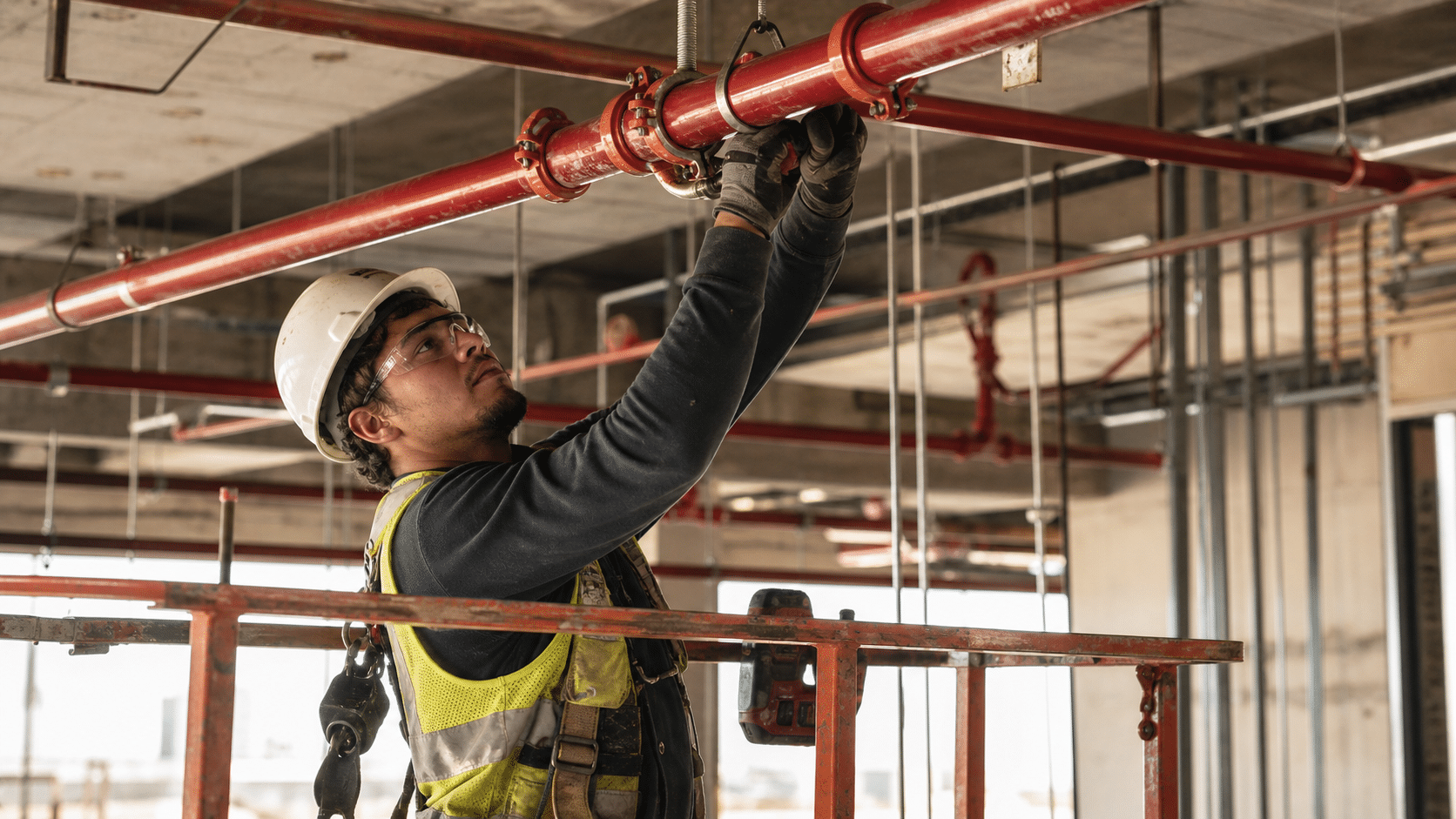
A fire sprinkler installer builds and services piping systems designed to release water when heat activates a sprinkler head. The work may include layout, pipe cutting, supports, fittings, valves, heads, testing, inspection corrections, and maintenance. It is often called sprinkler fitting and combines construction, mechanical work, lifting, and code-based installation details.
The trade is often called sprinkler fitting. It is a specialized form of pipefitting focused on fire-protection systems rather than ordinary household plumbing. A project may involve a new warehouse, apartment building, hospital, school, factory, commercial kitchen, or retrofit inside an occupied building.
It is a useful career to investigate if you like construction, mechanical work, plans, and visible results. It is also a serious safety trade. A poor installation can affect a system that people may depend on during an emergency, so the work is controlled by plans, codes, inspections, testing procedures, and the employer’s quality system.
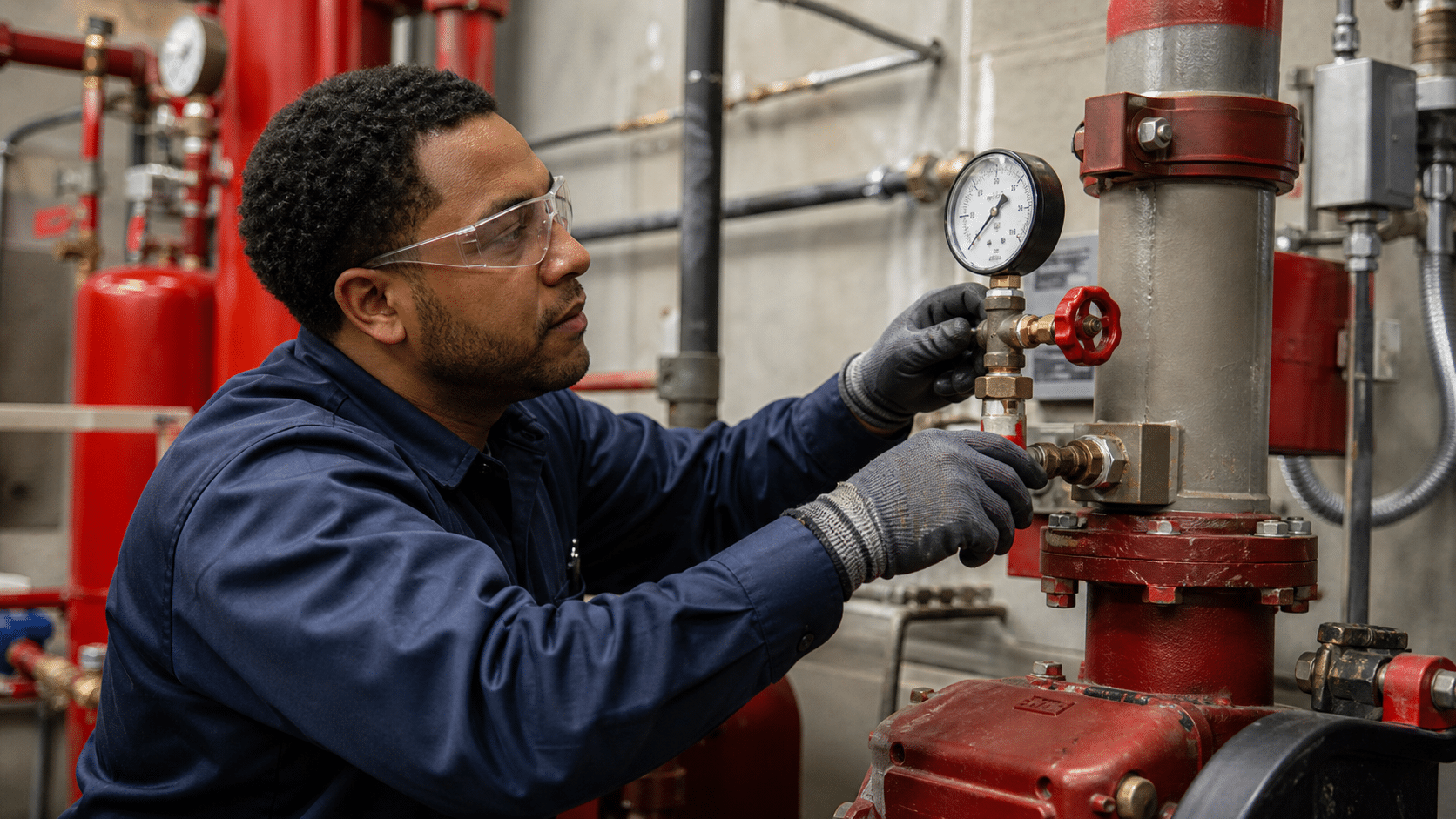
The system has to work as a network: A misplaced head, weak support, closed valve, incorrect pipe size, or inaccessible test connection can affect more than one room. The installer checks the drawing and field conditions together, then tests and documents the system before the next inspection or handoff.
What does a fire sprinkler installer do?
The work starts before a pipe is lifted into place. The crew studies drawings, identifies the route, checks dimensions, confirms materials, and coordinates with other trades. On site, the installer helps turn that plan into a supported, connected, and testable system.
Typical duties can include:
- reading fire-protection plans, specifications, and installation details;
- measuring and marking pipe routes and hanger locations;
- lifting, positioning, cutting, threading, grooving, or joining pipe as specified;
- installing sprinkler heads, fittings, valves, drains, gauges, and supports;
- connecting risers, mains, branch lines, and other system components;
- using lifts, ladders, hand tools, power tools, and material-handling equipment;
- pressure testing and flushing systems according to the project procedure;
- identifying leaks, damaged fittings, blocked components, or installation defects;
- assisting with inspection, testing, maintenance, and service calls;
- keeping records, labeling equipment, and reporting work that needs correction.
The exact work depends on the employer and the project. A new-construction installer may spend most days laying out and hanging pipe. A service technician may troubleshoot valves, alarms, gauges, or system impairments at existing buildings. An inspector or testing specialist follows another path and may spend more time documenting compliance than installing pipe.
Sprinkler fitter versus related jobs
Fire-protection job titles overlap, but the main responsibility can be different.
| Role | Main focus | Typical difference |
|---|---|---|
| Sprinkler fitter | Install and service fire-sprinkler piping and components | Pipefitting work centered on water-based fire protection |
| Fire sprinkler installer | Build or retrofit sprinkler systems on a job site | Often used for the installation side of the fitter trade |
| Fire sprinkler service technician | Inspect, test, maintain, and troubleshoot existing systems | More scheduled service and diagnostics than new pipe installation |
| Fire alarm technician | Install and maintain detection, notification, and alarm systems | Works primarily with electrical and signaling equipment |
| Plumber or pipefitter | Install piping for plumbing, industrial, steam, or process systems | May work on other fluid systems rather than fire protection |
| Fire-protection engineer | Design and analyze fire-protection systems | Engineering role with different education and responsibilities |
The BLS occupation page places sprinklerfitters within the broader plumbers, pipefitters, and steamfitters occupation. That classification helps with national labor statistics, but it does not mean every plumber performs sprinkler work or that every sprinkler fitter has the same day-to-day job.
How a sprinkler fitter apprenticeship works
Many people enter the trade through an apprenticeship sponsored by a union, contractor association, or fire-protection employer. You learn on the job under supervision and complete related technical instruction. The sponsor’s written standards should explain the term, wage schedule, work processes, classroom requirements, and credential.
The BLS says most plumbers, pipefitters, and steamfitters learn through an apprenticeship. It describes a typical four- or five-year program with about 2,000 hours of paid on-the-job training and technical instruction each year for the broader occupation. That is useful context, not a promise that every sprinkler-fitter program has the same duration or hours.
Training may include:
- fire-sprinkler plans, symbols, and layout basics;
- shop math, measurements, fractions, and basic geometry;
- pipe, fittings, valves, hangers, bracing, and system components;
- cutting, threading, grooving, soldering, welding, or other approved joining methods;
- use of ladders, lifts, rigging, hand tools, and power tools;
- pressure testing, flushing, drains, gauges, and valve supervision;
- installation quality, documentation, and correction procedures;
- construction-site coordination with electricians, plumbers, HVAC crews, and framers;
- fall protection, hot work, lifting, silica, PPE, and safe work around active facilities.
Apprenticeship.gov describes registered apprenticeships as paid jobs that combine on-the-job learning, related classroom training, wage increases as skills develop, and an industry-recognized credential. Use its career-seeker guidance and job-finder instructions to locate openings, then confirm the exact sponsor and occupation with the employer.
Requirements to apply
The usual starting point is a high school diploma or equivalent. Individual programs may also require applicants to be at least 18, pass an aptitude test, have a driver’s license, meet physical requirements, pass a background or drug screen, or be legally eligible to work for the sponsor.
Helpful preparation can include:
- construction, shop, welding, or mechanical coursework;
- comfort with measurements, fractions, and basic geometry;
- experience using hand and power tools;
- blueprint reading or technical drawing;
- plumbing, pipefitting, HVAC, welding, or sheet-metal exposure;
- a willingness to work at heights, in tight areas, and around other crews;
- reliable transportation and flexibility for changing job sites.
You do not need to know every sprinkler standard before applying. You do need to show that you can follow instructions, work carefully, communicate about hazards, and learn a system where details matter. Previous construction or military mechanical experience may help, but ask the sponsor whether it grants credit or changes placement. Never assume experience shortens the apprenticeship without written confirmation.
How to find a legitimate program
Search Apprenticeship.gov by keyword and location, then contact local sprinkler contractors, union training centers, contractor associations, and state apprenticeship offices. The National Fire Sprinkler Association’s career material is also useful for understanding the difference between installation and service work.
Before applying, ask:
- Is this a registered apprenticeship, an employer training program, or a helper position?
- Who is the employer during training?
- What is the starting wage and the full increase schedule?
- Which installation, testing, inspection, and service skills are taught?
- How much classroom instruction is required, and who pays for it?
- Will I work on new construction, retrofit, service, or a mix?
- What tools, PPE, transportation, and licenses are my responsibility?
- How often are ladders, lifts, roofs, tight spaces, or occupied facilities involved?
- What area does the contractor cover, and how much travel is normal?
- What credential or journey-level classification follows successful completion?
An attractive hourly rate can hide unpaid travel, inconsistent hours, tool costs, or a narrow helper role. Get the terms in writing before making a major career decision.
What does a fire sprinkler installer earn?
There is no single national BLS wage line reserved only for fire sprinkler installers. The BLS includes sprinklerfitters in the broader plumbers, pipefitters, and steamfitters occupation, so that is the appropriate benchmark to explain—but it is not a guarantee for a sprinkler fitter or apprentice.
For the broader occupation, the BLS reported a $63,800 median annual wage in May 2025, or about $30.67 per hour on a 40-hour-week conversion. The lowest 10 percent earned less than $39,860, while the highest 10 percent earned more than $107,140.
| BLS benchmark for plumbers, pipefitters, and steamfitters | May 2025 figure |
|---|---|
| Median annual wage | $63,800 |
| Approximate hourly equivalent | $30.67 |
| Lowest 10 percent | Less than $39,860 |
| Highest 10 percent | More than $107,140 |
Those figures cover a large occupation with different specialties, regions, experience levels, and work settings. Apprentices normally start below the fully trained benchmark and progress according to the sponsor’s wage schedule. Benefits, overtime, travel pay, shift premiums, and per diem can materially change the value of an offer.
Ask whether the quoted rate applies to classroom time, travel time, service calls, overtime, and every stage of the apprenticeship. Then compare the full package with local job postings rather than treating a national median as a starting wage.
Installation, inspection, testing, and service
A fire sprinkler career can branch after the early training period. Installation work is physical and project-based. Service work may involve scheduled inspections, repairs, impairments, valve checks, documentation, and troubleshooting at many different buildings.
An installer may spend a day cutting and hanging pipe overhead. A service technician may investigate why a valve is not fully open, replace a damaged gauge, test a waterflow device, or report a system that needs an authorized repair. The work still requires technical judgment, but the pace and customer contact can feel different.
Ask the employer how much of the job is:
- new construction;
- tenant improvement or retrofit work;
- inspection and testing;
- emergency or scheduled service;
- warehouse, residential, industrial, institutional, or high-rise work;
- driving between customer locations;
- documentation, permits, and coordination with authorities or building managers.
This distinction matters for a career changer. Someone who enjoys building with a crew may prefer installation. Someone who prefers diagnosis and a changing list of sites may enjoy service. Neither is automatically easier or safer.
Work conditions and safety
Sprinkler installers commonly work on construction sites, often above ceilings or below roof structures. The job can involve ladders, aerial lifts, scaffolding, unfinished floors, hot or cold weather, noise, dust, heavy pipe, and other trades working nearby.
The physical demands may include:
- carrying and positioning pipe, fittings, tools, and supports;
- climbing ladders or using lifts to reach overhead work;
- drilling, fastening, cutting, threading, or grooving materials;
- working overhead for extended periods;
- kneeling, crouching, reaching, and working in restricted areas;
- responding carefully when a system is drained, impaired, pressurized, or being tested.
Follow the employer’s training and the site’s requirements for fall protection, machine guarding, hot work, lifting, PPE, lockout, and chemical or silica exposure. Do not open a valve, drain a system, or modify a component because it appears convenient. Fire-protection work must be coordinated with the responsible supervisor and building procedures.
Licensing, codes, and credentials
Licensing is local. The BLS notes that most states and some localities license plumbers, while some states also license pipefitters and steamfitters. Fire-sprinkler requirements may involve state licensing, local permits, contractor credentials, inspection rules, or employer qualifications, depending on the work and jurisdiction.
Before paying for a course or exam, ask the local authority and the employer:
- whether an individual installer needs a license;
- whether the contractor holds the required license or permit;
- whether apprenticeship hours count toward a local requirement;
- which inspections or tests the worker may perform;
- whether a credential applies to installation, service, inspection, or design;
- which standards and documentation the employer expects.
Do not treat a short certificate as equivalent to an apprenticeship or a license. The value depends on who recognizes it and what work it allows you to perform.
Job outlook and demand
The BLS projects employment for the broader plumbers, pipefitters, and steamfitters occupation to grow 7 percent from 2025 to 2035, much faster than the average for all occupations. It projects about 42,000 openings per year, on average, across that occupation.
Sprinklerfitters are included in that occupational group, but the figures are not a sprinkler-fitter-only forecast. Local demand depends on construction activity, replacement and retrofit work, inspection requirements, industrial projects, and the contractor network in the area.
The work is also tied to building cycles. A busy construction market can create many openings, while a slowdown may reduce new-installation hours. Service and inspection work may provide a different pattern of demand than large new projects. Ask local employers which type of work is growing before assuming that a national outlook applies to your town.
Our boilermaker apprenticeship guide covers another pipe, metal, and industrial route. If you prefer electrical systems, compare the industrial electrician guide. For broader factory repair, see the industrial maintenance technician guide.
Is this a good second career after 40?
Fire-sprinkler installation can be a good fit for someone who wants practical work with a clear safety purpose and is comfortable learning through physical tasks. Previous experience in construction, maintenance, plumbing, welding, facilities, or military mechanics may make the environment more familiar.
The trade-offs deserve an honest look:
- apprentice pay may be below your current income;
- the work can be physically demanding and overhead-heavy;
- job sites, shifts, and travel may change;
- construction schedules can create overtime followed by quieter periods;
- licensing and local rules may affect where you can work;
- a service role can involve customer contact, driving, and urgent repairs;
- a short training course may not provide the same progression as a real apprenticeship.
Visit a contractor or training center if possible. Ask to see the wage schedule, typical projects, tool list, travel policy, and advancement path. Compare the answers with your financial runway using our career-change roadmap after 40.
Bottom line
A fire sprinkler installer or sprinkler fitter builds and maintains pipe systems that protect buildings and their occupants. The work combines construction, pipefitting, measurements, testing, teamwork, and strict attention to safety.
The BLS reports a $63,800 median wage for the broader plumbers, pipefitters, and steamfitters occupation in May 2025, but that is not a sprinkler-fitter-only or apprentice wage. Confirm the sponsor, training status, pay progression, local licensing rules, job mix, travel, and physical conditions before accepting an offer. For the right person, it can be a meaningful second-act trade with a direct connection between careful work and public safety.
Sources
- U.S. Bureau of Labor Statistics: Plumbers, Pipefitters, and Steamfitters
- U.S. Bureau of Labor Statistics: Occupational definition including sprinkler fitters
- Apprenticeship.gov: Career seekers
- Apprenticeship.gov: How to find open apprenticeship opportunities
- National Fire Sprinkler Association: Fire sprinkler service technician career path
\n
Reviewed September 3, 2026: Fire sprinkler installation combines piping, supports, layout, testing, job-site coordination, and safety. Compare contractor training with apprenticeship routes and ask about the work available locally. See sheet metal work for another building-systems path.