A diesel mechanic school should be judged by the work students actually perform, not by the size of its brochure or equipment yard. Compare shop hours, instructor access, engine and vehicle types, diagnostic tools, safety training, total cost, and the school’s record of helping graduates find relevant work. The best fit depends on whether you want trucks, buses, fleets, farm equipment, or construction machinery.
The cost matters, but so does the practice time. A short certificate with real shop hours may be more useful than a longer program that leaves you mostly watching demonstrations. An online class may help you learn terminology and systems. It cannot replace every task that requires tools, equipment, supervision, and a safe workspace.
This guide gives you a way to compare programs without treating a school brochure as a job guarantee.
Ask to see a typical lab schedule: A useful program can show when students inspect engines, use diagnostic software, measure components, follow service information, and write repair findings. If most of the training is demonstration or online video, ask how you will get supervised practice before applying for a shop job.
Diesel mechanic school at a glance
| Question | What to check |
|---|---|
| Main formats | Certificate, associate degree, employer training, apprenticeship, or hybrid program |
| Typical classroom topics | Diesel systems, electrical diagnosis, brakes, hydraulics, preventive maintenance, technical manuals, and shop safety |
| Hands-on question | How many supervised shop hours will you complete, and on which types of equipment? |
| Real cost | Tuition, fees, tools, books, transport, housing, and income you may give up while studying |
| Credential question | What certificate or degree is awarded, and which outside tests or employer sign-offs remain separate? |
| First-job question | Does the program provide introductions, internships, job leads, or only general career advice? |
| Best comparison habit | Request the same written details from at least two programs before paying a deposit |
The U.S. Bureau of Labor Statistics says diesel service technicians and mechanics typically enter with a high school diploma or equivalent and long-term on-the-job training. It also notes that some employers prefer candidates who completed postsecondary diesel repair programs. In other words, school is one route into the trade, not a universal requirement. Our guide to how to become a diesel mechanic covers the other entry routes and the first-job decision.
What does a diesel mechanic school teach?
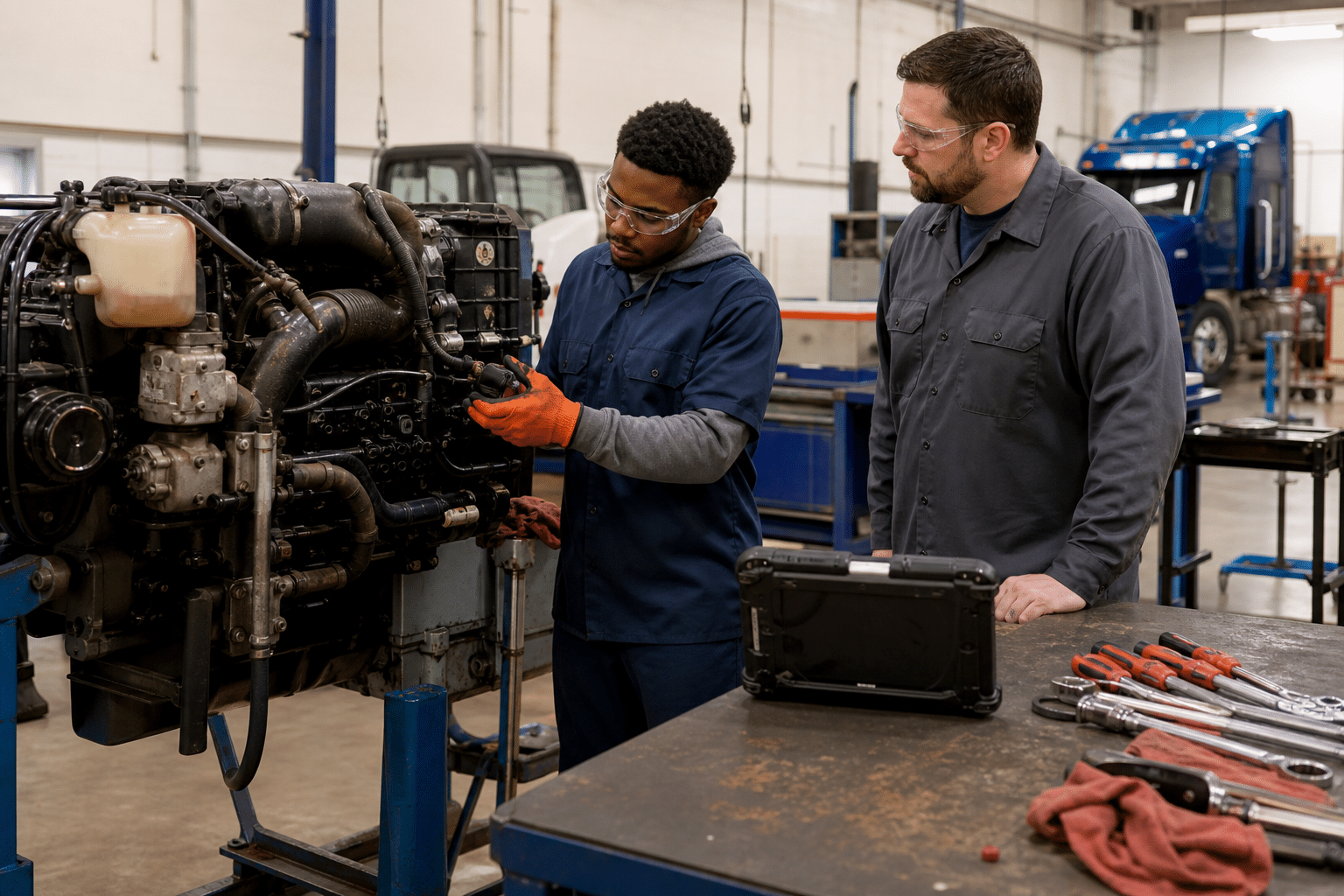
Programs vary because the work varies. A truck-and-bus program may spend more time on diesel engines, air brakes, electrical systems, emissions controls, and fleet maintenance. A heavy-equipment program may lean further into hydraulics, undercarriages, attachments, and field service. A manufacturer-backed course may focus on one equipment family.
The BLS describes postsecondary diesel programs as a mix of classroom instruction and hands-on training. Students may learn diesel technology, repair techniques, equipment use, technical manuals, and electronic diagnostic reports. That is a useful baseline, but the name of the program does not tell you how much time you will spend doing the work yourself.
Ask for the course list and look for practical details:
- Which engines, trucks, buses, or machines are available for practice?
- Do students diagnose faults or mainly remove and replace parts?
- Are electrical diagnosis and computer-based tools included?
- Does the program cover preventive maintenance, documentation, and work orders?
- Are welding, hydraulics, brakes, and emissions systems part of the curriculum?
- How often does each student use the equipment rather than watch an instructor?
If the school cannot explain the equipment and practice schedule, treat that as a warning. You are not buying a topic list. You are buying access to instruction, tools, equipment, feedback, and a path toward employable habits.
Four ways to train as a diesel mechanic
There is no single best format for every career changer. Your choice depends on your budget, schedule, location, and how quickly you need supervised practice.
| Training route | Strength | Trade-off |
|---|---|---|
| Certificate program | Often focused and shorter than a degree; can cover core diesel systems | May offer fewer general education credits and less time for advanced specialization |
| Associate degree | Broader program with more time for diagnostics and theory; may transfer more easily | Usually takes longer and can cost more in tuition and living expenses |
| Employer training | You learn the employer’s tools, procedures, and equipment while building work experience | Entry pay and training quality vary; the skills may be tied closely to one fleet or brand |
| Apprenticeship or paid trainee route | Combines work experience with structured instruction when a real sponsor is available | Availability depends on location and employer; the title does not automatically prove that the program is registered |
Apprenticeship.gov currently lists bus and truck mechanics and diesel engine specialists under O*NET code 49-3031.00, but its occupation page also says the occupation is not currently approved for use in a Registered Apprenticeship Program. The Department of Labor separately lists Diesel Mechanic among high-demand transportation occupations and provides an apprenticeship finder. These details are a reason to verify the exact sponsor, registration label, and training agreement instead of trusting the word “apprenticeship” in an advertisement.
For a school-based program, ask whether the school has employer relationships and how those relationships work. A guest speaker is not the same as a paid placement. A job board is not the same as an interview. Get the distinction in writing.
How much does diesel mechanic school cost?
The published tuition is only the first number. Build a total-cost sheet before comparing programs.
| Cost category | Questions to ask |
|---|---|
| Tuition | Is the price per credit, term, module, or entire program? |
| Fees | Are lab, registration, technology, testing, or graduation fees included? |
| Tools | Must students buy a complete tool set, specialty tools, safety gear, or a laptop? |
| Books and materials | Are manuals, software access, parts, and consumables included? |
| Transport | Can you reach the shop every day, including early or evening sessions? |
| Housing and food | Will the program require relocation or reduce your work hours? |
| Lost income | How much pay will you give up during class and practice time? |
| Financing | What grants, scholarships, payment plans, or loans are available, and what remains after aid? |
Federal Student Aid defines cost of attendance as more than tuition and fees. It can include books, supplies, food, and housing. It also distinguishes cost of attendance from net price, which is the estimated out-of-pocket amount after grants and scholarships. Use that distinction when a school presents a large headline price or an optimistic aid estimate.
For a career changer, lost income can be the largest hidden cost. A program that charges less may still be harder to afford if it requires a long commute or prevents you from keeping a part-time job. Write down the weekly schedule and calculate the full transition cost rather than the invoice from the school alone. Compare that cost with the pay and progression questions in our diesel mechanic salary guide.
How to judge hands-on training
“Hands-on” can mean several different things. It may mean that students handle tools, inspect a component, follow a service procedure, or diagnose a fault. Those are not identical experiences.
Ask the admissions office these questions:
- How many students share each engine, truck, or diagnostic station?
- How many shop hours are scheduled for each student?
- Are vehicles and components in working condition, or are they only display units?
- Do students perform inspections, measurements, testing, and documentation?
- Who checks the work before equipment is returned to service?
- What happens when a student needs more practice with electrical diagnosis or hydraulics?
- Are safety procedures taught before students use lifts, compressed air, batteries, or heavy components?
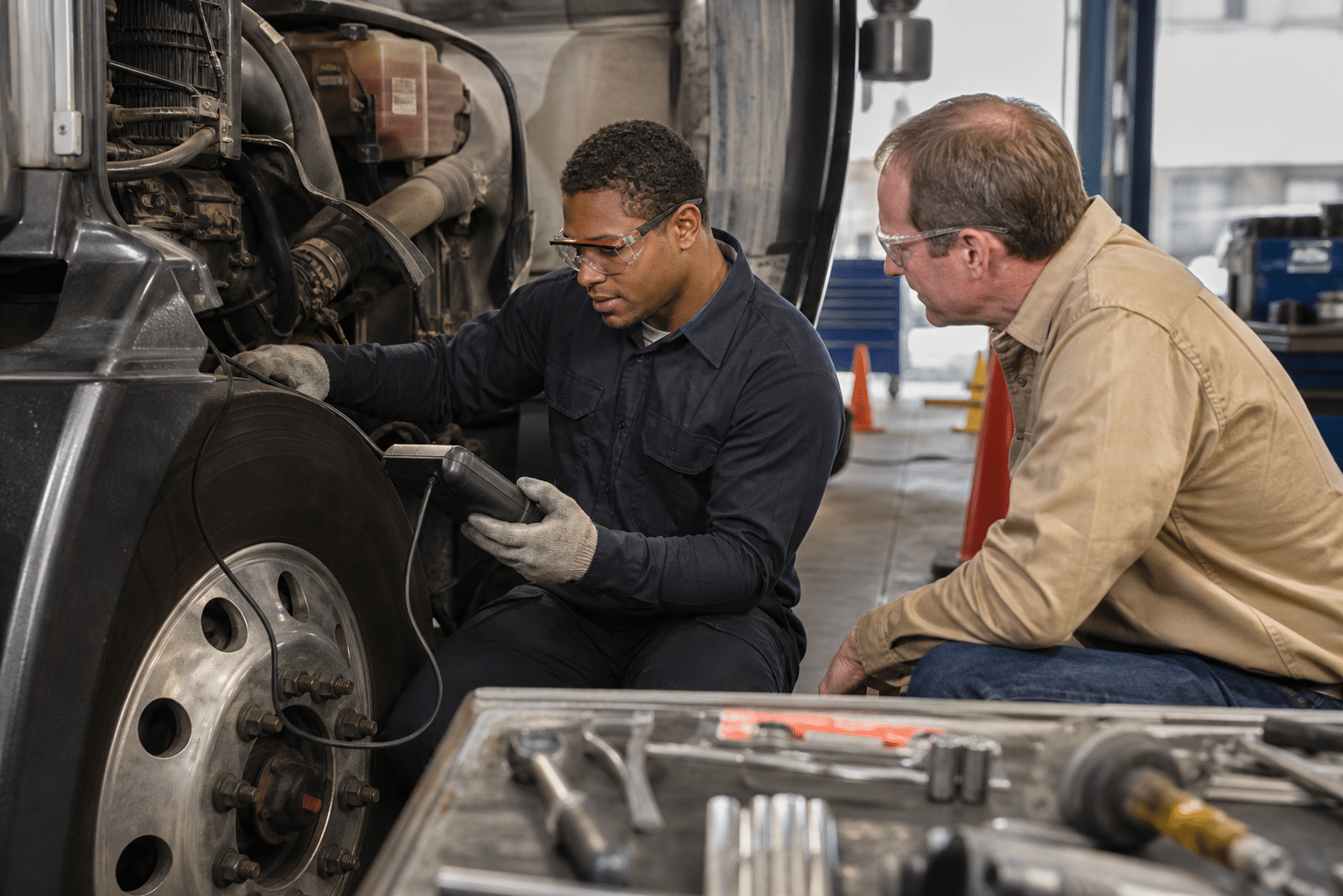
You should be able to see the training bay or receive a clear virtual tour. Notice whether the equipment resembles the jobs you want. A program can have impressive machinery and still provide little individual practice if the class is too large or the equipment is unavailable.
Is online diesel mechanic school enough?
Online lessons can be useful for vocabulary, diagrams, basic system theory, math, and preparation for a conversation with an employer. They can also fit around a full-time job. The limitation is practical: a screen cannot give you the feel of a fastener, the sound of a failing component, or the experience of safely positioning a heavy part.
Before enrolling in an online program, ask what the credential means to the employers you want to work for. Does the course include a supervised lab? Is there a local partner? Do students complete an internship? Are tools and equipment provided, or are you expected to find them yourself?
An online certificate should not be treated as equivalent to a program with extensive shop practice unless the employer says it is. If you already have mechanical experience, online theory may fill a specific gap. If you have never worked around heavy equipment, plan how you will gain supervised practice before relying on the credential in a job search.
Diesel truck school versus heavy-equipment training
The phrase “diesel mechanic” can cover several work settings. Truck and bus technicians may work on engines, transmissions, air-brake systems, electrical controls, emissions systems, and fleet preventive maintenance. Heavy-equipment mechanics may work on construction, agricultural, mining, or forestry machines, often with more hydraulics, attachments, and field repairs.
There is overlap, but it is not complete. Read the equipment list before you choose a program. If your goal is a fleet shop, a program built around excavators may leave gaps in air brakes and truck electrical systems. If you want construction equipment, a truck-only program may not give you enough practice with hydraulics or mobile machinery. Our heavy equipment operator certification guide explains the separate operator pathway.
This is also why a diesel school should not be confused with a heavy equipment operator course. Mechanics diagnose and repair systems. Operators use the machine to perform work. The tools, safety training, and first jobs are different. If you are comparing diesel repair with factory maintenance, the industrial maintenance technician guide gives you a different equipment and worksite baseline.
What credentials are included?
Some programs issue a certificate or degree. Others prepare students for an outside exam but do not include the exam fee or credential itself. Ask exactly what you receive at graduation.
ASE’s Medium-Heavy Truck series includes tests covering diesel engines, drive train, brakes, suspension and steering, electrical and electronic systems, HVAC, and preventive maintenance inspection. ASE certification can help an employer evaluate your knowledge, but it does not replace shop experience. It also may not be the credential a particular fleet uses.
The same principle applies to a commercial driver’s license. The BLS notes that diesel technicians might need a CDL to test-drive buses and large trucks. A school may discuss the license without providing the training, the testing vehicle, or the cost. Ask which part is included.
Do not pay extra for a vague phrase such as “industry recognized.” Ask for the exact certificate name, issuing organization, exam requirements, renewal rules, and employer use. A school that answers those questions directly is easier to compare.
How to evaluate job-placement claims
Placement language can sound more precise than it is. “Employers hire our graduates” does not tell you how many graduates found jobs, how long it took, what the jobs paid, or whether the job matched the program.
Ask for the definition behind the claim:
- Which graduating class does the number cover?
- Is placement measured in the field of study or in any job?
- Are part-time, temporary, and unrelated jobs included?
- How many graduates responded to the survey?
- Which employers hired recent graduates, and for which roles?
- Does the school provide an internship, an introduction, or only a list of openings?
You should still speak with local employers. Ask what they expect from a new hire, which school programs they respect, and whether they would interview someone from the program you are considering. That conversation can reveal more than a brochure.
Is diesel mechanic school worth it after 40?
It can be, but the answer depends on the transition plan. You may already have useful experience with tools, vehicles, construction, industrial maintenance, electronics, farming, or fleet operations. You may also have a mortgage, family responsibilities, or a current salary that makes a long unpaid program difficult.
Start by asking employers whether they hire helpers, trainee technicians, lube technicians, or maintenance apprentices. If the first job provides structured supervision, a shorter certificate may be enough to get started. If employers in your area expect stronger diagnostic skills, a longer program may make sense.
The physical side matters too. The BLS describes diesel work as involving heavy parts and tools, dirty equipment, uncomfortable positions, noise, and occasional roadside or worksite repairs. Spend time in a shop before enrolling if you can. A job shadow or conversation with a working technician can prevent an expensive mismatch.
Do not assume that a higher-priced program is safer because it is longer. Compare the training bay, supervision, equipment, total cost, and employer connections. Those details affect the value more than the number of months printed on the program page.
A simple school comparison worksheet
Use the same questions for every program. A short written comparison makes sales conversations less persuasive and the actual differences easier to see.
| Comparison point | Program A | Program B |
|---|---|---|
| Format and length | ||
| Truck, bus, or equipment types | ||
| Scheduled shop hours | ||
| Tuition and required fees | ||
| Tools, books, and safety gear | ||
| Estimated net price after aid | ||
| Weekly schedule and commute | ||
| Credential awarded | ||
| Outside tests or licenses | ||
| Internship or employer connection | ||
| Placement definition | ||
| First job you could reasonably target |
Then contact two employers and ask how they would view each program. You are looking for a realistic first step, not a perfect school.
Bottom line
The best diesel mechanic school is the one that matches the equipment and job setting you want, gives you meaningful supervised practice, explains its total cost, and describes its credentials and employer connections precisely.
Compare certificate, degree, employer, and apprenticeship routes before assuming school is the only option. Use BLS for the occupation baseline, Federal Student Aid for cost language, ASE for certification details, and Apprenticeship.gov for the exact status of any apprenticeship claim.
If you are changing careers after 40, protect your budget and your time. Visit the shop, speak with employers, and ask what a new hire from that program can actually do in the first month. That answer is more useful than a promise of a fast career change.
Sources
- U.S. Bureau of Labor Statistics: Diesel Service Technicians and Mechanics – education, training, work conditions, occupational scope, and May 2025 wage context; checked August 31, 2026.
- Apprenticeship.gov: Bus and Truck Mechanics and Diesel Engine Specialists – occupation description and current Registered Apprenticeship status; checked August 31, 2026.
- Apprenticeship.gov: Transportation industry – diesel mechanic apprenticeship context and industry resources; checked August 31, 2026.
- Apprenticeship.gov: Apprenticeship Finder – how to verify apprenticeship listings, registered occupations, and registered partners; checked August 31, 2026.
- ASE: Medium-Heavy Truck Certification Tests – T-series subjects and certification context; checked August 31, 2026.
- Federal Student Aid: Financial Aid Dictionary – cost of attendance and net price definitions; checked August 31, 2026.
- Federal Student Aid: How to evaluate your aid offers – comparing total cost, aid, and net price; checked August 31, 2026.
This article is educational. Program availability, costs, admission rules, licensing, certification requirements, and employer expectations can change by location and over time.
\n
Reviewed September 3, 2026: A diesel mechanic school should be judged by hands-on hours, equipment access, total cost, tools, and first-job support. Ask whether the program prepares you for the trucks or equipment local employers actually service. Compare it with diesel apprenticeships.