Becoming a diesel mechanic usually starts with learning how to inspect, diagnose, repair, and document work on heavy vehicles or equipment. Some people enter through a diesel program, some start as helpers or lubrication technicians, and others learn through an employer or apprenticeship. Your first choice should match the equipment you want to repair and the amount of hands-on practice you need.
Becoming a diesel mechanic is a practical route into repair work, but the job is broader than changing oil or replacing worn parts. Diesel technicians inspect, diagnose, repair, and document work on trucks, buses, fleets, construction equipment, and other diesel-powered machines. Modern engines also bring electrical systems, emissions controls, computer diagnostics, and more paperwork than many people expect.
The encouraging part is that you do not have to know every engine before applying. The U.S. Bureau of Labor Statistics says diesel service technicians and mechanics typically enter with a high school diploma or equivalent and learn through on-the-job training. Employers may prefer candidates with postsecondary diesel training, and some may require industry certification. That leaves several reasonable ways in, rather than one expensive path that everyone must follow.
Choose a first job that teaches a system: A shop assistant who spends months on inspections, fluid systems, brakes, electrical diagnosis, and service records may build a stronger base than someone hired under a mechanic title but given only cleaning or parts-running duties. Ask which repairs a new hire can learn under supervision.
Diesel mechanic at a glance
| Question | Practical answer |
|---|---|
| Main work | Inspect, diagnose, maintain, repair, and document diesel-powered vehicles or equipment |
| Common employers | Truck fleets, bus operators, dealerships, repair shops, rental companies, government, and equipment businesses |
| Typical entry education | High school diploma or equivalent; technical training can improve your starting position |
| Training routes | Employer training, community college or trade school, manufacturer training, and some apprenticeship programs |
| Main credential family | ASE Medium-Heavy Truck tests are relevant to truck and tractor work; employer and equipment credentials vary |
| License question | A CDL may be needed for certain test drives, but it is not automatically a requirement for every diesel job |
| Work reality | Noise, grease, heavy parts, awkward positions, outdoor calls, and occasional long or irregular shifts may be part of the job |
What does a diesel mechanic do?
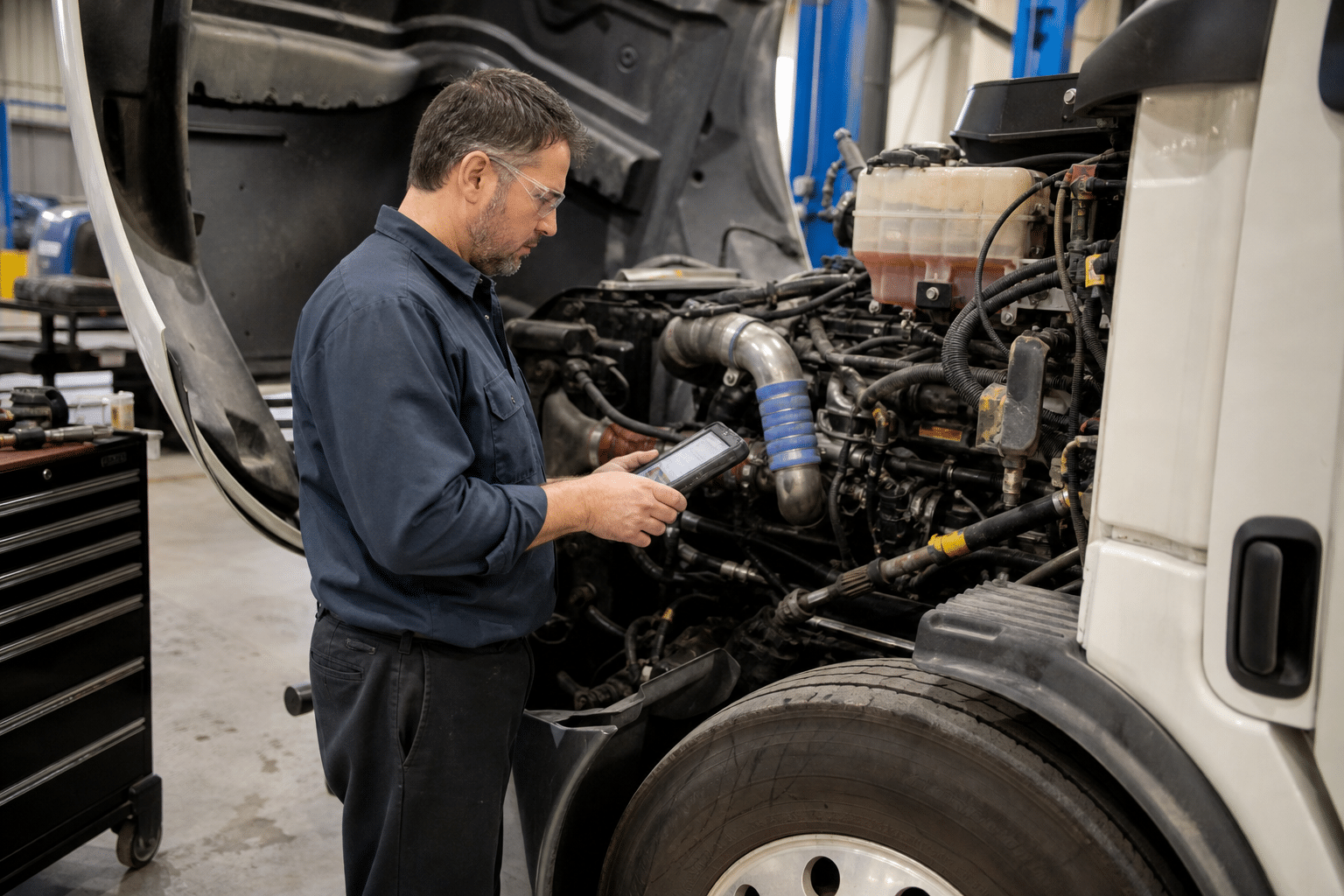
“Diesel mechanic” is a common job title, not one perfectly standardized occupation. A shop may use diesel technician, fleet mechanic, truck mechanic, heavy truck mechanic, or equipment mechanic for related work. Read the job duties carefully. A position repairing Class 8 trucks will not feel identical to one maintaining farm machinery or construction equipment.
The BLS describes diesel service technicians and mechanics as workers who inspect, repair, and overhaul buses, trucks, or any vehicle with a diesel engine. Typical tasks include:
- inspecting engines, brakes, steering, transmissions, and related systems;
- reading diagnostic results and tracing the cause of a fault;
- performing preventive maintenance, such as fluid checks and scheduled service;
- repairing or replacing mechanical, electrical, exhaust, and emissions components;
- using hand tools, pneumatic tools, machine tools, and computer diagnostic equipment;
- recording parts, hours, repairs, and vehicle condition; and
- explaining the problem and the repair to a customer, supervisor, or fleet manager.
The word “diagnose” matters. A diesel technician is often paid for finding the actual cause of a failure, not for replacing the first part that looks suspicious. That may mean checking a wiring circuit, interpreting fault codes, testing fuel or air systems, measuring wear, and confirming the repair under normal operating conditions.
Diesel mechanic, diesel technician, or heavy equipment mechanic?
The titles overlap, but the equipment can change the training you need.
| Role | Equipment focus | What to check in a job posting |
|---|---|---|
| Diesel mechanic or technician | Trucks, buses, trailers, fleets, and diesel engines | Engine systems, air brakes, electrical diagnostics, emissions, road calls, and possible CDL expectations |
| Heavy equipment mechanic | Excavators, loaders, dozers, agricultural machines, and mobile equipment | Hydraulics, mobile electrical systems, attachments, field service, and equipment-specific training |
| Fleet mechanic | A company’s trucks, vans, buses, or specialized vehicles | Preventive maintenance schedules, uptime, records, and the employer’s equipment mix |
| Entry-level lube or service technician | Routine maintenance under supervision | Safe inspections, fluids, filters, basic tools, and a path toward diagnostics |
There is useful overlap between these careers. Mechanical reasoning, safe tool use, electrical basics, documentation, and troubleshooting transfer well. The machines are not interchangeable, though. Our guide to heavy equipment operator certification explains why operating a machine and repairing one are separate career tracks.
The main ways to enter the field
Start with an employer
Many diesel technicians begin with an entry-level job and learn the employer’s equipment on the job. Search for titles such as lube technician, fleet maintenance trainee, shop helper, trailer technician, entry-level diesel technician, or preventive maintenance technician.
This route makes sense if you want to test the work before paying for a long program. You may begin with cleaning parts, checking fluids, servicing filters, organizing tools, performing inspections, or assisting a more experienced technician. As you prove that you can work safely and follow instructions, you may move into more complicated repairs.
The trade-off is that training quality varies. Before accepting an offer, ask:
- Who trains new hires, and how is progress documented?
- Which tasks can an entry-level employee perform alone?
- How much of the job is routine service versus diagnosis and repair?
- Are tools supplied, or must I buy a complete set immediately?
- Are night shifts, weekends, road calls, or overtime normal?
- Which certifications or licenses might the employer pay for?
An employer that can explain the first 30, 60, and 90 days is easier to evaluate than one that simply promises “great opportunity.”
Attend a diesel technology program
A community college, vocational school, or technical institute can give you structured practice before you enter a busy shop. Programs may cover diesel engines, brakes, steering, suspension, electrical systems, hydraulics, preventive maintenance, technical manuals, and electronic diagnostics.
Look for the details behind the brochure. A useful program should give you meaningful hands-on lab time, access to working equipment, and a clear explanation of the credential you earn. Compare total tuition, tools, fees, transportation, schedule, completion requirements, employer relationships, and what graduates do next.
An online course can help you learn vocabulary and basic theory. It is less convincing when a job requires you to use tools, inspect a vehicle, or diagnose a live system. Our guide to choosing a trade school without overpaying gives you a checklist for comparing cost and practical access. Online trade school is more useful when it connects to a lab, employer, or supervised practice.
Look for an apprenticeship or sponsored training
Apprenticeship can combine paid work with related technical instruction. The U.S. Department of Labor’s apprenticeship resources include diesel mechanic and diesel technician listings, but availability depends on the sponsor, location, employer, and occupation classification. Search the official finder and contact sponsors directly rather than assuming that every diesel job follows the same apprenticeship pattern.
Read the actual standard before applying. Check the wage progression, classroom schedule, tools, travel, overtime, training provider, completion credential, and the equipment you will work on. A program connected to heavy trucks may not prepare you for construction equipment, and a manufacturer-sponsored program may focus on one product family.
For a career changer, paid training can be attractive because you continue earning while building experience. It can also involve a lower starting wage, fixed schedules, and a demanding learning period. Compare the whole arrangement with a school offer, not just the first hourly number.
Use military, fleet, farm, or industrial experience
You may already have useful experience if you have worked around trucks, generators, agricultural machinery, industrial equipment, buses, or maintenance departments. Translate that experience into specific tasks: preventive inspections, hydraulic troubleshooting, electrical testing, parts documentation, welding, reading service manuals, or following hazardous-energy procedures.
Do not assume a related job automatically counts as diesel experience for a certification. Ask the certifying organization and the employer how they evaluate your background. Honest documentation is more helpful than stretching a job title.
Which certifications matter?
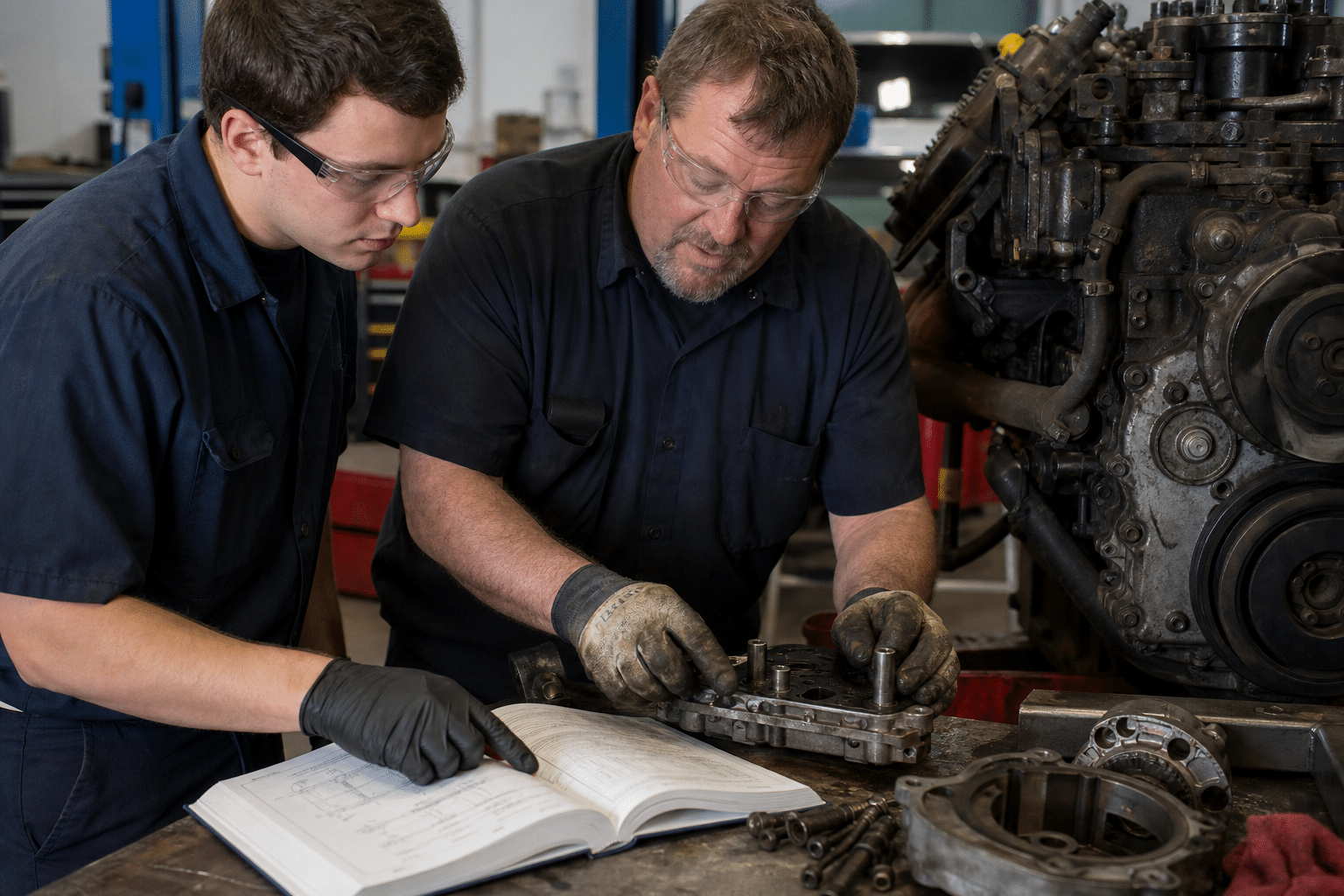
There is no single national “diesel mechanic license” that automatically qualifies you for every repair job. Requirements come from the employer, equipment, state, customer contract, or specific task. Certification can still help you prove knowledge and move toward more responsible work.
ASE Medium-Heavy Truck certification
ASE’s Medium-Heavy Truck series covers Class 4 through Class 8 trucks and tractors. The tests include:
- T1: gasoline engines;
- T2: diesel engines;
- T3: drive train;
- T4: brakes;
- T5: suspension and steering;
- T6: electrical/electronic systems;
- T7: heating, ventilation, and air conditioning; and
- T8: preventive maintenance inspection.
ASE recognizes technicians who pass T2 through T8 as Master Medium-Heavy Truck Technicians. T1 is not required for that master designation. ASE also says technicians must retest every five years to retain certification.
The important distinction is timing. You can study before your first job, but certification tests are designed around job-related knowledge. ASE’s work-experience rules and the employer’s expectations should be checked before you treat a test pass as proof that you are ready to work independently.
Manufacturer and employer credentials
Truck, bus, and equipment manufacturers may offer training on their engines, diagnostic software, or service procedures. A fleet may also have internal sign-offs for inspections, brakes, road testing, or particular equipment. These credentials can be useful inside that employer or dealer network, but they do not all carry the same meaning outside it.
Ask three simple questions: Who issues the credential? What task does it prove? How long does it remain current? That keeps you from paying for a generic certificate that employers in your area do not recognize.
CDL and other requirements
The BLS notes that diesel technicians might need a commercial driver’s license to test-drive buses and large trucks. The word “might” is doing real work. Some employers require a CDL, some prefer it, and others assign road testing only to workers who hold the right license and authorization.
Check the posting and ask whether the employer pays for training. Do not assume that an ASE certification replaces a CDL, or that a CDL proves repair skill. They solve different problems.
Safety is part of the qualification
Diesel repair exposes workers to moving equipment, stored pressure, electricity, hot surfaces, chemicals, vehicle movement, lifting hazards, and exhaust. A good entry-level candidate does not pretend these risks are routine. They learn the shop’s procedures and ask before touching unfamiliar equipment.
OSHA’s lockout/tagout standard addresses control of hazardous energy during servicing and maintenance in general industry. In practice, your employer must explain which energy sources must be isolated, who is authorized to apply or remove locks, how stored energy is released, and how work is handed off.
You may also need training on lifting, vehicle support, fire prevention, personal protective equipment, compressed air, batteries, chemicals, and ventilation. Completing a general online safety course does not authorize you to service every truck or machine. Authorization comes from the employer’s training, procedure, supervision, and the limits of your role.
Skills employers look for first
You do not need to be a master diagnostician on day one. You do need habits that make training possible.
Mechanical reasoning
Learn how engines, cooling, fuel, air, brakes, steering, and drive systems work together. Practice identifying symptoms without jumping straight to a replacement part. Basic measurements and a clean inspection routine will take you further than a large vocabulary of component names.
Electrical and diagnostic basics
Modern diesel equipment relies on sensors, control modules, wiring, and diagnostic software. Study voltage, resistance, continuity, connectors, grounds, and safe test procedures. You are not expected to bypass an employer’s authorization rules to prove confidence.
Documentation
Fleet work depends on records. A clear note about the symptom, test, part, repair, and final check helps the next technician and protects the customer. Employers notice people who keep a clean work order and return tools to the right place.
Physical readiness and patience
The work can involve lifting parts and tools, kneeling, reaching, climbing, crawling, noise, grease, and awkward positions. It may also involve long waits for a diagnosis to become clear. Physical fitness helps, but safe technique, equipment, teamwork, and knowing when to ask for help matter just as much.
A realistic first-job plan
Use this sequence if you are starting from limited diesel experience.
- Save 15 local job postings. Record the equipment, shift, pay structure, certifications, tools, CDL language, and repeated skills.
- Choose the equipment family. Decide whether you are aiming at trucks and buses, heavy construction equipment, agricultural machinery, or a mixed fleet.
- Close one foundation gap. Take a hands-on class or supervised lesson in basic electrical, brakes, diesel engines, hydraulics, or preventive maintenance.
- Apply for entry-level work. Use trainee, lube technician, fleet helper, service assistant, or maintenance roles if they provide real supervision.
- Build a work record. Keep copies of training completions, task sign-offs, and documented experience. Follow the certifier’s rules rather than guessing what counts.
- Choose certification after seeing the equipment. ASE T-series testing may fit a heavy-truck path; another employer or equipment family may point you elsewhere.
This order keeps you from buying an expensive credential before you know which machines and employers are actually available near you.
Is diesel mechanic a good career change after 40?
It can be a good fit if you enjoy practical problem-solving and are willing to start with a learning curve. Previous experience in maintenance, driving, construction, farming, manufacturing, aviation, or customer service can help. So can the less visible skills: showing up, documenting work, communicating clearly, and staying calm when a repair takes longer than expected.
The trade-offs are real. A new technician may start below a previous wage, work in uncomfortable conditions, buy tools over time, and accept a schedule that includes nights or weekends. Some jobs involve roadside calls or outdoor work in poor weather. The work may be easier to enter than to sustain if you dislike noise, dirt, heavy parts, or repeated bending.
Talk with two local shops or fleet managers before enrolling in school. Ask what entry-level workers actually do, how long training lasts, which certifications matter, and what makes someone successful after the first year. That conversation is often more useful than a brochure promising a fast career.
Bottom line
The most reliable way to become a diesel mechanic is to combine a credible entry route with supervised hands-on practice. A high school diploma or equivalent may be enough to begin, while diesel technology training can make you more competitive. ASE certification can document truck-repair knowledge, but it does not replace experience, employer authorization, or a CDL when a job requires one.
Start by choosing the equipment you want to work on. Then compare local trainee jobs, technical programs, and sponsored training. The best first step is the one that gives you safe access to real equipment, a patient trainer, and a clear path toward more difficult repairs.
Sources
- U.S. Bureau of Labor Statistics: Diesel Service Technicians and Mechanics — duties, education, training, certification, CDL considerations, pay, and outlook; checked August 31, 2026.
- ASE: Medium-Heavy Truck Certification Tests, T Series — T1-T8 test subjects, master certification, and recertification; checked August 31, 2026.
- ASE: Certification pathway and work experience information — certification structure and credentialing context; checked August 31, 2026.
- Apprenticeship.gov: Bus and Truck Mechanics and Diesel Engine Specialists — official occupation and apprenticeship-finder information; checked August 31, 2026.
- OSHA: Control of hazardous energy, 29 CFR 1910.147 — lockout/tagout requirements for servicing and maintenance; checked August 31, 2026.
Use this guide as a starting point for planning a diesel-mechanic career. Confirm current state rules and employer qualifications, and follow the safety instruction provided for the shop and equipment.
\n
Reviewed September 3, 2026: The best diesel mechanic entry route depends on the equipment you want to repair and the employers near you. Compare school, shop training, apprenticeships, ASE tests, and any CDL expectations before paying for a program. See diesel mechanic school options.