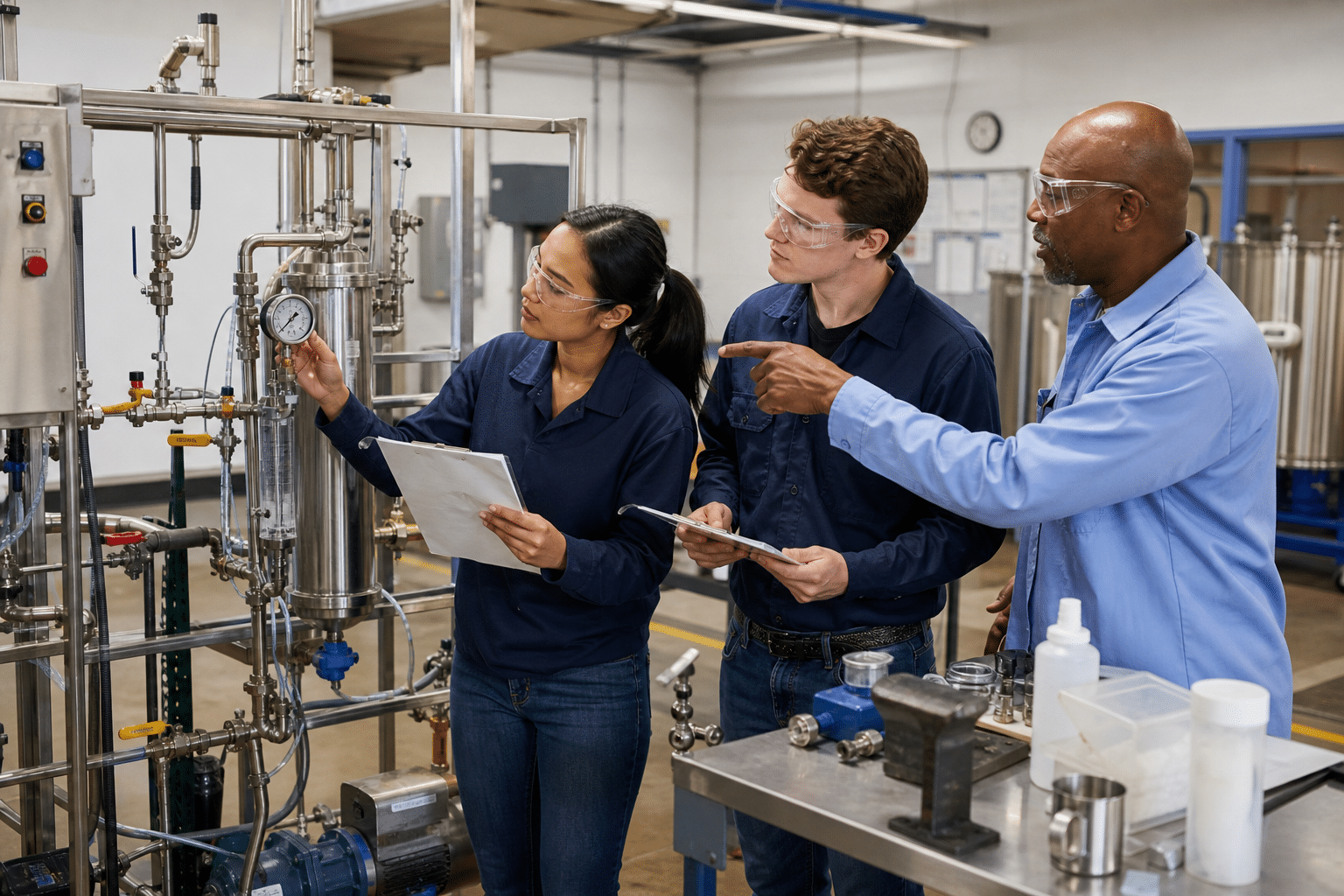
An industrial engineering technician studies how work moves through a factory, warehouse, laboratory, or service operation. The work may involve observing processes, measuring time and materials, organizing production data, updating layouts, and helping test improvements. It is analytical work that stays close to the people and equipment doing the job, so listening carefully matters as much as a spreadsheet.
What does an industrial engineering technician do?
The exact mix depends on the employer. Typical assignments include:
| Area | Typical work |
|---|---|
| Workflow study | Observe steps, measure delays, and document the current process |
| Layout | Prepare drawings showing people, equipment, and material movement |
| Production data | Clean, organize, and explain measurements |
| Improvement test | Help compare an old process with a revised process |
| Quality support | Track defects, variation, and corrective actions |
You may spend part of the day on a production floor and part of it in a computer system. Clear notes matter: a useful observation should help the team understand what happened, where the delay occurred, and what change is worth testing.
Is an industrial engineering technician an engineer?
No. An industrial engineering technician supports engineering and operations work; an industrial engineer generally has broader responsibility for analysis, design, and technical decisions. A technician may collect measurements, create process maps, update layouts, maintain spreadsheets, or help validate a change. The job is often a strong fit for someone who likes practical problem-solving but does not want to begin with a four-year engineering degree.
Related roles include manufacturing technician, production technician, and quality assurance technician. Read postings closely because employers may blend industrial engineering, quality, production control, and continuous-improvement duties.
How do you become an industrial engineering technician?
The Bureau of Labor Statistics notes that employers may look for an associate degree or certificate in applied science, industrial technology, or industrial engineering technology. Useful subjects include:
- production systems and process improvement
- basic statistics and data interpretation
- spreadsheets and reporting
- technical drawings or CAD
- measurement, quality, and root-cause thinking
- professional communication
A beginner portfolio does not need to be elaborate. You could map a process, measure a repeated task, identify a bottleneck, and show a small improvement with before-and-after data. Experience in manufacturing, logistics, inventory, quality, healthcare operations, or customer-service workflows can also provide relevant examples.
Industrial engineering technician pay and outlook
The U.S. Bureau of Labor Statistics reports a median annual wage of $66,120 for industrial engineering technologists and technicians in May 2025. It projects 3% employment growth from 2025 to 2035 and about 6,600 openings per year on average. This is a national benchmark for the occupation, not a guaranteed starting salary. Local pay depends on industry, region, shift, software, education, and whether the role includes quality or production responsibilities.
What is the work environment like?
Industrial engineering technicians often work between an office and an operating environment. That may mean walking a production line, observing material movement, interviewing operators, checking measurements, and then preparing a report or revised layout. Some sites involve noise, machinery, vehicles, lifting, or protective equipment. Safety and respect for operator knowledge are part of good process work.
Is it a good second career after 40?
It may suit you if you are organized, curious, comfortable asking how work is really done, and willing to learn basic data tools. Previous experience can transfer from supervision, manufacturing, warehouse operations, quality, construction planning, healthcare administration, or technical customer support. You do not need to present yourself as an engineer; show that you can observe accurately, communicate respectfully, and turn information into a workable next step.
Search for industrial engineering technician, process improvement technician, continuous improvement technician, production control technician, and quality technician. Compare the required software, shift, physical demands, and training path before choosing a program.

A useful improvement starts with the current process: The technician may follow a part from receiving to shipping, record waiting and movement, compare the written procedure with what workers actually do, and test one change at a time. A faster-looking layout is not an improvement if it creates more lifting, defects, or confusion downstream.
Bottom line
An industrial engineering technician helps teams understand and improve real work. The path combines observation, measurement, documentation, and practical change. A certificate or associate program can open doors, while experience with processes, people, and data can make a career change more credible.
Related guides: Robotics Technician: Duties, Training, Pay and Career Fit and Aircraft Mechanic Salary: Pay, A&P and Career Outlook.
Where the technician adds value on a real production floor
Industrial engineering technicians are often most useful when a process looks acceptable on paper but keeps producing small, costly problems. A line may run, yet operators lose time searching for parts, rechecking measurements, waiting for a changeover, or working around an awkward fixture. The technician helps turn those observations into usable evidence for the people making process decisions.
That means the job rewards patience with details. You may time a task, verify a work instruction, compare scrap records, measure a layout, or help test a change before it is rolled out. The work is less about issuing grand solutions and more about making sure a proposed improvement actually works for the operator, quality team, and maintenance crew.
Before applying, ask whether the position spends more time in the plant, with data, or supporting project engineers. Some roles are close to quality and production. Others are closer to drafting, logistics, or work measurement. A candidate with hands-on manufacturing experience can be credible here if they explain the connection clearly. Familiarity with production routines, safety, and written procedures is often more useful than trying to present yourself as an engineer.
Read the role alongside manufacturing technician work and quality assurance technician careers. If you prefer fixing equipment directly, those paths may fit better. If you enjoy noticing why a process wastes time and helping a team test a practical change, industrial engineering technology may be the stronger match.
Ask how a team decides that an improvement has worked. If the answer includes operator feedback, quality results, and a repeatable method, you will learn much more than you would from a role built around spreadsheets alone.
Sources
- U.S. Bureau of Labor Statistics: Industrial Engineering Technologists and Technicians
- OSHA: Occupational Safety and Health Administration
Reviewed September 3, 2026: Industrial engineering technicians stay close to the process: time studies, layouts, production data, materials, and practical changes. Check whether a role is mainly data, floor observation, or project support. Compare it with manufacturing technician work.