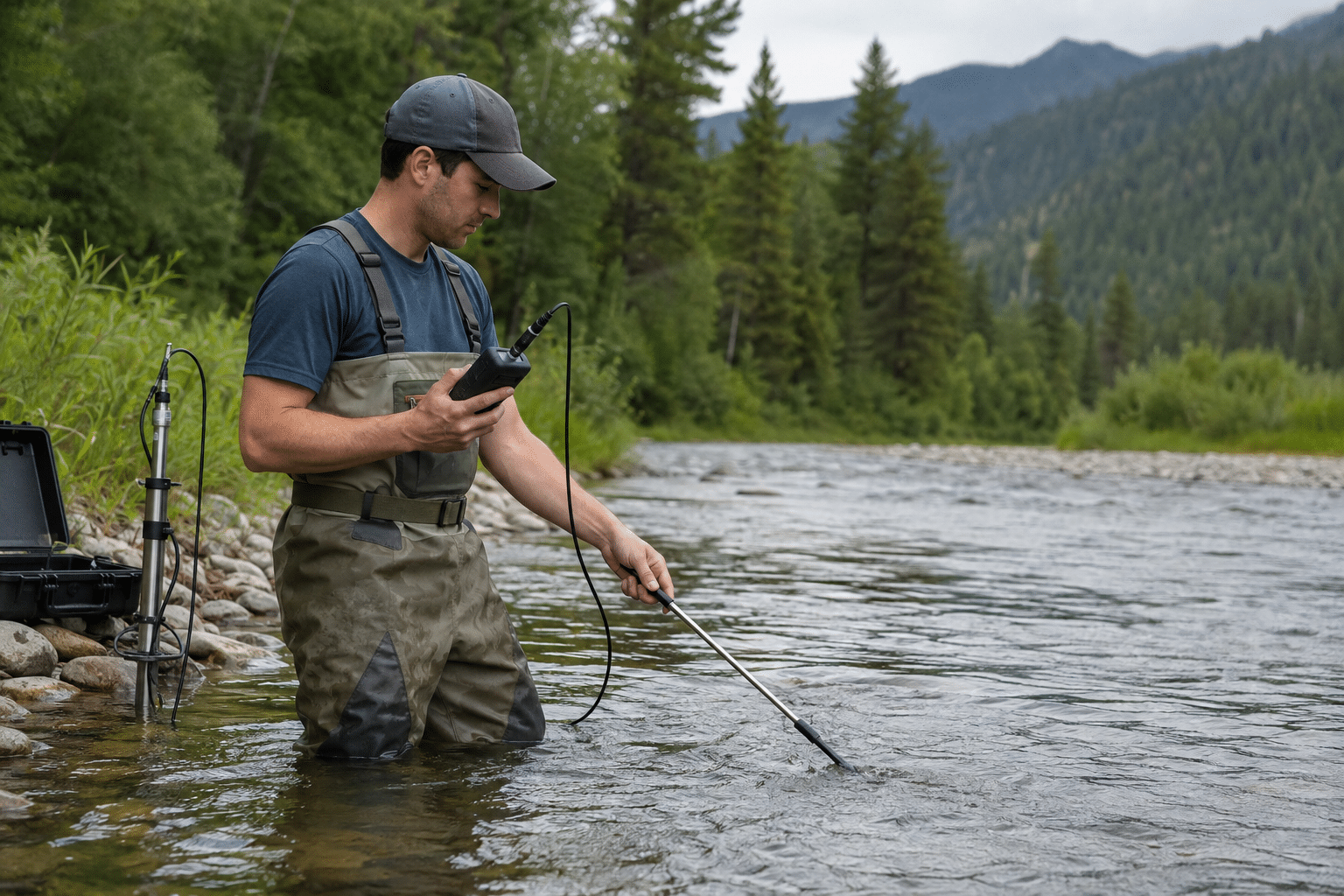
A hydrology technician collects and checks measurements about surface water and groundwater. The work may support flood monitoring, water-supply planning, environmental studies, engineering projects, or scientific programs. It mixes field conditions with instruments, samples, data checks, and reports, so the job requires patience with both the physical site and the quality of the record.
What does a hydrology technician do?
Typical duties include:
- Installing, inspecting, and servicing stream gauges, groundwater instruments, and data loggers.
- Measuring stream discharge, water levels, temperature, turbidity, or other field conditions.
- Collecting water samples and following labeling, preservation, and transport procedures.
- Checking equipment readings and investigating gaps or unusual results.
- Entering observations into databases and preparing field notes, tables, and reports.
- Traveling to rivers, lakes, wells, flood sites, and remote monitoring stations.
The U.S. Geological Survey describes hydrologic technicians as the people who help keep water data collection working in the field. That can include checking gauges, troubleshooting equipment, responding after floods, and reviewing data for accuracy. It is hands-on work with a strong record-keeping component.
Training and education
An associate degree or technical coursework in hydrology, geology, environmental science, physical science, surveying, or engineering technology can help. Some entry roles accept related trade or field experience, especially when it includes equipment maintenance, construction, surveying, or outdoor data collection.
Useful preparation includes algebra, basic physics, map reading, GPS, spreadsheets, water sampling, and safe work around moving water. A technician does not need the same education as a professional hydrologist in every role. OPM’s federal standard for hydrologic technicians describes practical technical work that supports hydrologic studies, while the separate hydrology series has professional degree requirements.
Expect employer-specific training. You may need instruction in wading safety, driving, lifting, weather response, confined spaces, boats, or site access. A driver’s license is often important because monitoring stations are spread across a large area.
Pay and job outlook
BLS reported 2025 median pay of $64,790 for hydrologic technicians. The lowest 10 percent earned less than $44,950, while the highest 10 percent earned more than $100,480. These are national occupation benchmarks, not a guaranteed offer for a new technician.
BLS projects hydrologic technician employment to be roughly flat from 2025 to 2035, with about 3,000 jobs in the occupation. The agency also notes that many hydrologic technicians work for the federal government, so funding for water-data programs can affect hiring.
Local demand can still be practical. Search for hydrologic technician, water monitoring technician, field technician, groundwater technician, and environmental data technician. Similar work may appear under different titles.
Could this career fit you after 35?
This career can fit someone who wants a technical outdoor role and does not mind routine checks. You need patience because reliable water data comes from repeating measurements carefully, not from one dramatic field day.
The physical side deserves an honest look. You may hike with equipment, work in cold or fast-moving water, drive long distances, climb banks, or respond during poor weather. Office time includes data review and report preparation. Ask whether the employer expects wading, boating, overnight travel, emergency response, or seasonal overtime.
How to prepare for the first job
- Review USGS and local water-agency job postings to see which instruments and methods recur.
- Take an introductory course in hydrology, environmental science, GIS, or surveying.
- Practice collecting observations with consistent dates, locations, units, and notes.
- Build familiarity with GPS, spreadsheets, basic databases, and field equipment maintenance.
- Apply to environmental, water-quality, surveying, or field-assistant roles if a hydrology title is not yet available.
You can compare this route with water quality technician, water resource specialist, and geology technician careers.
Plan a defensible field visit
A hydrology technician should know the purpose of the measurement before leaving the office. The site, instrument, timing, weather, access permission, and safety plan all affect the result. Review previous notes and expected conditions, then check batteries, calibration, reference marks, sample containers, and backup equipment. Returning to a remote station for one missing cable wastes more than time; it can also mean losing an important event measurement.
At the site, record conditions that a data table cannot explain. Debris may change flow around a sensor. Ice, algae, sediment, vandalism, bank erosion, or a shifted control can affect a reading. Photographs and field notes should show what was observed without turning a suspicion into a conclusion.
Protect the chain from measurement to database
Hydrologic data can pass through instruments, field sheets, telemetry, spreadsheets, and review systems before anyone uses it. Confirm station identifiers, units, time zones, and instrument settings at each step. Keep raw observations separate from corrected or calculated values. When a number is changed, the reason and reviewer should be traceable.
Quality control is not simply deleting an unusual point. Compare the value with field observations, nearby stations, equipment checks, and known events. A flood peak may be real even when it looks extreme. A smooth series may be wrong when a sensor is stuck. Good technicians flag uncertainty and preserve enough evidence for a reviewer to decide.
Choose training around the actual employer
For field-heavy jobs, surveying basics, safe work near water, instrument care, and reliable driving may matter as much as advanced analysis. Office-oriented roles may emphasize GIS, databases, statistics, and technical reports. Ask prospective employers which stations, instruments, and software trainees use during the first year. Build a small portfolio around public water data only after you understand its units and limitations.
Field safety deserves its own questions. Work may involve slippery banks, traffic near bridges, boats, heat, cold, insects, unstable channels, and rapidly changing water. Ask whether technicians work alone, how check-ins operate, and who decides that conditions are unsafe. Learn the difference between a routine wading measurement and a situation requiring specialized equipment or another crew member. Reliable data is never worth improvising access beyond the training and plan.
A dependable field technician also respects land access and station security. Confirm gates, permissions, keys, and contact instructions before travel, then leave instruments and enclosures protected from weather, animals, and unauthorized handling.
Sources
- U.S. Geological Survey: Hydrologic Technician
- OPM: Hydrologic Technician, GS-1316
- U.S. Bureau of Labor Statistics: Geological and Hydrologic Technicians
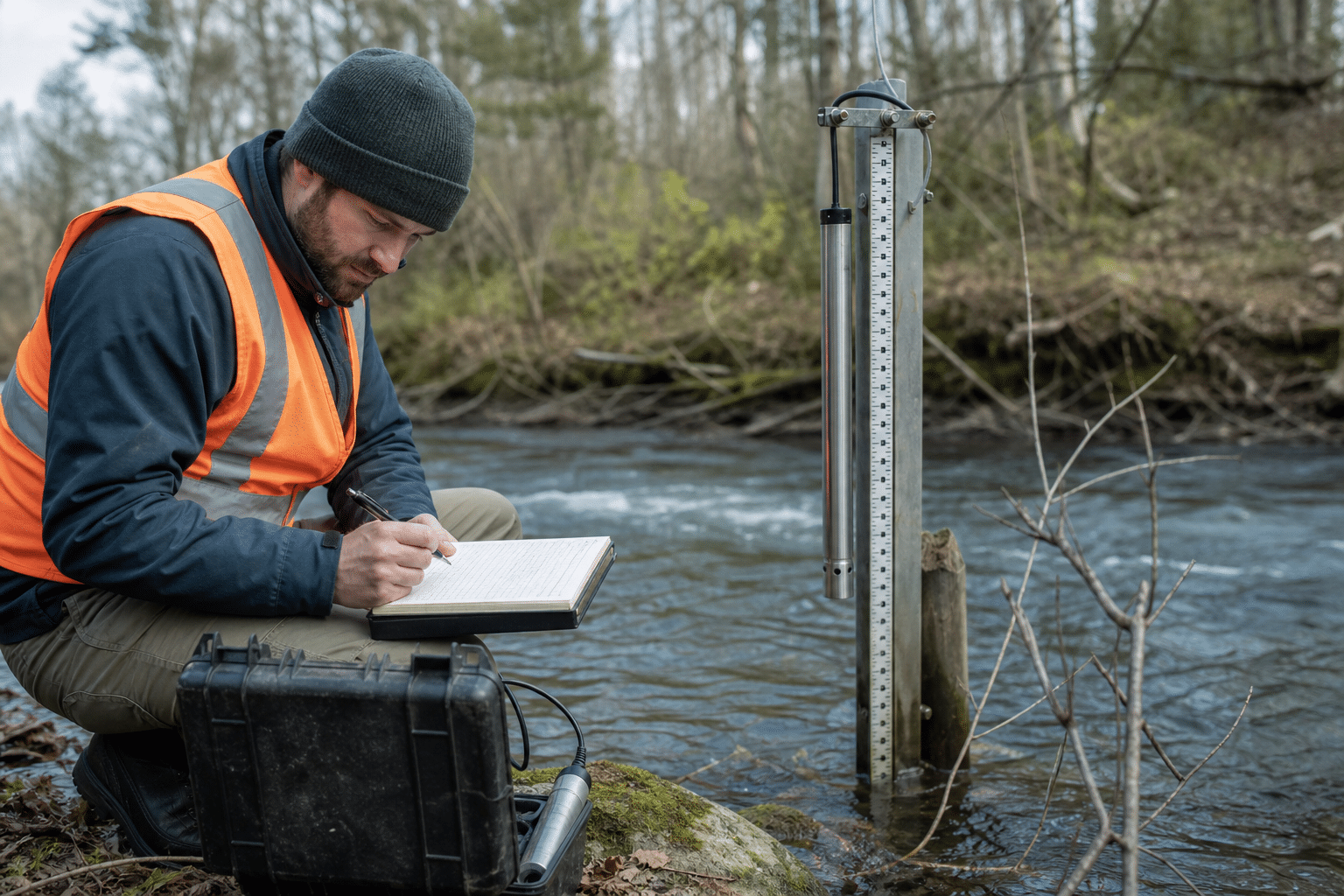
A field measurement needs context: A stream gauge reading may be affected by debris, weather, equipment drift, access conditions, or a recent storm. The technician records the site and instrument conditions, checks whether the result makes sense against nearby data, and flags anything that should not be treated as a clean measurement.