An automotive service technician inspects, diagnoses, and repairs cars and light trucks. The work may involve maintenance, brakes, steering, electrical systems, engines, diagnostics, customer explanations, and service records. The title covers both routine shop work and difficult fault-finding, so the tools, manufacturer training, pay plan, and certification expectations matter before accepting a job.
That does not mean every shop does everything. A quick-service center, dealership, independent repair shop, fleet garage, and specialty shop can offer very different jobs under the same title.
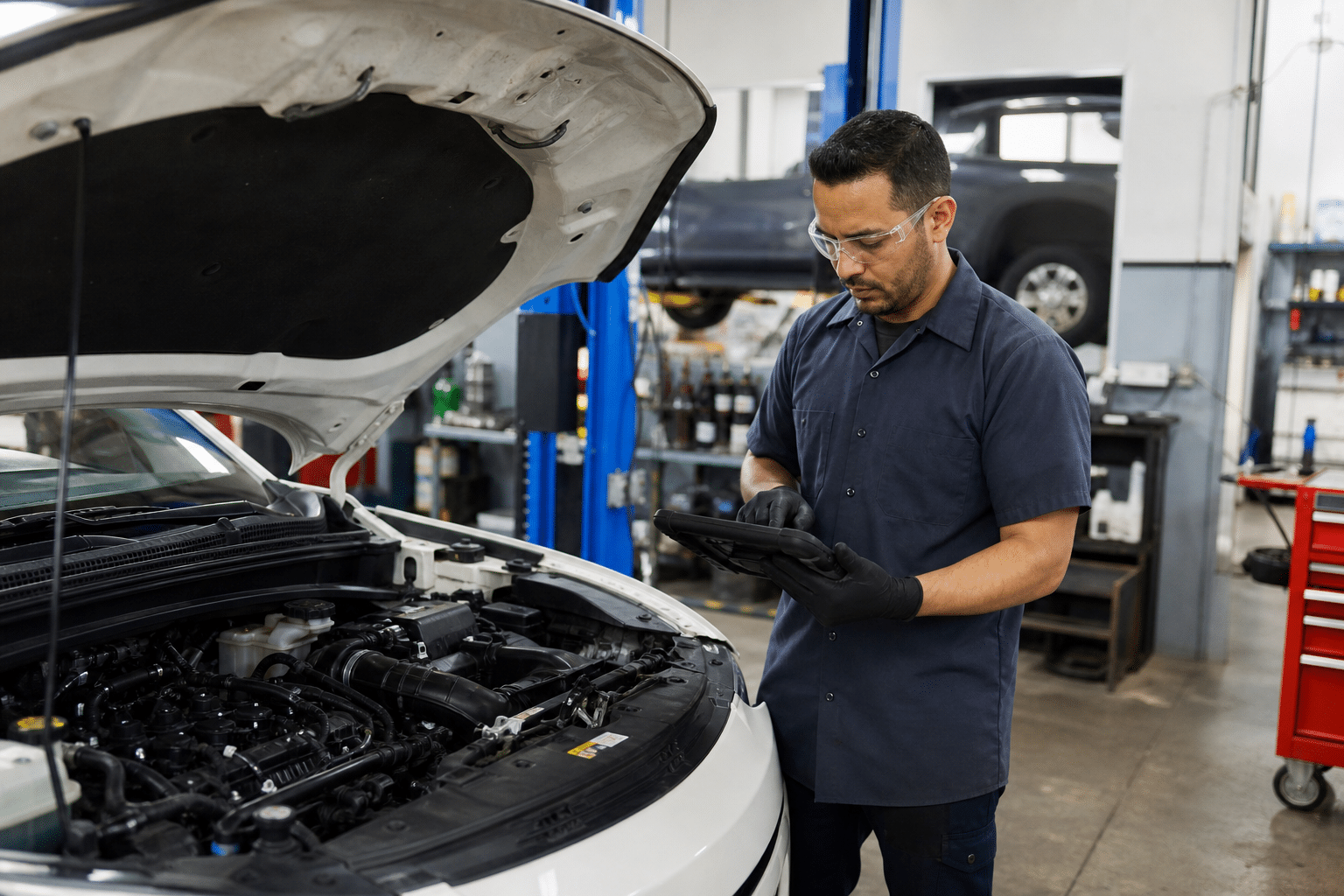
A warning light is only the starting point: The technician checks the vehicle history, confirms the symptom, retrieves diagnostic information, tests the likely system, and explains the repair in terms the customer can use. Replacing a part because it is commonly associated with a code is not the same as proving that part failed.
What does an automotive service technician do?
The Bureau of Labor Statistics describes the occupation as inspecting, maintaining, and repairing cars and light trucks. Common duties include:
- inspecting a vehicle and listening to the customer’s description of a problem;
- performing oil, filter, brake, tire, battery, and fluid services;
- using scan tools, test meters, pressure gauges, and service information;
- diagnosing engine, transmission, steering, suspension, brake, and electrical faults;
- removing, repairing, and replacing components;
- checking emissions, warning lights, sensors, and computer-controlled systems;
- road-testing a vehicle when the shop procedure requires it;
- writing inspection results and repair notes;
- explaining the repair, parts, labor, and follow-up work to a service advisor or customer.
The diagnostic part is where the job has changed most. A vehicle can have a mechanical fault, an electrical fault, a software-related issue, or several problems at once. A good technician tests instead of guessing and records what the test actually showed.
How the work changes by shop
Dealerships
Dealership technicians often work on a brand’s vehicles and have access to factory service information, specialty tools, and manufacturer training. The work may be organized by warranty, maintenance, recall, or repair order. Some shops separate entry-level maintenance from diagnosis and larger repairs.
Independent repair shops
Independent shops may see many makes and models. That can broaden your experience, but it also means learning how to find reliable service information and manage a wide range of designs. The pace and customer contact vary from one shop to another.
Fleet garages
Fleet technicians work on vehicles owned by a company, government agency, delivery service, transit system, or utility. Preventive maintenance and uptime may matter more than retail customer interaction. Fleets can include cars, vans, and light trucks, but the equipment mix must be checked.
Specialty and quick-service work
Tire, brake, alignment, glass, battery, exhaust, and quick-service shops can be an entry point. These jobs may build useful fundamentals, although they do not always provide a path into advanced diagnosis. Ask how technicians move from routine work to broader repair responsibility.
Automotive technician versus nearby careers
| Role | Main focus | Typical difference |
|---|---|---|
| Automotive service technician | Inspect and repair cars and light trucks | Vehicle systems and customer repair orders are central |
| Diesel mechanic | Repair buses, trucks, and diesel-powered equipment | Larger vehicles, diesel systems, and heavier components |
| Heavy equipment technician | Repair construction, farming, and industrial machinery | Mobile equipment rather than mainly passenger vehicles |
| Automotive body technician | Repair vehicle bodies, frames, glass, and finishes | Collision repair rather than mechanical diagnosis |
| Vehicle service advisor | Write repair orders and communicate with customers | Customer coordination rather than performing the repair |
| Quality control inspector | Measure and verify products against specifications | Inspection and documentation rather than vehicle repair |
Our guides to diesel mechanic salary, diesel mechanic school, medical equipment repair, and heavy equipment certification cover nearby technical routes.
Skills and tools that matter
You do not need to know every system before your first job. You do need a habit of testing, asking clear questions, and learning from the result. Useful skills include:
- basic electrical and mechanical reasoning;
- reading wiring diagrams and service information;
- using a scan tool without treating its code as the diagnosis;
- safe lifting, wheel removal, and tool handling;
- measuring voltage, resistance, pressure, temperature, or movement;
- keeping track of removed parts, fasteners, and repair steps;
- writing notes another technician can understand;
- explaining technical issues without making promises the evidence does not support.
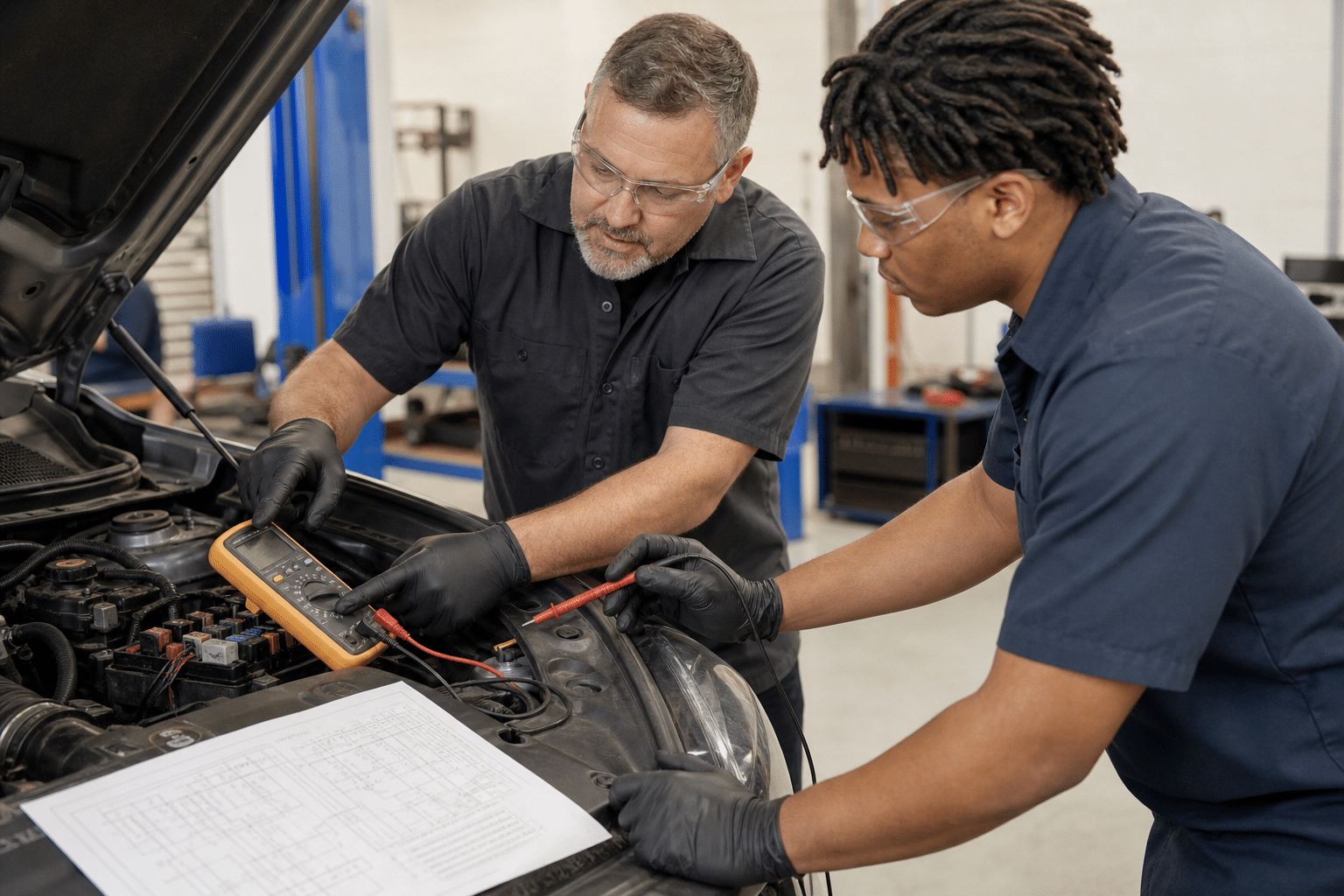
Modern shops may use scan tools, oscilloscopes, battery testers, alignment equipment, lifts, tire machines, service databases, and manufacturer portals. Hands-on ability still matters. So does computer comfort.
How do you become an automotive service technician?
The BLS lists a postsecondary nondegree award as the typical entry-level education, but it also says some workers enter with a high school diploma and learn on the job. Community colleges, technical institutes, high schools, manufacturers, dealers, and employers offer different routes.
- Complete an automotive service technology certificate with classroom and lab work.
- Earn an associate degree that includes electrical systems, engines, brakes, suspension, diagnostics, and shop practice.
- Start in a parts, tire, lube, or shop-helper role and move into supervised repair.
- Join a dealership, fleet, or employer training program.
- Move from diesel, small-engine, heavy-equipment, military, or industrial maintenance work.
The first job may involve inspections, maintenance, parts handling, tool organization, or supervised repairs. Ask how long it usually takes for a new hire to perform diagnosis and larger jobs. A school that advertises advanced diagnostics should show you the actual lab equipment and course sequence.
What does ASE certification mean?
ASE offers more than 50 tests across automotive service specialties. The A-series covers automobile and light truck systems such as engine repair, automatic transmissions, brakes, electrical systems, heating and air conditioning, and engine performance. ASE certification is an industry credential, not a universal state license.
The experience requirement depends on the test and the certification path. ASE’s own information explains that passing a test and providing the required work experience lead to certification, which must be renewed every five years. Check the current requirements directly before paying for a test or treating a credential as a hiring guarantee.
Pay and job outlook
The BLS reported a median annual wage of $50,620 for automotive service technicians and mechanics in May 2025. The occupation had about 825,800 jobs in 2025. Employment is projected to grow 5 percent from 2025 to 2035, with about 66,200 openings a year on average.
| BLS benchmark, May 2025 | Figure | How to read it |
|---|---|---|
| Median annual wage | $50,620 | Half earned more and half earned less |
| Jobs in 2025 | 825,800 | Size of the broad occupation |
| Projected growth, 2025-35 | 5% | BLS projection for the occupation |
| Projected annual openings | 66,200 | Includes replacement needs, not only new jobs |
| Self-employed workers | 15% | A work-setting share, not a profit estimate |
Pay can change with location, employer, certifications, specialty, overtime, commission or flat-rate systems, and the kind of vehicles served. Flat-rate pay deserves careful questions. Ask how diagnostic time, comebacks, training, warranty work, and slow days are handled.
Safety and working conditions
Automotive repair involves lifts, jacks, moving parts, hot components, batteries, chemicals, fumes, noise, tires under pressure, and heavy or awkward objects. Technicians often stand, bend, reach, kneel, and work in uncomfortable positions. Evening or weekend work may be required.
OSHA notes hazards around automotive service lifts and the need for safe operation, inspection, maintenance, and training. Follow the lift manufacturer’s instructions and the shop’s procedure. Do not treat an unlocked or poorly maintained lift as a minor inconvenience.
Ask an employer:
- Which lifts, diagnostic tools, and vehicle systems will I use?
- Is the job mostly maintenance, mechanical repair, electrical diagnosis, or a mix?
- Is pay hourly, salary, commission, flat rate, or a combination?
- How are training time, rechecks, comebacks, and warranty work paid?
- What ventilation, chemical handling, lifting, and PPE procedures are in place?
- Are evenings, Saturdays, mobile service, or emergency work part of the schedule?
Is automotive repair a good second career after 40?
It can suit someone who likes finding faults, working with tools, and seeing a clear result at the end of a repair. Prior experience with machines, electronics, customer service, logistics, maintenance, or technical work can transfer.
The physical reality should be tested before enrolling. A technician may spend most of a shift standing, kneeling, leaning over an engine bay, lifting tires, working under a vehicle, and handling dirty or hot parts. A modern shop is also more computer-heavy than the stereotype suggests.
The pay transition matters. A career changer may begin with maintenance or helper work before reaching a diagnostic rate. Compare the training cost, tool purchases, starting wage, health benefits, and path to advanced work. Use our career-change roadmap after 40 to map the cash-flow gap.
Questions to ask before applying
- What vehicles and systems will I work on most often?
- Does the shop train beginners, or does it expect prior experience?
- Which tools must I provide, and which tools are supplied?
- How are technicians paid during training and diagnostic work?
- Will I have access to factory or aftermarket service information?
- Are ASE tests or manufacturer training supported?
- What does advancement look like after the first year?
- How much customer contact is part of the role?
Bottom line
Automotive service work combines mechanical repair, electrical diagnosis, computer tools, paperwork, and customer expectations. The best entry route depends on whether you want dealership, independent, fleet, specialty, or quick-service work.
The BLS median was $50,620 in May 2025, with 5 percent projected growth through 2035. Those figures describe a broad occupation. Visit a shop, ask to see the training path, and find out how a beginner becomes trusted with diagnosis before paying for a program.
Sources
- BLS: Automotive Service Technicians and Mechanics
- Apprenticeship.gov: Occupation finder
- ASE: Certification test series
- ASE: Certification pathway
- OSHA: Standards applicable to automotive service lifts
\n
Reviewed September 3, 2026: Automotive service training should match the vehicles, tools, diagnostic systems, and certifications used by nearby shops. Ask whether the program includes real shop practice. See diesel mechanic school options for a related repair route.
\n