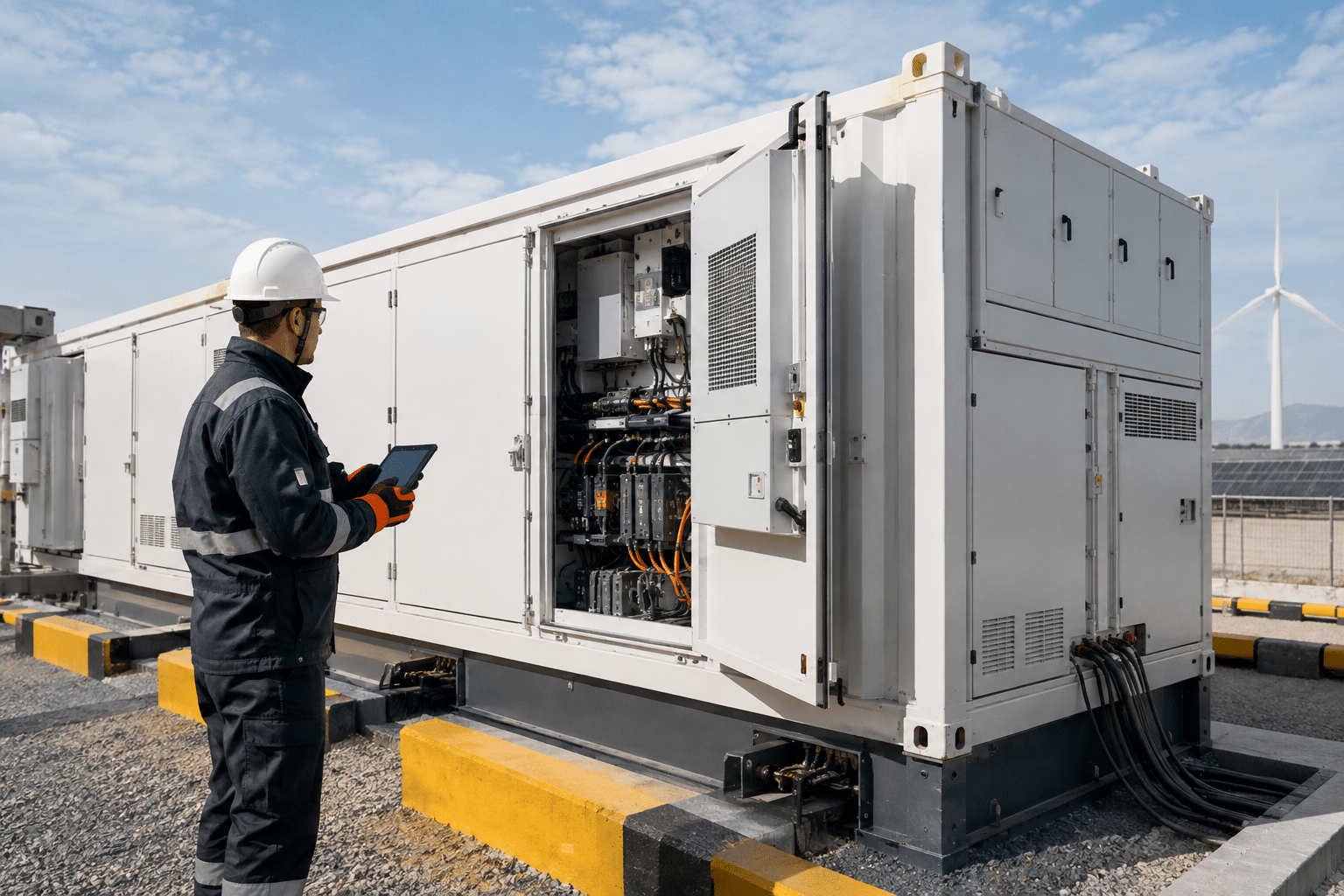
A battery storage technician works on stationary systems that store electricity for a building, utility, microgrid, or renewable-energy site. The job combines electrical testing, monitoring, maintenance, documentation, and strict emergency procedures.

What does a battery storage technician do?
- Inspect battery enclosures, racks, cabling, cooling, ventilation, and monitoring equipment.
- Review alarms, temperatures, state of charge, and system logs.
- Test connections and components under approved procedures.
- Coordinate isolation, corrective maintenance, and return-to-service checks.
- Record readings, faults, parts, and safety actions.
The equipment may use lithium-ion or another storage technology. The site design, manufacturer instructions, and employer procedures control the work. A technician should never improvise around a damaged or overheating battery.
Training and certification
Common entry backgrounds include electrical maintenance, solar, industrial controls, power systems, or data-center facilities. Training may cover DC systems, inverters, battery-management systems, thermal monitoring, networking, lockout/tagout, arc-flash awareness, and emergency response.
There is no single national battery-storage-technician license. Employers may require manufacturer training, electrical credentials, or documented experience. OSHA points workplaces toward ventilation, isolation, manufacturer instructions, and emergency planning for lithium-ion battery hazards.
Pay and job outlook
Battery storage technician is an emerging title and does not have a reliable standalone BLS wage category. Pay depends on the employer, system size, travel, electrical responsibility, shift schedule, and whether the job includes commissioning or field service. Use local postings instead of treating a solar or electrician wage as a promise.
Is this career a good fit after 35?
This work can suit a careful technician who likes electrical systems, monitoring data, and written procedures. It may involve outdoor enclosures, industrial sites, travel, on-call work, and serious fire or shock hazards. The job rewards people who stop and escalate a problem rather than trying to save time.
How to explore the field
Look for operations and maintenance openings with utilities, solar companies, battery manufacturers, microgrid contractors, and large facilities. Related paths include solar maintenance technician, substation technician, and controls technician.
What a normal week can include
Most battery storage technicians move between planned work and unexpected questions. The planned side may include inspections, readings, preventive tasks, scheduled service, or a review of records from the previous shift. The unexpected side is where judgment matters: a customer reports a problem, an alarm appears, a measurement does not match the drawing, or a component behaves differently from yesterday. Good work starts by confirming the condition before changing anything.
Because these jobs support utility-scale battery sites, commercial energy facilities, and service operations, the worker may coordinate with operators, customers, engineers, contractors, dispatchers, or a supervisor. A short, accurate handoff is often as important as the physical task. It should explain what was observed, what was tested, what was changed, and what remains open.
Tools, records, and technical judgment
The day-to-day equipment for a battery storage technician commonly includes battery modules, racks, inverters, thermal-management equipment, monitoring systems, meters, and PPE. The list changes by employer, but the habit is consistent: use the right instrument, check that it is suitable for the task, and record enough information for another person to understand the result. Temperature, state of charge, alarms, isolation status, and ventilation can all matter before a technician touches equipment.
Storage records need more than a generic alarm cleared note. Identify the rack or unit, state of charge, temperature, fault code, isolation steps, measurements, software version when relevant, and result after return to service. This detail helps engineering teams spot trends across cells, cooling equipment, controls, and operating conditions.
Training that actually helps
Relevant foundations include DC electrical safety, battery behavior, thermal management, controls, communications, and emergency procedures. Manufacturer-specific instruction is particularly important because fault codes and service limits vary. Ask who pays for required electrical or safety qualifications and whether technicians practice emergency scenarios before working alone.
Battery storage training should match the system chemistry, voltage, enclosure, controls, and fire-response plan used by the employer. Ask whether beginners monitor alarms, perform inspections, replace modules, test auxiliary systems, or support commissioning. Work inside restricted electrical or battery areas should have explicit qualification and supervision rules.
Safety and working conditions
Safety depends on the setting. A battery storage technician may face electricity, moving machinery, pressure, chemicals, heights, vehicles, weather, confined areas, or stored energy. The correct response is not to improvise. It is to follow the hazard assessment, use the required PPE, isolate equipment when required, and stop when the conditions do not match the work plan.
The job may involve containerized systems, utility sites, warehouses, rooftops, or customer facilities. Ask about shift coverage, emergency callouts, arc-flash boundaries, thermal hazards, respirators, lifting modules, and travel. Also learn the site’s evacuation and incident-reporting process before deciding whether the risk profile suits you.
Career fit after 40
This path can suit someone who brings reliability, patience, customer awareness, or practical troubleshooting from another industry. The strongest transferable skill is often not a specific tool; it is the ability to notice a change, ask a precise question, and complete the record. electrical or industrial maintenance with strong safety discipline can be learned, but it is easier when you already respect procedures and take pride in leaving a site or workstation in better condition.
The learning curve includes knowing when not to open, reset, or re-energize equipment. Treat unusual heat, odor, swelling, repeated alarms, or damaged enclosures as conditions to escalate under the site’s procedure. Calm communication and disciplined isolation are valuable strengths for a career changer, especially when an operations team is pressing for a quick restart.
Where the role can lead
With experience, a battery storage technician may move toward energy-storage specialist, commissioning technician, controls technician, or site supervisor. Advancement depends on demonstrated competence, additional education, employer structure, and sometimes a license or industry credential. Before applying, ask what the previous person in the role moved on to and whether internal training is available.
Questions to ask before applying
- What does the title mean at this company, and what tasks are outside the role?
- What equipment, software, PPE, and documentation system will I use?
- How are new workers trained and signed off for independent work?
- What are the schedule, travel, physical, and emergency expectations?
- What is the next realistic step after I become competent?