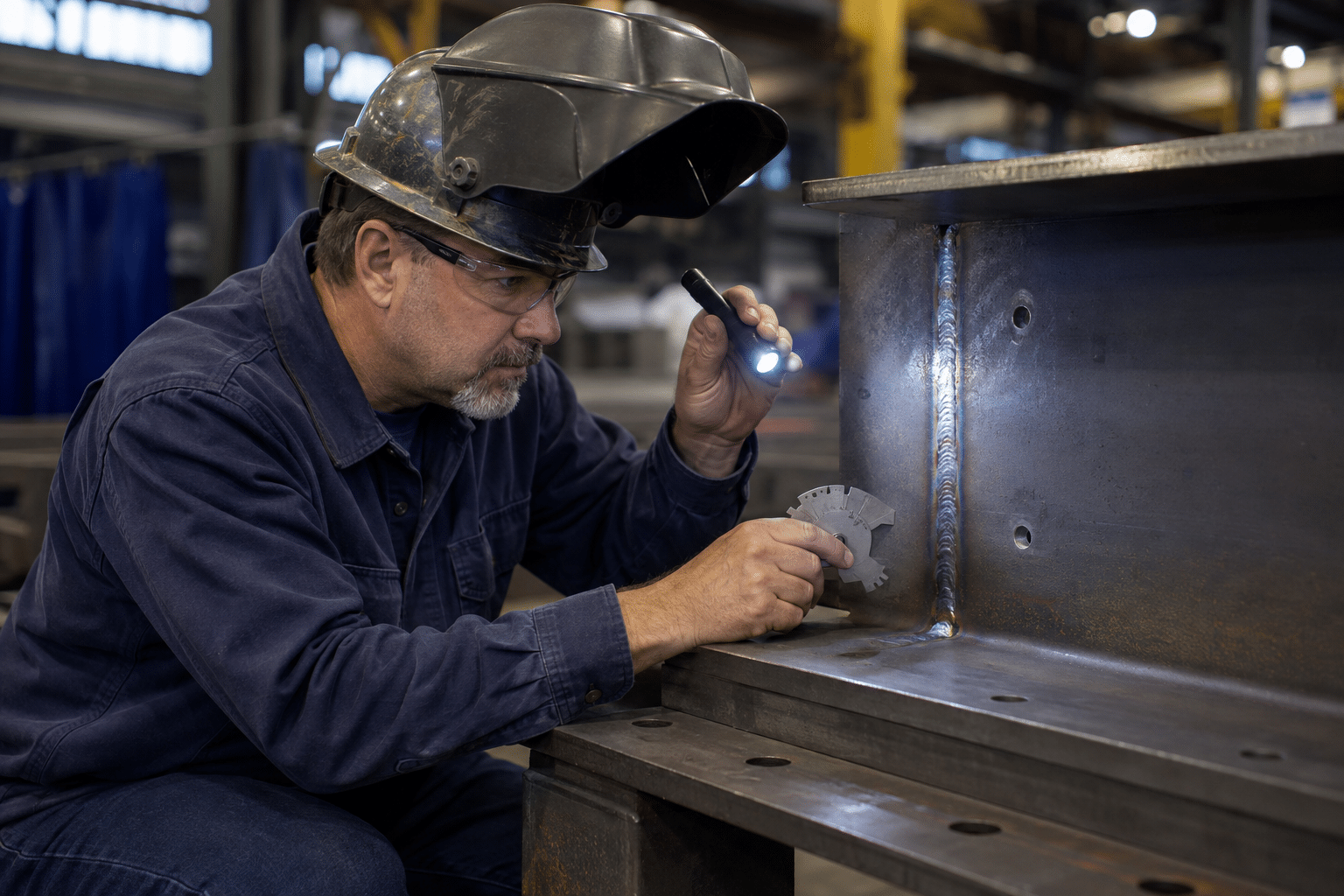
A welding inspector checks whether welded work matches the drawing, code, specification, and acceptance criteria for the job. The work may happen in a fabrication shop, on a construction site, in a plant, shipyard, or around heavy equipment. It is evidence-based work: the inspector observes the weld, reviews the records, uses the required inspection method, and documents what can be accepted or needs correction.
What does a welding inspector do?
Daily work varies by industry, but the role commonly includes:
- Reviewing drawings, welding procedures, material certificates, and inspection plans.
- Checking fit-up, joint preparation, preheat, consumables, welder qualifications, and visible weld quality.
- Using gauges, lights, measuring tools, and inspection records to document findings.
- Coordinating or reviewing nondestructive testing such as visual, dye penetrant, magnetic particle, ultrasonic, or radiographic inspection.
- Writing reports, recording nonconformances, and confirming that corrective work was completed.
- Communicating with welders, supervisors, engineers, clients, and quality teams when work does not meet the requirement.
Inspectors do not always perform the welds themselves. Still, practical welding knowledge matters because the inspector needs to recognize how joint preparation, heat, access, distortion, and repair work affect the finished result.
Training and certification
A high school diploma plus welding experience can be a realistic starting point. Technical courses in blueprint reading, shop math, metallurgy, welding processes, and inspection methods are useful. Experience as a welder, welding helper, quality technician, or fabrication lead can make the transition easier.
The American Welding Society’s Certified Welding Inspector, or CWI, is a well-known credential, but it is not an instant entry-level certificate. AWS requires a vision test and a combination of education and qualifying welding-based work experience. Depending on education, the experience requirement can range from one to five years or more.
AWS also offers the Certified Associate Welding Inspector, or CAWI, for candidates who do not yet meet the CWI experience level. Read the current AWS eligibility rules carefully before paying for a course or exam. Employer requirements can also vary by code, product, and industry.
Many inspectors build additional skills in visual inspection, weld symbols, quality systems, and nondestructive testing. Some jobs require credentials tied to a specific code or client. The certificate should match the work you want to inspect.
Pay and job outlook
Welding inspector is a specialized title, so BLS does not publish one clean national wage line for every inspector using that exact title. As a cautious comparison, BLS reported 2025 median pay of $53,750 for welders, cutters, solderers, and brazers. Inspection roles may pay more or less depending on certification, code knowledge, travel, overtime, industry, and responsibility.
The same BLS profile reports about 40,300 projected openings per year for welders and related workers from 2025 to 2035, with many openings coming from replacement needs. That is not a forecast for welding inspectors specifically, but it shows why a strong welding base can remain useful even when the inspector title is not tracked separately.
Could this career fit you after 35?
This path can work well for someone who has shop, construction, maintenance, or military experience and wants to move toward quality work. It rewards a steady eye, direct communication, and the willingness to document an unpopular finding when the evidence calls for it.
The job can be physically demanding. You may climb, crouch, work around noise and fumes, stand for long periods, or visit sites in bad weather. Some roles involve travel, shutdown work, nights, or short-term contracts. Ask how much time the position spends in the shop, how often travel occurs, and whether the employer pays for certification and continuing education.
How to prepare for the first job
- Read local inspector postings and note which codes, processes, and credentials appear repeatedly.
- Build or refresh hands-on welding knowledge through a community college or employer training program.
- Practice reading weld symbols, procedures, drawings, and inspection forms.
- Look for quality technician, fabrication quality, welding helper, or visual inspection roles.
- Compare AWS certification requirements with the actual experience you can document.
You can also compare this route with NDT technician, materials testing technician, and quality control inspector careers.
Read a welding procedure alongside the drawing
An inspector needs to connect the joint shown on the drawing with the applicable welding procedure and inspection requirements. A practice exercise can use a training drawing to identify the weld symbol, material, joint location, and information still needed before inspection. Record unanswered questions instead of supplying assumed values. The exercise tests whether you can find the basis for a decision, not simply name visible weld features.
Ask prospective employers which codes and product types their inspectors use. Structural steel, pressure equipment, pipelines, and fabricated machinery may require different experience. A preparatory course is most useful when it supports the code and qualification path requested by those employers. General welding familiarity remains useful, but it does not settle every acceptance question.
Budget for the credential you can qualify for
AWS lists different CWI experience requirements according to education. Its current table includes five years of welding-based experience for a high-school graduate, with other combinations for qualifying technical education. Read the application and employment-verification requirements before booking preparation. Paying for exam training cannot substitute for missing eligibility evidence.
Gather records while previous supervisors can still confirm your work. Ask AWS or the relevant credential provider about ambiguous experience instead of assuming a job title proves eligibility. Also budget for preparation, examinations, travel, and time away from work. An employer that supports the qualification may offer a better transition than pursuing every credential independently before securing an inspection role.
Practice a correction report that can be checked
Use a permitted classroom sample to write a short inspection record. Identify the specimen, location of the observation, measurement, applicable criterion, and requested review. A photograph should help locate the feature, while the written record explains why it matters. Avoid labeling every visible irregularity a defect before consulting the acceptance criteria.
Inspectors must also follow a repair through to its required reinspection. Ask how the company records the original finding, approved disposition, repair activity, and final result. This is a useful distinction when comparing inspection with hands-on welding: the inspector needs to maintain an evidence trail even when someone else performs the work. For career changers with shop experience, that shift in responsibility can be more significant than learning to use a gauge.
Sources
- American Welding Society: Certified Welding Inspector
- American Welding Society: Certified Associate Welding Inspector
- U.S. Bureau of Labor Statistics: Welders, Cutters, Solderers, and Brazers
- OSHA: Welding, Cutting, and Brazing
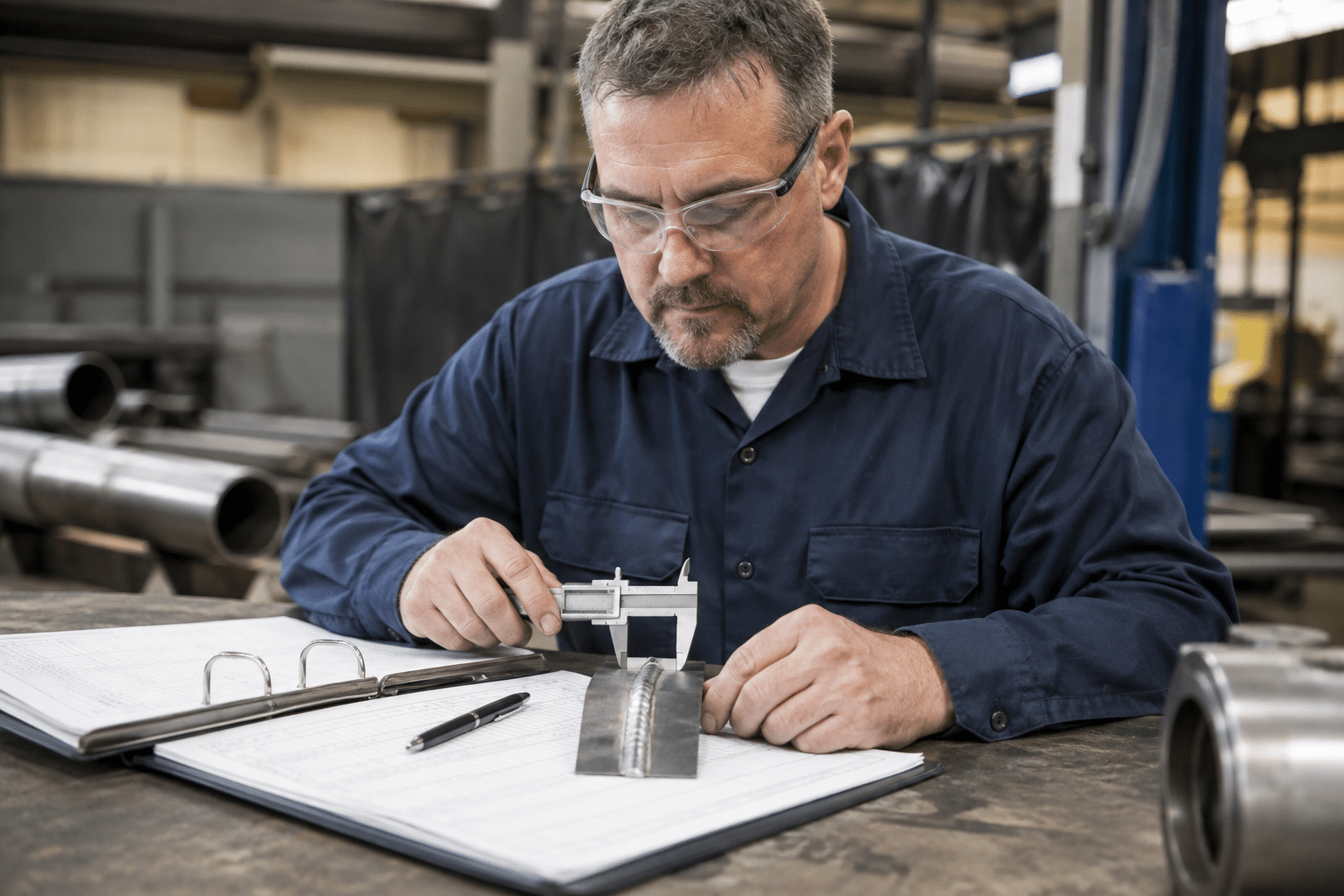
A weld can look acceptable and still need investigation: The inspector may compare the joint with the drawing, check the welder or procedure records, measure profile or discontinuities, and decide whether visual inspection is enough or another test is required. The report must separate an observed defect from a suspicion that needs further examination.