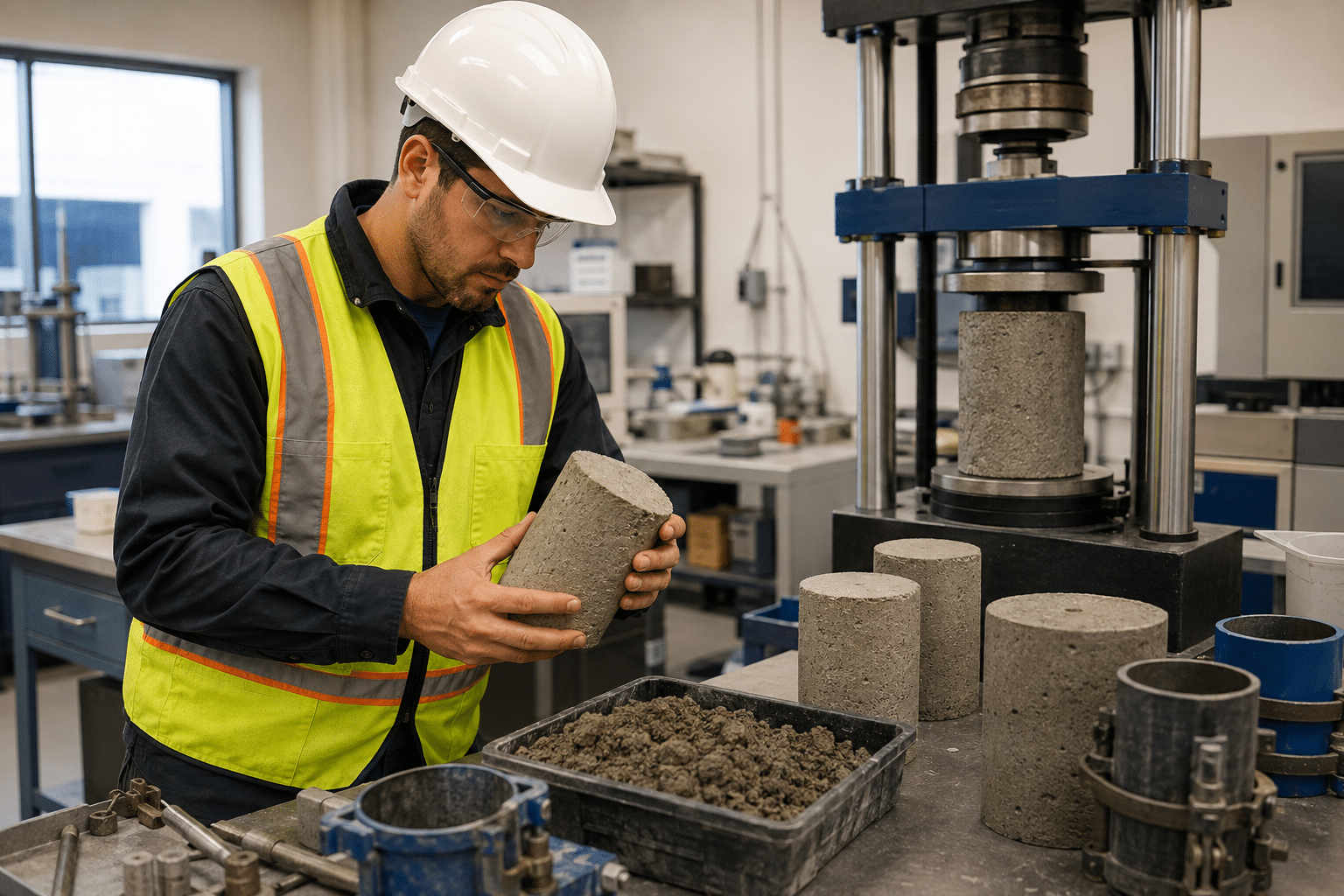
A materials testing technician measures how construction materials behave and records whether the results meet a project specification. The work may involve soil, concrete, asphalt, aggregates, or other materials in a laboratory and on active jobsites. It suits someone who likes repeatable procedures, instruments, and evidence, but the job can also mean early starts, travel, weather, and strict sample handling.
What does a materials testing technician do?
The sample and the industry determine the daily routine. Typical tasks include:
- Collecting, labeling, transporting, and preparing samples.
- Measuring density, moisture, dimensions, strength, hardness, or other properties.
- Running tests on concrete cylinders, soil, asphalt, aggregate, metals, or manufactured parts.
- Checking that equipment is calibrated and test conditions are controlled.
- Recording results in worksheets, laboratory software, and project reports.
- Notifying supervisors or engineers when a result is outside the specification.
Field technicians may test fresh concrete, compacted soil, pavement materials, or construction conditions. Laboratory technicians may spend more time preparing specimens and operating machines. Some employers combine both roles, while others separate field sampling from laboratory testing.
Training and entry requirements
Many entry-level jobs ask for a high school diploma and a willingness to learn documented procedures. An associate degree or certificate in civil engineering technology, construction technology, materials science, or laboratory work can help. Experience in construction, manufacturing, quality control, surveying, or equipment operation may also transfer.
Training is method-specific. You may learn how to take a representative sample, prepare it correctly, operate a testing machine, recognize an invalid result, and complete the required records. Some employers support certifications connected to concrete, asphalt, soil, welding, or laboratory quality systems. The correct credential depends on the material and the client, so check local job postings before buying a course.
ASTM develops standards used by laboratories and agencies involved in materials testing, inspection, calibration, and systems analysis. A technician must follow the method as written. Changing the sample size, timing, temperature, or calculation without authorization can make a result unusable.
Materials testing vs. nondestructive testing
There is overlap, but the fields are not identical. Materials testing may break a concrete cylinder, measure soil compaction, or test the strength of a metal specimen. Nondestructive testing looks for flaws without damaging the part, using methods such as ultrasound, radiography, magnetic particle, or liquid penetrant testing.
Read the equipment and method in the job description. Materials technician can mean construction quality testing, laboratory work, manufacturing inspection, or a specialized testing program.
Pay and career data
Materials testing technician is not one separate BLS occupation. The BLS profile for civil engineering technologists and technicians is a useful context for construction-related work because it includes testing materials and soil samples, site observations, and reporting. It reported 70,900 jobs in 2025 and a median annual wage of $64,950 for the broader occupation.
| Factor | What to check |
|---|---|
| Work setting | Laboratory, construction site, manufacturing plant, or a mixture |
| Materials | Concrete, soil, asphalt, aggregate, metals, plastics, or composites |
| Schedule | Standard lab hours or early site starts tied to construction |
| Credentials | Employer training and material-specific certifications |
| BLS benchmark | Civil engineering technologists and technicians: $64,950 median in 2025 |
What the work is really like
Accuracy is more important than speed. A technician may repeat a test, reject a bad sample, or stop to check equipment before releasing a result. The work can be repetitive, but it is not mindless. A small error in sampling or labeling can lead a project team to trust the wrong number.
Field work adds weather, traffic, uneven ground, dust, lifting, and early mornings. Laboratory work is cleaner but may involve standing, repetitive preparation, noise, chemicals, or heavy specimens. Ask which part of the job takes most of the week.
Could it fit after 40?
Materials testing can suit a career changer who likes practical science, measurements, written procedures, and a clear connection between a test and a construction or manufacturing decision. It can also be a bridge into quality control, civil engineering technology, inspection, or laboratory supervision.
Visit a testing laboratory if possible, or ask an employer what a new technician does during the first 90 days. Find out whether the job is mostly driving to sites, lifting samples, operating lab equipment, or entering results. That detail will tell you more about fit than the title alone.
How to tell a testing job from an inspection job
Materials testing is often confused with general site inspection because both involve checklists, samples, and reports. The distinction matters. A testing technician may prepare concrete cylinders, compact soil samples, log temperatures, run field tests, or maintain records that let an engineer decide whether material meets a project requirement. An inspector may have a broader responsibility to observe work against plans or code. Many smaller employers blur the titles, so read the duties line by line.
The best early training is hands-on and repetitive. You need to learn how a sample is labeled, protected, tested, and reported without losing the chain of information that makes the result useful. A careful technician who admits an invalid sample or unusual condition is more valuable than one who produces a neat number that cannot be trusted.
Work conditions deserve a direct question. Some jobs are based at a laboratory with scheduled testing. Others start early at construction sites, involve weather, traffic, and travel between projects. Overtime can rise during pours, paving, or major site work. That may suit someone who likes field days, but it should be part of the decision before you pay for training.
Compare postings with our guides to quality control inspector and NDT technician. The tools and industries differ, but each role depends on following a defined method and writing down what actually happened. That habit is the part of the work no quick certificate can replace.
A small error can make a result unusable, so ask how the employer trains new staff on sample handling and report review. That answer tells you whether accuracy is treated as a real responsibility or an afterthought.
Sources
- U.S. Bureau of Labor Statistics: Civil Engineering Technologists and Technicians
- ASTM International: Committee E36 scope
- ASTM International: Standards
Related reading: Quality Control Inspector, Civil Engineering Technician, and NDT Technician.

A test result is only useful when the sample is trustworthy: The technician records where and when the material was collected, follows the method, checks the equipment, and reports conditions that could affect the result. If a concrete sample is mishandled or a soil test is taken from the wrong location, a precise-looking number can still mislead the project.