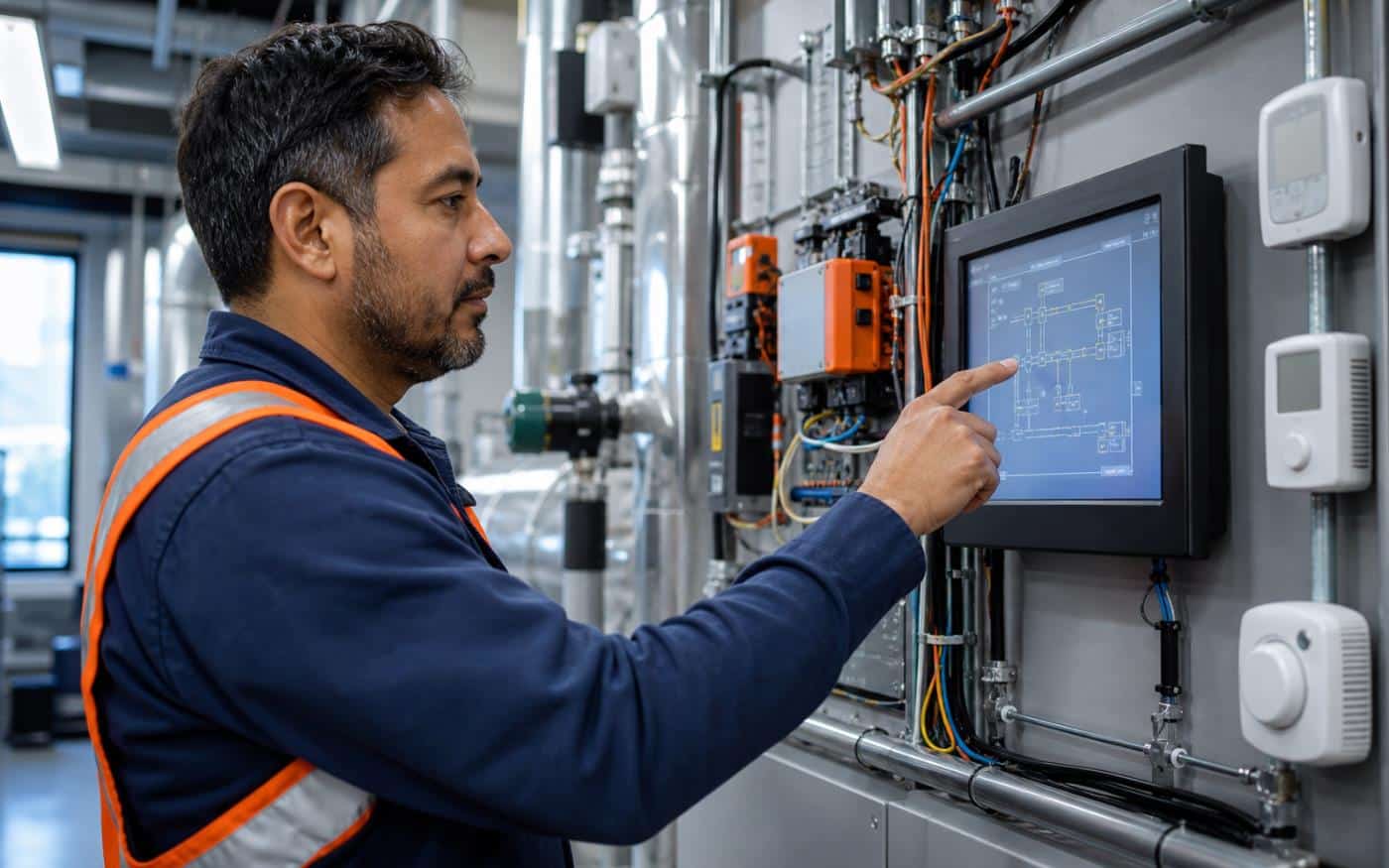
A building automation technician works on the controls that tell heating, ventilation, and other building systems when and how to operate. The job may involve sensors, controllers, networks, sequences, graphics, alarms, and trend data. It overlaps with HVAC controls, but building automation also requires understanding how multiple systems behave across a facility.
You might troubleshoot a temperature sensor in a school, commission a new air-handling unit in an office building, adjust a control sequence in a hospital, or investigate why a building management system keeps sending the same alarm. The work is technical, but it is usually tied to real equipment: fans, pumps, dampers, valves, chillers, boilers, rooftop units, and the sensors that tell those systems what to do.
The title can sound more specialized than the entry route really is. Employers use several labels, including BAS technician, building automation systems technician, HVAC controls technician, controls technician, and building controls technician. The exact job description matters more than the label.
A comfort complaint can start in the control sequence: The technician may check the sensor, schedule, setpoint, damper or valve command, equipment status, network communication, and trend history before changing the program. A quick override can hide the problem and create a larger energy or comfort issue later.
Building automation technician at a glance
| Question | Short answer |
|---|---|
| Main work | Install, test, program, troubleshoot, and service building control systems |
| Common systems | HVAC equipment, sensors, actuators, controllers, alarms, schedules, and building networks |
| Common settings | Offices, schools, hospitals, factories, campuses, data centers, and mechanical rooms |
| Useful background | HVAC, electrical work, industrial maintenance, instrumentation, networking, or facilities work |
| Typical entry route | Employer training, HVAC or controls school, apprenticeship, helper role, or technician trainee position |
| Common credentials | Employer or manufacturer training, an HVAC credential where relevant, and local licenses when the work requires them |
| Pay benchmark | The BLS HVAC occupation had a $61,010 median annual wage in May 2025. That is a proxy, not a BAS-specific salary. |
The best fit is usually someone who likes finding the reason behind a problem. A room that is too warm may have a bad sensor, a closed damper, a failed actuator, a scheduling error, a network problem, or an HVAC component that cannot deliver what the controls are asking for. Guessing is expensive. The technician has to test the system in a sensible order.
What does a building automation technician do?
The daily work changes with the employer and the building. A service technician may spend most of the day responding to alarms and customer calls. A controls contractor may spend weeks installing and commissioning a new system. A facilities department may have one technician who handles controls alongside preventive maintenance.
Common tasks include:
- Install controllers, sensors, relays, actuators, thermostats, and low-voltage control wiring.
- Check that points are labeled correctly and that the displayed value matches what is happening in the building.
- Test temperature, humidity, pressure, occupancy, airflow, and equipment status signals.
- Commission air-handling units, rooftop units, variable-air-volume boxes, pumps, boilers, chillers, and other equipment.
- Review control sequences and verify that equipment starts, stops, stages, and responds to setpoints as intended.
- Diagnose alarms, communication failures, failed sensors, stuck dampers, valve problems, and incorrect schedules.
- Use a laptop or service tool to adjust parameters, download programs, trend data, and document changes.
- Work with HVAC mechanics, electricians, engineers, building operators, vendors, and facility managers.
Some assignments are mostly screen-based. Others involve climbing a ladder to reach a sensor, opening a control panel, tracing a wire, or walking through a mechanical room to compare the software display with the physical equipment. A technician who refuses to leave the desk will miss half the evidence.
What is a BAS?
BAS means building automation system. The U.S. Department of Energy describes these systems as controls that use sensors, actuators, and programmed logic to monitor and regulate building equipment in a coordinated way. HVAC is the main application, although a building may also connect lighting, security, access, metering, or other systems.
The BAS gives people a way to see what equipment is doing and to change how it operates. A facility manager might use it to set schedules, review alarms, compare temperatures, or check whether a fan is running. A technician uses the same system to test inputs, locate faults, adjust sequences, and confirm that a repair worked.
The system is not magic. A screen can say that a fan is on when the fan is actually tripped, or a sensor can report a plausible number that is still wrong. Good troubleshooting compares the control signal, the physical device, and the measured result.
ASHRAE’s BACnet FAQ explains that BACnet is a communication protocol designed to let building control products from different manufacturers exchange information. That does not mean every BAS installation is simple or perfectly interoperable. Older equipment, vendor-specific software, incomplete drawings, and inconsistent naming can turn a small change into a careful investigation.
What happens during a normal service call?
Imagine a school reports that several classrooms are too warm in the afternoon. A BAS technician may begin by checking the schedule, current setpoints, zone temperatures, and alarms. If one zone is different from the others, the technician may compare its sensor reading, damper position, airflow, and communication status with a neighboring zone.
The next step could involve a physical inspection. Is the damper moving? Is the actuator powered? Is the air-handling unit supplying air at the expected temperature? Is a filter blocked? Is the sensor mounted in a poor location? A BAS problem and an HVAC problem can look exactly alike from a wall thermostat.
The final work includes recording what was tested and what changed. A clean service note helps the next technician avoid starting from zero. It also protects the building owner from paying for repeated guesses.
Building automation technician vs. related jobs
These roles overlap, which is why job titles can be confusing.
| Role | Center of the work | Where it overlaps with BAS |
|---|---|---|
| BAS technician | Sensors, controllers, sequences, alarms, networks, and building management software | Works directly with HVAC equipment and may perform field wiring |
| HVAC technician | Heating, cooling, refrigeration, airflow, refrigerant circuits, and mechanical repair | Tests controls and may install or troubleshoot thermostats and control boards |
| Instrumentation technician | Measurement, calibration, control loops, transmitters, and industrial process equipment | Uses similar testing and signal-tracing habits, often in plants rather than buildings |
| Electrician | Power, wiring, equipment connections, and electrical safety | May install power and control wiring, but may not program or service the BAS |
| Building operator | Daily operation, rounds, alarms, schedules, vendors, and occupant issues | Uses the BAS every day and may perform basic adjustments or first-line troubleshooting |
An HVAC technician may move into BAS because the mechanical knowledge is useful. An instrumentation technician may move into building controls because the logic and measurement work feel familiar. An electrician may be well positioned for the wiring side but still need HVAC and control-sequence training.
Our guides to HVAC apprenticeships, instrumentation technician work, and stationary engineer careers cover those neighboring paths in more detail.
How to become a building automation technician
There is no single national path that every employer follows. A realistic plan usually combines basic HVAC knowledge, electrical safety, control logic, and supervised field practice.
Route 1: Start with HVAC
Many BAS technicians come from commercial HVAC. An HVAC program can teach refrigeration and air movement, electrical fundamentals, equipment operation, and systematic troubleshooting. Those skills make it easier to understand what a control sequence is supposed to accomplish.
The BLS says HVAC technicians typically enter with a postsecondary nondegree award, although some enter with less education. Programs often last from six months to two years, followed by on-the-job training. That description applies to the broader HVAC occupation, not specifically to BAS technicians, but it is a useful starting point for planning.
If you choose this route, look for classes that include commercial equipment, electrical controls, motors, sensors, and troubleshooting. A program focused only on residential installation may leave you needing extra BAS training later.
Route 2: Take a building automation or controls certificate
Community colleges and technical schools offer certificates in building automation systems, energy management, HVAC controls, and related subjects. The useful programs include a lab, real control hardware, wiring practice, and time spent reading sequences or system diagrams.
Online lessons can explain terminology and basic logic. They cannot replace hands-on practice with a meter, controller, sensor, actuator, and actual air-side or hydronic equipment. Use online trade school as a comparison guide, then ask exactly how much equipment you will touch before enrolling.
Route 3: Enter as a helper or technician trainee
Controls contractors, HVAC companies, mechanical contractors, equipment manufacturers, and facilities departments may hire entry-level workers under titles such as controls trainee, HVAC controls helper, service technician trainee, or building automation technician I.
This route can work well for a career changer who already has practical experience. The first months may include staging materials, labeling wires, pulling cable, assisting with checkout, updating documentation, and shadowing a senior technician. That can feel slower than a short course, but it shows you how real systems are installed and repaired.
Route 4: Use an apprenticeship
Apprenticeships vary by sponsor. ApprenticeshipUSA’s occupation list includes Building Automation Technician under code 17-3023.00, but the existence of the occupation in the list does not guarantee that a program is available in your area.
Search for sponsors through Apprenticeship.gov, local HVAC and mechanical contractors, community colleges, public facilities, and union or employer associations. Ask whether the program includes BAS software, control wiring, HVAC equipment, commissioning, and paid field hours. A general electrical apprenticeship may be valuable, but it is not automatically a BAS apprenticeship.
Do you need certification or a license?
This answer depends on the work and the location.
There is no single BAS technician license that applies across the United States. A company may require manufacturer training, a controls certificate, an HVAC credential, electrical qualifications, or experience with a particular platform. State and local rules can also affect electrical work, HVAC work, or contracting activities.
EPA Section 608 certification applies to technicians who service equipment that could release regulated refrigerants. A BAS technician who only works on sensors, controllers, software, and low-voltage controls may not be doing the same work as a refrigerant service technician. Do not assume that every BAS job needs Section 608, and do not assume that a BAS title excuses anyone from the rules when refrigerant work is part of the assignment. Check the EPA Section 608 requirements and the employer’s actual job duties.
Before paying for a credential, ask three questions:
- Do the employers in my area ask for it?
- Does it teach a skill I can demonstrate in an interview?
- Does it add something beyond the training already included in my program?
Skills and tools that matter
The strongest BAS technicians are comfortable moving between several kinds of evidence.
You may need to read a wiring diagram, understand a basic HVAC sequence, use a multimeter safely, check a network connection, interpret a trend graph, and explain the problem to a building operator. You do not need to be a software developer, but you do need patience with configuration, naming, logic, and documentation.
Useful skills include:
- Basic heating, cooling, ventilation, and air-distribution concepts
- Low-voltage wiring and safe electrical testing
- Sensors, actuators, relays, controllers, and variable-frequency drives
- Control logic, setpoints, schedules, alarms, and trend data
- IP networking and communication basics
- Reading plans, points lists, sequences of operation, and equipment manuals
- Clear service notes and change tracking
- Customer communication and calm troubleshooting
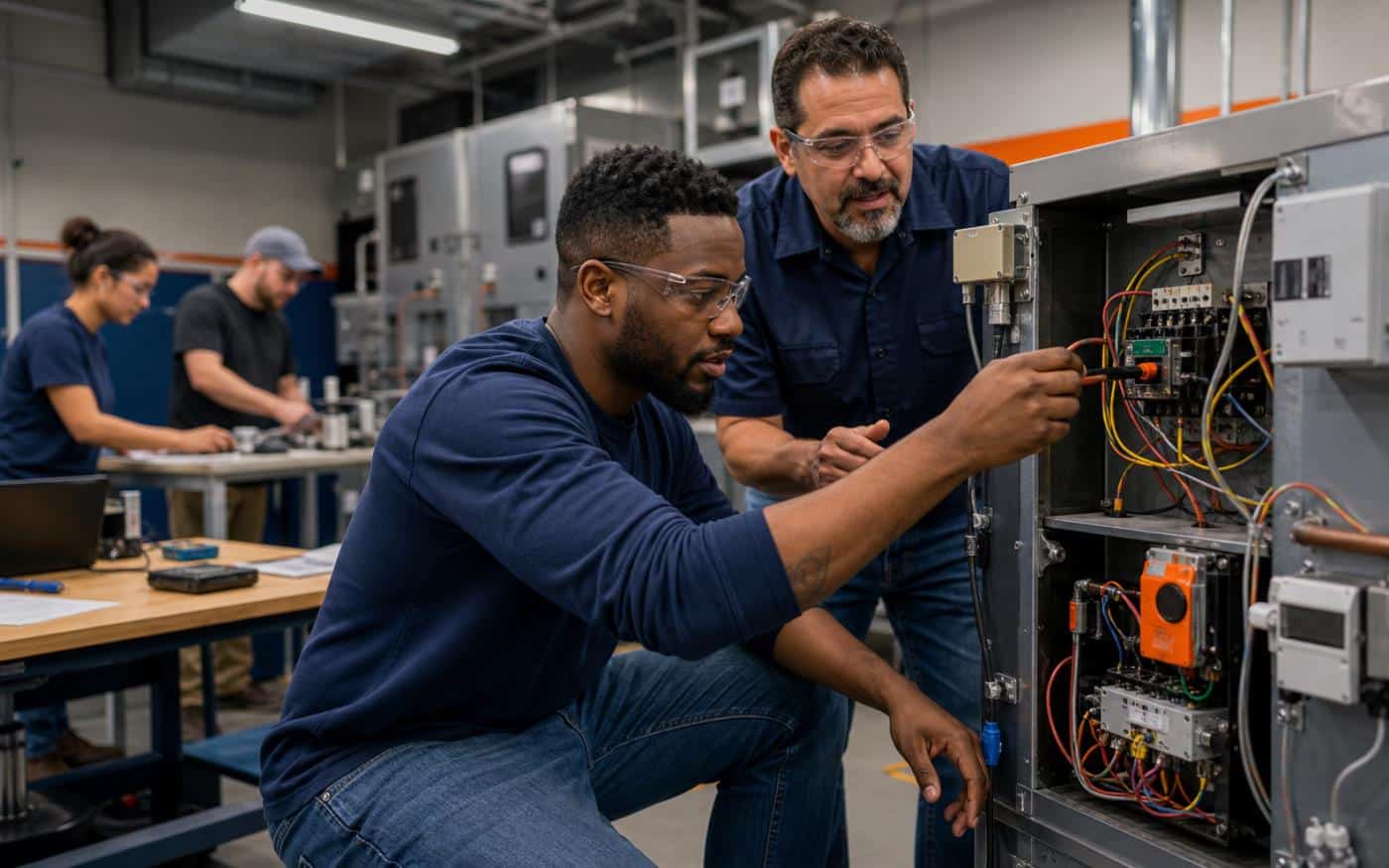
Common tools include a laptop, manufacturer software, a digital multimeter, hand tools, labels, test leads, network tools, and personal protective equipment. The tool list changes by employer. The habit of testing before replacing parts matters more than owning an impressive bag of equipment.
How much does a building automation technician make?
BAS technician is not presented as a standalone occupation in the BLS Occupational Outlook Handbook profile used for this article. That means a national BAS salary number can give a false sense of precision.
The closest broad benchmark is HVAC mechanics and installers. The BLS reported a $61,010 median annual wage in May 2025 for that occupation, with the lowest 10 percent below $40,050 and the highest 10 percent above $95,210. It also counted about 440,900 jobs in 2025 and projected 11 percent employment growth from 2025 to 2035, with about 40,600 openings per year.
Those figures include residential and commercial HVAC workers, refrigeration technicians, and other specialties. They are not a promise of what a BAS technician will earn. A controls technician’s offer can change with location, travel, commissioning responsibility, overtime, software knowledge, union coverage, industry, and whether the role includes sales or project management.
Use the BLS figure as context, then compare real local job postings. Ask whether the listed wage is hourly or salaried, whether overtime is common, whether travel time is paid, and whether on-call work is expected.
Is the work physical?
BAS work can be less physically demanding than full-time HVAC installation, but it is not a desk job by default.
You may walk large buildings, carry tools, kneel near equipment, work in mechanical rooms, climb ladders, reach above ceilings, and spend time in hot or cold areas. Construction and retrofit projects can involve dust, noise, tight spaces, and changing site conditions. Service work may require driving between buildings or responding outside normal hours.
The physical balance depends on the job. A programmer or controls engineer may spend more time at a computer. A commissioning technician may move through several floors and mechanical rooms every day. Read the job description and ask what percentage of the week is field work, travel, panel work, programming, and customer support.
Is building automation a good career change after 40?
It can be a sensible second-act option for someone who wants technical work without starting from zero. Experience in HVAC, electrical work, maintenance, construction, facilities, networking, or industrial troubleshooting can transfer.
The transition is easier when you are honest about the gap between your current skills and the target job. Someone with commercial HVAC experience may need BAS programming and networking. Someone from IT may need HVAC equipment and field safety. Someone from facilities may already understand buildings but need deeper controls practice.
Age is not the main question. The better questions are:
- Can I learn enough HVAC and controls to troubleshoot methodically?
- Am I comfortable with travel, mechanical rooms, ladders, and occasional on-call work?
- Can I document changes carefully and explain technical issues to nontechnical people?
- Will I accept a trainee or junior role while I build proof of skill?
For a broader planning framework, see our career change after 40 roadmap.
How to compare BAS training programs
Do not judge a program by the word "automation" in its title. Ask for the course list and the lab details.
Look for:
- HVAC fundamentals, not just software demonstrations
- Sensors, actuators, controllers, relays, and low-voltage wiring
- Air-handling or other real equipment for testing sequences
- Troubleshooting exercises with deliberate faults
- Network and communication basics, including how devices exchange data
- Plans, points lists, sequences, commissioning, and service documentation
- A clear explanation of tools, tuition, lab hours, and employer connections
Be cautious when a course promises a high salary after a few weeks or treats one vendor’s software as the whole field. Platforms change. The durable skills are understanding equipment, signals, control logic, testing, and communication.
How to evaluate a BAS job posting
The title alone does not tell you what you will do. Read the verbs.
"Install," "terminate," "pull cable," and "checkout" point toward field installation. "Program," "commission," "sequence," and "trend" point toward controls work. "Service," "repair," and "diagnose" suggest a troubleshooting role. "Operate," "monitor," and "respond to alarms" may describe a building operator position rather than a contractor technician role.
Ask the hiring manager:
- Which BAS platforms and communication protocols are used?
- What equipment will I work on most often?
- How much HVAC knowledge is expected on day one?
- Is training paid, and who supervises it?
- How much travel and on-call work is normal?
- Will I be doing low-voltage installation, programming, commissioning, or all three?
- Which licenses or certifications are actually required for this position?
The answers will tell you more than a generic promise about working with smart buildings.
Bottom line
A building automation technician keeps building control systems connected to the equipment they are supposed to control. The work rewards people who like practical troubleshooting, careful testing, and the mix of mechanical and digital systems.
The safest entry plan is usually grounded in real equipment. Build HVAC and electrical basics, practice with sensors and controllers, learn to read sequences, and get supervised field experience. Treat salary numbers as benchmarks rather than guarantees, and check local licensing rules before accepting work that includes regulated electrical or refrigerant tasks.
Sources
- U.S. Bureau of Labor Statistics: Heating, Air Conditioning, and Refrigeration Mechanics and Installers
- ApprenticeshipUSA: Occupations list
- U.S. Department of Energy: Building Controls
- U.S. Department of Energy: Commercial building controls and energy savings
- ASHRAE: What is BACnet?
- U.S. EPA: Section 608 Technician Certification
\n
Reviewed September 3, 2026: Building automation work may involve sensors, controls, HVAC systems, networking, commissioning, or service. Ask which systems the employer uses and compare the route with controls technician work.
\n