A millwright installs, aligns, maintains, and repairs industrial machinery. The work may involve conveyors, pumps, gearboxes, bearings, motors, shafts, rigging, vibration, and precision measurement. It is a broad mechanical trade where the quality of the setup matters: a machine can run after installation and still be misaligned, unsafe, or likely to fail early.
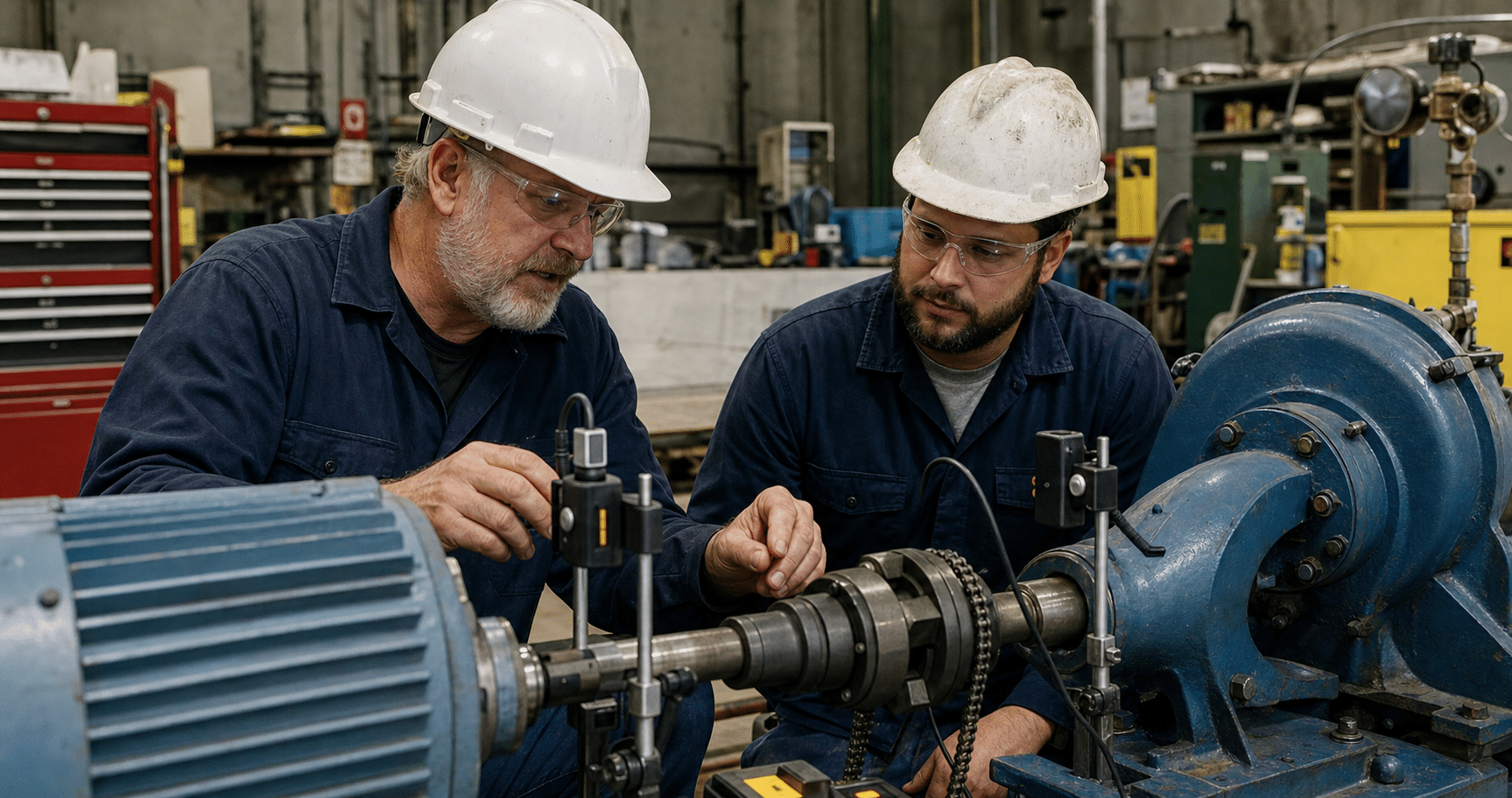
Alignment is more than getting the bolts tight: The millwright may check elevation, soft foot, shaft position, coupling condition, base movement, and manufacturer tolerances before startup. A precise record gives maintenance and reliability teams something useful to compare when the machine changes over time.
What a millwright actually does
A millwright installs, aligns, maintains, and repairs industrial machinery. The work may involve conveyors, pumps, gearboxes, bearings, motors, shafts, rigging, vibration, and precision measurement. It is a broad mechanical trade where the quality of the setup matters: a machine can run after installation and still be misaligned, unsafe, or likely to fail early.
A millwright may set a motor and pump on a base, align their shafts, install a conveyor, replace a bearing, rig a heavy component, or help commission a production line. The work sits between mechanical installation and industrial maintenance. It demands more than strength. Measurements, drawings, tolerances, planning, and a willingness to stop when something is not right all matter.
The title can be used differently by employers. One company may use millwright for machinery installation and shutdown work. Another may expect the person to handle preventive maintenance and troubleshooting too. Read the actual job description before comparing two offers.

Millwright at a glance
| Question | Short answer |
|---|---|
| What is the trade? | Installing, aligning, moving, maintaining, and repairing industrial machinery. |
| Typical starting education | High school diploma or equivalent. |
| Common entry route | Apprenticeship, employer training, or related maintenance and construction experience. |
| Important skills | Mechanical reasoning, measurement, blueprint reading, rigging awareness, troubleshooting, and patience. |
| BLS group median pay | $64,100 in May 2025 for industrial machinery mechanics, machinery maintenance workers, and millwrights. |
| Millwright-specific BLS pay | $65,700 median in May 2025 within that broader group. |
| Group outlook | 14% projected growth from 2025 to 2035, with about 51,900 openings per year. |
| Main tradeoff | Strong technical and industrial demand, but the work can involve heavy equipment, shutdowns, travel, noise, and awkward positions. |
The BLS numbers need a footnote. Its main profile combines industrial machinery mechanics, machinery maintenance workers, and millwrights. It separately reports a $65,700 median for millwrights, but the 14% growth rate and 51,900 annual openings apply to the broader group. That is a better description of the data than pretending there is a precise national forecast for every millwright job.
Millwright duties and daily work
The work changes with the project. A millwright on a new production line may spend weeks installing and aligning equipment. A millwright at a running plant may spend more time on breakdowns, inspections, and planned shutdowns.
Typical tasks include:
- reading equipment drawings, layouts, manuals, and work orders;
- unloading, positioning, and securing machinery or components;
- using hoists, jacks, rigging, and lifting plans under the site’s rules;
- setting bases, shims, anchors, rails, and supports;
- aligning shafts, couplings, motors, pumps, gearboxes, and driven equipment;
- installing conveyors, presses, fans, compressors, turbines, or production machinery;
- measuring clearances, vibration, level, runout, and other mechanical conditions;
- replacing bearings, belts, seals, couplings, rollers, and worn components;
- performing preventive maintenance and helping diagnose failures;
- coordinating with electricians, welders, operators, engineers, and supervisors; and
- documenting what changed, what was measured, and what the next crew needs to know.
Some of these tasks overlap with industrial maintenance. The difference is often the emphasis. Millwright work tends to include machinery installation, movement, precision alignment, and major shutdown projects. Maintenance mechanics may spend more of the week keeping operating equipment available. At smaller plants, one person may do both.
Precision matters more than brute force
Heavy machinery gets attention because it is visible. The quiet part of the job is the measurement.
A motor and pump can look correctly installed and still fail early if the shafts are misaligned. A conveyor can be mounted but track poorly. A gearbox can run but transfer vibration into the rest of the line. Millwrights use levels, straightedges, dial indicators, feeler gauges, torque tools, laser alignment equipment, and other instruments to find problems that are too small to see.
That is why employers value workers who can read a measurement, record it, make a controlled adjustment, and check the result. Hurrying a setup can create a larger repair later. The best work often looks uneventful when it is finished.
Millwright versus related trades
Millwright and industrial maintenance mechanic
There is a large overlap. An industrial maintenance mechanic may inspect, lubricate, repair, and troubleshoot production equipment. A millwright may do those things as well, with more emphasis on installation, rigging, alignment, and machinery moves. Ask whether a position is mainly maintenance, construction, shutdown work, or a mixture.
Our guide to industrial maintenance technician careers covers the broader maintenance path and its focus on keeping plant equipment available.
Millwright and machinist
Machinists make or modify parts with machine tools. Millwrights install and maintain the machinery that a plant uses. A millwright may use machining skills or work with a machinist during a repair, but the two jobs usually have different daily settings.
If you are comparing the paths, see our machinist apprenticeship guide. It focuses on precision manufacturing rather than industrial machinery installation.
Millwright and electrician
Millwrights work with motors, sensors, and equipment that may connect to electrical systems, but they are not automatically electricians. Electrical installation, testing, and licensing responsibilities depend on the job and the jurisdiction. A plant may assign the mechanical setup to a millwright and the power connections to an industrial electrician.
Millwright and welder
Welding can be part of some millwright work, especially during fabrication or field modification. It is not the whole trade. A millwright may need to fit, bolt, align, rig, and test equipment without doing any welding on a given shift.
Where millwrights work
Manufacturing is the largest setting in the BLS profile, but millwrights also work for machinery repair contractors, construction companies, utilities, food and beverage plants, paper mills, steel facilities, power generation sites, distribution operations, and other industrial employers.
The workplace affects the schedule. A plant employee may work rotating shifts or respond to breakdowns. A contractor may travel between facilities and work long hours during planned shutdowns. A new construction project may have a more predictable daytime schedule until the deadline approaches.
Ask whether the job is permanent plant maintenance, industrial construction, field service, or shutdown work. These can share a title and have very different lifestyles.
How to become a millwright
There is no single national license that every millwright must hold. The most common routes are apprenticeship, employer training, or a related trade followed by millwright work.
Apprenticeship
The BLS says most millwrights go through an apprenticeship that may last up to four years. Apprentices learn on the job and may complete related instruction in safety, mechanical systems, rigging, blueprint reading, welding, hydraulics, pneumatics, and precision measurement.
Registered apprenticeship listings can be searched through Apprenticeship.gov. Programs differ by sponsor, location, wage progression, classroom schedule, and the equipment apprentices actually touch.
Before applying, ask whether the program is paid from the first day, how raises work, how much classroom time is required, what tools are provided, and whether the work is plant maintenance, industrial construction, or both. A program’s name matters less than its written training plan.
Employer training
Some employers hire helpers, maintenance trainees, or mechanical installers and teach the company’s methods internally. This route can work well if you already have experience with tools, equipment moves, construction, maintenance, or production machinery.
Do not assume that “training provided” means a structured apprenticeship. Ask who teaches you, how competency is checked, whether you receive documented hours, and what role you can reach after the first year.
Related experience
People coming from industrial maintenance, HVAC, heavy equipment, plumbing, welding, pipefitting, construction, or machinery operation may have useful skills. Mechanical awareness transfers better than a job title does. The gaps may be rigging, precision alignment, drawings, and the employer’s procedures for isolating equipment before work begins.
Training and tools that matter
A beginner does not need every specialty before the first job. A useful foundation includes:
- shop math, fractions, measurements, tolerances, and unit conversion;
- mechanical drawings, equipment manuals, and simple layouts;
- bearings, shafts, couplings, gears, belts, chains, pumps, and motors;
- basic hydraulics and pneumatics;
- rigging awareness, load paths, lift planning, and communication;
- precision alignment and the use of measurement tools;
- torque, fasteners, shims, bases, anchors, and grouting;
- safe tool use and the site’s equipment-isolation procedures; and
- clear maintenance notes and shift handoffs.
Training should include practice. A certificate that never lets you handle a tool, read a drawing, or measure an assembly may help with vocabulary, but it cannot show whether you enjoy the work. Our online trade school comparison can help you evaluate lab access, employer recognition, schedule, and cost.
Millwright salary and job outlook
The BLS reports a May 2025 median annual wage of $64,100 for the combined occupation of industrial machinery mechanics, machinery maintenance workers, and millwrights. Within that group, the reported median for millwrights was $65,700. The lowest 10 percent of the combined group earned less than $45,760, while the highest 10 percent earned more than $94,530.
The BLS also reports 40,700 millwright jobs within the 547,300 jobs in the combined group in 2025. It projects 14% growth for the combined occupation from 2025 to 2035 and about 51,900 openings per year. Those figures include industrial machinery mechanics and machinery maintenance workers, so use them as a market signal rather than a millwright-specific guarantee.
Offers vary with plant type, union coverage, shift premiums, overtime, travel, shutdown work, and whether you are hired by a plant or a contractor. A job with a high hourly rate may also expect extended shutdowns, overnight travel, or on-call response. Compare the schedule and pay progression, not just the top number in a job ad.
The physical side of millwright work
Millwrights may lift, push, pull, climb, kneel, reach, work in awkward positions, and spend time around noisy machinery. Some jobs take place in hot plants, cold structures, dusty areas, cramped spaces, or active construction zones. Shutdown work can compress many hours into a short window.
The physical demands are not identical at every employer. A precision alignment role inside a clean facility feels different from a field service job that moves large equipment between sites. Ask what a normal week looks like and what the hardest recurring task is.
The safety culture deserves direct questions. Find out how new workers are trained, who approves lifts, how equipment is isolated, what protective equipment is provided, and whether production pressure changes the expected pace. A good employer can explain the process without pretending the job has no hazards.
Is millwright work a good second-act career?
Millwright work can fit someone who enjoys machines, physical problem-solving, and visible results. It also offers several directions: plant maintenance, industrial construction, field service, shutdown work, alignment, supervision, or a broader maintenance role.
It is a weaker fit if you want a fixed desk schedule, little travel, or work that rarely requires kneeling and lifting. The apprenticeship can take years, and the first stage may involve helper tasks before you get the most technical assignments.
For a career change after 40, related experience may help, but age does not remove the learning curve. Visit a shop or plant if you can. Watch how workers communicate around a lift, how long setup takes, and whether the environment feels tolerable for a full shift. Our career-change-at-40 roadmap is a useful companion for comparing the trade with other technical paths.
Questions to ask before accepting a millwright job
| Topic | Question to ask |
|---|---|
| Work type | Is the job plant maintenance, industrial construction, field service, shutdown work, or a mix? |
| Training | Is there a registered apprenticeship or a documented employer training plan? |
| Daily tasks | How much time goes to alignment, rigging, repairs, fabrication, paperwork, and cleanup? |
| Schedule | Are nights, weekends, overtime, shutdowns, or on-call response normal? |
| Travel | How often do crews travel, and are mileage, lodging, or per diem covered? |
| Scope | Which tasks belong to the millwright, electrician, welder, machinist, or operator? |
| Tools | What tools and protective equipment does the employer provide? |
| Advancement | What can a worker move into after completing the apprenticeship or first qualification? |
The answers will tell you more than the job title. Two millwright jobs can share a name and lead to very different lives.
Bottom line
Millwright is a serious mechanical trade for people who like equipment, measurement, and hands-on problem-solving. The BLS data show a solid market for the broader industrial machinery group, and the millwright-specific pay figure is useful, but neither replaces a local job search.
Start by comparing apprenticeships, trainee jobs, and related maintenance openings. Read the training plan. Ask about the hardest part of the schedule. Then decide whether you want to build machines, maintain them, travel for shutdowns, or move toward a different technical trade.
Sources
- U.S. Bureau of Labor Statistics: Industrial Machinery Mechanics, Machinery Maintenance Workers, and Millwrights
- Apprenticeship.gov: Apprenticeship Finder
- UBC Millwrights: Millwright Qualification Programs
\n
Reviewed September 3, 2026: Millwright work changes by plant, equipment, shutdown schedule, rigging needs, and maintenance team. Check the apprenticeship and physical requirements before choosing the trade. Compare it with maintenance mechanic work.
\n