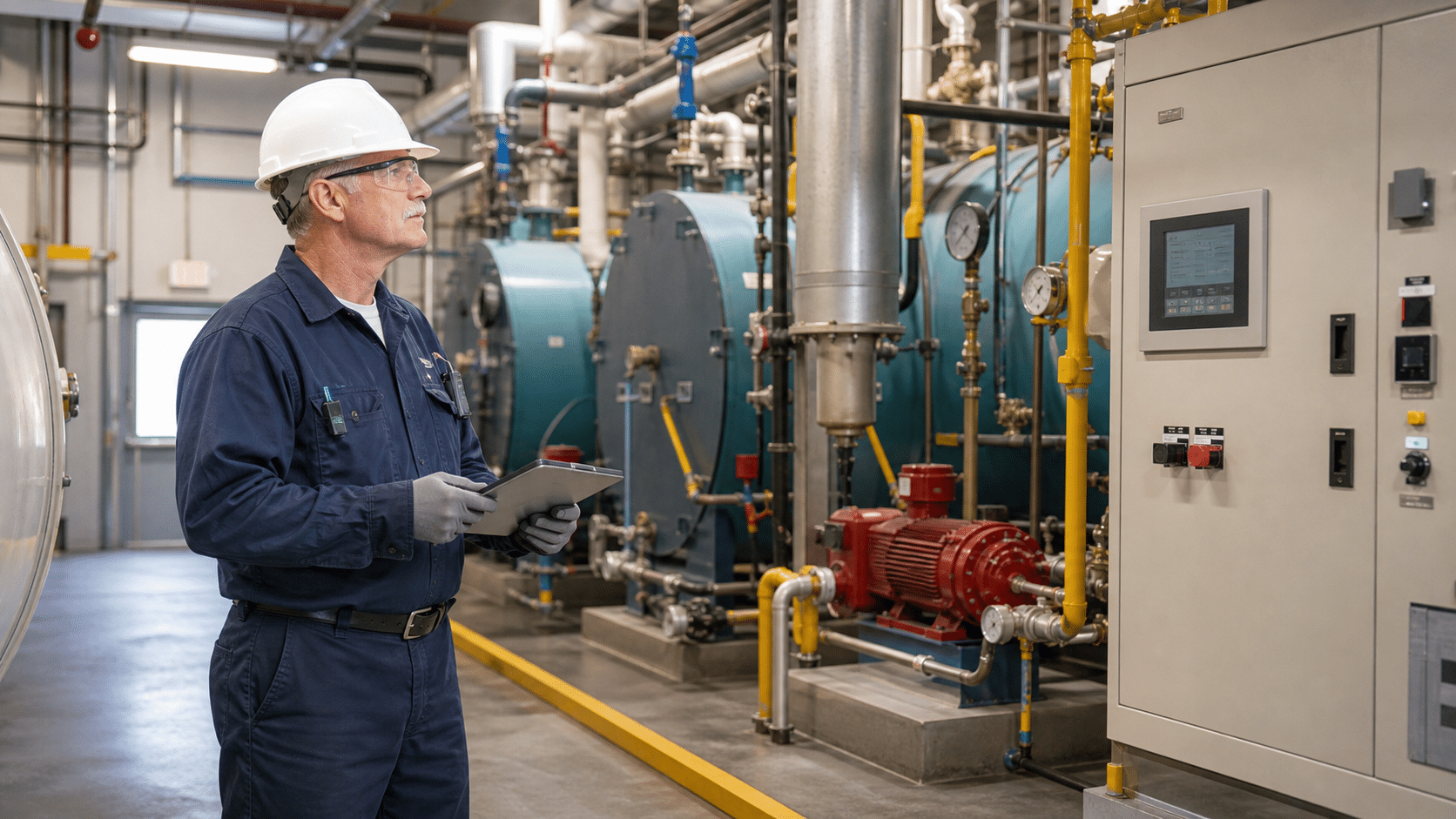
A stationary engineer operates and maintains the mechanical systems that keep a large building, plant, campus, or facility working. The job can involve boilers, chillers, pumps, compressors, generators, turbines, heating and cooling controls, and water or fuel systems. The title sounds like an engineering degree, but the work is generally hands-on and may require local licenses or shift coverage.
The title sounds like an engineering degree, but the occupation is generally hands-on operations and maintenance. The U.S. Bureau of Labor Statistics (BLS) groups stationary engineers with boiler operators. Most people enter with a high school diploma or equivalent and learn through long-term on-the-job training or an apprenticeship.
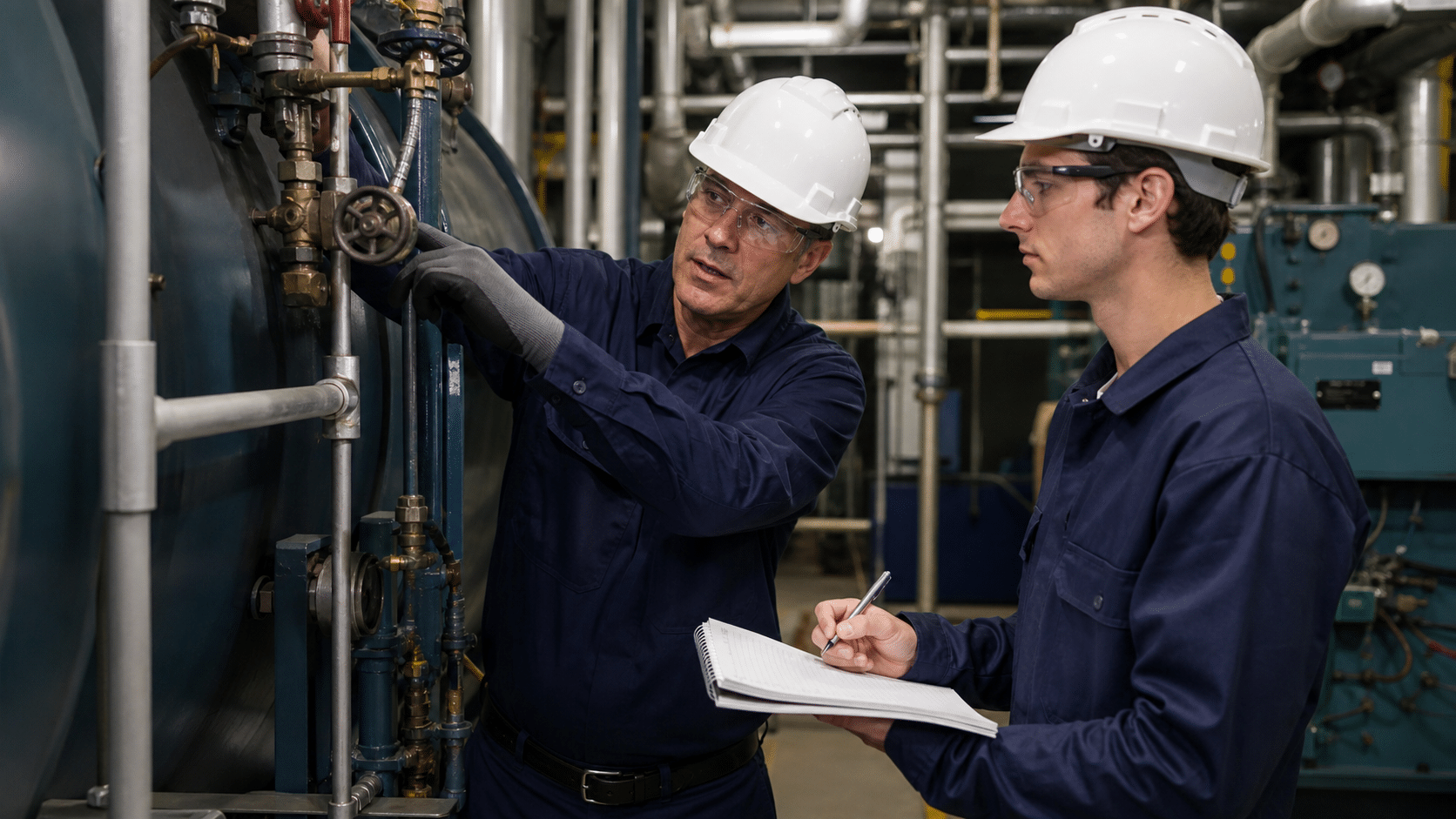
Facility systems interact: A chiller problem may affect temperature, water flow, electrical demand, alarms, and the schedule of other equipment. The stationary engineer checks the operating condition and trend, follows the plant procedure, and records the response instead of treating each alarm as an isolated event.
What does a stationary engineer do?
The daily work is built around operating equipment safely, watching system conditions, and fixing problems before they become an outage. A stationary engineer may work from a mechanical room, boiler room, control panel, or building-management system and then walk the facility to inspect equipment.
Typical duties include:
- operating engines, boilers, chillers, pumps, compressors, and auxiliary equipment;
- reading gauges, meters, charts, and computerized controls;
- monitoring pressure, temperature, water, chemical, and fuel levels;
- opening or closing valves to change flows;
- starting up, regulating, and shutting down equipment;
- checking safety devices and alarms;
- lubricating moving parts and replacing filters;
- repairing or replacing valves, gaskets, bearings, and other components;
- keeping operation, maintenance, and safety logs.
The exact mix depends on the facility. A hospital may prioritize steam, heating, cooling, and backup systems. A manufacturing plant may use boilers, compressors, process utilities, and large pumps. An office building may place more emphasis on HVAC, chillers, generators, and a building-management system.
Stationary engineer versus similar jobs
Job titles overlap, so the duties matter more than the label. A stationary engineer is usually responsible for equipment that stays in one facility rather than traveling from site to site to install or repair systems.
| Role | Main focus | Typical difference |
|---|---|---|
| Stationary engineer | Operate and maintain building or plant utility systems | Equipment remains at one facility |
| Boiler operator | Monitor and operate boilers and related systems | May have a narrower equipment assignment |
| Power plant operator | Control equipment that generates electricity | Focuses on generation and plant output |
| HVAC technician | Install, service, or repair heating and cooling systems | Often travels between customer sites |
| Industrial maintenance technician | Repair a broad range of production machinery | More focused on manufacturing equipment |
Our power plant operator guide covers generation and control-room work. The industrial maintenance technician guide is a better comparison if you want varied factory-equipment repair rather than facility utilities.
Where stationary engineers work
Stationary engineers and boiler operators work in places that need reliable heat, cooling, steam, pressure, or mechanical utilities. The BLS lists hospitals, educational services, manufacturing, local government, and traveler accommodation among the largest employers.
The setting can be a hospital basement, a university central plant, a hotel mechanical room, a factory, a municipal facility, or a large commercial building. Some workers stay at one property. Others are part of a facilities team that covers several buildings on a campus.
The control area may be clean and organized, but the equipment spaces can be hot, dusty, greasy, and loud. Maintenance may require standing for long periods, kneeling, crouching, or crawling inside a boiler or other restricted area. Workers may handle tools, filters, valves, and parts while following strict energy-isolation and entry procedures.
What is the schedule like?
Some facilities operate during ordinary business hours. Others cannot stop. Hospitals, campuses, hotels, factories, and large buildings may need engineers on site at night, on weekends, and on holidays.
The BLS describes schedules that can include three rotating eight-hour shifts or two rotating twelve-hour shifts. The actual pattern depends on the employer. Ask whether the schedule is fixed, rotating, or tied to a relief pool. Also ask about emergency call-ins, overtime, shift differentials, and the number of people on each shift.
Shift work is part of the career fit. A worker who likes routine monitoring and an established facility may appreciate the stability. Someone who needs predictable daytime hours may find a 24-hour operation difficult even if the wage is attractive.
Education and entry requirements
The usual entry-level education is a high school diploma or equivalent. Courses in math, science, mechanical systems, electricity, HVAC, or technical drawing can help, but a four-year college degree is not the normal entry requirement for this occupation.
Employers may prefer candidates with experience in building maintenance, HVAC, industrial maintenance, plumbing, electrical work, the military, or facilities operations. Useful habits include reading gauges carefully, documenting changes, following procedures, using tools correctly, and communicating a developing problem to the next shift.
Some employers hire assistants or helpers and train them internally. Others prefer a completed apprenticeship or a worker who already holds a local license. Read the posting closely because the same title can mean a trainee role in one city and a senior operating position in another.
How training works
Stationary engineers and boiler operators usually learn through long-term on-the-job training under an experienced engineer or operator. The BLS describes a progression from basic monitoring of temperatures and pressures to more complicated work such as high-pressure boiler repairs.
Some apprenticeships last about four years, include roughly 8,000 hours of on-the-job training, and require about 600 hours of technical instruction. The training can cover equipment operation, maintenance, HVAC controls, safety, electricity, and air quality. That is a BLS example of apprenticeship structure, not a promise that every sponsor uses the same hours.
Before accepting a training position, ask:
- what equipment you will learn to operate;
- how long you remain under direct supervision;
- whether classroom hours are paid;
- how progress is tested and recorded;
- which license class the training supports;
- whether the employer pays for exams, tools, and protective equipment;
- what happens after the trainee or apprentice period ends.
The HVAC technician salary guide provides a useful comparison for people more interested in mobile heating and cooling service. Stationary work can include HVAC systems, but it also adds boilers, pumps, compressors, utilities, and facility-wide operations.
Licenses and exams
Licensing is one of the most important local variables. Some states and cities require stationary engineers or boiler operators to hold a license before operating certain equipment without supervision. License classes may limit the size or type of boiler and facility a worker can run.
Applicants may need documented experience, technical education, and a written exam. Some employers also administer their own competency test. A license from one city or state may not transfer automatically to another jurisdiction.
Ask the employer or licensing authority:
- Is a license required for this exact facility and equipment?
- What class or grade applies to the position?
- Can a trainee work under a licensed engineer?
- Which hours or tasks count toward the next license level?
- Is a written, practical, medical, or background examination required?
- Does the employer pay renewal and continuing-education costs?
Do not assume that the word engineer in the job title means a professional engineering license. Stationary-engineer licensing and professional-engineer registration are different paths with different purposes.
Stationary engineer salary
The BLS reported a median annual wage of $78,620 in May 2025 for stationary engineers and boiler operators. The approximate hourly equivalent is $37.80. The lowest 10 percent earned less than $50,590, while the highest 10 percent earned more than $125,390.
| BLS measure | May 2025 figure |
|---|---|
| Median annual wage | $78,620 |
| Approximate hourly equivalent | $37.80 |
| Lowest 10 percent | Less than $50,590 |
| Highest 10 percent | More than $125,390 |
These figures describe the occupation, not a guaranteed trainee wage. Pay can change with license class, facility size, shift premiums, overtime, industry, union agreement, and responsibility for a full mechanical plant.
The BLS reports these industry medians for May 2025:
| Industry | Median annual wage |
|---|---|
| Local government, excluding education and hospitals | $105,500 |
| Hospitals | $80,800 |
| Manufacturing | $74,130 |
| Educational services | $72,920 |
| Traveler accommodation | $55,220 |
An industry median is not a salary promise. A local government job may require a higher license class. A hospital job may include shift work and emergency coverage. A hotel position may have a different range and responsibility level from a large central plant.
Job outlook
The BLS projects employment for stationary engineers and boiler operators to grow 3 percent from 2025 to 2035, about as fast as the average for all occupations. It projects about 3,200 openings per year, on average, over the decade.
Many openings are expected to come from workers retiring or moving to other occupations. The work also remains tied to equipment that needs routine inspection, maintenance, and safe operation. More efficient systems and computerized controls may change the job, but they do not remove the need for people who can understand the equipment and respond when conditions move outside normal limits.
The outlook varies by facility and region. A hospital, university, manufacturing site, or municipal plant may have different hiring needs. Check local postings and licensing rules rather than treating the national projection as a guarantee of employment nearby.
Safety and physical demands
Stationary-engineer work is safety-sensitive. The BLS identifies risks including burns, electric shock, noise, moving parts, and hazardous materials. Boiler rooms and mechanical rooms can expose workers to heat, dirt, oil, grease, and smoke.
Daily safety may include checking pressure and temperature limits, inspecting safety devices, following lockout/tagout procedures, using protective equipment, and keeping accurate logs. Confined-space work or boiler entry requires additional controls and should never be treated as a casual inspection.
The job can be physically demanding in less obvious ways. A worker may spend hours on their feet, climb stairs, crouch near equipment, crawl into restricted areas, or work in a hot room while handling tools. Ask to see the actual job description and facility conditions before deciding that a role is a good fit.
Is this a good second career after 40?
It can fit someone who enjoys mechanical systems, practical troubleshooting, and a stable worksite. Experience in maintenance, HVAC, plumbing, electrical work, manufacturing, or the military can help with tools, procedures, and equipment vocabulary.
The transition still takes time. You may start under supervision, work nights or weekends, and need to build hours before qualifying for a higher license class. The most attractive salary figures often belong to experienced workers with responsibility for larger equipment, not to a first-year trainee.
Before applying, compare the schedule and license path with your household needs. Ask how often the plant has emergencies, how much of the job is preventive maintenance versus repair, and whether the employer invests in training. If you prefer electrical systems and plant controls, our industrial electrician guide may be a closer match. If you prefer a generation facility and control-room operations, read the power plant operator guide.
Questions to ask before accepting a position
Use these questions to make the posting concrete:
- Which boilers, chillers, pumps, compressors, generators, and controls will I operate?
- Is this a trainee, assistant, licensed, or senior stationary-engineer position?
- What license class is required now and after training?
- What is the shift schedule, including nights, weekends, holidays, and call-ins?
- What training hours are paid, and how is competency measured?
- Does the employer pay for licensing exams, renewals, tools, and protective equipment?
- What are the hottest, loudest, or most confined areas of the facility?
- How many workers cover each shift?
- Which parts of the compensation depend on overtime or shift differentials?
- What advancement follows the first license or qualification?
These answers are more useful than the title alone, especially because local rules and facility size can change the job substantially.
Bottom line
A stationary engineer operates and maintains the equipment that provides heat, cooling, steam, pressure, power, or other utilities to a building or industrial facility. The normal entry route is a high school diploma or equivalent followed by long-term supervised training or an apprenticeship. Local licensing can determine which equipment you may operate independently.
The BLS reports a median wage of $78,620 in May 2025, 3 percent projected growth from 2025 to 2035, and about 3,200 annual openings. The strongest fit is someone who can monitor systems carefully, work safely around high-energy equipment, accept the schedule, and keep learning as the facility changes.
Sources
- U.S. Bureau of Labor Statistics: Stationary Engineers and Boiler Operators
- International Union of Operating Engineers: Stationary Engineers
- CareerOneStop: Stationary Engineers and Boiler Operators
\n
Reviewed September 3, 2026: Stationary engineer duties depend on the building or plant and may include boilers, chillers, pumps, controls, and shift coverage. Check local license rules and the actual equipment before choosing training. Compare the role with HVAC technician work.