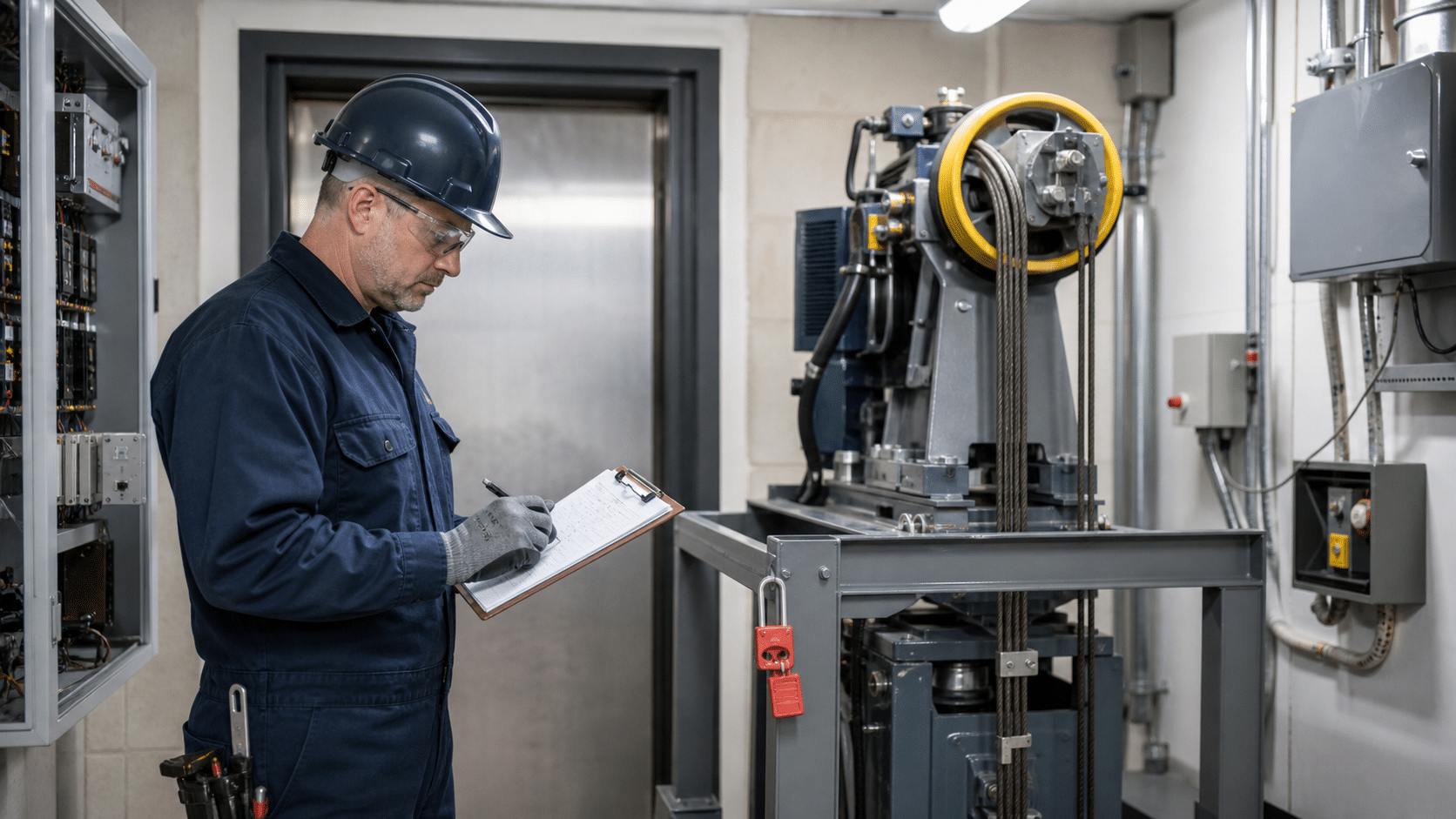
Elevator mechanic salary figures depend on more than the job title. Experience, employer, location, licensing, overtime, union coverage, and the kind of elevator or escalator work all affect pay. The BLS national benchmark is useful for context, but it does not predict the first offer, the training wage, or the income possible after a mechanic gains experience and a strong service territory.
The strongest national benchmark comes from the U.S. Bureau of Labor Statistics (BLS) occupation called elevator and escalator installers and repairers. The BLS reports a median annual wage of $109,910 in May 2025, or about $52.84 per hour when expressed as an hourly equivalent. That is a benchmark for the broader, fully employed occupation. It is not a guaranteed starting wage for an apprentice or a promise from every elevator contractor.

Compare the pay structure, not only the headline: Ask about apprenticeship wages, overtime, on-call work, travel, union benefits, licensing, and when raises occur. A job with a lower starting rate may include supervised training and a clear progression that changes the long-term picture.
The latest elevator mechanic salary benchmark
The BLS groups installation, maintenance, repair, and related elevator and escalator work in one occupation. Its May 2025 wage distribution gives a useful national reference:
| BLS measure | May 2025 figure |
|---|---|
| Median annual wage | $109,910 |
| Approximate median hourly equivalent | $52.84 |
| Lowest 10 percent | Less than $59,270 |
| Highest 10 percent | More than $158,890 |
The median is the midpoint: half of workers in the occupation earned more and half earned less. It is more useful than a headline maximum when you are evaluating a career, but it still does not describe one specific job offer.
The figures include workers with different levels of experience, responsibilities, schedules, and local labor-market conditions. They also include more than one job title. An employer may advertise for an elevator mechanic, elevator constructor, elevator technician, elevator installer, or service mechanic while the official labor data use a broader occupation.
Does an apprentice earn the full salary?
No. An apprentice normally starts below the fully trained occupation’s median. The BLS says apprentice starting pay is usually about 50 percent of what fully trained workers make, with increases as the apprentice advances through the program.
That statement is a general guide, not a universal wage schedule. A sponsor may set a starting percentage, scheduled raises, benefits, classroom rules, and progression requirements. Union and employer programs can use different agreements. Some jobs also have waiting periods, probationary rates, travel rules, or separate classifications.
If you are comparing an apprenticeship, ask for the written progression:
- starting hourly wage;
- date or milestone for each increase;
- maximum apprentice rate;
- health, retirement, and other benefits;
- overtime and emergency-callout rules;
- expected classroom hours and whether they are paid;
- wage and classification after successful completion.
Our elevator installer apprenticeship guide explains why the training route and the occupation-wide wage benchmark should be treated as related but separate questions.
Salary by industry
The BLS reports different median wages by industry for this occupation. In May 2025, the published figures included:
| Industry | Median annual wage |
|---|---|
| Government, excluding education and hospitals | $116,480 |
| Building equipment contractors | $113,290 |
| Educational services | $98,300 |
These numbers do not mean that government jobs always pay more or that every contractor offer will be close to $113,290. They are industry-level medians across the occupation. The actual offer can change with local bargaining, job classification, overtime, travel, and the amount of specialized work available.
The employer type can also change the rhythm of the job. A service contractor may schedule preventive maintenance and emergency repairs. A construction or modernization contractor may follow project timelines and travel between sites. A public employer may have a different pay scale, benefits structure, and promotion process.
What experience changes
Experience matters because an elevator mechanic is not paid only for handling tools. With training and supervised practice, a worker may become responsible for troubleshooting, testing, documentation, customer communication, code-sensitive work, and decisions that affect safety and equipment uptime.
Early-career work often involves assisting a mechanic, preparing equipment, learning procedures, carrying parts, recording measurements, and completing technical instruction. Later responsibilities may include:
- diagnosing electrical, mechanical, hydraulic, and control problems;
- adjusting doors, brakes, switches, motors, drives, and safety devices;
- performing preventive maintenance;
- replacing worn or obsolete components;
- testing equipment after repair or modernization;
- documenting work for the employer, owner, or inspector;
- coordinating with building staff and other trades.
Not every worker performs every task. A mechanic who specializes in a difficult control system, modernization project, high-rise service territory, or emergency response may have a different offer from someone in a narrower maintenance role.
Overtime, on-call work and travel
Two jobs with the same base hourly rate can produce very different annual earnings. Elevator service is important to building owners, and some employers need coverage outside ordinary business hours. The BLS notes that overtime and on-call repair work can be part of the occupation.
Before treating overtime as part of your expected salary, find out whether it is frequent, voluntary, rotating, or required. Ask how emergency callouts are paid, whether there is a minimum callout time, and whether travel time counts as paid time under the employer’s policy.
Travel can affect both the value and the cost of a job. A contractor may cover mileage, provide a vehicle, pay per diem, or expect the worker to report to different sites. A higher annual total is less attractive if it depends on unpredictable nights, long drives, or unpaid time between locations.
Location and state rules
Location can affect an elevator mechanic salary through demand, construction activity, building density, local wage agreements, and living costs. A national median cannot tell you what one city or state will offer.
Licensing is another local variable. The BLS says most states require elevator and escalator installers and repairers to be licensed, but the issuing authority, exam, registration, supervision rules, and continuing-education requirements vary. Some cities or jurisdictions add their own requirements.
Before applying in a new state, check the local licensing authority and ask the employer:
- whether the position requires a current license;
- whether an apprentice can work under a licensed mechanic;
- which training hours count toward the requirement;
- whether the employer pays examination or renewal costs;
- whether the license transfers from another jurisdiction.
Do not assume that a national apprenticeship title automatically satisfies every local rule.
Union, employer, and training-program differences
An elevator apprenticeship may be sponsored by a union, employer, industry group, or joint labor-management organization. The name of the sponsor matters less than the conditions in the written agreement.
For example, the National Elevator Industry Educational Program describes an IUEC pathway with classroom semesters and a mechanic exam. Its FAQ also describes school as part of the apprenticeship and says IUEC apprentices do not pay out of pocket for that school while they are in the program. That is useful information about that program, not a claim that every elevator apprenticeship has the same costs or benefits.
Apprenticeship.gov is useful for finding opportunities and understanding occupation terminology, but its current occupation page has a specific status note about Registered Apprenticeship approval. Verify the sponsor, employer, wage schedule, credential, and licensing path directly instead of treating the word apprenticeship as a guarantee of federal registration.
How the salary compares with nearby trades
Nearby technical careers can look similar in a salary search while having different work and training requirements. Industrial electricians may spend more time with plant power and controls. Instrumentation technicians may focus on measurement, calibration, and process control. Industrial maintenance technicians may work across motors, conveyors, hydraulics, pneumatics, and production equipment.
Our industrial electrician salary guide uses BLS electrician data as a benchmark, but it does not turn that benchmark into a guaranteed industrial wage. The industrial maintenance technician guide covers the broader equipment-maintenance route, while the wind turbine technician salary guide shows why height, travel, and specialized equipment can change the pay discussion.
The right comparison is not just the largest number. Compare the training time, licensing, physical demands, schedule, commute, benefits, and how much of the advertised total depends on overtime.
Is elevator mechanic work a good second career after 40?
It can be a good fit for someone who already likes mechanical troubleshooting, electrical systems, careful procedures, and hands-on work. Previous experience in industrial maintenance, electrical work, millwright work, HVAC, welding, military maintenance, or controls can make some concepts easier to learn.
The trade-offs are real. The work can involve heights, shafts, cramped spaces, ladders, machine rooms, construction sites, heavy parts, travel, and urgent repairs. The first part of the career may also involve apprentice wages before the fully trained wage benchmark becomes relevant.
Use the salary number as one part of a practical test. Read current local postings, ask for the wage progression, confirm the licensing path, estimate your household budget during training, and ask how often overtime or on-call work is expected. Our career-change roadmap after 40 can help you assess the transition timeline and financial runway.
Questions to ask before accepting an offer
Use these questions to turn a headline salary into a real comparison:
- Is this an apprentice, mechanic, installer, or service position?
- What is the base hourly rate and the expected first-year total?
- Which parts of the total depend on overtime, callouts, travel, or bonuses?
- What raises are written into the apprenticeship or employer agreement?
- Which benefits begin immediately, and what do they cost the worker?
- Which license, exam, or registration is required in this jurisdiction?
- Who pays for classroom training, tools, protective equipment, and exams?
- How much travel, night work, weekend work, and lifting is typical?
- What happens to the training path when construction or service volume slows?
- What title and wage apply after the program or probationary period ends?
These answers are more valuable than comparing a local job ad with the top 10 percent of a national wage distribution.
Bottom line
The latest BLS benchmark places the median wage for elevator and escalator installers and repairers at $109,910 in May 2025, but an elevator mechanic salary depends on where you enter the occupation and what the job includes. Apprentices start lower and usually move through scheduled increases. Industry, licensing, employer structure, location, overtime, callouts, travel, and benefits can all change the real value of an offer.
For a second-career decision, focus on the written wage progression and the working conditions. A credible apprenticeship can provide a strong path into a specialized trade, but the national median belongs to the broader trained occupation, not day one.
Related guides: Diesel Mechanic Apprenticeships: Paid Training, Requirements and What to Expect and How to Get an HVAC License: Requirements, Experience and State Rules.
Sources
- U.S. Bureau of Labor Statistics: Elevator and Escalator Installers and Repairers
- BLS May 2025 OEWS wage table
- Apprenticeship.gov: Elevator and Escalator Installers and Repairers
- Apprenticeship.gov: Apprenticeship Job Finder
- NEIEP: IUEC Apprenticeship FAQ
\n
Reviewed September 3, 2026: Elevator mechanic pay depends on apprenticeship progression, location, employer, overtime, licensing, and the equipment serviced. Treat the national benchmark as a comparison point and review the entry route in elevator apprenticeships.