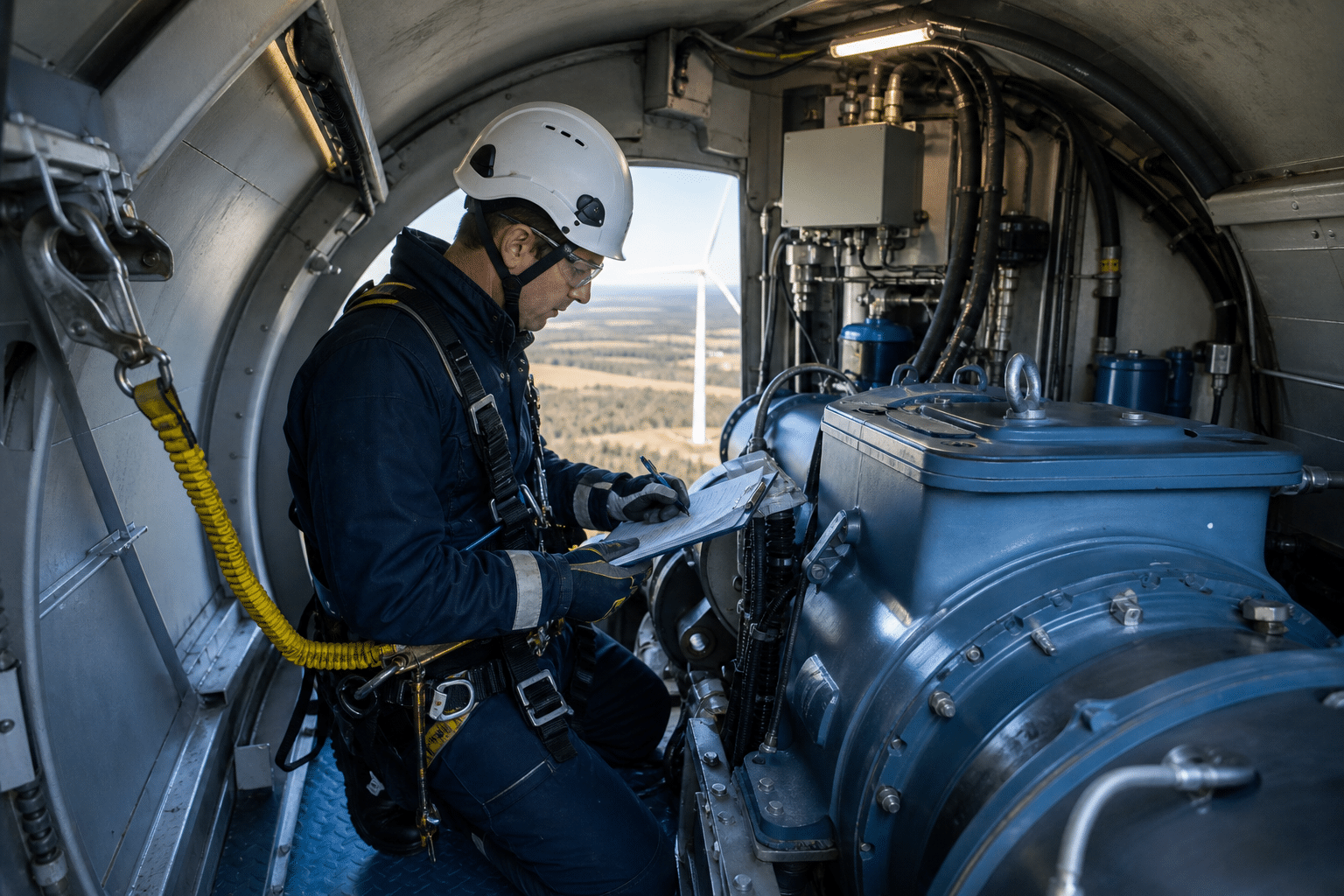
A wind turbine technician inspects, maintains, and repairs the equipment that converts wind into electricity. The work can take place at the base, inside the nacelle, or high on the tower, and it may involve mechanical systems, electrical testing, hydraulics, safety equipment, and detailed service records. Height, weather, travel, and rescue procedures are part of the job itself.
The job can look attractive on a career list because employment is projected to grow quickly. The work is also specific. You need to be comfortable with heights, ladders, weather, travel, safety procedures, and hands-on troubleshooting. A career changer should understand those trade-offs before paying for a long training program.
A routine service visit still has a sequence: The technician secures the turbine, checks the work order and isolation steps, climbs with the required equipment, inspects the reported component, completes the repair, and records what the next crew needs to know.
Wind turbine technician at a glance
| Question | Practical answer |
|---|---|
| Main work | Inspect, maintain, troubleshoot, and repair wind turbines |
| Common systems | Electrical, mechanical, hydraulic, control, and monitoring equipment |
| Typical entry education | Postsecondary nondegree award, according to BLS; employer training is also important |
| BLS median pay | $64,120 per year in May 2025 |
| BLS projected growth | 30% from 2025 to 2035, much faster than average |
| Work reality | Heights, climbing, weather, travel, confined spaces, on-call work, and strict safety rules may apply |
What does a wind turbine technician do?
Wind turbine technicians, sometimes called windtechs, work on the equipment that captures wind energy. The exact balance depends on whether you work in installation, scheduled maintenance, troubleshooting, component replacement, or commissioning.
Typical duties can include:
- inspecting towers, ladders, platforms, blades, and the nacelle;
- checking generators, gearboxes, brakes, bearings, and hydraulic systems;
- testing electrical components, sensors, cables, and control equipment;
- using manuals, digital diagnostic tools, and work orders to find faults;
- lubricating, tightening, cleaning, or replacing components;
- helping install new turbines or major replacement parts; and
- recording readings, repairs, hazards, and follow-up work.
The work is maintenance, not simply climbing. A technician may spend part of the day in a nacelle, part of it at the base of the tower, and part of it entering notes into a maintenance system. A small fault can require careful testing before anyone changes a part.
Some roles are more electrical. Others lean toward mechanical systems, hydraulics, blade inspection, or field service. Read the job description closely. Two employers can use the same title for noticeably different work.
What is the work environment like?
Wind turbines are often located in rural or remote areas, although offshore projects create a different work pattern. You may travel to a wind farm, work at several turbines in one day, or stay away from home during a maintenance rotation.
Heights and climbing
Towers can be more than 100 feet tall. OSHA notes that wind-energy workers can face fall hazards during construction and maintenance, and that maintenance workers may climb fixed ladders inside towers. Fall-protection equipment, site procedures, inspections, and rescue planning are part of the job. They are not optional details to learn after you start.
The height is worth testing honestly. Watch a tower-climbing demonstration, visit a training facility, or speak with a technician about the physical sensation of climbing and working in a nacelle. Being fine on a ladder at home does not automatically mean you will enjoy repeated tower access.
Weather and remote sites
Technicians may work in heat, cold, rain, snow, and wind when the site considers conditions safe. Weather can delay work, change access plans, or make a long day more tiring. Remote locations may also mean a longer drive, limited services, and fewer alternatives if you decide the job is not a fit.
Physical demands
Expect climbing, standing, kneeling, reaching, lifting tools, and working in awkward positions. Nacelles can be tight. You may carry equipment up a tower or use lifting systems according to the site’s procedures. The work is not a medical fitness test, but a realistic job preview matters more than a generic statement that the job is “hands-on.”
Schedule and travel
Most wind turbine service technicians work full time. Some employers use on-call rotations, early starts, overtime, or travel-heavy schedules. Offshore and traveling roles may use longer rotations followed by time at home; the exact pattern depends on the employer and project.
Ask how often technicians sleep away from home, how emergencies are handled, and whether weather delays create unpaid time or schedule changes. Those answers affect the value of the salary offer.
How to become a wind turbine technician
There is no single route that fits every employer. BLS lists a postsecondary nondegree award as the typical entry education and long-term on-the-job training. In practice, employers may also value electrical, mechanical, industrial maintenance, or field-service experience.
1. Start with a short technical program
Look for programs in wind energy technology, renewable energy, industrial maintenance, electrical technology, or electromechanical systems. Compare the lab and tower practice, not only the program name.
Useful training may include electrical measurements, motors, mechanical systems, hydraulics, safety, technical drawings, computer-based monitoring, and working at heights. Ask whether students practice rescue procedures and equipment handling under supervision.
An online course may explain turbine components, but it cannot by itself give you the physical practice or employer authorization needed for field work. Our online trade school guide explains what to check before paying for a remote program.
2. Apply for an entry-level field role
Search for wind technician trainee, wind service technician, electrical technician, field service technician, turbine maintenance technician, and renewable energy technician. Some employers hire people with related mechanical or electrical experience and provide model-specific training.
Read the minimum requirements carefully. A posting may mention a driver’s license, travel, climbing, technical coursework, troubleshooting, or the ability to work outdoors. If the role says entry-level, ask what the first 90 days actually look like.
3. Consider an apprenticeship
Registered Apprenticeship can combine paid work, a mentor, related classroom instruction, progressive wage increases, and a portable credential. Apprenticeship.gov advises career seekers to search for an opportunity and apply directly to the employer or sponsor.
Wind-specific openings may not always use the exact phrase “wind turbine technician.” Search related titles and ask the sponsor which occupation standard applies. Our electrician apprenticeship guide can help you understand questions about wages, supervision, and application requirements.
4. Build from another maintenance trade
Industrial electricians, industrial maintenance technicians, mechanics, and military technicians may already have useful habits: reading manuals, using tools, documenting repairs, and following isolation procedures. That experience can help, but it does not remove the need for wind-turbine-specific training.
Our industrial electrician guide is a useful comparison if you like troubleshooting but are unsure about tower climbing and travel.
Safety is part of the qualification
Wind-turbine maintenance combines several hazards. A job may involve electricity, rotating machinery, stored hydraulic or mechanical energy, heights, weather, lifting, and confined work areas.
OSHA’s wind-energy guidance explains that maintenance workers can face fall hazards and may need personal fall-protection systems or other controls. The employer’s procedures determine how equipment is accessed, isolated, inspected, and serviced. A general safety certificate does not give a new worker permission to perform every task.
Before accepting a job, ask:
- What fall-protection and rescue training is provided?
- How is a turbine isolated before maintenance begins?
- Who can authorize a new technician to work aloft?
- How are weather, lightning, and high-wind decisions made?
- What happens if a worker feels unsafe or cannot complete a climb?
Good answers should be specific. “We care about safety” is not a training plan.
Wind turbine technician pay and outlook
BLS reported a median annual wage of $64,120 for wind turbine service technicians in May 2025. The lowest 10 percent earned less than $49,230, while the highest 10 percent earned more than $92,460.
BLS also reported these median wages by major industry:
| Industry | Median annual wage in May 2025 |
|---|---|
| Commercial and industrial machinery and equipment repair and maintenance | $70,670 |
| Wind electric power generation | $65,000 |
| Power and communication line and related structures construction | $63,080 |
The industry figures are useful comparisons, not promises. A job with travel, overtime, per diem, or a difficult location may produce a higher annual total than its base rate. Ask which parts of the compensation are guaranteed.
BLS projects employment of wind turbine service technicians to grow 30 percent from 2025 to 2035, with about 1,500 openings per year on average. The percentage is high, but the occupation is relatively small. Fast projected growth does not mean every town will have a nearby opening or that every graduate will receive the same offer.
For a second-career decision, separate base pay from overtime, travel pay, bonuses, per diem, and benefits. A strong-looking annual figure may rely on a schedule you cannot sustain.
Is this a good career change after 40?
It can work for someone who genuinely wants technical field work and can handle the physical and travel demands. Age itself is not the main question. The better questions are whether you can climb repeatedly, learn new equipment, follow detailed procedures, and accept the schedule that local employers offer.
Your previous experience may help with tools, electrical work, mechanics, construction, aviation, military maintenance, facilities, or industrial troubleshooting. Explain those connections instead of presenting yourself as starting from zero.
The financial transition needs equal attention. Training may take months, and the first job may pay less than the long-term benchmark. Keep your current income while you compare programs and employers when possible. Our career change at 40 roadmap can help you map the cash-flow gap and first-job test.
A practical 30-day test
Days 1-7: study real postings
Save 15 postings from different employers. Record travel, shift, climbing, education, tools, driver’s license, and pay requirements. Note which duties repeat.
Days 8-14: test the physical side
Visit a training center or talk with a technician. Ask about tower access, nacelle space, weather, rescue drills, and time away from home. Do not rely on a polished career video.
Days 15-21: compare routes
Call two technical programs and two employers. Ask about supervised practice, employer hiring relationships, first-job titles, and total costs. Confirm what is included in tuition.
Days 22-30: apply carefully
Apply for a trainee role, apprenticeship, or program that matches your budget. Before resigning from your current job, calculate the lower starting wage, commute, travel, and time before the first review.
Bottom line
Wind turbine technician is a real technical trade with strong projected growth and a BLS median wage of $64,120 in May 2025. The work also asks more of you than a salary page can show: climbing, weather, travel, physical effort, safety training, and careful troubleshooting.
Start with local job postings and a realistic job preview. Then choose the shortest credible route that gives you supervised practice, not just a certificate. If the work environment fits, the trade can offer a clear technical path. If the height and travel do not fit, industrial electrical or maintenance work may offer a better match.
Sources
- U.S. Bureau of Labor Statistics: Wind Turbine Technicians – duties, work environment, education, pay, and 2025-35 outlook; checked September 1, 2026.
- Apprenticeship.gov: Career Seekers – paid work, mentorship, related instruction, progressive wage increases, and sponsor search; checked September 1, 2026.
- OSHA: Green Jobs – Wind Energy: Falls – fall hazards and protection considerations for wind-turbine construction and maintenance; checked September 1, 2026.
- OSHA: 1910.140 Personal fall protection systems – performance and use criteria for personal fall-protection systems; checked September 1, 2026.
This article is for career research. Pay, training, travel, safety procedures, and job duties vary by employer and location. Confirm current requirements before enrolling or accepting an offer.\n
Reviewed September 3, 2026: Wind turbine work combines mechanical, electrical, climbing, weather, and travel requirements. Ask about rescue training, rotation schedules, and the first job after school. The salary guide adds the pay comparison.