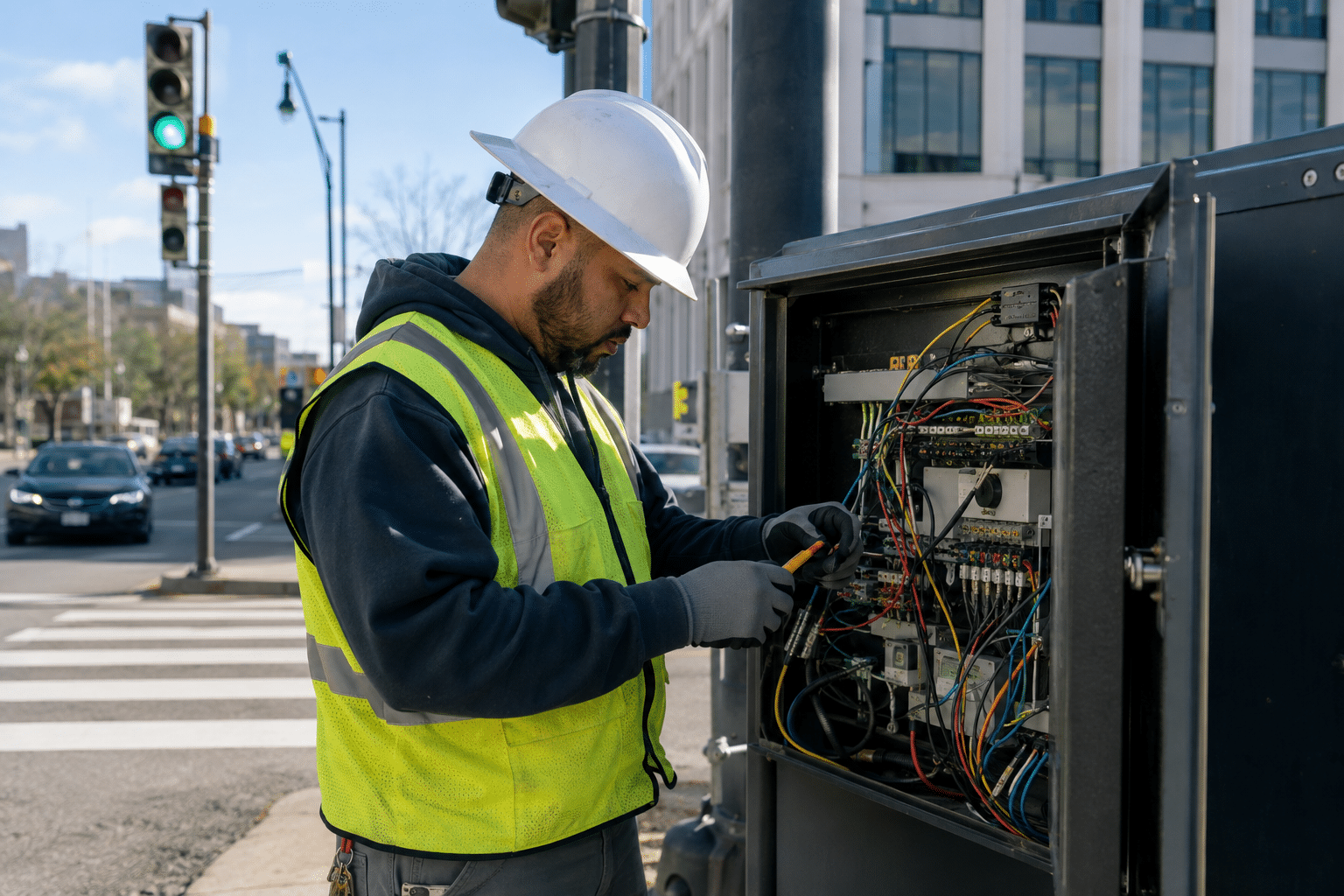
Traffic signal technicians keep the equipment that controls intersections working safely and predictably. The work may include controllers, detection devices, signal heads, cabinets, wiring, communications, and emergency repairs after storms or crashes. It combines electrical troubleshooting with public-road safety, traffic-control procedures, and coordination with a city, county, or contractor.
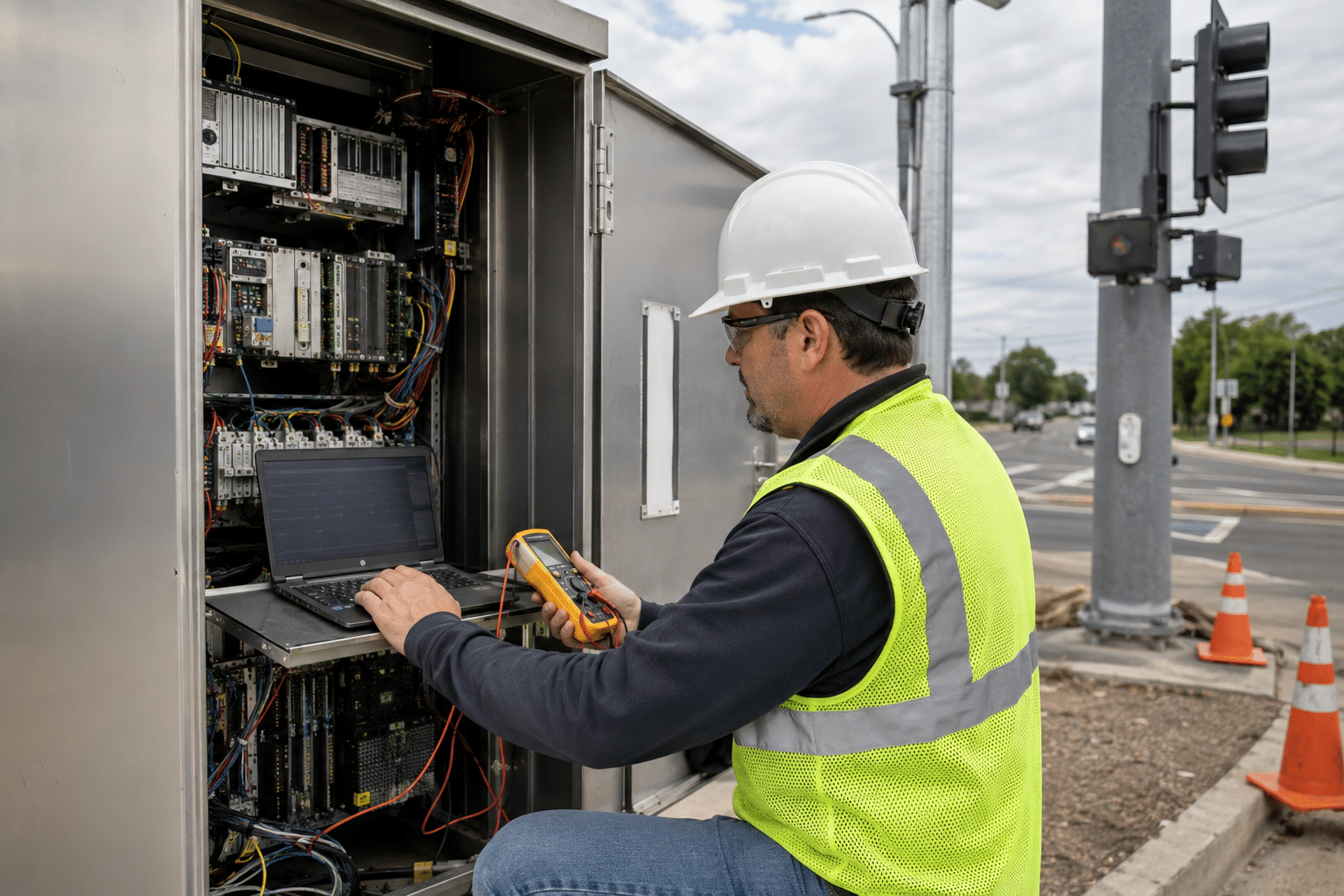
A roadside fault can have several causes: If one signal head is dark, the technician may need to check the lamp or LED unit, cabinet power, wiring, controller output, detector information, and damage from a vehicle strike. The repair is complete only when the intersection operates correctly and the work is documented for the next crew.
What does a traffic signal technician do?
Responsibilities vary by city, county, contractor, and system age. A typical technician may:
- Inspect and repair signal heads, controllers, detectors, cabinets, wiring, and power equipment.
- Diagnose conflicts, dark signals, intermittent detectors, communication failures, and timing problems.
- Replace damaged components and verify that the intersection operates safely after the repair.
- Use meters, test equipment, controller software, drawings, and maintenance records.
- Work with traffic engineers, dispatchers, utility crews, police, and contractors.
The job is different from traffic engineering. Engineers usually handle design, analysis, timing plans, and project decisions. Technicians work closer to the hardware and field conditions, though larger agencies may divide those duties carefully.
The field conditions
Some work happens at a desk or in a maintenance shop. Much of it happens beside live roads, in heat, rain, cold, noise, and traffic. Technicians use cones, high-visibility clothing, truck-mounted equipment, and the agency’s traffic-control procedures. Climbing or bucket-truck work may be part of the role. Ask about the physical requirements, on-call rotation, and driving expectations before you apply.
Preventive maintenance matters as much as emergency repair. A technician may check detector operation, signal visibility, controller settings, cabinet condition, and communications before a failure stops an intersection.
Training and certification
A high school diploma is a common starting point. Employers also look for electrical safety knowledge, basic electronics, mechanical confidence, and the ability to read wiring diagrams. New technicians often learn through supervised work, agency training, equipment vendors, or a formal apprenticeship-style route.
The Federal Highway Administration’s traffic signal staffing guidance describes technician levels. Entry-level work can include replacing and repairing controllers, signals, wiring, and field equipment under direction. More experienced technicians may program controllers and troubleshoot ancillary equipment with less supervision. The guide also identifies IMSA Traffic Signal Level I and Level II certification as common qualifications in its example framework.
Requirements are not identical across the United States. One city may require IMSA certification within a year; another may accept electrical experience and train the right applicant. Read the actual posting and check the agency’s civil-service or contractor rules.
Pay and job outlook
Traffic signal technician is not always reported as a standalone BLS occupation. Pay therefore depends heavily on the employer, union agreement, overtime, location, and whether the job includes electrical or communications work. Compare local public-sector postings with private traffic-signal contractors rather than relying on a national number that may describe a different occupation.
Can this career fit after 40?
This can be a good second-career option for someone who enjoys troubleshooting and wants visible results. Experience with electrical maintenance, telecommunications, industrial controls, fleet repair, or construction can help. So can a calm approach to frustrated drivers and urgent service calls.
The downside is that the work is not always predictable. A storm, crash, or failed controller can change the day’s plan. You may work near traffic, climb, lift, and respond outside normal hours. If you want a steadier schedule, ask whether the position is preventive-maintenance focused or part of a 24-hour response team.
How to test the path
Start with local job postings and the public works department’s maintenance requirements. Look for entry-level signal technician, traffic signal mechanic, electrical maintenance, or ITS field technician roles. A basic electrical course, OSHA safety training, and an honest conversation with a current technician can help you judge the fit. The most useful question is simple: what would a new hire be expected to diagnose alone after six months?
For related paths, compare our guides to railroad signal maintainer, telecommunications technician, and industrial electrician.
Understand the intersection environment
Traffic signal technicians work with cabinets, controllers, detection, communications, wiring, poles, and field devices while traffic continues around them. Before service, identify the intersection, complaint, current timing operation, work-zone plan, and authority for changing settings. Cabinet access does not automatically authorize a technician to modify timing or safety-related programming.
Troubleshooting should move from the reported symptom to power, communications, inputs, outputs, field wiring, and device operation under the agency’s procedure. Record controller logs and conditions before clearing faults. An intermittent detector or communication problem may disappear during a visit, so exact times, weather, traffic conditions, and event history can be more useful than replacing a part without evidence.
Ask about roadway exposure and callouts
Clarify traffic-control training, bucket trucks, electrical qualification, lifting, weather, nights, emergency response, and work near live lanes. Ask whether crews work alone and who approves temporary operation when equipment cannot be restored. New technicians need both cabinet instruction and supervised field practice. Comfort with electronics is useful, but situational awareness around moving traffic is equally important.
Traffic agencies also need accurate asset records. Confirm cabinet, controller, detector, communication device, firmware, and configuration identifiers before updating a work order. Back up settings according to policy and document any authorized change. If a temporary timing plan or flash condition is used, record who approved it and what follow-up remains. Before applying, ask whether the role includes signal construction, preventive maintenance, fiber or radio communications, street lighting, signs, or only fault response. These duties change the training path. A commercial driver’s license or other credential may be required for certain vehicles, while electrical work may have separate rules. Compare the job description with the agency’s actual crew assignments rather than assuming every traffic signal title covers the same work.
Learn the agency’s process for notifying dispatch, police, contractors, and the public when an intersection cannot operate normally. Technical repair and safe temporary operation are separate responsibilities.