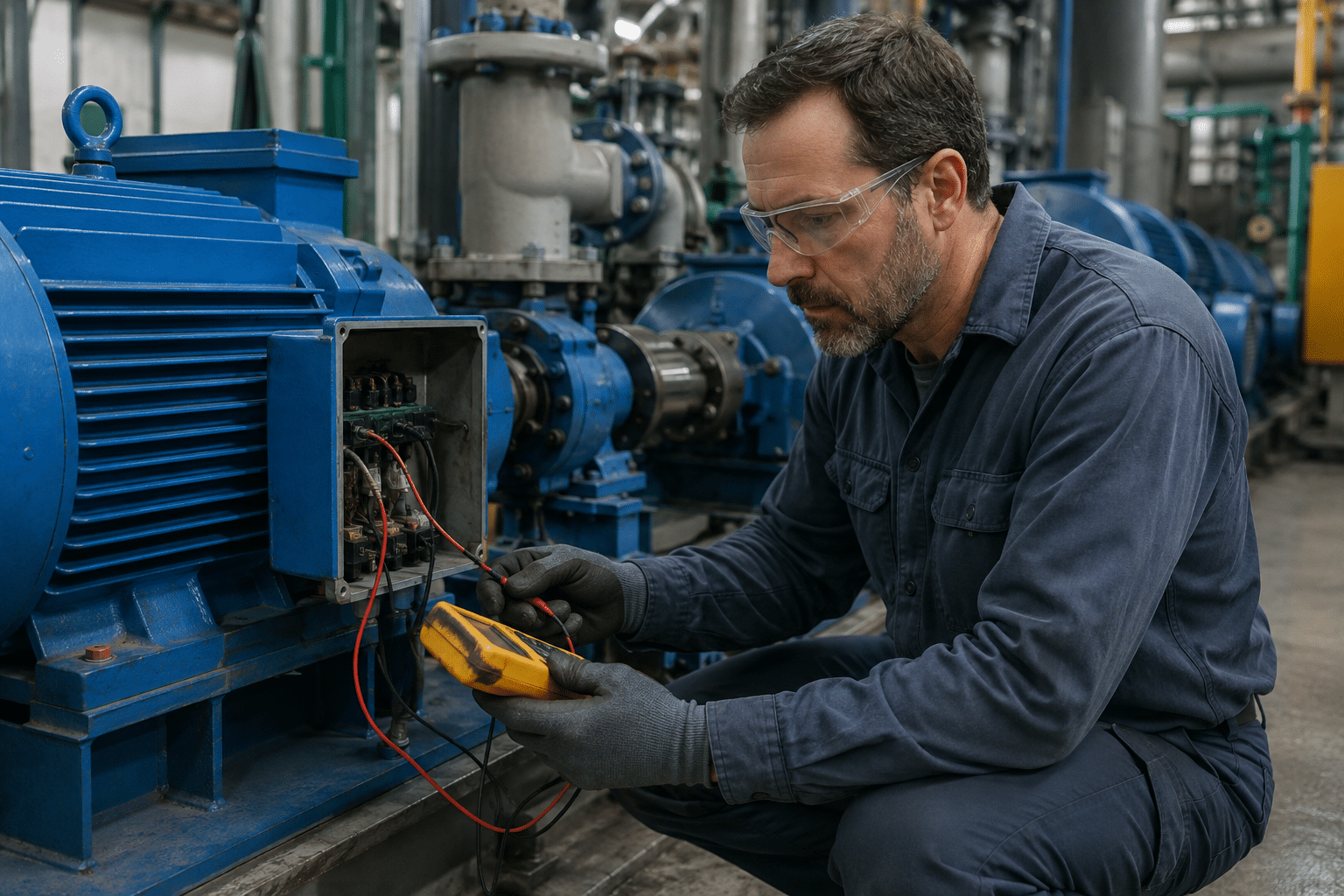
Industrial equipment technicians keep production machinery working, but the job is not simply a list of repairs. One shift may involve a planned inspection on a conveyor or pump; the next may start with an alarm, an unusual vibration, or a production line that will not restart. The role sits between mechanical troubleshooting, electrical checks, documentation, and safe coordination with operators and supervisors.

One realistic fault: A conveyor may still run while a bearing begins to heat up. A careful technician records the symptom, checks the approved measurements, follows the energy-isolation procedure, and decides whether the problem needs immediate repair or planned downtime. That judgment is what separates useful maintenance from replacing parts at random.
What does an industrial equipment technician do?
A technician may perform preventive maintenance, inspect bearings and belts, test motors and controls, replace worn parts, check lubrication, trace faults, and record repairs. Some jobs are closer to maintenance; others support installation, commissioning, or equipment testing. The job posting should tell you whether the role is mechanical, electrical, or a mix.
Training and safety
High school education plus mechanical, electrical, or industrial maintenance training is a common route. Employers value schematic reading, hand tools, meters, lockout/tagout, and the ability to explain a failure clearly. Safety comes first around moving equipment, stored energy, electrical hazards, pressure, and unexpected startup.
Pay and career fit
Pay varies by industry, shift, overtime, location, and the machinery involved. Compare local postings with industrial machinery mechanic and electromechanical technician roles rather than treating one national number as exact. This path can suit a career changer after 40 with experience in machine repair, facilities, automotive work, manufacturing, or field service. Night shifts and production deadlines are the main trade-offs.
Related guides include industrial mechanic, electromechanical technician, and field service technician.
What a normal week can include
Most industrial equipment technicians move between planned work and unexpected questions. The planned side may include inspections, readings, preventive tasks, scheduled service, or a review of records from the previous shift. The unexpected side is where judgment matters: a customer reports a problem, an alarm appears, a measurement does not match the drawing, or a component behaves differently from yesterday. Good work starts by confirming the condition before changing anything.
Because these jobs support factories, warehouses, processing plants, and distribution centers, the worker may coordinate with operators, customers, engineers, contractors, dispatchers, or a supervisor. A short, accurate handoff is often as important as the physical task. It should explain what was observed, what was tested, what was changed, and what remains open.
Tools, records, and technical judgment
The day-to-day equipment for an industrial equipment technician commonly includes motors, conveyors, pumps, gearboxes, sensors, compressed-air systems, and computerized controls. The list changes by employer, but the habit is consistent: use the right instrument, check that it is suitable for the task, and record enough information for another person to understand the result. A vibration, unusual heat, a leaking seal, or a recurring jam can be an early warning rather than a minor nuisance.
Maintenance notes should capture the asset, symptom, measurements, work performed, parts used, and result after restart. That history helps the next technician separate a recurring defect from a one-time failure. Precise entries also let planners order parts and schedule downtime before a small vibration, leak, or temperature change becomes a production stop.
Training that actually helps
Relevant preparation may include mechanical drives, bearings, hydraulics, pneumatics, alignment, basic electrical testing, and lockout/tagout. The right mix depends on the plant. Ask whether training covers the specific conveyors, pumps, packaging lines, or process equipment on site and whether the employer provides manufacturer courses after hiring.
Before accepting industrial equipment training, ask which machines the facility actually uses and whether new technicians begin with lubrication, inspections, component replacement, or fault diagnosis. Good onboarding includes supervised work on real production equipment, clear lockout boundaries, and a named person who signs off skills. A broad maintenance course helps only when it connects to the plant’s machinery and hiring standards.
Safety and working conditions
Safety depends on the setting. A industrial equipment technician may face electricity, moving machinery, pressure, chemicals, heights, vehicles, weather, confined areas, or stored energy. The correct response is not to improvise. It is to follow the hazard assessment, use the required PPE, isolate equipment when required, and stop when the conditions do not match the work plan.
Industrial equipment technicians may crawl around conveyors, climb platforms, handle greasy components, or respond when production is waiting. Ask about shift rotation, planned shutdowns, overtime, noise, heat, and the heaviest routine tasks. Tour the maintenance area if possible; the condition of the shop and its tools often reveals how the employer supports its technicians.
Career fit after 40
This path can suit someone who brings reliability, patience, customer awareness, or practical troubleshooting from another industry. The strongest transferable skill is often not a specific tool; it is the ability to notice a change, ask a precise question, and complete the record. Mechanical troubleshooting and planned maintenance can be learned, but it is easier when you already respect procedures and take pride in leaving a site or workstation in better condition.
The first months are often about learning the plant’s sounds, recurring failure points, and safe access routes. Keep notes on equipment names and normal readings, but avoid guessing when energy isolation or machine movement is involved. Experienced career changers can add value quickly by being dependable during handoffs and by explaining what they observed before touching a component.
Where the role can lead
With experience, a industrial equipment technician may move toward millwright, maintenance planner, reliability technician, or maintenance supervisor. Advancement depends on demonstrated competence, additional education, employer structure, and sometimes a license or industry credential. Before applying, ask what the previous person in the role moved on to and whether internal training is available.
Questions to ask before applying
- What does the title mean at this company, and what tasks are outside the role?
- What equipment, software, PPE, and documentation system will I use?
- How are new workers trained and signed off for independent work?
- What are the schedule, travel, physical, and emergency expectations?
- What is the next realistic step after I become competent?
What to look for on a site visit
If an interview includes a plant tour, notice whether tools are labeled, guards are in place, maintenance records are accessible, and operators can explain how problems are reported. A well-run shop makes safety and quality visible. It also gives new technicians a clear way to learn instead of expecting them to guess. Ask how the team balances production targets with preventive maintenance and safe shutdowns.