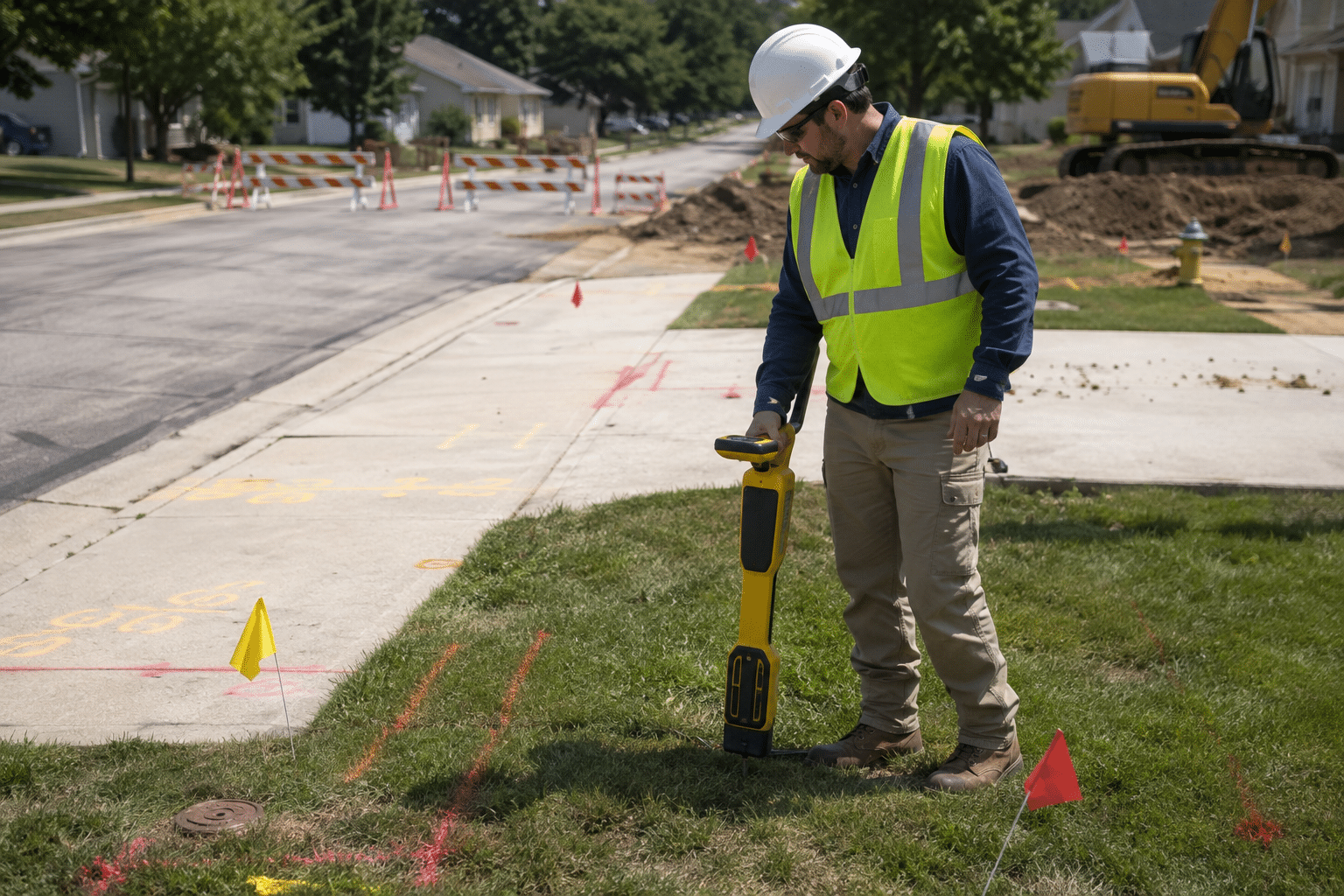
A utility locator marks underground lines before excavation begins. The work protects digging crews and the public, but it also involves incomplete records, changing site conditions, weather, driving, and the need to explain what the marks do and do not mean. Locators may work around electric, gas, water, sewer, and telecommunications infrastructure, so careful documentation is part of the safety task.
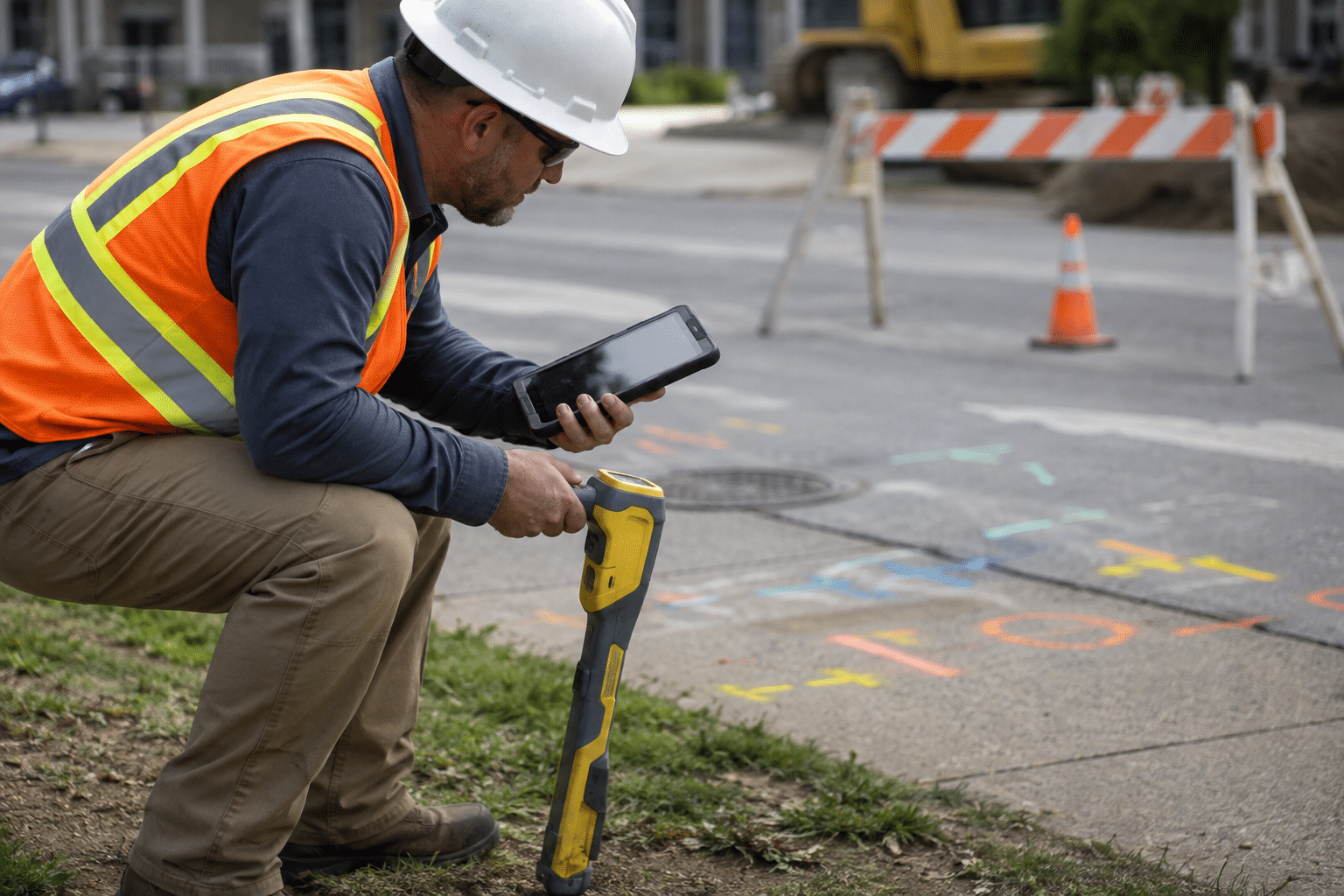
A locate request is not always straightforward: The records may show a line crossing a property, while the field markings, access conditions, and visible service features tell a more complicated story. The locator uses the approved detection method, marks the area clearly, notes limitations, and communicates when an excavation needs clarification before work starts.
What does a utility locator do?
Locators may work with electric, gas, water, sewer, telecommunications, and other buried infrastructure. Depending on the employer and equipment, the work can include:
- Reviewing locate tickets, plans, as-built records, and the proposed excavation area.
- Using electromagnetic locating equipment, transmitters, probes, or ground-penetrating radar where appropriate.
- Tracing a line, checking signal quality, and marking its approximate route with paint or flags.
- Recording measurements, photographs, utility responses, and site conditions.
- Explaining locate limits to excavators and escalating conflicts, missing records, or unsafe conditions.
A locator does not make underground lines risk-free. Marks can be approximate, private lines may fall outside a standard public locate request, and the crew still has to follow the required tolerance-zone and safe-excavation procedures.
Training and certification
Many people enter through employer training. Useful preparation includes basic electrical and mechanical concepts, map reading, outdoor safety, documentation, traffic awareness, and practical equipment instruction. Some employers also value experience in surveying, construction, telecom, water systems, or damage prevention.
Requirements are not identical across the country. Before applying, ask the employer which state rules, utility-owner procedures, and 811 process the team follows. OSHA advises employers to plan excavation work and contact utility companies to locate underground installations before digging.
Pay and career outlook
Utility locator is not always reported as a standalone occupation in national wage tables, so a single salary number would be misleading. Pay depends on the contractor or utility, region, travel, overtime, technical scope, and whether the role includes quality control or crew leadership.
The broader construction and infrastructure workforce can offer several directions. Experience as a locator may lead toward damage prevention, surveying support, utility mapping, field supervision, or safety work. Treat local job postings as the best guide to current pay and entry requirements.
Is this career a good fit after 35?
This work can fit someone who wants active outdoor days and a practical public-safety purpose. Attention to detail matters more than a particular degree, and experience around construction sites can be valuable.
The job also requires patience. Weather, traffic, uneven ground, changing tickets, and pressure from a waiting excavation crew are part of the environment. A strong locator communicates uncertainty instead of guessing and keeps accurate records even when the site is busy.
How to explore the field
Read your state’s 811 guidance, then compare local locator openings with related roles such as surveying technician, geotechnical technician, water distribution operator, and construction safety officer. Ask employers whether training is paid and whether private utility locating is part of the job.
What the work looks like in practice
A utility locator usually balances scheduled work with problems that cannot be predicted from a calendar. The scheduled side may include inspections, readings, preventive tasks, site visits, customer appointments, or a review of records from the previous shift. The unscheduled side may begin with an alarm, a complaint, a weather event, a failed test, or a result that does not match expectations. The first professional habit is to confirm the condition before changing anything.
Because the work supports utility locating companies, municipalities, construction sites, and excavation projects, communication is part of the technical job. A worker may coordinate with a supervisor, customer, contractor, operator, dispatcher, engineer, or emergency team. A good handoff explains what was observed, what was checked, what action was taken, and what still needs attention.
Equipment and records
The tools used by a utility locator may include locating receivers, maps, paint, flags, records, traffic-control equipment, and communications tools. The exact list varies, but the principle is consistent: select an appropriate tool, use it according to the procedure, and record enough information for another person to understand the result. A mark is only useful when it is placed accurately, documented clearly, and interpreted with the limits of the locate in mind That is why a reading without location, time, condition, or method can be less useful than a shorter record made carefully.
Locate records should show the ticket limits, facilities searched, frequencies or methods used, access problems, marks placed, photos, and communications with the excavator or utility. Documentation matters when plans are inaccurate or a line cannot be positively identified. Never describe an assumption as a confirmed facility.
Training and the first months
Utility locator onboarding should cover the ticket system, local color codes, maps, electromagnetic equipment, grounding methods, site documentation, and escalation rules for uncertain facilities. Ask how many supervised locates are required before solo work and how damaged or incomplete records are handled.
Preparation is largely employer and utility specific, though basic electricity, map reading, construction awareness, and traffic safety help. Ask whether training includes difficult sites with congestion, tracer-wire failures, nonconductive lines, and abandoned facilities. Classroom demonstrations alone do not prepare someone for ambiguous field conditions.
Safety and working conditions
A utility locator may face moving equipment, electricity, pressure, traffic, heights, weather, chemicals, confined areas, or unfamiliar properties. The correct response is to follow the hazard assessment, use the required PPE, isolate equipment when required, and stop when the real condition does not match the work plan. Production pressure or a customer deadline does not remove the need for a safe method.
The work involves driving, walking construction sites, kneeling, carrying equipment, working near traffic, and meeting deadlines in poor weather. Ask about route size, overtime during construction season, emergency tickets, production quotas, and stop-work authority. Speed expectations should never override an uncertain mark.
Career change after 40
This path can suit someone who brings reliability, practical judgment, customer awareness, or careful documentation from another field. The most transferable skill is often the ability to notice a change, ask a precise question, and complete the record. outdoor work, infrastructure, and careful observation can be learned, but it is easier when you already respect procedures and understand the consequences of a rushed decision.
New locators improve by walking the entire work area before tracing, comparing records with visible utility features, and questioning signals that do not make physical sense. Recheck from another access point when possible. If confidence remains low, escalate under procedure rather than leaving a neat mark that may be wrong.
Advancement and fit
With experience, a utility locator may move toward senior locator, damage-prevention trainer, utility coordinator, or field supervisor. Advancement depends on demonstrated competence, additional education, employer structure, and sometimes licensing. Before accepting a job, ask what the previous person moved on to and whether internal postings or tuition support are available.
Questions to ask before applying
- What does this title mean at this employer, and which tasks are outside the role?
- What are the normal schedule, travel, physical, and emergency expectations?
- Which tools, software, records, and safety qualifications are required?
- How are new workers trained and approved for independent work?
- What is the realistic next step after the first year?