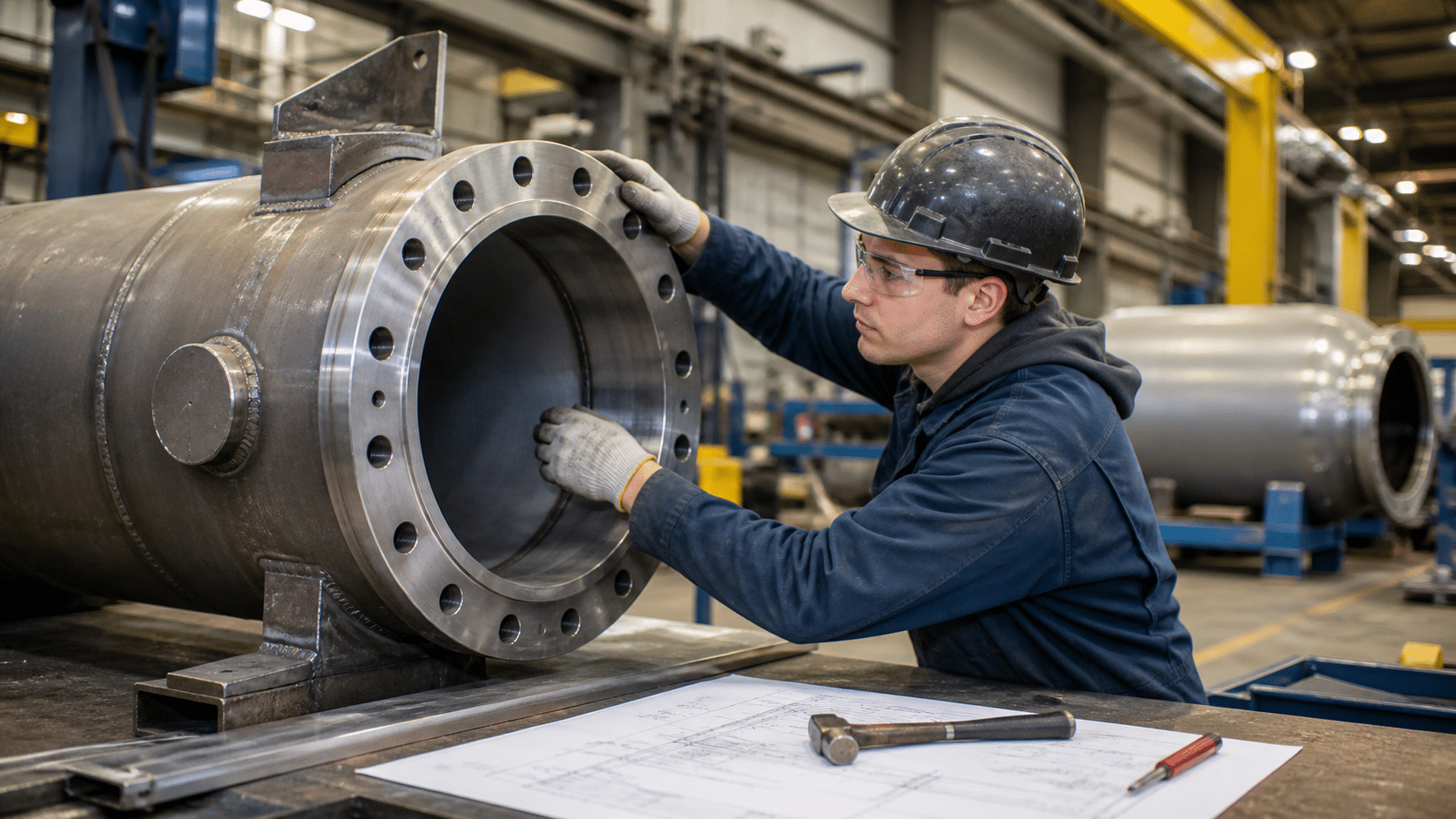
A boilermaker apprenticeship is a hands-on route into industrial construction, maintenance, and repair. Boilermakers assemble, install, maintain, and repair boilers, pressure vessels, tanks, vats, stacks, and related systems that hold or move liquids and gases. The work can involve welding, rigging, confined areas, shutdowns, travel, and strict safety procedures.
The name can sound narrower than the work. Boilermakers may work in power generation, manufacturing, utility construction, shipyards, refineries, water treatment, and large industrial facilities. The job can involve layout, metal fitting, welding, rigging, inspection, refractory materials, and repairs during scheduled shutdowns.
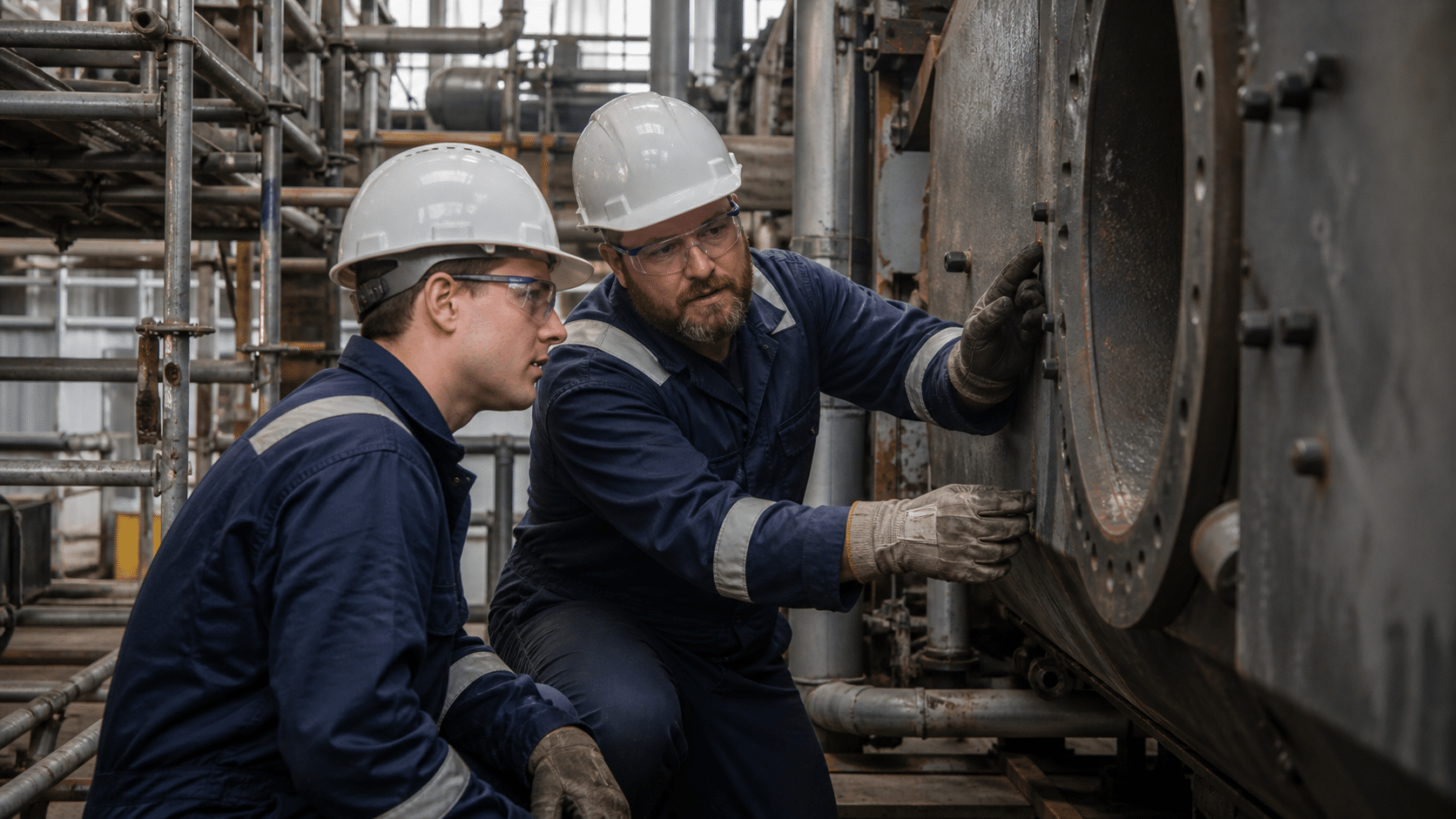
The job changes with the project: One assignment may involve fitting plate and welding in a fabrication shop; another may involve a plant shutdown, heavy lifts, confined-space controls, and inspection documentation. Ask how often apprentices travel, what work they perform under supervision, and how pay changes as skills and certifications advance.
What does a boilermaker do?
The work begins with understanding the drawings, dimensions, materials, and sequence for a large vessel or mechanical system. A boilermaker then helps position, align, join, test, maintain, or repair the components.
Typical duties include:
- reading blueprints to locate and measure boiler parts;
- laying out prefabricated sections before assembly;
- installing small boilers in buildings or manufacturing facilities;
- assembling boiler tanks and pressure-vessel components;
- aligning plates, pipes, valves, joints, and supports;
- bolting, riveting, welding, or fitting parts together;
- testing and inspecting systems for leaks or defects;
- repairing valves, pipes, tubes, and joints;
- cleaning boilers, vats, furnaces, and related equipment;
- helping install heat-resistant materials and pollution-control equipment.
The U.S. Bureau of Labor Statistics (BLS) describes boilermakers as workers who assemble, install, maintain, and repair boilers, closed vats, and other large vessels or containers. The work is about more than welding. Welding may be central to one assignment, while layout, fitting, inspection, rigging, or maintenance is more important on another.
Boilermaker versus similar trades
Industrial trades often share tools and work sites, but their main responsibilities differ.
| Trade | Main focus | Typical difference |
|---|---|---|
| Boilermaker | Large boilers, tanks, pressure vessels, and related systems | Works on vessels and industrial structures |
| Stationary engineer | Operate and maintain boilers and facility systems | Usually stays with operating equipment at one facility |
| Welder | Join or repair metal components | Welding is the central skill across many projects |
| Pipefitter | Install and maintain piping systems | Focuses on pipe routing, valves, and connections |
| Power plant operator | Control equipment that generates electricity | Focuses on operation, readings, and plant output |
Our stationary engineer guide covers workers who operate equipment inside a building or plant. A boilermaker may install or repair the boiler during construction or a shutdown, then leave for the next project.
How a boilermaker apprenticeship works
Most boilermakers learn the trade through an apprenticeship. The BLS says programs typically last four years and combine on-the-job learning with instruction in tools, equipment, metals, installation techniques, blueprint reading, safety, and other technical topics.
An apprentice normally starts with supervised tasks and gradually handles more complex work. Training may include:
- hand and power tools;
- metal layout, fit-up, and measurement;
- blueprint reading and sketching;
- welding and flame-cutting fundamentals;
- rigging, hoists, signals, and safe material movement;
- boiler and pressure-vessel components;
- inspection and leak-testing procedures;
- confined-space, fall, respiratory, and other site safety;
- maintenance and shutdown work.
The exact wage schedule, classroom hours, travel rules, and benefits depend on the sponsor. Programs may be sponsored by a union, contractor association, joint apprenticeship committee, or employer. The International Brotherhood of Boilermakers describes its apprenticeship as an earn-while-you-learn path, but a local program’s written terms should control your decision.
Requirements to apply
The usual baseline is a high school diploma or equivalent. Some programs also require applicants to be at least 18, pass an aptitude test, have a driver’s license, pass a physical assessment, or meet local employment rules. Requirements are not identical across locals or contractors.
Helpful preparation can include:
- welding or metalworking experience;
- shop, mechanical, or technical coursework;
- comfort with fractions, measurements, and basic geometry;
- experience with hand and power tools;
- military maintenance or construction experience;
- previous work as a welder, pipefitter, millwright, or sheet-metal worker;
- a willingness to travel and work safely in difficult environments.
The BLS notes that welding or related military experience may improve an applicant’s position and, in some cases, qualify someone for a shortened apprenticeship. That is not automatic credit. Ask the sponsor what documentation it accepts and whether prior experience changes placement, pay, or training length.
Our welder certification guide explains why welding experience can help without replacing the broader boilermaker training path.
How to find a program
Start with the national Boilermakers apprenticeship information, local union lodges, contractor associations, and Apprenticeship.gov. Search by your location, then check whether the program is accepting applications and what area it serves.
Before submitting an application, write down:
- The sponsor and the employer or contractor network.
- The application opening and closing dates.
- The required documents and tests.
- The starting wage and scheduled increases.
- The classroom or technical-instruction requirements.
- The travel territory and expected time away from home.
- The equipment, welding, rigging, and safety skills taught.
- The process for reaching journey-level status.
An apprenticeship posting may use words such as helper, trainee, pre-apprentice, or apprentice. Read the agreement carefully. A helper job can offer useful experience without being a registered apprenticeship or a guaranteed route to journey-level classification.
What does a boilermaker apprentice earn?
Apprentices earn less than fully trained boilermakers and receive increases as they learn more skills. The exact progression belongs to the sponsor’s agreement, so a national wage number should not be presented as a first-year offer.
The BLS reported a median annual wage of $76,410 in May 2025 for boilermakers. The approximate hourly equivalent is $36.74. The lowest 10 percent earned less than $50,490, while the highest 10 percent earned more than $110,370.
| BLS measure | May 2025 figure |
|---|---|
| Median annual wage | $76,410 |
| Approximate hourly equivalent | $36.74 |
| Lowest 10 percent | Less than $50,490 |
| Highest 10 percent | More than $110,370 |
The BLS also reports industry medians of $80,060 in utility system construction, $79,110 in other building equipment contractors, $74,960 in nonresidential building construction, $73,150 in plumbing, heating, and air-conditioning contractors, and $63,760 in fabricated metal product manufacturing.
Those figures cover experienced workers across the occupation. They do not include the value of every benefit, travel allowance, per diem, overtime hour, or shutdown premium. Compare the full package and ask how much annual income depends on long hours or traveling to the next project.
Travel, shutdowns, and periods between projects
Boilermakers may travel to worksites and stay away from home for extended periods. Construction and repair projects can be spread across a wide territory, especially when a contractor responds to industrial shutdowns.
The schedule may change sharply. A planned outage can bring extended overtime because equipment has to return to service on time. After a contract ends, there may be a gap before the next project. This pattern is different from a permanent maintenance job at one factory.
Ask about:
- the normal travel radius;
- hotel, mileage, per diem, and travel-time policies;
- how often shutdown work occurs;
- typical shift length during an outage;
- how much notice workers receive for a new project;
- what happens when a contract ends;
- whether benefits continue between assignments.
The highest annual total may come with the least predictable calendar. Build a realistic budget rather than assuming every week will include overtime.
Physical demands and job conditions
The work can be demanding. The BLS describes boilermakers working inside boilers, vats, and tanks that may be dark, damp, noisy, cramped, and poorly ventilated. Workers may also work outdoors in heat or cold and at great heights.
The physical and environmental requirements can include:
- climbing and working from platforms or scaffolding;
- crouching, kneeling, or crawling in tight spaces;
- lifting and positioning heavy components;
- using tools for long periods;
- wearing a hardhat, eye protection, hearing protection, gloves, and other PPE;
- using respiratory protection when the job requires it;
- coordinating lifts and movement around cranes or suspended loads.
Safety training is part of the trade, not a footnote. Follow site rules, energy-isolation procedures, confined-space requirements, fall protection, hot-work controls, and the mechanic or supervisor’s instructions. The exact hazards depend on the job site and equipment.
Licensing and certification
Some states require boilermakers to hold a license, and the requirements can include experience and a written exam. Other employers may require or prefer professional certifications even when the state does not require one.
Check the state licensing authority and the employer before paying for training. Ask whether the apprenticeship hours count toward a local license, whether welding qualifications are tested separately, and which credentials are actually recognized by contractors in your target area.
Certification is not the same as journey-level status. A credential may demonstrate one skill, while the apprenticeship covers the broader work of assembling, installing, maintaining, and repairing industrial vessels and systems.
Job outlook
The BLS projects boilermaker employment to decline 2 percent from 2025 to 2035. It still projects about 700 openings per year, on average, mainly because workers retire or move to other occupations.
Boilers and pressure vessels can last for decades, so employers will continue to need workers who maintain, repair, and replace components. The BLS also notes that the shift away from coal-fired generation may reduce some demand, while industrial construction, utility systems, storage tanks, pollution-control equipment, and other projects continue to create work.
The outlook is therefore uneven by specialty and region. A worker who can travel, read drawings, fit metal accurately, weld safely, and work across more than one type of project may have more options than someone limited to one local facility.
Is this a good second career after 40?
It can be a fit for someone who enjoys large mechanical systems, metalwork, practical problem-solving, and project-based work. Previous welding, fabrication, maintenance, military, or construction experience can reduce the learning curve in some areas.
The trade-offs need to be visible before you apply. The work can involve heights, confined spaces, noise, outdoor weather, heavy components, travel, shutdown overtime, and gaps between contracts. Apprentice pay may also be lower while you build skills.
Before making the change, visit a local program or contractor if possible. Ask to see the wage progression, travel policy, physical requirements, and recent project pattern. Our career-change roadmap after 40 can help you compare the apprenticeship timeline with your financial runway.
If you want a fixed facility and ongoing equipment operation, compare the stationary engineer guide. If you prefer control-room work, read the power plant operator guide. If you want broader factory maintenance, see the industrial maintenance technician guide.
Questions to ask a sponsor
Use these questions before committing:
- Is this a registered apprenticeship, a union program, or an employer trainee position?
- Who is the employer during training?
- What is the starting wage and the full raise schedule?
- How long does the program last, and what makes someone journey-level?
- Which welding, fitting, rigging, blueprint, and inspection skills are taught?
- How much travel and time away from home is typical?
- What happens between shutdown or construction contracts?
- Who pays for tools, PPE, exams, transportation, and classroom training?
- What licenses or certifications are needed in the work area?
- How are overtime, per diem, travel time, and benefits handled?
The answers will help you distinguish a genuine training route from a short-term helper job with no clear progression.
Bottom line
A boilermaker apprenticeship is a demanding, paid learning route into industrial construction and repair. It can lead to work on boilers, pressure vessels, tanks, industrial piping, pollution-control systems, and other large equipment.
The BLS reports a median wage of $76,410 for boilermakers in May 2025, but apprentices start below the fully trained occupation’s wage and move up as they build skills. Travel, shutdown overtime, heights, confined spaces, and gaps between contracts are part of the decision. For the right person, the combination of metalwork, large mechanical systems, and structured training can make it a serious second-career option.
Sources
- U.S. Bureau of Labor Statistics: Boilermakers
- International Brotherhood of Boilermakers: Apprenticeship Program
- Apprenticeship.gov: Boilermakers
- CareerOneStop: Boilermakers
\n
Reviewed September 3, 2026: Boilermaker work varies by plant, construction site, shutdown, and repair assignment. Before choosing the route, ask about travel, confined spaces, safety training, and the apprenticeship schedule. The power plant operator guide shows a different industrial path.