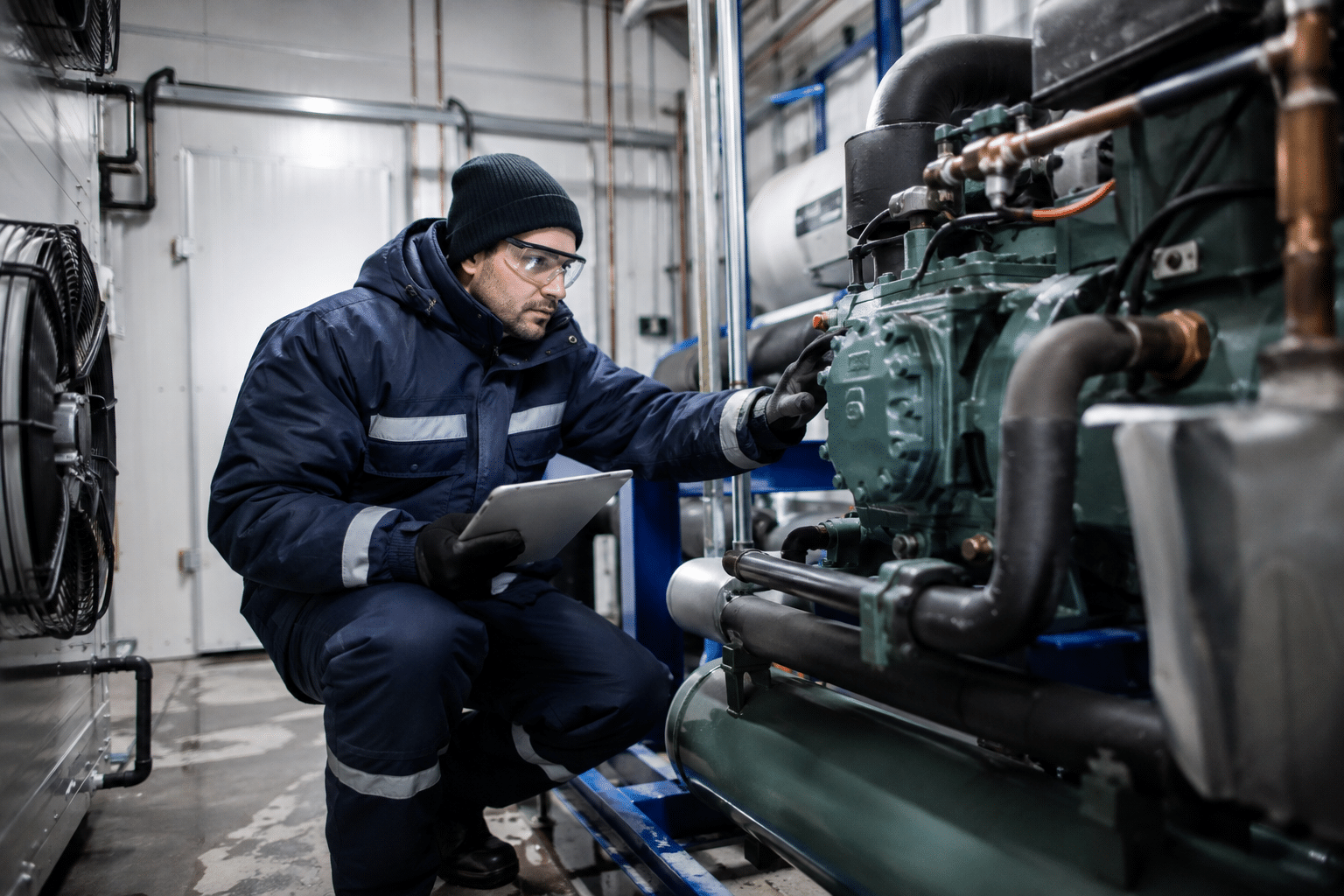
An industrial refrigeration technician maintains systems that keep plants, warehouses, food operations, and other facilities within a controlled temperature range. The work may involve compressors, evaporators, condensers, pumps, valves, controls, refrigerant circuits, and ammonia safety procedures. It is a specialized HVAC path with serious process and emergency responsibilities, so training and employer practices matter.
What does an industrial refrigeration technician do?
The daily work depends on the system and the employer. A technician may:
- Monitor pressures, temperatures, oil levels, alarms, and operating conditions.
- Inspect compressors, pumps, valves, motors, controls, and insulated piping.
- Respond to equipment faults, leaks, unusual sounds, and temperature problems.
- Perform preventive maintenance and document repairs in a maintenance system.
- Assist with start-ups, shutdowns, defrost cycles, and equipment changes.
- Coordinate with production, sanitation, electricians, contractors, and safety staff.
Some facilities use ammonia. Others use different refrigerants or a mixed system. That choice changes the training, hazards, tools, and regulatory requirements.
Industrial refrigeration vs. residential HVAC
Both fields involve refrigeration cycles, compressors, heat transfer, controls, and troubleshooting. Industrial systems are usually larger and more tightly connected to production. They may operate continuously, use ammonia or another industrial refrigerant, and include pressure vessels and extensive process piping.
A technician who moves from residential HVAC may already understand refrigeration fundamentals, but should not assume that experience transfers automatically to an industrial ammonia system. The equipment, procedures, and emergency planning are different.
Training and certification
Employers may hire people with HVAC, industrial maintenance, electrical, instrumentation, or mechanical experience. Community-college programs and apprenticeships can build the basics, while employer training teaches the facility’s actual system.
EPA Section 608 certification is required for technicians who maintain, service, repair, or dispose of equipment that could release regulated refrigerants. The EPA-approved exam depends on the type of work. Section 608 certification does not expire, but it does not by itself qualify someone to operate every industrial refrigeration process.
Ammonia facilities also require site-specific safety training. OSHA identifies process hazards, emergency response, operating procedures, mechanical integrity, and process safety management as important parts of ammonia refrigeration work. A facility with 10,000 pounds or more of anhydrous ammonia is generally covered by OSHA’s Process Safety Management standard.
Pay and career data
Industrial refrigeration technician is not one separate BLS occupation. Pay can overlap with heating, air-conditioning, and refrigeration mechanics, industrial machinery mechanics, stationary engineers, or specialized maintenance roles. Read the employer’s wage range carefully and ask how overtime, shift premiums, callout pay, and certification affect the offer.
| Factor | What to check |
|---|---|
| Refrigerant | Ammonia, HFCs, carbon dioxide, or another system |
| Work setting | Food plant, cold storage, distribution, brewery, dairy, or process facility |
| Schedule | Shift work, callouts, weekends, and production shutdowns |
| Credentials | EPA Section 608 plus employer and site-specific qualifications |
| Technical mix | Mechanical, electrical, controls, piping, and safety procedures |
Safety and working conditions
Industrial refrigeration can involve cold rooms, moving machinery, stored pressure, electrical energy, and refrigerants that can harm people if released. Technicians follow isolation, lockout, ventilation, monitoring, and emergency procedures. They should never treat an alarm or suspected leak as a routine service call.
The job may include noisy machinery, wet floors, protective clothing, ladders, confined areas, and long periods on your feet. Ask to see the facility and learn how often technicians enter freezers, work nights, or respond to emergencies.
Could it fit after 40?
This can be a realistic second-career move for someone with mechanical troubleshooting, HVAC, industrial maintenance, electrical, or controls experience. It rewards patience and careful diagnosis. The learning curve is serious, but you do not need to know every system on day one if the employer has a strong training program.
Compare job postings by equipment and schedule, not title alone. A supermarket service route, a cold-storage plant, and a food-processing facility can all use the word refrigeration while offering very different work.
Know the system and refrigerant scope
Industrial refrigeration can involve ammonia, carbon dioxide, or other refrigerants in large facilities. The equipment, hazards, and regulatory duties differ from residential air conditioning. Ask which systems the employer operates and whether the job is maintenance, operations, installation, or emergency service. Confirm which refrigerant tasks require certification and which plant procedures control access.
Learn the flow path through compressors, condensers, receivers, evaporators, pumps, valves, and controls. A technician should understand what normal pressure, temperature, oil condition, and liquid level look like before diagnosing a fault. Never use residential shortcuts on industrial equipment. Follow the site’s isolation, ventilation, detection, permit, and emergency procedures.
Evaluate the schedule and safety culture
Cold-storage and food plants may run continuously. Ask about nights, callouts, overtime, freezer work, roof access, respirator requirements, and response expectations during a leak alarm. Find out how many qualified people are available after hours. A lone trainee should not become the default emergency plan for a complex system.
Maintenance records should identify the equipment, operating condition, measurements, alarms, oil or refrigerant work, and result after restart. Trend information can reveal a developing problem before a shutdown. Ask whether the employer provides paid manufacturer training and supervised progression. A credible program teaches when to stop and escalate, not only how to restore production quickly.
Ask to review the site’s emergency expectations before accepting the role. Learn who leads a refrigerant release response, where technicians report, what respiratory protection requires medical clearance and fit testing, and which employees may enter a restricted area. A short ammonia-awareness class is not the same as qualification for emergency response. Daily work also includes ordinary reliability tasks: checking leaks under approved procedures, observing oil and vibration, maintaining detectors, inspecting insulation, and coordinating shutdowns with production. These details help a career changer distinguish a maintenance job from an operator or emergency-response position. During an interview, ask about recurring training, drills, contractor support, and recent system upgrades. Listen for a clear chain of command. Industrial refrigeration offers technically demanding work, but a plant that treats every alarm as a maintenance inconvenience is a poor place for a beginner to learn.
Sources
- U.S. EPA: Section 608 Technician Certification
- OSHA: Ammonia Refrigeration eTool
- OSHA: Ammonia Refrigeration Standards
Related reading: How to Get an HVAC License, Industrial Maintenance Technician, and Building Automation Technician.
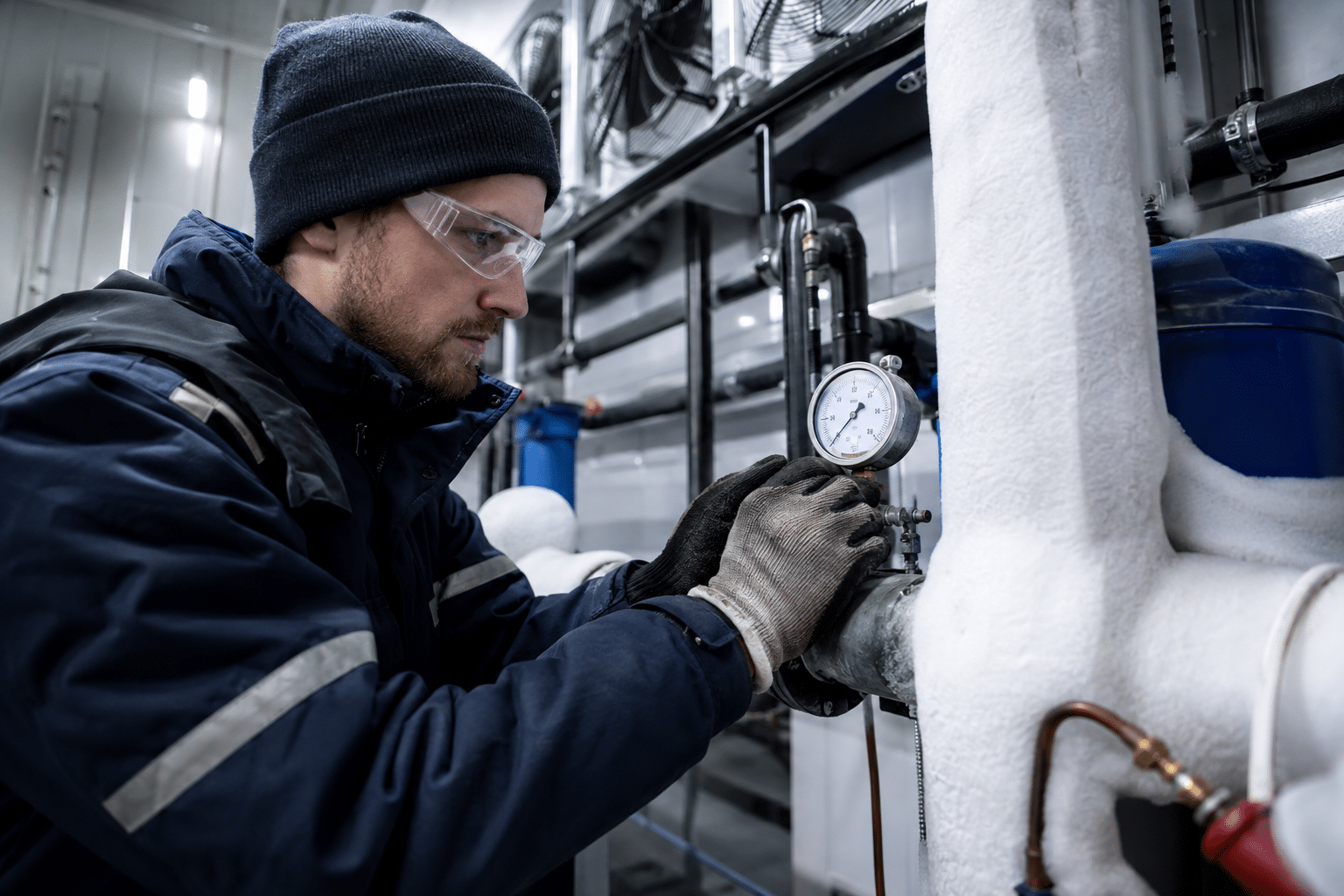
A temperature problem may start somewhere else: A room that is warming up could reflect a sensor issue, low flow, a control setting, a fouled condenser, compressor trouble, or a leak. The technician checks the system in a safe order, follows the site’s ammonia or refrigerant procedures, and records the readings that support the diagnosis.