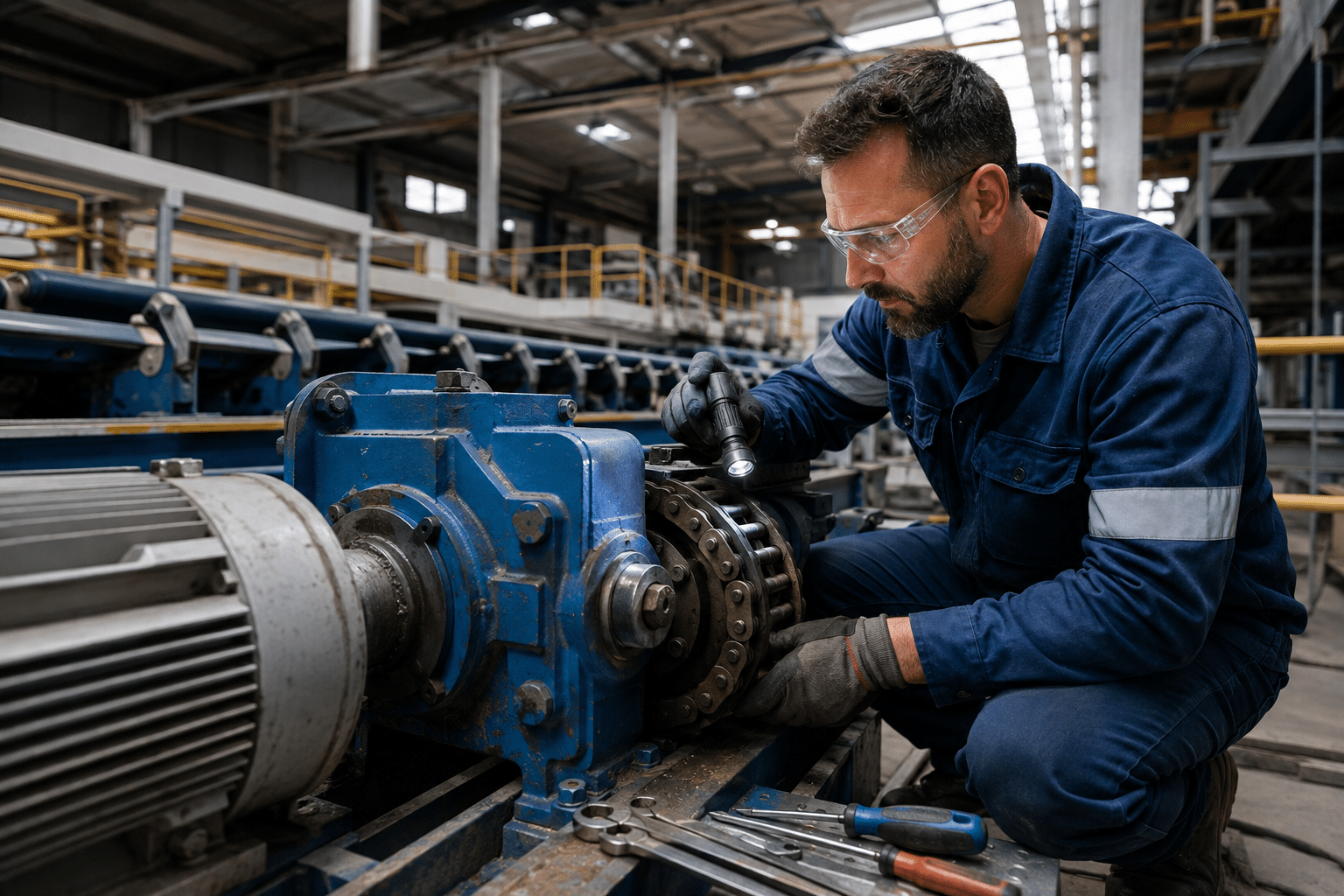
An industrial mechanic keeps production equipment running safely, often around conveyors, pumps, gearboxes, bearings, motors, hydraulics, and compressed-air systems. The title overlaps with millwright and industrial maintenance roles, so the equipment, shift, and level of troubleshooting matter more than the job title alone. This can be a strong second-career path for someone who likes finding the cause of a failure instead of only replacing the visible part.
What does an industrial mechanic do?
Typical duties include:
- Inspecting machines for wear, vibration, leaks, heat, noise, or alignment problems.
- Disassembling and replacing bearings, belts, chains, seals, couplings, and other components.
- Aligning shafts and couplings with precision tools.
- Repairing or supporting pumps, conveyors, gearboxes, compressors, and hydraulic or pneumatic systems.
- Reading equipment manuals, drawings, schematics, and work orders.
- Recording repairs and explaining recurring failures to supervisors, engineers, or operators.
Some mechanics respond to breakdowns. Others work from preventive-maintenance schedules and catch problems before a line stops. In a large plant, the job may be divided between mechanical, electrical, controls, and millwright teams.
Training and education
BLS says industrial machinery mechanics and machinery maintenance workers typically need a high school diploma and at least a year of on-the-job training. A technical program in industrial maintenance, mechatronics, machine technology, or millwright work can shorten the learning curve.
Useful skills include mechanical fundamentals, shop math, blueprint reading, lubrication, rigging, vibration awareness, and safe use of hand and power tools. Basic electrical and controls knowledge helps because mechanical failures often interact with sensors, motors, drives, or PLC-controlled equipment.
Safety training is part of the job, not a box to check once. OSHA’s lockout/tagout rules require employers to control hazardous energy during servicing and maintenance. A new worker should learn the site’s written procedures and never rely on a machine simply being switched off.
Pay and job outlook
BLS reported 2025 median pay of $64,100 for industrial machinery mechanics, machinery maintenance workers, and millwrights. The combined occupation is projected to grow 14% from 2025 to 2035, with about 51,900 openings per year on average. Those figures cover several related roles, not every job advertised as industrial mechanic.
Shift premiums, overtime, union coverage, plant type, and troubleshooting ability can change the offer. Ask about rotating shifts, call-in work, weekend shutdowns, tools, and the ratio of preventive maintenance to emergency repair.
Could this career fit you after 35?
Industrial mechanics often suit people who like finding the physical cause of a problem and seeing the result of a repair. Experience with vehicles, farm equipment, HVAC, construction machinery, or facilities maintenance can provide a useful starting point.
The tradeoffs are clear. Plants can be noisy, hot, dirty, and physically demanding. You may work in awkward positions, lift components, climb, or respond quickly during a production stoppage. Night and weekend work is common in facilities that run around the clock. A realistic job preview is worth more than a generic promise about “hands-on work.”
How to prepare for the first job
- Compare local postings for industrial mechanic, machinery maintenance, and millwright roles.
- Refresh mechanical math, drawings, bearings, alignment, lubrication, and basic electrical safety.
- Take a short industrial-maintenance or mechatronics course if your hands-on experience is limited.
- Look for helper, maintenance trainee, machine operator, or facilities-maintenance openings.
- Ask employers what equipment, shifts, certifications, and tools a new hire will actually encounter.
Related options include industrial maintenance technician, maintenance mechanic, and millwright careers.
A repair begins with the machine’s history
Consider a conveyor that repeatedly loses a bearing. Replacing the bearing may restore movement, but it does not explain the recurrence. A mechanic reviews previous repairs and asks the operator when the symptoms began. The eventual investigation might involve loading, alignment, contamination or lubrication. The particular checks belong to the machine’s procedures and the mechanic’s training.
This is a useful distinction when comparing jobs. Some vacancies mainly involve scheduled component replacement. Others expect fault diagnosis across several production lines. Ask what an inexperienced mechanic is allowed to diagnose independently and when an electrician, controls technician or reliability specialist becomes involved. A broad title does not tell you how much support exists during a difficult breakdown.
Mechanical energy needs its own attention
A stopped motor does not describe every hazard in a machine. A raised assembly, compressed spring or pressurized system may still contain energy. OSHA’s hazardous-energy guidance addresses stored energy as part of servicing and maintenance. Your employer must train you in the applicable procedure; this article is career information rather than instructions for isolating a particular machine.
At an interview, ask how the plant teaches its energy-control procedures and how mechanics coordinate work involving more than one trade. That question shows an understanding of the job’s responsibility. It also helps you evaluate whether a prospective employer has organized maintenance or simply expects whoever arrives first to solve everything.
What a shutdown teaches you
A planned shutdown makes the preparation behind maintenance visible. Parts must match the machine, tools must be available and the team needs an agreed sequence. Finding an incompatible replacement after disassembly can delay the whole job. A mechanic who can read a parts drawing and identify missing information is useful before the first wrench is picked up.
Restoration involves more than putting a cover back. The plant has a process for checks, removal of maintenance controls and return to production. A beginner should understand their assigned part in that process and avoid claiming responsibility for checks they have not performed. Clear handover notes help operators distinguish a completed repair from an issue still being monitored.
Build evidence of mechanical reasoning
For an application, describe one real mechanical problem you have worked on. State the symptom, what evidence you gathered and how the outcome was checked. An automotive or farm-equipment example can be relevant even when the machinery differs. Be accurate about your level of responsibility. Assisting an experienced mechanic is useful experience without being described as an independent overhaul.
Technical courses can strengthen drawing interpretation, measurement and understanding of power transmission. Ask a school how much supervised practical work students perform. A program with access to real bearings, couplings and assemblies may reveal whether you enjoy the careful fitting work that a description of industrial maintenance leaves abstract.
Choose the plant as well as the occupation
Food production, packaging and heavy manufacturing can offer very different environments. Ask about cleaning requirements, shutdown frequency, night coverage and the plant’s oldest equipment. The answers help you picture the actual week. Your long-term fit may depend more on that particular operation than on whether the vacancy says mechanic, maintenance mechanic or industrial technician.
Sources
- U.S. Bureau of Labor Statistics: Industrial Machinery Mechanics, Machinery Maintenance Workers, and Millwrights
- OSHA: Control of Hazardous Energy, Lockout/Tagout
- OSHA: Machine Guarding
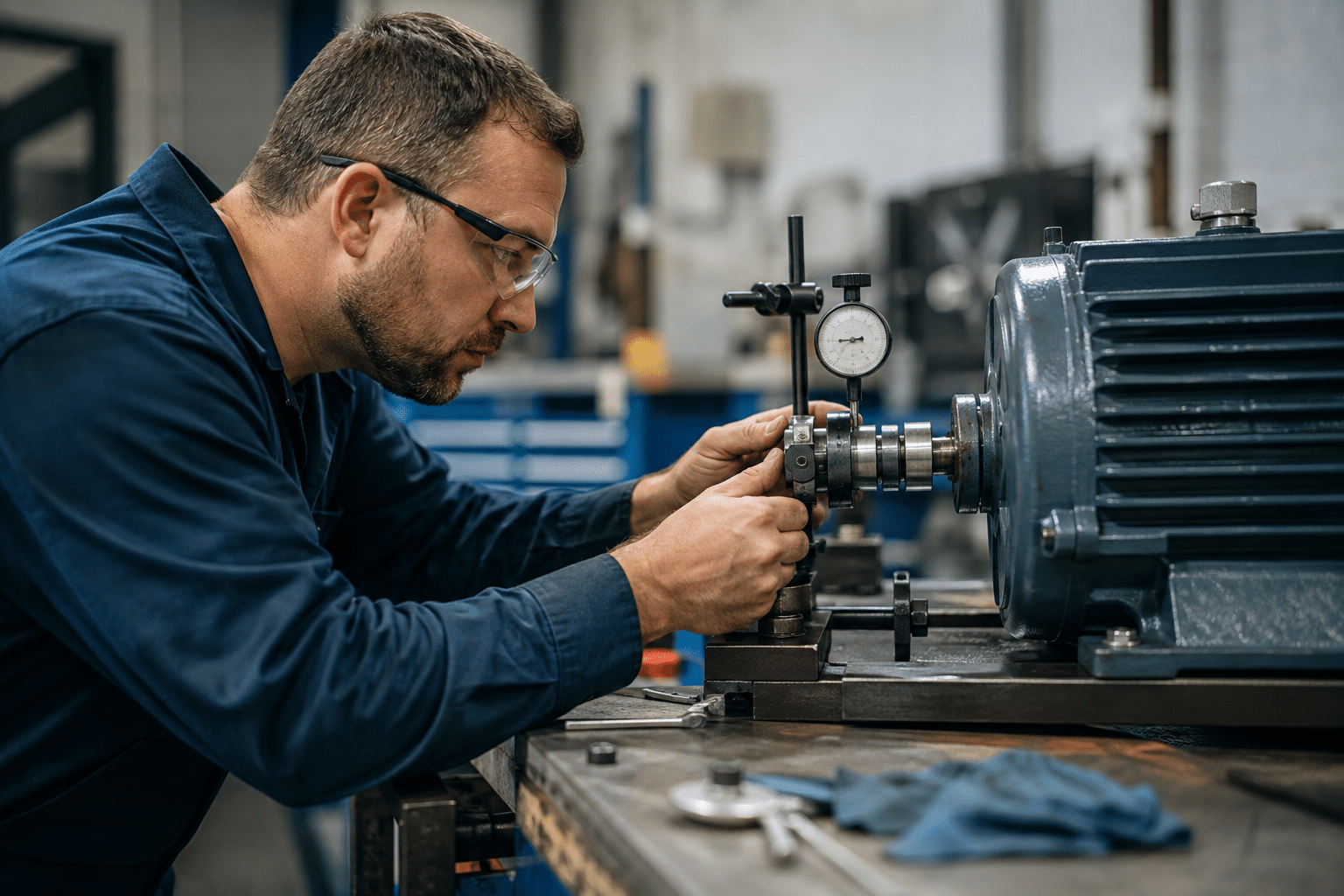
One fault can have several symptoms: A conveyor may stop because of a motor, sensor, belt, gearbox, control signal, or mechanical jam. A careful mechanic confirms the condition, isolates the equipment, checks the likely failure points, and records what changed after the repair. That process is more valuable than guessing from the first alarm.